If you've searched "is LLMrefs worth it," you're probably trying to decide whether to spend money on a tool that watches how AI engines talk about your brand. Short answer: LLMrefs is worth considering if you want a broad, affordable monitoring layer for AI-search mentions, citations, and share of voice, and you're willing to treat the numbers as directional rather than exact. It's not worth it if you need prompt-level diagnosis, traffic attribution, sentiment analysis, or a tool that tells you exactly what to fix and then produces the fix, which is where something like DeepSmith covers both halves. This LLMrefs review judges the product on one question: does its AI-search rank and citation tracking give you reliable, actionable data for the price.
LLMrefs is a good fit if you're a small or mid-sized marketing team, an agency running several client accounts, or an SEO professional who wants to add AI visibility monitoring without learning a whole new discipline. It's a weaker fit if you need to explain exactly why one specific prompt produced a citation, tie AI visibility to revenue, or get daily, real-time alerts out of the box. Keep both of those groups in mind as you read, because most of what makes LLMrefs worth it or not comes down to which one you're in.
What LLMrefs Does

LLMrefs calls itself an AI-search analytics platform and LLM brand-visibility tracker. It's built for brands, in-house marketing teams, agencies, SEO professionals, and growth or product teams who want to know whether their brand shows up when people ask AI engines questions.
LLMrefs AI search tracking is built around a keyword-first model. You add topics or keywords along with your competitors, and LLMrefs expands those into AI-search prompt patterns: best-tool queries, comparison queries, alternative queries, how-to questions, and AEO or GEO-flavored questions. That's a deliberate design choice. It lets an SEO team start with a keyword list they already have instead of hand-writing a large prompt library from scratch, which lowers the barrier to entry for anyone coming from traditional search.
It's worth being precise about what LLMrefs measures, because it isn't a traditional rank tracker. There's no ten-blue-links equivalent inside an AI-generated answer. Instead, LLMrefs looks at whether your brand is mentioned, whether your brand or a page of yours is cited as a source, whether you're recommended, your share of voice against competitors, and which domains AI systems cite most often. Those are related ideas but they're not interchangeable, and a good chunk of getting value out of LLMrefs comes from keeping them separate in your own head, not just in the dashboard.
Mentions, Citations, and Share of Voice

A mention just means the AI system named your brand somewhere in its answer. That's the most basic signal LLMrefs tracks, and on its own it doesn't tell you much: a mention isn't the same as a citation, a positive description, or a click.
LLMrefs citation tracking is where the product does its best work. It extracts cited URLs and domains where they're available, so you can see top-cited domains, filter by source, and spot new citations as they appear. That's more useful than a raw mention count because it points at which page or third-party source actually influenced the answer, which gives you somewhere to start when you're thinking about content or digital PR. It's not proof of causation, though. Seeing that a page was cited doesn't tell you it'll stay cited or that anyone clicked through, so it's best read as attribution of observed sources in sampled answers, not as web analytics.
Share of voice compares how often your brand shows up against competitors across your tracked topics. It's a genuinely useful metric for questions like whether a competitor is gaining ground on you, or whether your position on a topic improved after you published something. The catch is that share of voice is only as good as the keyword set, prompt generation, and engine coverage behind it. A high share of voice inside a narrow topic set isn't the same as owning the category.
LLMrefs also reports ranking or position signals, but there's no stable equivalent to a Google ranking position here, and the product itself doesn't claim there is. Treat these as comparative visibility signals rather than a deterministic rank number.
Fan-Out Queries and Competitor Benchmarking
LLMrefs also tracks what it calls fan-out queries, the related subquestions an AI system might generate while answering a broader question, and it estimates monthly AI prompt volume for topics. That can surface content angles you wouldn't find from the original keyword alone, though there isn't enough public detail on the sampling method to independently verify the volume numbers, so treat them as estimates.
Competitor benchmarking lets you define rivals and compare share of voice, rankings, and cited sources across topics and engines over time. This turns "I saw a competitor cited in ChatGPT" into a repeatable check instead of an occasional manual search. What it doesn't do, based on the public evidence, is automatically turn a competitor's citation into an assigned content brief or a task on someone's plate. You still have to decide what to do with what you see.
Engine Coverage
LLMrefs AI search coverage is marketed as broad and multi-engine, including ChatGPT, Google AI Overviews, Google AI Mode, Gemini, Perplexity, Claude, Copilot, and Meta AI, with other product pages also naming Grok and DeepSeek. That's a wide net for a single subscription, and it's genuinely appealing if the alternative is manually checking five or six engines yourself.
There's a real inconsistency worth flagging here, though. The pricing page lists a shorter engine roster than the broader product copy does, and a third-party pricing review specifically calls this out as a public-source conflict. So rather than quote an exact engine count, it's fairer to say LLMrefs advertises coverage across most major AI answer engines, but you should confirm the exact list on your plan before you buy, because the public pages don't fully agree with each other.
Refresh Cadence and Data Freshness
This is one of the murkier parts of the product to evaluate. The pricing page promises weekly AI visibility reports, the product's visibility page describes daily prompt runs, and the homepage separately claims real-time or continuous checking. Independent reviewers mostly describe weekly reporting as the normal cadence, though one hands-on review mentions monthly dashboard updates during testing and another flags weekly updates as the main tradeoff, with daily monitoring possibly requiring extra configuration.
It helps to separate four different things that get blurred together here: how often the service actually runs prompts, how often summaries get refreshed, how soon a new run shows up in the dashboard, and how observations get aggregated into trend lines over time. For quarterly planning or a visibility baseline, weekly reporting is probably fine. For a fast-moving category where you want to connect a specific publish date to a specific visibility change, weekly can be too slow to draw a clean line between cause and effect. Before you commit, it's worth asking directly which engines run daily, which metrics only update weekly, and whether daily updates need a different plan.
Pricing
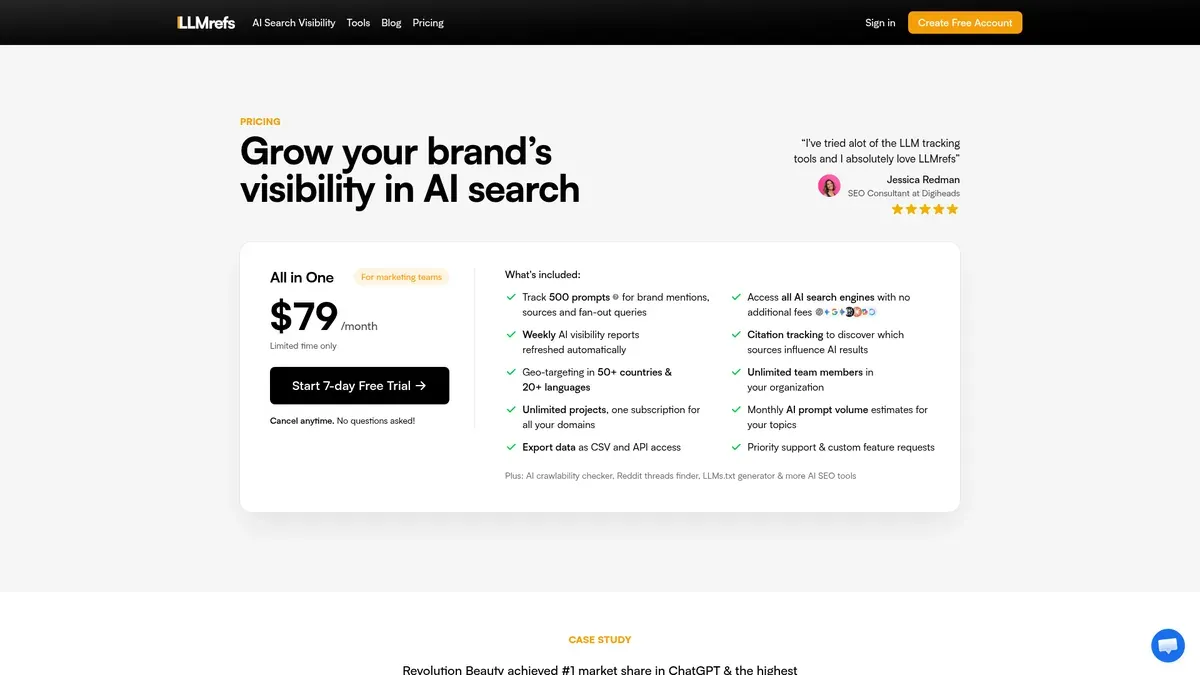
LLMrefs pricing comes down to a single plan called All in One at $79 per month, and the page describes this as a limited-time price rather than a permanent one. That plan includes 500 tracked prompts, broad AI-engine access, weekly AI visibility reports, citation tracking, geo-targeting, unlimited team members, unlimited projects across one subscription, monthly AI prompt-volume estimates, CSV export, API access, and priority support. There's a 7-day free trial with no credit card required and cancellation available anytime.
Doing simple arithmetic, $79 divided by 500 prompts works out to roughly $0.158 per tracked prompt per refresh cycle. That's a capacity calculation, not a measure of how useful each prompt's data actually is, so don't read too much into the precision of that number. The plan looks financially attractive if you'd otherwise be manually checking a lot of prompts across several engines yourself. It looks a lot less attractive if you only care about one brand and a handful of prompts, because you'd be paying for capacity you never use while still missing the diagnostic depth and attribution features that LLMrefs doesn't offer.
A few things stay genuinely unclear in the public pricing: whether there's a lasting free tier beyond a free-account entry point, what enterprise pricing looks like, and why some review sites describe a 50-keyword allowance that doesn't match the official 500-prompt language. Prompts and keywords appear to be different units here, so don't treat those two numbers as interchangeable when you're comparing plans.
Key Features Beyond Core Tracking
LLMrefs bundles in a few extra AI SEO utilities. An AI crawlability checker got a positive mention from at least one independent reviewer, though there's no independent validation of its false-positive rate or exactly which crawlers it supports. There's also a Reddit-thread finder aimed at surfacing discussions relevant to your brand's AI visibility, though it's unclear how comprehensively it searches or how often results refresh.
The LLMs.txt generator is worth a specific caveat: one reviewer argued fairly strongly that it doesn't meaningfully affect Google AI Overview citations. That's one reviewer's judgment rather than a settled fact, but it's a reasonable reminder that a generated file existing doesn't prove it changes anything. Treat each of these bundled utilities on its own merits rather than assuming the whole bundle carries the same quality bar as the core tracker.
On the integration side, the paid plan includes CSV export and a documented public API with bearer-token authentication, covering organizations, projects, keywords, search engines, locations, and keyword data by ID, capped at 10 authenticated requests per minute. There's also an open-source JavaScript SDK on the llmrefs npm package. A newer integration guide describes broader concepts like webhooks and retry behavior, but those examples go further than what the narrower API reference currently documents, so it's safer to confirm what's actually live on your account rather than assume every webhook described in the guide is generally available. Native integrations with Google Analytics 4, CRM tools, Slack, or a BI platform aren't established in the public materials, so custom reporting will likely mean building your own connection off the API or CSV export.
Reliability and Methodology
LLMrefs says it aggregates responses across multiple prompts and engines, applies weighting, and aims for statistically meaningful, repeatable results, using multiple runs to manage the fact that AI answers aren't deterministic. Those are the vendor's own claims. What's missing publicly is detail on exactly how many runs happen per keyword, what the confidence intervals look like on share-of-voice numbers, or how the weighting formula actually works. That doesn't mean the numbers are wrong, but it does mean you should treat LLMrefs as a directional monitoring tool rather than something built for audited, high-stakes reporting.
The independent evidence is mixed in an informative way. One reviewer compared LLMrefs output against manual prompt testing and found that it reliably caught citations and that share-of-voice numbers roughly matched manual spot checks. Another reviewer scored it lower on data accuracy specifically because of the lack of prompt-level context. Both things can be true at once: LLMrefs can correctly detect broad presence while still not giving you enough detail to explain any single result.
Where It Falls Short
The keyword-first design that makes LLMrefs approachable is also its biggest limitation. A single keyword can represent many different natural-language questions, and aggregating them into one number can hide real differences in how your brand performs on each one. That matters most when you actually want to know what to change, because broad visibility data tells you there's a problem without telling you which wording, content gap, or source relationship is behind it.
Citation tracking, as covered earlier, is not traffic attribution. LLMrefs doesn't show, based on the reviewed evidence, whether a citation actually drove a visit, a lead, or a sale, and reviewers specifically call out the missing Google Analytics 4 connection as a gap for proving return on investment. There's also no established sentiment or description analysis: LLMrefs can tell you your brand was mentioned, but not whether the AI described you accurately, neutrally, or unfavorably, and those are meaningfully different outcomes to lump together.
Monitoring isn't optimization. LLMrefs surfaces gaps and cited sources, but you're still the one deciding what to change, briefing the fix, and publishing it. Weekly reporting cadence can also be a real limitation for teams that need to react quickly to changes rather than review them after the fact. And because the methodology behind the statistics isn't fully documented publicly, agencies reporting exact share-of-voice movement to clients or executives should treat the numbers as a strong directional signal, not an audited metric they can defend line by line.
Finally, enterprise depth is thin in the public materials. There's no clear public documentation for SSO, white-label reporting, or detailed governance controls, and as a newer product, LLMrefs naturally has less historical data than more established platforms. If any of that matters to you, it's worth asking directly rather than assuming it's covered.
Who Should Use It
LLMrefs is a strong fit for small or mid-sized in-house marketing teams starting systematic AI-search measurement for the first time, agencies who want one repeatable dashboard across several client accounts, and SEO professionals who'd rather work from a familiar keyword list than build a prompt library by hand. It also suits anyone whose immediate question is simply "are we showing up, and which sources are getting cited," and who's comfortable treating that as a strategic signal rather than a number they can trace straight to revenue.
Who Should Skip It
Skip LLMrefs, or at least test it carefully first, if you need real-time operational monitoring, exact prompt-by-prompt explanations of why a citation happened, or a tool that ties AI visibility directly to sessions and revenue. The same goes if sentiment or tone analysis matters to you, if you're expecting the product to generate and publish the content fixes itself, or if you're an enterprise buyer who needs documented security, governance, or SLA terms before signing anything. If your reporting depends on a transparent, auditable methodology, this is a place to ask hard questions during the trial rather than assume the answer.
Alternatives to Consider
If the gap you hit with LLMrefs is that monitoring stops where the work starts, these are the options worth putting next to it.
-
DeepSmith. DeepSmith tracks the same AI-search visibility data LLMrefs does, mention rate, citation rate, share of voice, sentiment, and visibility trend across ChatGPT, Gemini, Perplexity, Claude, Google AI Overviews and AI Mode, Grok, Meta AI, Copilot, and DeepSeek, with engine coverage rising by plan. The difference is what happens after the gap shows up: DeepSmith maps your topic coverage against competitors, turns the gaps into evidence-backed content ideas, and produces publish-ready articles that push straight to WordPress, Webflow, Strapi, Sanity, or Contentful. Plans start at $99 per month with a 7-day trial, so it costs more than LLMrefs and covers a wider job.

-
Peec AI. A focused AI-visibility tracker with a clean daily read on where your brand shows up and which sources the engines lean on, and, like LLMrefs, it leaves the content work with you.
-
Otterly.AI. Positioned for solo marketers and small teams that want daily monitoring across a focused prompt set, with pricing that climbs once you want more engines or a longer prompt list.
-
Profound. An enterprise-grade option with deeper analytics and sentiment across many engines, priced well above LLMrefs and aimed at teams that need audit-grade data rather than a directional signal.
Is LLMrefs Worth It? The Verdict
Coming back to the question this review set out to answer: does LLMrefs give you reliable, actionable AI-search data for $79 a month? For a team that wants broad engine coverage, citation-level visibility, and competitor benchmarking without building any of it themselves, yes, it's worth testing during the trial. For a team that needs prompt-level diagnosis, verified ROI, or enterprise-grade governance, the honest answer is that the public evidence doesn't yet support treating LLMrefs as a complete answer, and you should validate those specific gaps before you commit further.
The gap this review keeps landing on is the one between seeing a visibility problem and fixing it. LLMrefs can tell you a competitor owns a topic and show you the domains being cited, but the brief, the article, and the publish are still yours to run, and the weekly cadence means you often see the change well after it happened. That is the axis DeepSmith is built on, not tracking better than LLMrefs but carrying the same tracking through to production: the same mention, citation, share of voice, and sentiment data, a topic map that shows where a competitor out-publishes you, and a writer that turns those gaps into finished, on-brand articles on a schedule. It does not solve traffic or revenue attribution either, so if that is your blocker, neither tool closes it.
If that is the half you are missing, you can start a free DeepSmith trial and see your own visibility data and a real draft before you pay.