When people say "AI is changing Google," they usually mean one of two very different things, and mixing them up leads to bad decisions. One is generative AI: a system like ChatGPT or Google's own AI Overviews that writes a new answer from scratch. The other is machine learning inside classic Google Search, the kind that has been quietly sorting results since long before anyone said "large language model" out loud. This piece is about the second one, and about how ML affects Google rankings specifically, not about answer generation. Google's classic search systems use machine learning to figure out what a query means, find pages that match, and help put them in a useful order. Their job is to retrieve and rank content that already exists on the web, not to compose a new paragraph and hand it to you. Anyone doing machine learning SEO work needs this distinction straight before anything else makes sense. If you came here looking for how AI answer engines decide what to cite, that is a different question with its own answer, and it is worth reading separately from this one.
What does machine learning actually do inside Google Search?
Here is the short version: machine learning helps Google understand what you meant by a query, find the pages that are actually about that thing, and put the more useful ones higher up the list. That's retrieval and ranking, not writing.
Google is upfront that this isn't one single model doing everything. Its ranking systems guide describes a collection of systems, each with a specific job, working across page-level signals and site-wide signals together. Some systems handle freshness, some handle link analysis, some handle original content, and some handle matching the meaning of your query to the meaning of a page. Thinking of "the Google algorithm" as one model that spits out a score is the first thing to drop if you want to understand this correctly.
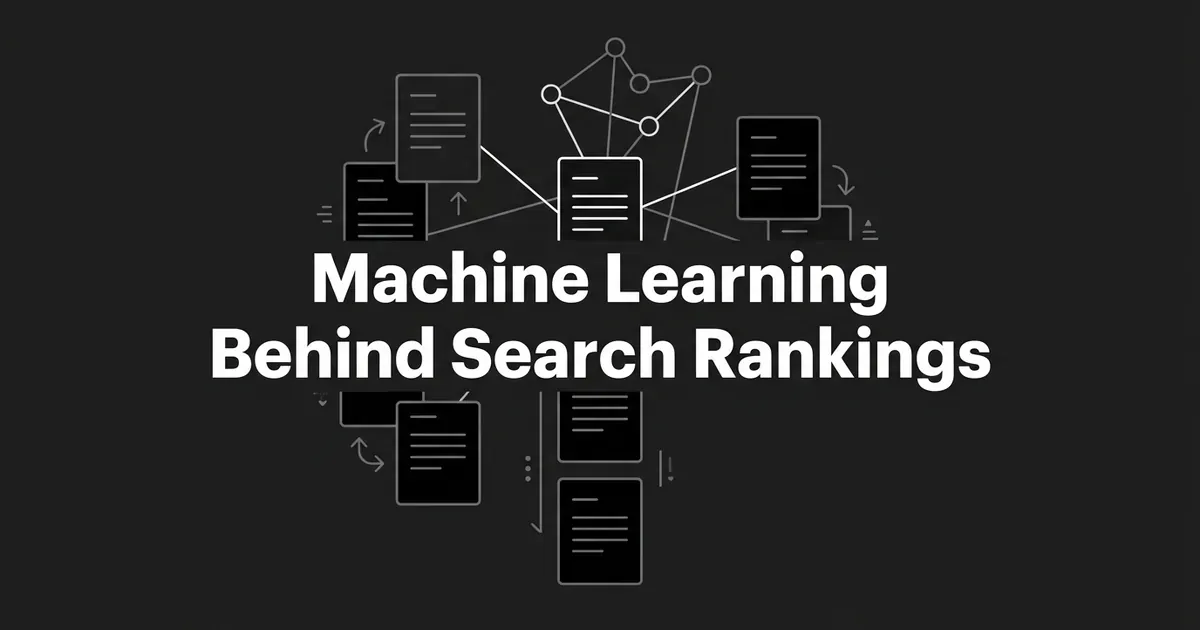
The useful mental model is a loop, not a single step: understand what the query is about, retrieve a set of pages that could be relevant, assess and order those pages, then show the results. Google hasn't published this as an official engineering diagram, so treat it as a simplified teaching picture rather than a leaked blueprint. But it's close enough to how these systems are usually described to be a fair starting point when you're trying to picture what's happening.
The reason this distinction matters for anyone doing SEO or content work: a generative answer engine's job is to produce new text. Classic Search's job is to decide which existing pages deserve to be shown, and in what order. Those are different problems, solved by different parts of the system, and conflating them is how marketers end up chasing the wrong fix.
How does learning to rank actually work?
Learning to rank, often shortened to LTR, is a general approach in machine learning for teaching a model to order a list of items well. It's one of the techniques that learning to rank Google systems are built on, at least in the general sense documented outside the company. In search, the "items" are candidate pages for a query, and "well" means more useful results near the top.
There are three common ways researchers set up the training problem, and it helps to know the difference even in plain terms.
| Approach | What the model is trained to compare | Plain-language version |
|---|---|---|
| Pointwise | One item and its relevance label | "How relevant is this single page for this query?" |
| Pairwise | Two items and which one should rank higher | "Should page A sit above page B for this query?" |
| Listwise | The quality of an entire ordered list | "How good is this whole results page, top to bottom?" |
These are general concepts from the learning-to-rank field, not a confirmed description of what Google runs on organic web search. Google doesn't publish its exact training method, feature list, or scoring formula for ranking the open web. What is documented is that Google's own TensorFlow Ranking library has been used inside the company for things like Gmail Search and document recommendations in Google Drive, where researchers tested these pointwise, pairwise, and listwise approaches on real search logs. That's solid evidence machine learning ranking works and runs in Google's production systems somewhere. It is not evidence that a specific one of these methods is the exact thing scoring your website on google.com.
In practice, you can think of any learned ranking system as having two phases. During training, the model sees examples and is adjusted so it gets closer to putting the right items higher. At serving time, that trained model helps score or sort a fresh set of candidates for whatever someone just searched. What exact signals go into the training, what the labels are, and how the live version works for organic web search, Google has not spelled out, and nobody outside the company can say with certainty.
What does neural matching actually do?
Neural matching is the name Google gives to a specific system it introduced to Search in 2018. Its job, as Google describes it, is to understand the concepts behind an entire query or page rather than just the individual keywords in it, and to match those concepts to find relevant pages. It plays a role in retrieval, meaning it helps surface candidate pages in the first place, which is a different job from reordering a list that already exists.
This distinction matters because a lot of casual explanations flatten neural matching into "an AI reranker that shuffles your results." Google's own description is narrower and more specific than that: it's about matching the meaning behind words, not reshuffling a fixed shortlist after the fact.
Google's own illustration of this is the query "insights how to manage a green." Read literally, that's a strange collection of words. Neural matching, per Google's explanation, can connect it to pages about management, leadership, personality traits, and even a color-based personality framework that uses "green" as a category. The point of the example isn't that this is a trending search. It's that the system is built to connect ideas and concepts, not just to match the literal words typed into the box.
Google has also said, in its broader explanation of how Search works, that it builds language models to help interpret what a query is really asking and connect it to useful content, using paired examples like "change laptop brightness" and "adjust laptop brightness" to show how different wording can point at the same need. Google states that a system built for this kind of understanding meaningfully improves results in over 30% of searches across languages, though it hasn't given a specific measurement window or methodology for that number, so treat it as a general claim about scale rather than a precise, current statistic you can cite with confidence.
None of this means Search runs on no language models, and it doesn't mean "machine learning" and "generative AI" are two totally separate technologies that never touch. The distinction that matters here is about the task: retrieving and ranking existing pages is a different job from generating new text, even when both rely on learned language understanding under the hood.
How does Google actually test and evaluate changes to Search?
Before a ranking change ships broadly, Google runs it through a testing process that includes live traffic experiments and side-by-side comparisons. In a live experiment, Google typically turns a change on for a small slice of real searchers, often starting around 0.1% of traffic, and compares what happens against a control group that doesn't get the change. Google has said it looks at things like what people click, how many queries they run, whether they abandon a search, and how long it takes them to click something useful.
The scale of this testing is worth knowing, because it explains why Search doesn't change overnight based on one anecdote. For 2023, Google reported 4,781 launches, 16,871 live traffic experiments, 719,326 search quality tests, and 124,942 side-by-side experiments, adding up to more than 700,000 experiments that led to over 4,000 improvements that year. Those numbers describe the size of Google's evaluation program for that specific year. They don't measure how much any individual machine learning system affected rankings, and they shouldn't be read as proof that a particular update caused a particular result.
Search Quality Raters are part of this evaluation process too, and they're commonly misunderstood. Raters review search results and give feedback that helps Google judge whether its systems are performing as intended. Google has stated plainly that rater feedback does not directly affect rankings. There's no human sitting somewhere assigning your page a score that moves you up or down. The feedback is used to assess and improve the systems over time, not as a direct input into any individual ranking decision.
What should SEO and content teams actually do with any of this?
None of the mechanics above change the basic job of good content, but they do rule out a few specific mistakes people still make. If you've been asking how ML affects Google rankings so you can reverse-engineer a shortcut, the honest answer is that there isn't one to find, and the practical moves below are what actually holds up.
Write for the person who actually has the question, not for a model you're guessing at. Google's own guidance points toward content that's genuinely helpful and reliable, rather than material built mainly to game a ranking system. That's compatible with everything above: a system built to understand concepts and match them to useful pages rewards pages that are actually about the thing people are asking, written clearly enough that the meaning isn't buried.
Use the words a real reader would use, and cover the subject with real depth, but don't treat this as a checklist with a secret number attached. Google has said the words in your query and on the page are still basic relevance signals, and that systems like neural matching help connect different phrasings of the same idea. That's a reason to write naturally and cover related concepts, not a reason to believe there's a specific count of synonyms or entities that triggers a match.
Remember that relevance depends on the query. Google has said the weight given to different factors changes depending on what's being searched: freshness matters more for a breaking news query than for a dictionary definition, for instance. A page that's the right answer for one intent isn't automatically the right answer for a related but different one.
Resist the idea that one model or one metric explains your ranking. Google describes multiple systems working together, at both the page level and the site level, which means a change in position can have more than one possible cause. If your ranking moves, the honest answer is often "something in a system we can't see changed," not "the neural matching score updated."
Drop any belief in a hidden, learnable score. Google does not publish its feature weights, its model architecture, or the exact formula behind organic rankings. There's no leaked semantic score to hit, no verified keyword density target, and no documented neural-matching checklist, because none of those things have been made public, and some may not exist in the simple form people imagine.
Be careful with clicks, too. Google has acknowledged that it uses aggregated, anonymized interaction data to help assess relevance. That is a real statement, but it doesn't tell you how much weight an individual click carries, or whether your own click patterns are doing anything measurable. Treat it as context, not as a lever you can pull.
What is genuinely not known about how Google ranks pages?
It's worth being honest about where the documentation stops, because a lot of SEO advice quietly treats guesses as facts.
Nobody outside Google has confirmed the complete architecture of its organic ranking pipeline, the full list of input signals, the exact weight given to any one factor, or the training data, labels, and loss function behind its web ranking systems. There's no public confirmation of which style of learning to rank Google uses, if any, in a specific part of organic web search, whether pointwise, pairwise, or listwise, or any public way to isolate how much neural matching specifically changes a given page's position. The TensorFlow Ranking research showing production use in Gmail Search and Google Drive is real and useful context for how the underlying techniques work, but it is evidence about those products, not a description of how google.com ranks your website.
When you read a claim about "the algorithm" that sounds oddly specific, a decent rule of thumb is to ask whether it traces back to something Google actually said, or to a generic machine learning concept dressed up as inside information. The two get blended constantly, and that blending is where most of the bad advice in machine learning SEO circles comes from.
Where this leaves the AI-search conversation
Everything above is about classic Google Search deciding which existing pages to show and in what order. It is a different system, doing a different job, from the generative answer engines that write new responses, whether that's an AI Overview, a chatbot, or any other tool that composes an answer instead of linking to one.

If you want the deep dive on the step that comes right before an AI answer engine decides what to cite, a separate piece covers how AI re-ranking works, the stage between being retrieved and being cited. Platforms built for AEO work, including DeepSmith, focus on that second problem: tracking whether AI answer engines mention and cite a brand, and producing content formatted to be retrieved and cited rather than just ranked. That's a separate discipline from what's covered here, and conflating the two is exactly the mix-up this piece set out to untangle. If your next question is how AI answer engines decide what to cite, that's worth reading on its own terms rather than assuming it works the same way as the ranking systems described above.