If the phrase "aeo vs seo" makes you feel a step behind, take a breath. You are not late. You are right on time to understand the one shift that matters most.
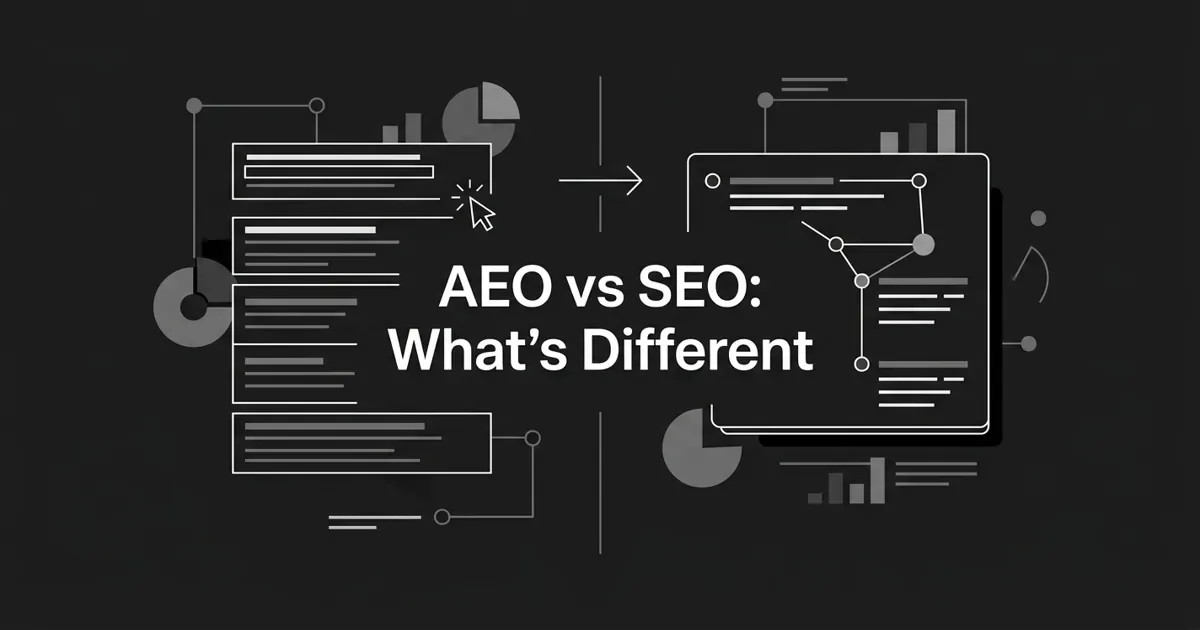
Here is the whole thing in a sentence. Rankings win clicks. Citations win the answer itself.
SEO gets your page onto a list of blue links, and then a human decides whether to click. AEO gets your brand named or cited inside the answer an AI writes back, which the person often reads without clicking anything at all. Same goal, being found. Very different game.
That gap is what this piece is about. By the end, you will understand the concrete, mechanical difference between AEO and SEO, why the two compete for different surfaces, and why the change moves where your buyers actually find you. No jargon wall. Just the difference, and why it matters for you.
The click economy is becoming the answer economy
Start here, because this is the ground everything else stands on. The old deal was simple: you rank, someone clicks, they land on your page. That deal is quietly breaking.
Look at what is happening to clicks. In 2024, nearly 6 in 10 US Google searches ended with zero clicks to the open web. For every thousand searches, only a few hundred actually sent someone to a website. The rest got their answer right there on the results page and moved on.
Then AI Overviews arrived and pressed harder. On the informational queries where Google shows an AI answer, organic click-through has fallen by roughly 60% since mid-2024. Paid click-through on those same queries dropped even more. Ahrefs, tracking top-ranking pages over two years, found AI Overviews now cut clicks to that content by more than half.
Feel the weight of that? You can hold the number one spot and still watch the clicks evaporate, because the answer got served before anyone scrolled to you.
This is the wedge. The click economy, where you earned traffic by ranking, is turning into an answer economy, where you earn influence by being inside the answer. SEO was built for the first world. Answer engine optimization vs seo is really a question of which world you are optimizing for.
And this is not a blip. Analysts expect traditional search volume to keep sliding as assistants take share, with one widely cited forecast putting the drop at a quarter of search volume within a couple of years. Another projects hundreds of billions of dollars in US consumer spend flowing through AI-powered search by the end of the decade. You do not have to believe every number to feel the direction. The travel is one way.
One reframe to carry with you: if your brand is not in the answer, you are not in the consideration set. Even if you rank first. That is the reframe at the heart of answer engine optimization vs seo, and it is why the rest of this matters.
The real difference between AEO and SEO
Let's define both cleanly, then get concrete.
SEO, search engine optimization, is the practice of optimizing web pages so they rank highly on a results page for target keywords, so a human clicks through. You measure it with rankings, organic traffic, click-through rate, and the conversions downstream of that click.
AEO, answer engine optimization, is the practice of structuring content so AI answer engines like ChatGPT, Perplexity, Gemini, Claude, and Google AI Mode understand, trust, and cite your brand as the answer. You measure it with mentions, citations, share of voice inside answers, and the referral traffic AI sends you.
Now here is how the two differ in plain mechanics. Six shifts, and you only need to feel them, not memorize them.
You optimize for a different reader. SEO writes for a human who scans a list. AEO writes for a machine that reads your page, then serves a human. Two audiences, two sets of expectations.
You optimize a different unit. SEO tunes the whole page. AEO tunes the chunks, the individual facts and passages an AI can lift out and stitch into its answer. This is why a page can rank number one on Google and never get cited by ChatGPT. The page pleases a reader. The chunks inside it were never built to be extracted.
You optimize for a different input. SEO targets keywords. AEO targets conversational prompts, the long, messy questions people actually ask an assistant.
You optimize for a different trust signal. SEO leans on backlinks and domain authority. AEO leans on citation authority, clear expertise, freshness, and how easy your facts are to pull out and verify.
You optimize for a different output. SEO earns a click. AEO earns a citation, often with no click at all.
And you optimize across a different scope. SEO is mostly Google. AEO is a portfolio of platforms, each with its own habits. More on that next, because it trips people up.
There is one more quiet shift worth naming. SEO tunes for exact keywords and their close variants. AI answer engines fan a question out into many related sub-questions, then gather passages from across all of them. So a page can earn a citation not because it matched the exact query, but because it answered one of the smaller questions the engine spun off. You are writing for a wider net of intent, not a single search box.
Here is the good news hiding in all of this. Seo vs ai search optimization is not a fork in the road where you pick one. AEO builds on SEO. Almost every URL that shows up in an AI answer was already ranking in the top organic results. Strong SEO is the foundation the AI stands on when it decides who to cite. Framed that way, seo vs ai search optimization is less a battle and more a relay: SEO gets you eligible, AEO gets you chosen.
Why the platforms are not interchangeable
This is the part most people miss, so slow down with me for a second.
There is no single "AI search" to optimize for. A brand can get cited on ChatGPT for a question and be completely absent on Perplexity for the exact same question. The engines have different tastes.
ChatGPT skews encyclopedic. It leans hard on established, authoritative sources, with Wikipedia by far its most-cited source, followed by community and major media names. If you want to show up there, credibility and clear reference-grade content matter.
Google's AI Overviews pull a broader mix. Reddit, YouTube, professional networks, and analyst names all show up near the top. It blends social proof with professional authority.
Perplexity leans the hardest into community. Reddit alone makes up a huge share of its citations, with video and peer-driven sources close behind. It wants the wisdom of real people, not just polished brand pages.
So what does this mean for you? Optimizing for ai answers is not one channel you flip on. It is a set of platform-specific behaviors. The content that earns a ChatGPT citation is not always the content that earns a Perplexity one.
Do not let that overwhelm you. You do not need all of them at once. Pick the one or two platforms where your buyers actually ask questions, and start there. Momentum matters more than coverage.
One more fact worth sitting with. When researchers checked how much overlap there is between Google's top-ranked pages and what AI answers actually cite, the answer was humbling. Only a minority of Google's top-ten pages show up in AI answers at all, and the overlap between ChatGPT's citations and Google's top ten is tiny. Ranking is no longer a reliable proxy for AI visibility. That is the whole reason AEO exists as its own discipline.
How the buyer journey has actually changed
Here is why this stops being abstract. Your buyers are already researching differently, whether or not you have noticed.
Half of US consumers now use AI-powered search. A large share call it their primary source of insight, the first place they go to learn. And most of them are asking top-of-funnel questions to AI to understand categories, brands, and products before they ever touch a traditional search box.
The B2B picture is even sharper. The overwhelming majority of B2B buyers now use large language models somewhere in their buying process. Your next customer may form their entire shortlist inside a chat window, and you will never see it in your analytics.
You can already feel this in the traffic reports. Many B2B sites saw meaningful organic declines through 2024 and 2025, even when their rankings held steady. The rankings did not move. The clicks did. That gap between "we still rank" and "the traffic is gone" is exactly the moment optimizing for ai answers stops being a nice-to-have and starts being how you protect pipeline.
Watch how the behavior changes once someone trusts the answer. In one study comparing ChatGPT and Google for complex decisions, ChatGPT users visited outside websites only around one in ten times. Google users left to visit sites the majority of the time. When the answer is good enough, people stop clicking out. They just decide.
So the funnel is quietly rewiring. The old one: search, scan the results, click, read, decide. The new one: ask, read the synthesized answer, notice the brands it cites, decide. Often without a single click.
And the buying itself is moving inside the answer too. Assistants are starting to build personalized buyer's guides right in the chat, powered by structured product data. If your brand is not in that data or not cited in that guide, you are invisible to that whole journey, no matter how well you rank.
Sit with what that means for you. The place where buyers first meet you is shifting from a page you own to an answer someone else generates. AEO is how you stay in that room.
What you measure changes too
If the surface changed, your scoreboard has to change with it. This is where a lot of teams get stuck, so let's make it simple.
Three core metrics carry most of the weight.
Mention rate is how often an AI names your brand when someone asks a relevant question. It is the share of your tracked prompts where the answer says your name. This is direct exposure, the highest-quality kind of visibility, because the AI is recommending you by name.
Citation rate is how often the AI actually links to your pages as a source. It is the share of prompts where your URL gets pulled in as evidence. This tells you the model finds your content worth reading and trustworthy enough to point to.
Share of voice is how often you win the answer versus your competitors for the same questions. It is the competitive read: are you the brand the AI reaches for in your category, or is someone else?
Notice how cleanly these map to the old scoreboard. Keyword rankings become mention and citation rates. Organic traffic becomes AI referral traffic. Click-through rate becomes share of voice. Impressions become a visibility score. You are not throwing away your instincts. You are translating them into a world where the answer, not the link, is the prize.
One detail that should make you a little more hopeful about the clicks you do still get. AI-referred visitors tend to arrive further along, more decided, and they convert at a meaningfully higher rate than standard organic traffic. Brands cited inside AI answers also pull more clicks than the brands left out. Less traffic, yes. But often better traffic.
If you only track one new thing this quarter, track citation rate on the handful of questions that actually decide deals in your category. That single number tells you whether the answer economy knows you exist.
What to do about it without blowing up your strategy
Take a breath here, because the honest answer is calmer than the panic around this topic suggests. You do not tear down SEO. You extend it.
Most teams that adapt well keep the majority of their search budget on core SEO and carve out a slice, often somewhere in the range of a fifth to a third, for AI search visibility. A common starting point is a 70/30 split. SEO stays the engine. AEO becomes the new lane you build alongside it.
Inside that slice, the work is not exotic. Rewrite key pages so the answer comes first and the facts are specific and easy to lift. Earn credible third-party mentions, because AI answers lean heavily on sources beyond your own site. Keep your content fresh, because AI-surfaced pages skew newer than traditional results. And put a tracking rhythm in place so you can actually see your mention and citation rates move.
If you only change one thing this month, make it this: pick the ten questions that matter most in your category, check how AI answers them today, and write down which brands get named. That is your baseline. Everything else builds from there.
This is also the honest place to name what a tool can do, because doing all of this by hand gets heavy fast. This is the problem DeepSmith was built to take off your plate. It tracks how AI engines answer the questions that matter in your space, across ChatGPT, Gemini, Perplexity, Claude, and Google AI Mode, so you can see your mention rate, citation rate, and share of voice instead of guessing. Then it finds the gaps where you are invisible or losing, and produces on-brand, publish-ready content built to close them, with the SEO and AEO structure baked in during writing rather than bolted on after. The point is not more dashboards. The point is seeing where you show up, and closing the gaps without adding hours to your week.
You do not need a bigger team to start. You need a smaller first step, taken this week.
The throughline
Come back to the one line whenever this feels like a lot. Rankings win clicks. Citations win the answer itself.
SEO is not dead, and AEO is not a replacement for it. The surface where buyers find you is simply expanding, from a list of links you climb to an answer you have to earn your way into. The teams that notice early, keep their SEO strong, and start building answer-engine visibility now are the ones who will still be in the room when the buyer decides.
You are closer to this than you think. Pick your questions. Check your answers. Start.