You liked the idea of watching every AI engine at once. Then you started pricing it out, and the plan that actually covers the engines you care about is nowhere near the plan you were quoted. That is the moment most people start looking at maxaeo alternatives.
Take a breath. This is a normal place to land.
The AEO tracking market has grown up fast, and it now splits into shapes rather than winners. Some tools measure very broadly. Some go deep on citations. One connects the measuring to the writing so the gap you find on Monday becomes a published page on Thursday.
This guide walks you through eight alternatives to Maxaeo. You will finish knowing which shape fits your team, and roughly what it costs.
We are not reviewing Maxaeo here. We are looking at what you would move to. Trackers that only watch one engine are out, because broad coverage is the thing you came for.
How we picked these Maxaeo alternatives
A roundup is only useful when you can see the yardstick. The best maxaeo alternatives for your team are the ones that win on the criteria you actually care about, so here is ours.
Engine breadth. How many AI engines and AI surfaces the tool watches, and whether that breadth is on a self-serve plan or locked behind a sales call. This one matters more than any other line on a pricing page.
Analytics depth. Mentions, citations, position, sentiment, share of voice, competitors, sources, prompts, pages, trends, and revenue. Depth is what turns a score into a diagnosis.
Actionability. Audits, recommendations, optimization workflows, content generation. A gap you cannot act on is just a worry with a chart attached.
Operational fit. Prompt or credit limits, refresh cadence, dashboards, seats, workspaces, regions, APIs, and CMS integrations. This is where a tool quietly stops fitting at month three.
Value for a marketing lead. Whether the platform moves your team from measuring to publishing, or hands you one more tab to check on Monday morning.
One honest note before the list. This ranking of maxaeo.ai competitors reflects published capability and buyer fit, not a live head to head test of every product. Prices and limits are published snapshots, and so is any maxaeo pricing you are holding them up against. Confirm at checkout before you buy, because this market changes fast.
The 8 best Maxaeo alternatives at a glance
| Rank | Tool | Best for | Published entry price | Engine coverage | Main tradeoff |
|---|---|---|---|---|---|
| 1 | DeepSmith | Visibility plus publish-ready content production | Pro $99/mo, Grow $199/mo, Scale $399/mo, Enterprise custom | Ten named engines, tiered by plan | Broadest coverage sits on Enterprise |
| 2 | Rankscale | Maximum engine, region and object coverage | Essentials $20/mo, Pro $99/mo, Growth $385/mo, Enterprise $780/mo | 17+ engines | Credit model needs planning, no production layer |
| 3 | Scrunch | Citation-level source intelligence for enterprise | Core $250/mo, Enterprise custom | Four LLMs on Core, nine on Enterprise | Breadth, API and controls are Enterprise |
| 4 | OtterlyAI | Affordable prompt and citation monitoring | Lite $29/mo, Standard $189/mo, Premium $489/mo | Four core engines on paid tiers, seven named on the feature page | Prompt allowances are small at the bottom |
| 5 | Peec AI | Structured marketing analytics and prompt organization | Starter $95/mo, Pro $245/mo, Advanced $495/mo | Six default engines, three selectable per self-serve tier | Three-model cap unless you pay for add-ons |
| 6 | Goodie | AEO tied to revenue attribution and AI shopping | Explorer $399/mo, Pro and Enterprise custom | Three on Explorer, up to 11 on Enterprise | Entry price is high for three engines |
| 7 | Profound | Enterprise answer-engine platform with agents | Starter $99/mo billed yearly, Growth $399/mo billed yearly | ChatGPT only on Starter, three on Growth, up to nine on Enterprise | Entry plans are narrow, API is Enterprise |
| 8 | ZipTie.dev | Focused monitoring of three major surfaces | Basic $69/mo, Standard $99/mo, Pro $159/mo | Google AI Overviews, ChatGPT Search, Perplexity | Three engines, no API today |
1. DeepSmith
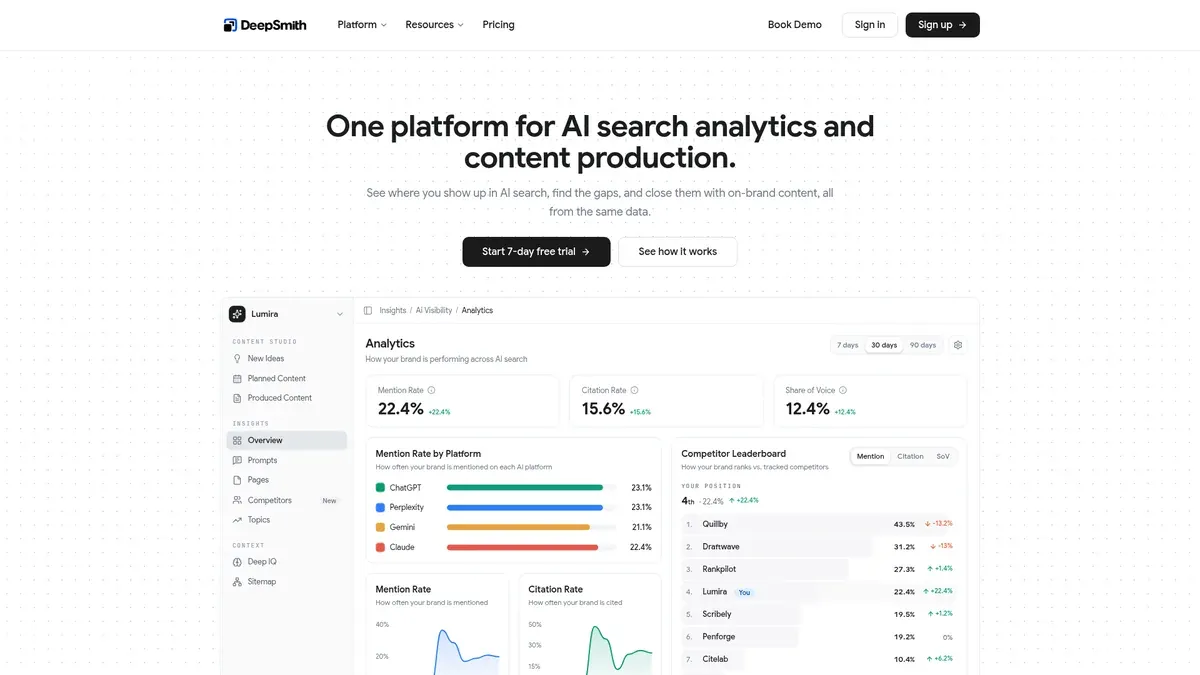
Best for: Marketing leads who need to see where AI answers mention or cite their brand, understand the gaps behind those numbers, and move straight into producing the content that closes them.
DeepSmith is one platform for AI search analytics and content production. That sentence is the whole reason it sits at number one here.
Every other tool on this list hands you a finding and stops. You still have to turn that finding into a brief, a draft, an edit, a set of links, an image, and a published page. DeepSmith carries the finding all the way through.
Let's walk it in the order you would actually use it.
You measure. AI Visibility reports mention rate, citation rate, share of voice, sentiment, and visibility trend, with per-platform breakdowns, a competitor leaderboard, and the sources AI cites most. Prompts gives you per-prompt mention and citation rates plus full answer history, so you can watch a question turn from a miss into a win. Pages shows which of your URLs AI actually cites and which prompts drive each one. Competitor citations shows which rival page is beating you, on which engine.
DeepSmith covers ten engines: ChatGPT, Gemini, Perplexity, Claude, Google AI Overviews, Google AI Mode, Grok, Meta AI, Microsoft Copilot, and DeepSeek.

You find the gap. Content Map crawls your site and unlimited competitor sites, then classifies every page onto one shared topic taxonomy and funnel stage. You get coverage gaps, where a competitor publishes more than you, and untapped topics, where a competitor publishes and you have nothing at all. Sitemaps are re-checked every 24 hours, so new pages fold in without a re-import.
You get ideas with the evidence attached. Opportunity Agents read your own visibility and Content Map data and return ideas, each carrying the data point that justifies it. There are agents for winning a tracked prompt, turning mentions into citations, taking a competitor's citations, fixing how AI describes you, and closing awareness, consideration, or decision-stage gaps against up to four competitors at once. Every run is logged. That means you can defend your backlog in a planning meeting instead of guessing.
You produce. Content Studio moves an idea through New Ideas, Planned Content, and Produced Content. The Writer turns one planned idea into a finished, brand-grounded article with research, internal and external links, a cover image, and publish-ready metadata. Keyword coverage, heading structure, schema markup, and internal linking are built into the pipeline rather than bolted on after. Autowrite writes on a scheduled date with nobody in the app.
You stay on brand. Deep IQ stores your positioning, products, personas, brand voice, visual guidelines, and content types once. Every draft runs against that context, so you stop re-briefing per article.
You publish and distribute. Produced Content publishes straight to WordPress, Webflow, Strapi, Sanity, or Contentful, or to your own webhooks, with Markdown and HTML export as a fallback. Repurpose and the Apps Library turn a finished article into LinkedIn, X, Medium, Substack, newsletter and nurture email, Reddit, Facebook, Instagram, Slack or Discord, and WhatsApp versions. Distribution stops being the step that falls off the list.

Pricing: Pro is $99 a month, Grow is $199, Scale is $399, and Enterprise is custom. Billed annually those become $80, $160, and $299. Pro includes 20 articles, 50 tracked prompts, and 5 seats. Grow includes 40 articles, 100 prompts, and 7 seats. Scale includes 90 articles, 200 prompts, and 10 seats. There is a 7-day free trial with real data and real drafts before you pay, no long-term contracts, and no cancellation fees. Enterprise adds 1:1 onboarding, a dedicated account manager, and custom limits.
Honest limitation: Engine coverage is tiered. Pro tracks ChatGPT, Grow adds Perplexity, Scale adds Gemini, and all ten engines sit on Enterprise. If Gemini is your day-one priority, you start at Scale. That tiering does not touch the production side at all, so a team whose first measurement priority is ChatGPT, or ChatGPT plus Perplexity, gets the whole workflow from the entry plan.
2. Rankscale
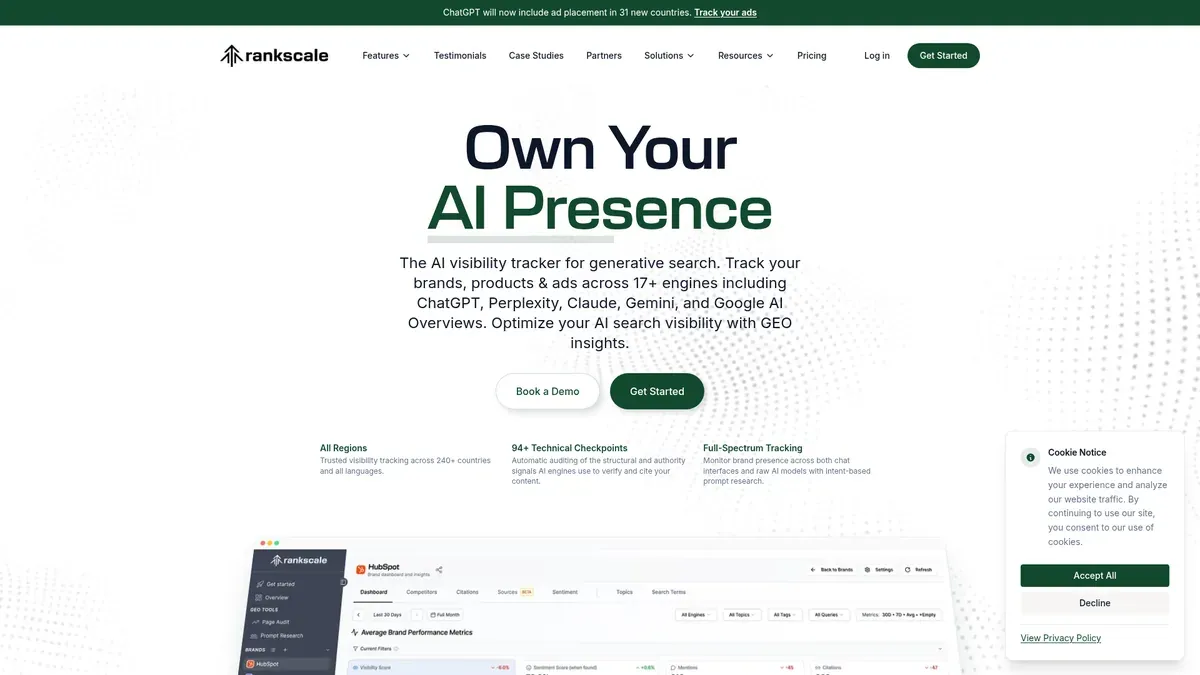
Best for: Teams and agencies that want the widest possible net across engines, regions, brands, products, and ads.
Rankscale advertises 17+ engines and names ChatGPT, Perplexity, Claude, Gemini, Google AI Overviews, Google AI Mode, DeepSeek, Grok, Copilot, and Mistral among them. It tracks an AI visibility score, rankings, sentiment, brand mentions, citations, and share of voice, and it can identify competitors for you and expose ranking gaps.
Prompt research estimates search volume through semantic reconstruction and decodes intent and prompt density. AI-readiness audits cover bot crawlability, site hierarchy, and technical SEO signals. Dashboards support multiple brands, engine and timeframe filters, all regions and languages, and eight monitoring schedules.
Pricing: Essentials is $20 a month with unlimited search prompts but no included monthly credits, dashboards, or audits shown. Pro is $99 a month with 1,200 credits, up to 4,800 answers, 10 dashboards, and 50 audits, plus a seven-day free trial. Growth is $385 a month with 5,500 credits, up to 22,000 answers, 50 dashboards, 200 audits, a REST API, and white-label options. Enterprise is $780 a month with 12,000 credits and up to 48,000 answers. Annual billing shows a 15% saving.
Honest limitation: It runs on credits, not prompt counts, so your real capacity depends on which engines you pick. The research found no content production or CMS publishing layer here, which is a scope difference rather than a fault. If breadth is the job, this is the broadest published count on the list.
3. Scrunch
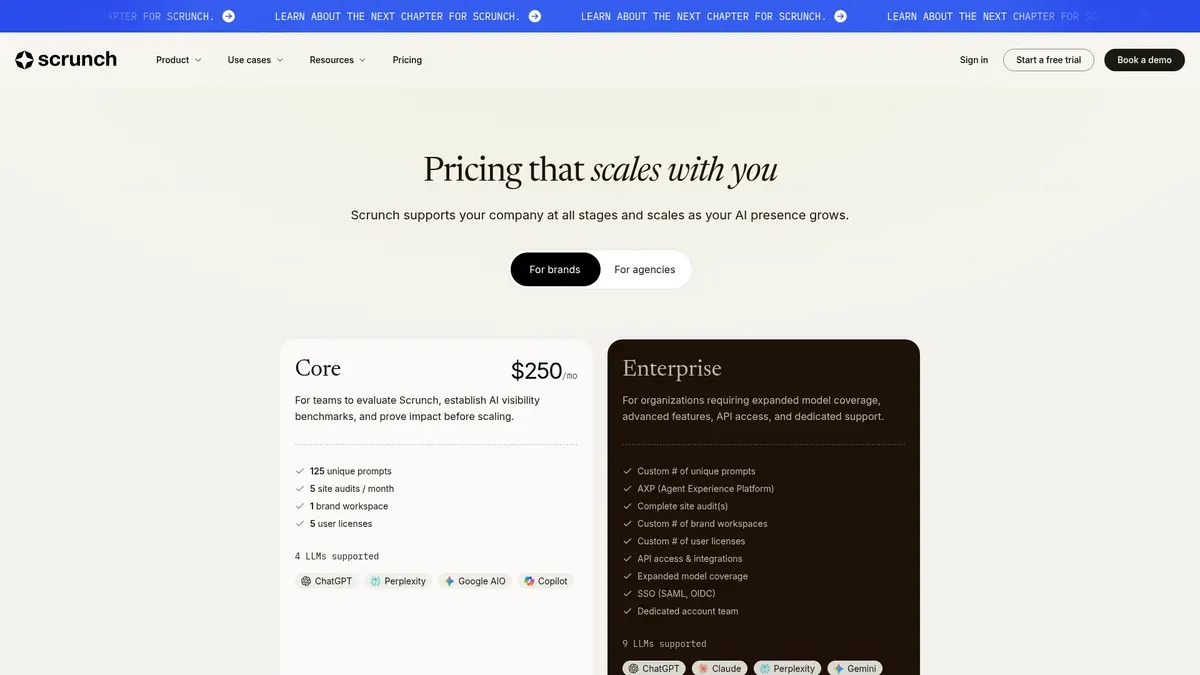
Best for: Enterprise teams whose core question is which sources AI trusts, and why that changed this week.
Scrunch monitors prompt results and reports brand presence, competitive presence, position, sentiment, citations, shopping responses, AI search volume, AI bot traffic, and AI referral traffic. Its citations area is the standout: cited domains and URLs, brand and competitor mentions, topics, prompts, responses, citation consistency, and an Influence Score. You can open the full answer, see the cited page, and read the week-over-week trend.
Filters go deep too, covering citation owner, topic, persona, AI platform, funnel stage, branded versus non-branded prompts, and country.
Pricing: Core is $250 a month for 125 unique prompts, 5 site audits a month, 1 brand workspace, 5 user licenses, and 4 LLMs, which are ChatGPT, Perplexity, Google AI Overviews, and Copilot. It includes one page optimization a month and a seven-day free trial. Enterprise is custom and covers nine LLMs, adding Claude, Gemini, Meta AI, Google AI Mode, and Grok, plus API, Looker Studio, custom MCP, CLI, SAML or OIDC SSO, and a dedicated account team.
Honest limitation: The nine-LLM coverage and the advanced API, SSO, and workspace controls sit behind custom Enterprise pricing. Core is a benchmarking and citation-monitoring plan, so if you came here for breadth on a self-serve budget, check the Core engine list first.
4. OtterlyAI

Best for: Solo marketers, small teams, and agencies that want a practical monitoring stack without a four-figure commitment.
Otterly monitors brand and website visibility, detects URL citations daily, tracks link-position changes, and benchmarks you against competitors through Brand Report. It discovers audience prompts from keywords, brand names, or URLs. GEO audits cover crawlability checks, content audits, and prioritized recommendations. Exports include prompt and citation data as CSV, and the public API exposes brand reports, prompts, citations, and workspace data. A Looker Studio connector handles automated reporting.
Pricing: Lite is $29 a month, or $25 billed annually, for 15 search prompts and 1,000 GEO audits, on one workspace with unlimited team members. Standard is $189 a month for 100 prompts and 5,000 URL audits, adding unlimited workspaces plus API and MCP. Premium is $489 a month for 400 prompts and 10,000 audits. Enterprise is custom, starting at $1,000 a month. All listed tiers offer a free trial.
Honest limitation: Read the two engine lists carefully. The feature page names seven engines, including Gemini, Google AI Mode, and Claude, while the public paid-plan table lists four core engines. Ask which set your chosen tier includes before you commit, and remember that 15 prompts on Lite is a starter allowance, not a program.
5. Peec AI

Best for: Marketing and SEO teams who want clean, structured analytics and good prompt organization.
Peec focuses on brand performance: visibility, position, sentiment, brand mentions, impressions, competitor ranking, key sources, prompt tagging, custom prompts, AI-suggested prompts, and search volumes. It is a monitoring and analytics specialist, and it is comfortable being one.
Pricing: Brand plans are Starter at $95 a month for 50 prompts and 1 project, Pro at $245 for 150 prompts and 2 projects, and Advanced at $495 for 350 prompts, 5 projects, deeper reporting, Looker Studio, and multi-country tracking. All three run daily and include unlimited users. Enterprise is custom and unlocks all default models plus Claude Sonnet 4, GPT-5 Search, DeepSeek, Qwen, and Mistral through the API, with SSO and unlimited prompts. Agency plans run from Essential at $245 a month to Scale at $795, with Comprehensive at custom pricing.
Honest limitation: Six default engines are named, but each self-serve tier lets you choose only three of them. The Additional Models add-on costs $35 a month on Starter, $85 on Pro, and $165 on Advanced. That is a real cost to add to your comparison, since broad coverage is the reason you are shopping.
6. Goodie

Best for: Mid-market and enterprise teams that need AI visibility connected to revenue, not just to a dashboard.
Goodie tracks mentions, citations, sentiment, competitive share, customer prompts, search-volume patterns, visibility opportunities, and prioritized optimization actions. Its distinctive move is attribution: it ties AI visibility to revenue and tracks product visibility in AI shopping experiences across ChatGPT, Amazon Rufus, Perplexity, and other surfaces. It also supports brand-voice-aware optimized content, multi-domain dashboards, and white-label reporting.
The integration list is unusually commercial. Google Search Console maps organic performance to AI visibility, Google Analytics attributes sessions and revenue, Shopify syncs product catalogs, and HubSpot and Salesforce connect pipeline data. Vercel, Cloudflare, AWS, Akamai, and Google Cloud cover crawler activity.
Pricing: Explorer is $399 a month for 100 prompts, 3,000 AI responses, 10 optimization actions, 3 seats, and 3 engines, with a seven-day free trial. Pro is demo-only and adds Gemini, Copilot, and Rufus with 250 prompts and 30 optimization actions. Enterprise is demo-only and supports up to 11 models, 500+ prompts, and unlimited seats.
Honest limitation: Explorer costs $399 and gives you three engines. Model breadth, full API and export, custom revenue modeling, and unlimited seats live on Enterprise, behind a demo. One reviewer also noted that Goodie lacks the prompt-volume data Profound offers, which is reviewer commentary rather than an audited fact.
7. Profound
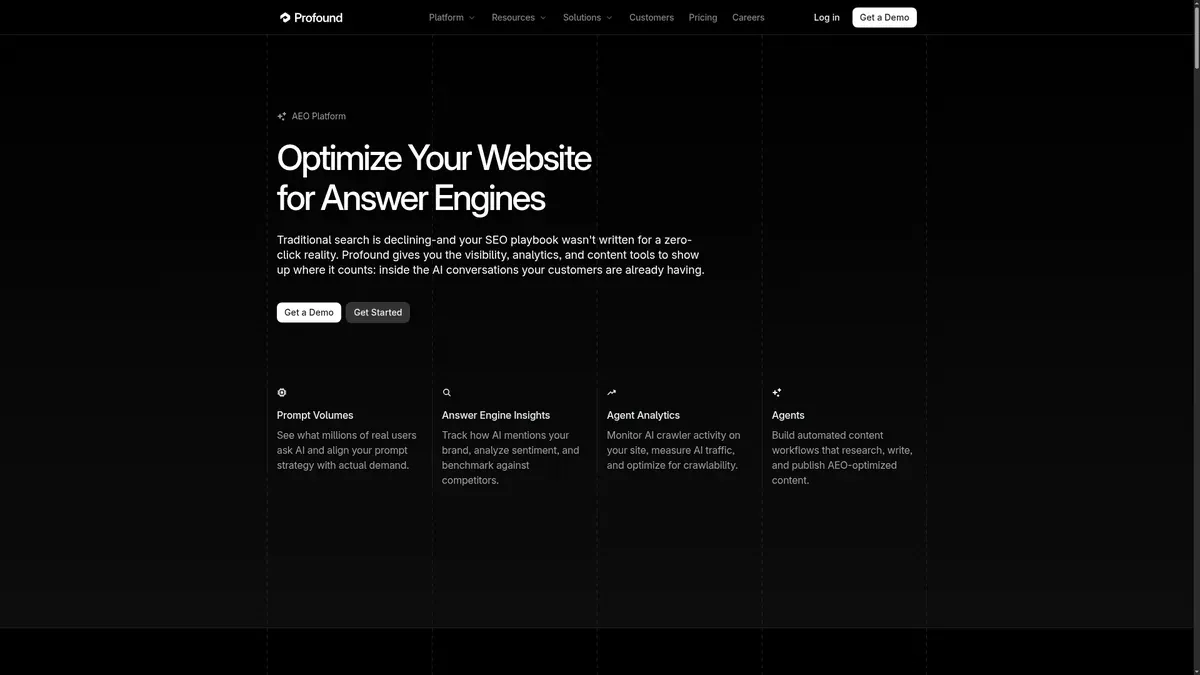
Best for: Larger brands and agencies that want an enterprise answer-engine platform with agents and a very large integration ecosystem.
Profound publicly lists ChatGPT, Perplexity, Google AI Overviews, Google AI Mode, Gemini, Microsoft Copilot, Grok, DeepSeek, and Claude, with plan access varying. It provides visibility and citation insights, prompt and answer-engine research, competitive analysis, agents, content and technical optimization, and reporting. Its integration list runs to dozens of names across CDNs, CMSs, analytics, and productivity tools, including Contentful, Sanity, Webflow, WordPress, Adobe Analytics, Google Search Console, Slack, and Notion.
Pricing: Starter is $99 a month billed yearly for 50 prompts, ChatGPT only, 100 agent credits, 1 region, and 1 seat, with no API. Growth is $399 a month billed yearly for 100 prompts, three answer engines, 400 agent credits, and 3 seats, also without API. Enterprise is custom and covers up to nine engines with API, SSO and SAML, SOC 2, a dedicated specialist with a 24-hour SLA, and a dedicated Slack channel. Both paid plans include two months free on yearly billing.
Honest limitation: If you are here for engine breadth, the entry plans will disappoint. Starter is effectively a one-engine plan and Growth tracks three. Teams above three people are pointed at Enterprise, so budget for a sales-led deployment rather than a card on file.
8. ZipTie.dev

Best for: Teams whose priority surfaces are Google AI Overviews, ChatGPT Search, and Perplexity, and who want exports they can work with.
ZipTie tracks mentions, citations, sentiment, and an AI Success Score by query. It identifies citation leaders, mention leaders, influential sources, and the competitor pages AI engines cite, alongside your own pages already earning citations. Queries can be generated automatically, entered by hand, imported from Google Search Console, or generated from a URL you submit. The content optimization module finds gaps and recommends how to improve a page for mentions and citations.
Pricing: Basic is $69 a month for 500 AI search checks, 5 data summaries, and 10 content optimizations. Standard is $99 for 1,000 checks, 50 summaries, and 100 optimizations. Pro is $159 for 2,000 checks, 100 summaries, and 200 optimizations. Annual plans are $703.80, $1,009.80, and $1,621.80. There is a 14-day full-access trial, and it requires a card.
Honest limitation: Three engines is genuinely narrow next to a seven, nine, or 17+ engine platform, and there is no API today. Its answer to that is export depth, including full AI responses, brands mentioned, and sources cited, plus Google Search Console integration. If those three surfaces are where your buyers actually are, that tradeoff is reasonable at $69.
How to choose your Maxaeo alternative
Not sure which one is yours? Match the sentence that sounds most like your week.
"I can see the gap, I just cannot produce fast enough." Choose DeepSmith. Measurement, evidence-backed ideas, brand-grounded production, publishing, and repurposing sit in one workflow, so the finding becomes a page instead of a note.
"I need to watch everything, everywhere." Choose Rankscale. 17+ engines, all regions, and tracked products and ads. Plan your credits, and plan your writing somewhere else.
"I need to know exactly which sources AI trusts." Choose Scrunch. The URL-level citation table, Influence Score, filters, and trends are built for that job.
"My budget is small and I need to start this quarter." Choose OtterlyAI. Lite is $29, the audits are useful, and there is a real path up to API and Looker Studio. Check the engine list on your tier.
"I want clean analytics my SEO team will actually use." Choose Peec AI. Just price the Additional Models add-on into your comparison first.
"My CFO wants revenue, not visibility." Choose Goodie. Revenue attribution, AI shopping, and the analytics and infrastructure integrations are the point, and $399 is the entry.
"We are enterprise and we need agents plus integrations." Choose Profound. Go in knowing that breadth, API, and SSO are Enterprise conversations.
"Three engines cover our buyers." Choose ZipTie. It is focused and inexpensive, and the exports do a lot of work.
One more thing worth saying plainly. You cannot line maxaeo pricing up against these eight and compare like for like, and you cannot do it across these eight either. They meter different units: prompts, AI responses, credits, audits, checks, projects, and model selections. Before you buy, write down the exact tier, its engine set, its usage unit, its refresh cadence, and the integrations you need. That one page of notes will save you a renewal you regret.
Ready to close the gap, not just watch it?
Here is the good news: you already know what you are looking for. If you want the measuring and the writing in the same place, start a DeepSmith free trial and use it on your own prompts and your own site. Seven days, real data, real drafts, before you pay anything.