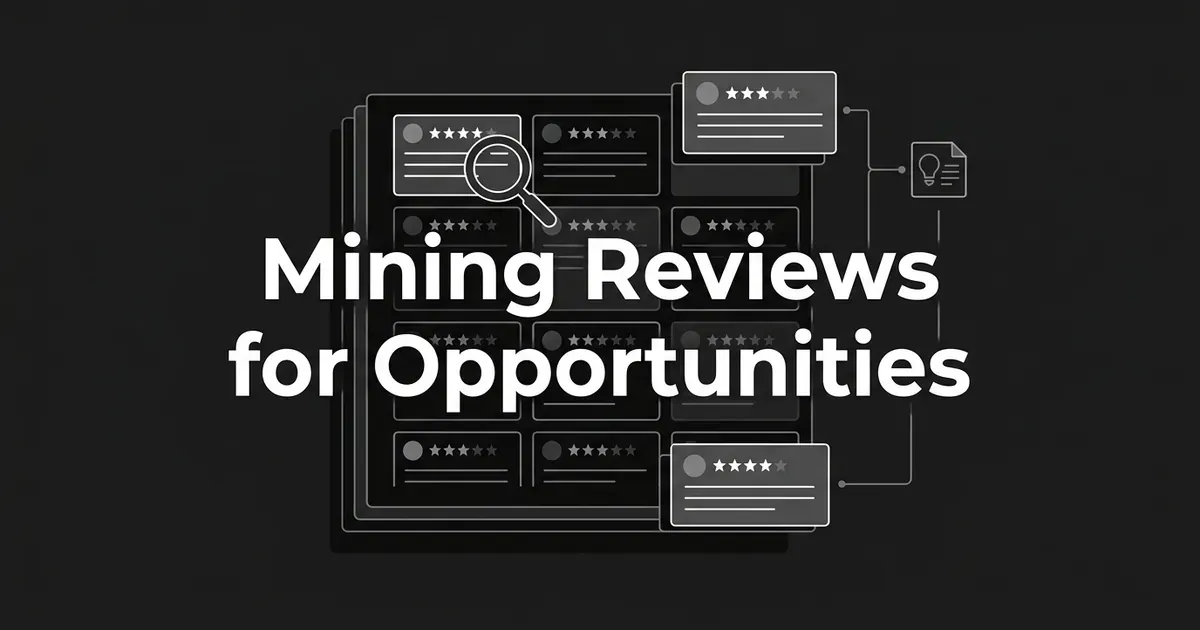
If you sell to the same buyer as a competitor, that competitor's review page already has your next content idea written on it, in the buyer's own words. A founder who wants to mine competitor reviews does not need a research team or a paid tool. You need a competitor's G2, Capterra, or TrustRadius page, an hour of focused reading, and a way to tell a real pattern from one loud complaint. This guide walks through that process step by step, from picking the right competitors to handing a checked idea to your writer or your product team.
Step 1: Choose the competing products and the buyer you care about
Start with the buying decision, not the software category. Write down who evaluates this kind of tool, what size company they run, the job they are hiring it to do, and the two or three alternatives they would actually put in front of a decision maker. Pick competitors that compete for that same decision. A tool that gets mentioned in the same shortlist as yours is a real competitor. A tool that just happens to rank near yours in a review directory is not.
A founder doing this well often calls it a G2 review gap analysis, though the same reading applies just as well to Capterra or TrustRadius. Once you have your list, find each product's public review page on one of those sites. Note the product name, the site, the category it is listed under, the page address, and the date you looked. You will not print any of that in the finished article, since linking happens later in the process, but you want it on hand so you or anyone else can go back and check a claim.
You are done with this step when you can say, in one sentence, why each product you picked competes for the same buyer, and you have its review page open in a tab. This first pass at picking competitors is what separates a useful G2 review gap analysis from a pile of unrelated complaints.
Where people go wrong here is casting too wide a net. Adding every poorly rated tool in the category, or assuming that a site's "similar products" widget proves buyers see two tools as interchangeable, pollutes everything that follows. A loose competitor set gives you complaints that do not apply to your actual prospect.
Step 2: Narrow the reviews to a comparable buyer segment
A five-person startup and a 2,000-person enterprise can use the same software and have almost nothing in common in what frustrates them. Before you read for patterns, filter for the segment you actually sell to.
On G2, look for the company-size, role, industry, and region filters on the product page, plus the Most Recent, Most Helpful, Highest Rated, and Lowest Rated sort options. One G2 product page we checked while researching this guide grouped companies into three bands: Small Business at 50 employees or fewer, Mid-Market from 51 to 1,000, and Enterprise above that. G2 publishes its own community guidelines for reviewers, which is worth knowing before you decide how much weight a given review deserves. Capterra shows the reviewer's role, industry, and how long they used the product, along with rating breakdowns by category. On TrustRadius, use the Filter Results control and read the reviewer's organizational context along with any labels shown on the review. Exactly which filters and labels are available can vary from product to product and site to site, so treat this as a starting point, not a fixed menu.
Read the newest reviews first, since that tells you what today's buying experience looks like, then check further back to see whether an issue you noticed is still showing up or was already fixed. Read the good reviews too. A four-star review that mentions one specific limitation often tells you more than a one-star review with no detail behind it.
You are done here when your notes say which segment and which date range you looked at, and you have kept both praise and complaints from that slice, not just the negative ones.
Pro tip: compare like with like before you start counting anything. An enterprise administrator asking for more granular permissions and a solo founder complaining that onboarding took too long are not the same objection, even if both show up under "setup."
Step 3: Capture the reviewer's problem, not just the star rating
A star rating is a summary of a summary. The actual complaint, and the context around it, is what turns into a usable content or positioning idea, so read the full review text before you record anything.
G2's review format separates what the reviewer liked, what they disliked, and what problem the product solved for them. Capterra shows overall and category ratings next to the written feedback. TrustRadius shows individual reviews with labels like Vetted Review or Incentivized attached to some entries, the same kind of disclosure regulators have started requiring. Capterra publishes its own account of how it collects and verifies reviews, which is worth a skim if you want to know what a verification badge actually checks. None of those labels tell you whether the specific complaint inside the review is accurate, so read past the label to the sentence that explains the friction.
Set up one row per review in a simple sheet: platform, product, a link or identifier for the review, date, reviewer role, company-size band, industry, use case, star rating, any verification or incentive label shown, a short and faithful paraphrase of the complaint, a pain category, the outcome the reviewer seemed to want, and how confident you are in the read. If a single review raises two distinct problems, tag both, but count it as one reviewer, not two.
You are done when someone who has never read the original review could look at your row and understand exactly why you coded it the way you did.
The mistake to avoid is screenshotting an aggregate score, copying an auto-generated pros-and-cons summary without opening the reviews behind it, or trimming the sentence that gives a complaint its context. The same discipline applies if you later mine support tickets and sales calls for the questions your own buyers ask, since a first-party complaint needs the same care as a third-party one. Any of those turns a specific, checkable observation into a vague one you cannot defend later.
Step 4: Code repeated complaints and preserve disagreements
Once you have twenty or thirty rows, read through them and start assigning short codes to concrete problems. Group related codes into themes as the language starts to repeat. "Setup needs a specialist" and "took too long to get a first workflow running" might both belong under a theme like time to initial value. "Cannot customize a report" belongs under reporting flexibility, not automatically lumped in with setup just because both are early-experience complaints.
As you group, go back and check the source rows behind each theme, and keep the reviews that disagree. A reviewer who praises the exact thing others complain about might be on a different plan, using a different workflow, or reviewing an older version of the product. That disagreement is information, not noise to discard.
Count distinct reviews that mention a theme within your defined sample, not the number of times a word appears across all of them. Keep your denominator and your selection rules next to any count you write down, and resist the urge to treat a round number like "five mentions" as some kind of published threshold. A theme with several specific, relevant accounts is worth investigating further. A single vivid quote, however quotable, is a hypothesis.
You are done when each theme you are keeping has a clear definition, the rows that support it, any counterexamples you found, and the segment those rows came from.
Watch for the trap of turning one especially well-written complaint into evidence of a widespread problem, collapsing different root causes into a vague label like "bad UX," or quietly turning a count from your filtered sample into a claim about the whole market.
Step 5: Translate each need into a useful buyer question
For every theme that survived the last step, write the question a prospective buyer would actually ask before or during a purchase decision. "Setup needs a specialist" becomes "What work is actually involved in getting this kind of tool live?" "Reporting cannot be customized for my workflow" becomes "Which reporting options matter for this use case, and what should I check for in a demo?"
Match the format to the job the question implies. Some of these fit a setup checklist, some fit a decision framework or an implementation guide, and some fit a straightforward, fair comparison. A few will fit inside an existing topic cluster you already own rather than needing a standalone piece. In every case, answer the buyer's question first, and treat the competitor complaint as the research signal that pointed you there, not as license to build the whole piece around someone else's bad experience.
A useful format for tracking these is an opportunity card: the buyer segment, the underlying task, the coded theme, the evidence rows behind it, the buyer question, a proposed article angle, what still needs checking before you publish, and who owns it next.
You are done when you can imagine a reader getting real value from the piece you are proposing even if they never buy anything from you.
This is where founders most often go wrong: writing "Why Competitor X Is Terrible" instead of addressing the buyer's actual problem, or treating a theme from review-site reading as proof of search demand. That is a separate question, closer to a content gap analysis than to review reading, and it is deliberately out of scope for this method.
Step 6: Test positioning claims against your actual product
Now put the buyer need next to what your own product actually does, not what you assume or hope it does. For each theme, classify the result as demonstrably addressed, partly addressed or conditional, not addressed, or unknown. Check plan restrictions, required integrations, onboarding steps, and whether the advantage you are about to claim actually depends on some configuration step a buyer might skip.
If a claim is verifiable, draft a narrow positioning statement that names the buyer and the specific capability, not a sweeping one. A positioning statement is really just your unique selling proposition applied to one specific buyer objection, so it should hold up to the same scrutiny. If it is not verifiable yet, keep the finding alive as a content question or a product hypothesis, and do not turn it into a comparison claim you cannot back up.
Say reviews of a competing workflow tool keep mentioning that setup takes a lot of manual configuration. If your own product genuinely walks a new user through a guided setup, that is worth an article explaining what a buyer should look for in an onboarding demo. But a claim that you are "faster to set up" needs evidence about your own setup time specifically, the same standard the FTC applies to any claim your advertising can support. The competitor's reviews alone cannot establish that, and reviewers describing one product's pain do not automatically prove your product avoids it.
You are done when every claim you are considering has a named person or source inside your company who can actually verify it, and anything unresolved is clearly marked as such rather than smoothed over.
The failure mode here is saying "everyone struggles with this" when you only read a sample, assuming your product avoids a weakness just because a review did not mention it in yours, treating an old review as a description of the current product, or claiming a quantified edge you cannot support.
Step 7: Hand the best opportunities to the right owner
At this point you should have a stack of opportunity cards, the raw material for real competitor feedback opportunities. Triage them the same way you would turn any gap into a backlog: by how relevant they are to your actual buyer, how specific and recent the evidence is, how much the underlying task matters, and whether you can substantiate a response. These are practical judgment calls, not a formula with a defined score.
Route an answerable buyer question to whoever owns content. Route a provable difference to whoever owns positioning and competitive research. Route a real gap in your own product to the product team as something worth investigating, not as a validated feature request just because one reviewer asked for it somewhere else.
This is the point where the review work hands off to production. Once you have a checked idea, DeepSmith's Content Studio turns that idea into a write-ready piece: it researches the topic, drafts against your stored brand voice and product facts, adds internal and external links, and prepares metadata and a cover image, all pulled from the brand context you set up once in Deep IQ. What it will not do is the review reading itself. Nothing in DeepSmith imports your competitors' G2 or Capterra pages, codes their themes, or checks a reviewer's identity for you. That part of the work, reading the actual reviews and deciding what they mean, stays with you or your team.
You are done when each card you are keeping has an owner, a destination, the evidence rows behind it, and a clear next action.
The common mistake is sending every complaint straight into a writing tool without checking whether it fits your buyer, or treating a competitor's requested feature as a settled roadmap priority just because it showed up more than once.

Step 8: Recheck the evidence and review the finished claim
Before anything with a competitor's name or a positioning claim in it goes live, go back to the source. Reopen the review page and your current product documentation. Confirm the review still says what your card says it says, note its date, check whether anything contradicts it, and have the product owner sign off on how you described your own feature.
There is no established schedule for how often to repeat this exercise, and no review-count threshold that makes a theme official. Revisit your cards when new, relevant reviews change what you are seeing, and treat the whole method as ongoing rather than a one-time sweep.
You are done when the piece you are about to publish clearly separates what you observed from what you inferred, keeps the fair context around any competitor mention, and does not claim more superiority or prevalence than your evidence supports.
Watch for treating an old complaint as a permanent flaw, quoting a review word for word without checking the site's terms on reusing its content commercially, or assuming that a publish-ready draft means the factual comparisons inside it no longer need checking.
What to do next
The method does not change once you have run it a few times. You still mine competitor reviews the same way: pick the right competitors, filter to your segment, read the actual review text, code what repeats, and check every claim before it goes anywhere near a published article.
Pick one direct competitor, open its G2 or Capterra page, and spend thirty minutes reading the last twenty reviews from buyers who look like yours. Treat it as a small, repeatable G2 review gap analysis rather than a one-time project, and you will likely walk away with at least one theme worth turning into a buyer question. Do this across two or three competitors and you start to see which competitor feedback opportunities keep coming up regardless of which product the reviewer was describing. From there, drop the checked idea into your backlog and let DeepSmith's Content Studio research, draft, and prepare it for publishing, so the time you spent reading reviews turns into a finished article instead of a spreadsheet nobody opens again. Start a free trial to see how quickly a vetted idea becomes a publish-ready draft.