You already know the questions your buyers ask AI. You just have not looked in the right drawer yet.
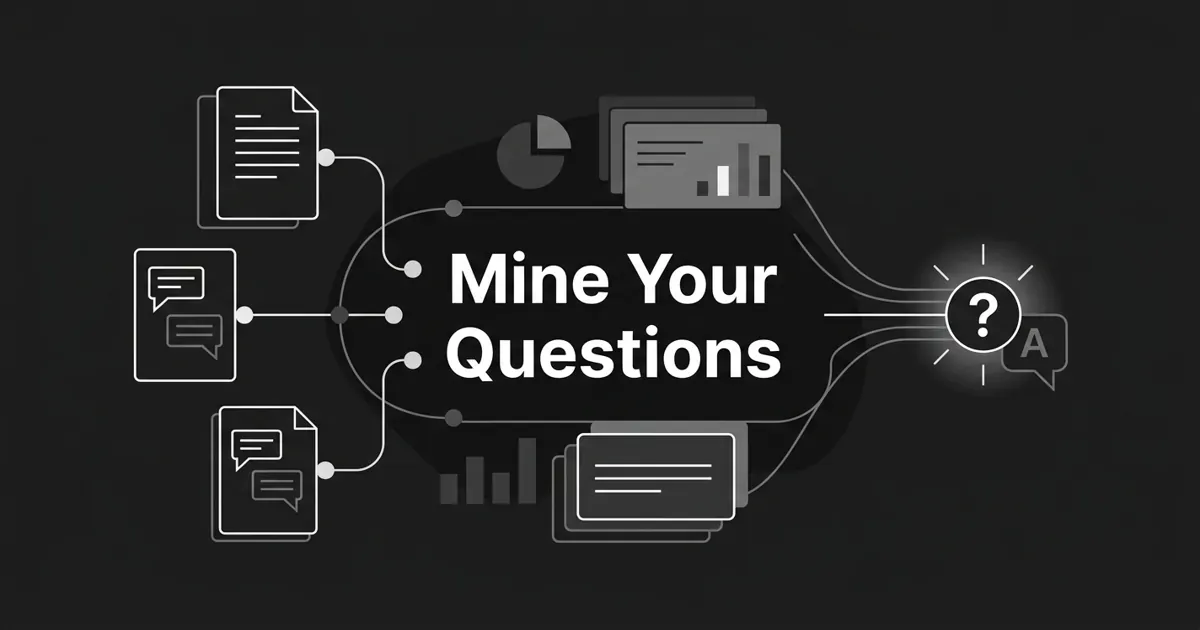
Every support ticket, every recorded sales call, every stray CRM note is a buyer saying, in their own words, exactly what they need to know. That is the same language they type into ChatGPT, Perplexity, and Gemini. So when you mine support tickets for prompts, you are not guessing at what buyers ask AI. You are reading the receipts.
This guide walks you through six steps to pull the real questions out of your support queue, your sales calls, and your CRM, then turn them into prompts you can track and answer. It is for marketing leads who want their AI-search strategy grounded in real buyer language, not a keyword tool's best guess. By the end, you will have a ranked list of prompts, each tied to the content that should win the citation.
If this feels like a big lift, take a breath. You are closer than you think, and every step here is small.
Why your own data beats any external keyword tool
Here is the good news: buyers do not change how they talk when they switch tabs. The person who types "how do I connect Salesforce to Slack" into your support chat types the same thing into an AI assistant. The vocabulary, the intent, and the gap are already sitting inside your company.
External tools have their place. Autocomplete scrapers, People Also Ask pulls, and competitor prompt lists cover the wide discovery surface, and those live in sibling guides. This guide is about the highest-signal surface you own: your first-party records. This is internal data ai prompt discovery, and nothing an outside tool sells you comes closer to how your buyers actually phrase things.
This matters more every month. Around 37% of consumers now start a search with AI instead of Google, per recent survey data. The questions are moving to a channel most content was never built for, and the brands that answer them first tend to keep the citation.
Two facts make this work. AI engines lean heavily on help-center and FAQ content, so the questions your support team already answers are the exact queries an engine wants to resolve. And your sales conversations are the highest-intent moments in your whole funnel, because the buyer is deciding right now, not idly browsing. When you mine support tickets for prompts alongside those calls, you cover both the how-to questions and the buying questions in one sweep.
Three sources, three flavors of gold:
- Support tickets are the cleanest. Subject lines are usually a question already ("Can't export CSV", "How do I add a user?"), and first messages carry raw, unedited buyer phrasing.
- Sales calls are the richest. Discovery questions, objections, comparisons, and pricing worries all show up in the buyer's own voice. This is where you turn sales calls buyer questions ai engines now field into tracked prompts.
- CRM notes are the connective tissue. Win/loss reasons, stage notes, and email replies add funnel-stage context. Your crm data ai prompts often overlook is exactly this: the paraphrased "they are worried about SOC 2" that a transcript would bury.
Ready? Let's mine.
Step 1: Pull your three sources into one place
Start by gathering six to twelve months of exports from all three sources.
Pull support tickets from Zendesk, Intercom, Freshdesk, Help Scout, or Front, with subject, body, tags, resolution, and timestamps. Pull sales call transcripts and recordings from Gong, Chorus, Otter, Fireflies, or Avoma, with the rep, account, stage, and outcome attached. Pull CRM records from Salesforce, HubSpot, or Pipedrive, including notes, win/loss reasons, and email subjects.
You know this step is done when all three datasets sit in one workspace, each row carrying a timestamp, a source label, and a joinable account ID.
Here is where people go wrong: they export only resolved tickets. The in-flight conversations, the ones still open and messy, often carry the most vivid buyer language and the questions that never got a clean answer. Grab those too.
One more thing before you touch the data. Check in with Legal or Privacy that these records can be used for content and SEO work. A two-minute conversation now saves a painful one later.
Step 2: Strip the PII before you do anything else
This step protects the whole program, so do it before any human or model reads a single row.
Run a pass that removes personal detail. Replace names and emails with hashed IDs. Delete phone numbers, account names, and any free-text detail that could re-identify someone. Keep the timestamps and the ticket or call IDs so you can still group records.
The one thing you must preserve is the verbatim question text. That phrasing is the entire asset. If you scrub it down to "customer had a question," you have thrown away the reason you are here.
You will know this is done when a random audit of fifty records shows no PII and nothing re-identifiable.
The common mistake here is over-redacting. Teams get nervous, strip too aggressively, and destroy the buyer's exact words in the process. Redact the identity, keep the language. If you plan to run this through a model, use a private deployment and never paste raw customer text into a public endpoint.
One more guardrail on the call side. If you are mining recorded conversations, your consent notice should mention AI analysis, not just recording, and you should check your local rules, since many regions and several US states require all-party consent. When in doubt, the safest pattern for a content program is to mine themes in aggregate and write fresh content, rather than publishing any identifiable customer text.
Step 3: Extract the real questions
Now you pull candidate questions out of the noise. You do not need a data science team for a first pass, and you can layer in more as you grow.
Start simple with rule-based extraction. Search for interrogatives (who, what, where, when, why, how, can, does, is, should), grab any sentence ending in a question mark, and catch imperative fragments like "export" or "connect" that are really requests in disguise.
Then add intent labeling. A hosted model with a clear prompt, or a fine-tuned classifier, can tag each question as pricing, integration, comparison, or troubleshooting. Modern intent classifiers reach high accuracy on a well-built taxonomy, and a domain-specific label set beats a generic one every time. A fintech product should tell "ACH return" apart from "wire cutoff," not fold both into "billing."
Topic modeling is your third layer. Unsupervised methods surface clusters of related questions and reveal themes nobody thought to write down. You might learn that buyers ask about "SSO with Okta" and "SAML metadata" as if they were separate problems, when they map to one need.
There is a fourth layer worth adding once the basics work: paraphrase normalization. An LLM prompted to "rewrite these as one canonical question, keeping the user's vocabulary" collapses a dozen wordings into a single form you can track. Embedding-based clustering does the same job deterministically if you prefer a repeatable pipeline. Either way, you stop counting the same question five times.
This step is done when every record yields a candidate question, or an honest "none," each with an intent label and a confidence score, exported as one flat table.
The mistake to dodge: dumping every question into the pile without filtering. Low-quality questions make low-quality prompts. Trust the intent labels to keep the signal clean.
Step 4: Cluster and rank by intent, not by volume
You now have a table of questions. Time to group them into clusters and decide which ones matter.
Most B2B SaaS questions fall into a handful of intent clusters:
- How-to and usage: "How do I add a user?", "How do I export to CSV?"
- Integration: "Does it work with Salesforce?", "How do I connect to Slack?"
- Comparison: "What is the difference between X and Y?"
- Pricing and packaging: "How much does it cost?", "Is there a free trial?"
- Troubleshooting: "Why is my export failing?"
- Compliance and security: "Is this SOC 2 compliant?", "Where is data stored?"
- Migration and onboarding: "How do I import from a competitor?", "How long does setup take?"
Cluster by intent, not by surface words. "How do I add a user" and "how do I invite a teammate" are the same question wearing different clothes, so they belong in one canonical cluster with the variants tracked underneath. This matters because AI engines treat different phrasings as different prompts. A page that answers one wording may never get cited for the other.
Then rank. And here is the pro tip that saves you from a common trap: do not rank by raw volume alone. The most-asked question is rarely the most valuable to answer. Weight each cluster by funnel stage and revenue impact too. A comparison question from a stalled six-figure deal outranks a password-reset question asked a thousand times. Tag every cluster with a funnel stage (awareness, consideration, decision, onboarding) and the persona who asked.
You are done when you have a top list of fifty to two hundred prompts, grouped into five to ten intent clusters, each ranked by frequency and impact together.
Step 5: Rewrite each cluster as a prompt in your buyer's voice
This is the step where mined questions become AI-search prompts. And the whole thing lives or dies on one rule: write in the buyer's voice, never in marketing voice.
Buyers phrase things in predictable patterns, so lean on them:
- Direct how-to: "How do I [task] in [product]?"
- Comparison: "What is the best [category] for [use case]?"
- Problem-solving: "Why is [product] [error]?" or "How do I fix [issue]?"
- Evaluation: "Is [product] [attribute]?" (SOC 2, GDPR, mobile, free)
For each cluster, write one clean prompt in the words a real buyer would use, then annotate it with the intent, the funnel stage, and the source records that justify it. Treat the cluster as the unit of work: one canonical question, with its paraphrases tracked alongside.
Watch for the vendor-voice trap. It is tempting to write "Why choose our platform for enterprise teams?" But no buyer types that. They type "what's the best analytics tool for a small team." Trust the corpus, not the website. The fastest way to find buyer questions for aeo is to read what buyers already asked you, then repeat it back word for word.
If writing a starter set from scratch feels heavy, this is one place a platform earns its keep. DeepSmith's Discover Prompts generates a starter list of prompts from your product, persona, and buyer-stage context, so you have a first draft to refine against your mined questions instead of a blank page. Your first-party data still leads. The tool just gets you moving faster.
Step 6: Track coverage and feed prompts into your content
A prompt is only worth mining if a page exists to answer it. So the final step closes the loop.
For each prompt, name the content asset that should win the citation: a help article, a comparison page, a FAQ, a blog post, or a definition page. Then tag every prompt as covered (an asset exists and is getting cited) or uncovered (no asset yet, or a weak one). The uncovered prompts are your editorial calendar, already prioritized.
Match the asset type to the intent:
- How-to gets a knowledge-base article with the question as an H2 and a short direct answer up top.
- Comparison gets a dedicated page with a head-to-head table and a clear verdict.
- Troubleshooting gets a help article that quotes the error, names the cause, and lists the fix.
- Compliance gets a trust page with a plain yes or no and the policy links.
Then measure. Every quarter, re-run your top prompts through the AI engines you care about and record which URL got cited. Watch your citation share climb as your new assets land. This is where measurement and production want to sit in one place. DeepSmith tracks per-prompt mention and citation rates across ChatGPT, Perplexity, Gemini, Claude, and Google AI Mode, shows which of your pages actually earn the citations, and feeds uncovered prompts straight into an idea backlog you can write from. The mining tells you what to answer. The platform tells you whether the answer is working.
You are done when every top prompt has an owning asset or a spot in the queue, and you can see citation share moving.
A quick word on tools
You do not need to buy anything to start. A spreadsheet handles the first few thousand rows just fine, paired with a clustering tool and a model to canonicalize paraphrases. Do the manual pass once so you feel the data.
When volume outgrows the spreadsheet, the categories to know are simple. For tickets, voice-of-customer platforms like SentiSum and Thematic, or a no-code text workbench, tag and cluster feedback at scale. For calls, conversation intelligence platforms like Gong and Chorus record, transcribe, and index every conversation, while lighter transcription tools like Otter and Fireflies get the words into text cheaply. For CRM, you often already have call intelligence built into HubSpot or Salesforce.
Pick based on where your richest data lives and what you already pay for. The pipeline matters more than any single tool.
The mistakes that quietly sink a prompt-mining program
A few traps catch almost everyone. Name them now and you sidestep them:
- Pulling only resolved tickets. The open, unresolved ones hold the questions that never got a good answer, which is exactly where your content gap lives.
- Treating raw volume as signal. Cross-reference frequency with funnel stage and revenue, or you will write your tenth password-reset article while the deal-blocking question sits uncovered.
- Writing prompts in vendor voice. Buyer vocabulary is not your marketing copy. Use theirs.
- Skipping the PII audit. One privacy incident on day one ends the whole program. Do not let it.
- Stopping at extraction. Prompts only matter when a page answers them and you can measure the citation.
- Ignoring the long tail. The prompts ranked ten through fifty are often where the opportunity hides, because competitors built only for the top ten.
What to do next
You do not need to boil the ocean. Pick one source this week, most likely your support tickets, since they are the cleanest, and run the six steps on a single quarter of data. Get one ranked list of prompts. Answer the top three with real pages. Then come back and add sales calls next month.
Momentum matters more than completeness here. The team that mines a little every quarter beats the team that plans a perfect pipeline and never ships it.
When you are ready to connect the mining to real citation tracking and content production in one place, start a free DeepSmith trial and point it at your own site. You will see real prompts and real drafts before you decide anything.