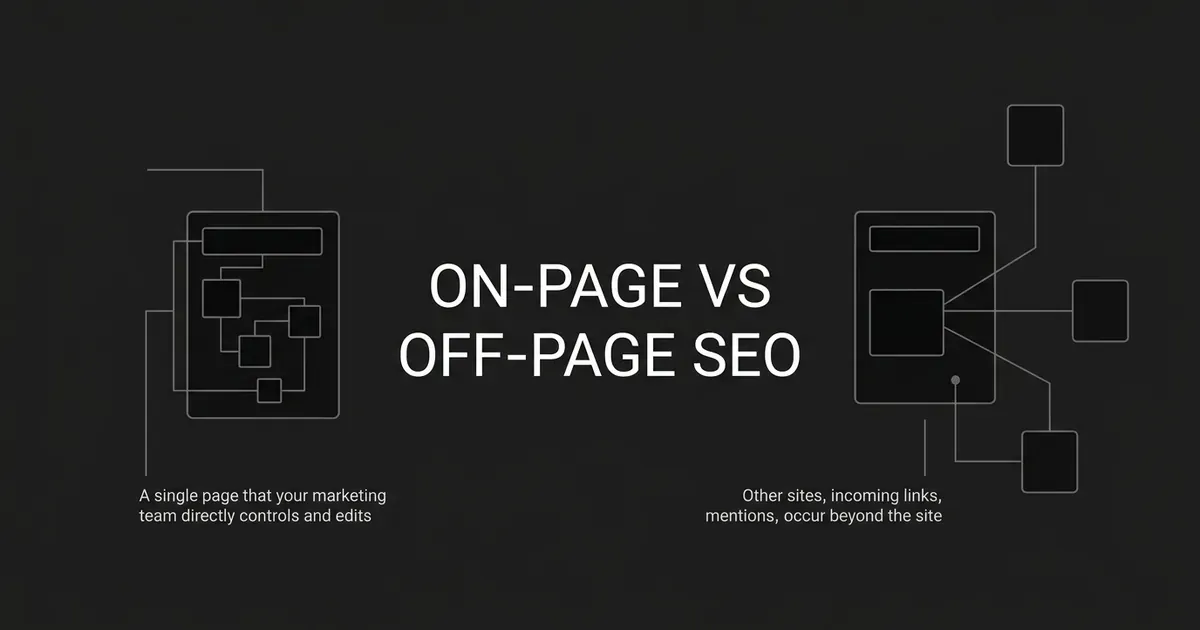
If you're trying to figure out where to put your time this quarter, the on-page vs off-page SEO question comes down to who is doing the work. On-page SEO is everything you change on your own pages, the words, the titles, the structure, the internal links. Off-page SEO is everything that happens somewhere else, another site mentioning you, linking to you, or putting your page in front of people who wouldn't have found it on their own. You can rewrite a page today because it's yours to change, but you can't make another publisher link to it today, no matter how good the page is.
Neither one guarantees a ranking. Google looks at both when it decides what to show and where to show it, and it doesn't publish a formula that splits the credit between them. But the distinction still matters for a practical reason: it tells you which lever is actually in your hands right now, and which one depends on someone else's decision.
Here's the short version, side by side.
| Axis | On-page SEO | Off-page SEO |
|---|---|---|
| Where the change happens | On your own page or site | Somewhere else, another site, a profile, a mention |
| Who controls it | You do, directly | You can only influence it, not control it |
| The core question | Is this page clear, accessible, and useful for the query | Is this page being found and referenced elsewhere |
| What it looks like | A better title, a clearer answer, internal links to related pages | An earned link, independent coverage, a mention from someone else |
| The common mistake | Chasing a word count or repeating a keyword | Treating a purchased link or a vendor's score as a guaranteed shortcut |
What on-page SEO actually is
On-page SEO means improving the content and the HTML of your own pages so both readers and search engines can understand them. This includes the words on the page, the title element, the headings, the structure, the images, and any links you place. The reason this category exists as its own thing is control. You can rewrite a weak page this afternoon without asking anyone's permission.
That control has a limit, though. You control the input, not the outcome. You can write a better title, but Google decides what title link actually shows up in the search result, and it pulls from several possible sources: your HTML title, prominent text on the page, and even how other sites refer to the page. You're influencing that decision, not dictating it.
Start with the content itself. Figure out the question your page is supposed to answer, and answer it well. Use the words your reader would actually use, not a pile of synonyms stuffed in for coverage. Google's own guidance says there's no magic word count for ranking and that keyword stuffing violates its spam policies, so a longer page isn't automatically a better one. A page that gives a clear, original answer, with a concrete example and a link to something genuinely useful, does more work than a page padded out to hit a number.
Titles and headings matter for a similar reason. Give each important page a clear, specific title, one that's different from every other title on your site. Make the visible heading on the page match what it's actually about. A short, specific meta description can help shape the snippet that shows up in results, but it's not a guarantee of the exact text Google displays. Google says a title change can take a few days to a few weeks to get picked up, since the page has to be recrawled and reprocessed. That's about how fast the change gets noticed, not a promise that your ranking improves once it does.
Structure counts too. Organize your pages so a visitor can tell where they are and what's related. Internal links, the links from one of your own pages to another, help both people and search engines find their way around, and they're something you place yourself. An outbound link from your page to someone else's is also on-page work, it's a choice you're making on your own site, even though the destination lives elsewhere.
None of this works if the page can't be crawled or indexed in the first place. Site access and indexability are usually treated as their own technical discipline, but they're the floor everything else sits on. A page with excellent copy that Google can't reach or won't index isn't going to outrank anything, no matter how well it's written.
What off-page SEO actually is
Off-page SEO, sometimes called off-site SEO, covers what happens away from your own website that still affects how people find and judge your pages. The clearest example is an inbound link, a link from someone else's page pointing to yours. Google has said its link-analysis systems look at how pages link to each other to help figure out what a page is about and how useful it might be for a given search. PageRank is still part of that system, though Google has also said how it works has changed a lot since it launched, so treating it like a simple link-counting exercise misses what's actually going on.
Links aren't the only kind of off-page signal. Independent coverage, mentions and citations from other sites, and general promotion that puts your page in front of new people all fall into this category too. For a local business, its Business Profile and the reviews it collects belong here as well. These things aren't interchangeable, though. A brand mention with no link attached doesn't turn into a backlink just because your name is in the text. A social share can introduce your page to new readers and potential publishers, but a share count by itself isn't a confirmed Google ranking factor. A profile on another platform counts as off-page because it lives outside your own site, even if you're the one editing it.
Promotion has a real, limited role here too. Google's own starter guide says reasonable promotion can help interested people and search engines find new content faster, while excessive promotion can work against you. That supports the idea that getting the word out helps discovery, not that promotion by itself produces a ranking. There's also a line Google draws clearly: buying or selling links to manipulate rankings, or trading links excessively, counts as link spam under its policies. Earned recognition and manufactured links aren't the same thing, and mixing them up is a real risk, not just a technicality.
Who actually controls what
The cleanest way to hold this distinction is direct control versus someone else's judgment. You can edit your own page right now. You can start a promotion campaign, or keep your own social profile updated, but you can't force another site to publish a link back to you, no matter how much you'd like them to. That's a better dividing line than "on-page is content, off-page is links," because plenty of links are on-page work too. An internal link and an outbound citation both live on your site. An inbound editorial link lives on someone else's.
This is also why the two categories aren't interchangeable fixes for the same problem. A pile of off-page mentions doesn't repair a page that's confusing or hard to find. A beautifully written page doesn't get discovered on its own if nobody beyond your own site ever points to it. Good on-page work establishes what the page is actually about and whether it's worth a reader's time. Off-page signals help people and search systems find that page and can add context about how it's regarded elsewhere. Google uses a mix of page-level and site-wide signals, and it hasn't published a universal percentage split between the two categories, so treat any exact ratio you hear as someone's guess, not a documented rule.
Your edits versus what actually shows up in results
There's a gap between what you write and what Google displays that's worth naming directly, because it trips people up. You can propose a title and page text. You don't control the final title link or snippet that shows in the results, since Google can and does generate those from other sources when it thinks that serves the searcher better. You can go out and earn an external reference. You don't control what that reference does to your ranking once it exists.
That gap is why promises like "add this keyword to the title and you'll rank" or "one link equals one vote" don't hold up. The honest version is closer to: you make the changes that are yours to make, you watch what actually happens in the search result, and you adjust based on that, rather than assuming your edit landed exactly as written.
Why local search plays by different rules
It's worth pulling local search out separately, because a lot of general on-page vs off-page seo advice gets applied to local businesses where it doesn't quite fit. For local results, Google names three main considerations: relevance, distance, and popularity. Distance isn't something you can optimize away with better copy. Popularity, in Google's own guidance, is shaped in part by links to the business and by its reviews, so completing an accurate Business Profile and collecting genuine reviews matters here in a way that doesn't generalize to every blog page on the internet. And Google is explicit that a business can't pay or ask for a better local ranking. If your organization has a local storefront or service area, treat this as its own checklist rather than folding it into your general content strategy.
What to prioritize when you're starting from zero
If you're building from nothing, work in this order, and expect to circle back as you learn more.
First, confirm the basics are in place. Find your important pages, make sure they're accessible to both visitors and to Google's crawlers, and check whether they're actually indexed. If a key page isn't in the index, a shortage of backlinks isn't your real problem yet.
Second, make each important page worth finding. Give it a clear purpose, a specific title, a genuinely useful answer, and internal links that connect it to related pages on your site. Answer the questions your audience is actually asking instead of writing to a keyword quota. Get the page right before you ask anyone else to point to it.
Third, once you have something worth pointing to, start making it discoverable outside your own site. Promote it to the audience it's actually for, and look for genuine opportunities to be referenced elsewhere. This doesn't have to wait until every on-page task is finished. Fixing the weak spots first just means you're not sending people to an unfinished page.
Fourth, keep reassessing where the real bottleneck is. If pages are indexed but the impressions are for the wrong queries, that's a relevance problem, back to on-page. If the right pages are getting impressions but not clicks, look at how the title and snippet are representing the page in results. If a page is genuinely useful, indexed, and well targeted, but still barely gets found, that's when a lack of outside recognition becomes the more likely explanation.
To check any of this, use the Performance report in Search Console. Look at queries and pages together, along with impressions, clicks, click-through rate, and average position, and compare that across date ranges. Indexing status tells you whether a page isn't eligible to compete yet or is indexed but simply underperforming. One change in clicks won't prove that a single edit or a single new mention caused a shift, so treat these as clues you're following, not a lab result.
When each one wins
If your site is new, or a key page just went live, on-page work wins first. There's nothing wrong to point to yet, so promotion and outreach don't have much to work with. If your pages are already solid, indexed, and answering the right questions, but you're still losing to competitors who show up more often in results, that's usually when off-page work, genuine promotion and earned references, deserves more of your attention. Most teams will be doing a version of both at once, just leaning harder on whichever one is actually the bottleneck at that moment.
This is also a good moment to be honest about what a marketing lead can actually track without drowning in busywork. Writing pages that already have internal links, clear titles, and solid structure built in during creation removes a chunk of the on-page checklist before it ever becomes a backlog. DeepSmith's writing pipeline handles keyword coverage, heading structure, and internal linking as part of producing the draft, so the on-page side of a new page is largely done by the time it's written, leaving your attention for the off-page side, which is the part that actually needs a human judgment call about who to reach out to and what to promote.
Whichever side you're working on this month, the questions to keep asking are the same ones this piece keeps coming back to: is the page itself good, and is anyone beyond your own site finding out about it.