Otterly.AI and the Semrush AI Visibility Toolkit split on one thing for this job. Otterly.AI offers a public API, an MCP server and a Looker Studio connector from its $189 Standard plan, while Semrush documents no AI visibility API and only partial MCP and BI access. DeepSmith is a strong third option here, because its read-only API and MCP server expose visibility, competitor, Content Map and article data, and its Writer produces the articles that close the gaps neither tracker writes.
If you want AI visibility numbers in your own dashboards and in an AI assistant, the question is which tool will actually hand them over. That is a narrower question than which tracker measures better, and the answer is clearer than usual. Otterly.AI vs Semrush AI Visibility Toolkit for API and MCP access mostly comes down to what each vendor has documented and on which plan. DeepSmith belongs in the comparison too, since it opens the same kind of data access and also writes the content.
Otterly.AI vs Semrush AI Visibility Toolkit for API and MCP access: the short answer
- Choose DeepSmith if you want your visibility data available through a REST API and an MCP server, plus the Writer that turns the gaps into publish-ready articles, on one plan starting at $99 per month.
- Choose Otterly.AI if you build your own reporting and need an API, an MCP server and a Looker Studio connector, all of which start on the $189 Standard plan.
- Choose Semrush AI Visibility Toolkit if you already work in Semrush and are fine with built-in reports and CSV exports, since it documents no AI visibility API.
| Criterion | DeepSmith | Otterly.AI | Semrush AI Visibility Toolkit |
|---|---|---|---|
| Entry price (monthly) | $99 (Pro) | $29 (Lite) | $99 (standalone) |
| Public API | Yes, read-only REST | Yes, Standard and up | Partial, no AI visibility endpoints documented |
| MCP server | Yes, 23 read-only tools | Yes, Standard and up | Partial, SEO data documented |
| BI connectors | - | Yes, Looker Studio, Standard and up | Partial, report add-ons |
| API and MCP allowance | 120 requests per minute per workspace | 2,000 each per month on Standard | 50,000 MCP API units on Starter and Pro+ |
| Data export | - | CSV, JSON and PDF | CSV and PDF |
| White-label reporting | - | Yes | Yes, $20 Pro Report add-on |
| Free trial | Yes, 7 days | Yes, 7 days, no card | No, standalone toolkit |
| Content generation | Yes | Not listed | No |
| CMS publishing | Yes | Not listed | Not listed |
Pricing and features as of September 2026, from each vendor's site and public reviews.
Otterly.AI

Otterly.AI is a self-serve monitoring tool for small and mid-sized teams and agencies that track a prompt set daily across ChatGPT, Google AI Overviews, Perplexity and Microsoft Copilot. For data access, it is the more complete of the two. The public REST API, the MCP server and the native Google Looker Studio connector all start on Standard, with 2,000 API requests and 2,000 MCP requests a month, rising to 5,000 each on Premium at $489. Tableau, Power BI, BigQuery and Snowflake only work through the API. Raw answers export as CSV or JSON.
The limits are plain enough. Lite at $29 has none of the API, MCP or Looker access, and extra requests can't be bought, so a team that outgrows the allowance has to move up a plan. Its API keys can be set to read or to read and write. G2 listings show 4.7/5 from 54 reviews and 4.8/5 from 42, and reviewers ask for more integrations. A longer Otterly review covers pricing and features beyond data access.
Semrush AI Visibility Toolkit

The Semrush AI Visibility Toolkit sits inside the wider Semrush platform and costs $99 per month standalone, or comes in the $199 to $549 Semrush One bundles. It suits teams that already live in Semrush and want AI visibility next to their SEO reports. For DIY reporting it is thinner. The Semrush API documents SEO, Projects, Local and Trends endpoints, with no AI visibility ones, and API integration is advertised only on Semrush One Advanced and Enterprise.
The MCP data scope lists SEO, traffic and backlink data, and AI visibility data is not listed. What you do get is built in: My Reports with PDF export, scheduling and shareable dashboards, plus CSV export limited to 1,000 rows per export and 10 exports per user a day. G2 shows 4.4/5 from 4,046 reviews, but that rating covers Semrush as a whole, not this toolkit.
DeepSmith: the alternative that opens its data and writes the articles
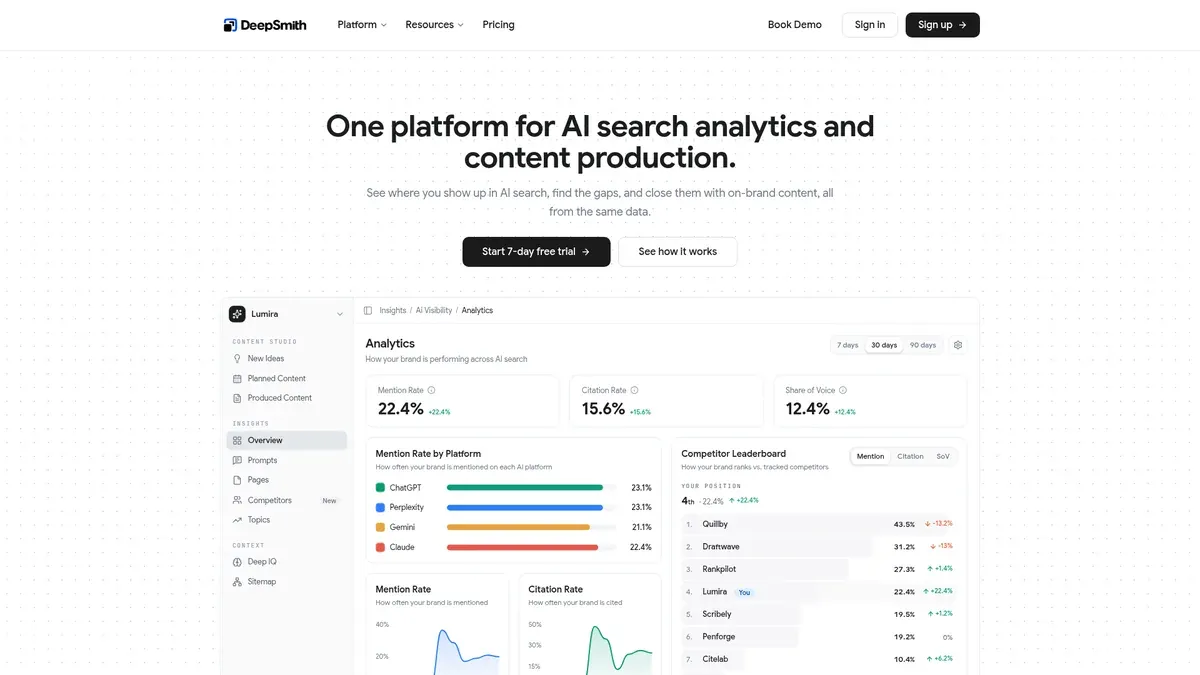
If the goal is to pull AI visibility data into your own tools, the gap in this pair is that one vendor documents the access and the other mostly doesn't, and neither writes the content that fixes what the data shows. DeepSmith covers both halves. Its read-only REST API uses scoped keys and returns mention rate, citation rate, share of voice, per-platform and per-category results, the competitor leaderboard, cited sources, your cited pages, prompts and the AI answers themselves. It also reaches Content Map topics, sites and pages, the content library including article bodies, and Deep IQ assets. Reads spend no credits, the limit is 120 requests per minute per workspace, and the OpenAPI spec is published.
The MCP server connects an assistant to the workspace with 23 read-only tools, and it works with Claude, Claude Code, Microsoft Copilot, Perplexity, Cursor, VS Code, Windsurf, Gemini CLI, Codex, Zed, Raycast and JetBrains AI Assistant. Webhooks add signed, real-time callbacks for content status changes and Opportunity Agent runs, so your own workflows can react. Because the API and MCP server only read, nothing an assistant does can change the workspace.

Then the Writer takes a planned idea and produces a finished article with research, links, a cover image and metadata, and Autowrite can do that on a schedule. Finished pieces sit in Produced Content, and you can publish them to WordPress, Webflow, Strapi, Sanity or Contentful, or to your own webhooks. Pro is $99 per month with 50 tracked prompts and 20 articles a month, Grow is $199, Scale is $399, and there is a 7-day free trial.

API access and request limits
Otterly.AI is the clear pick between the two for API access, because it documents a public REST API with request allowances on three tiers and Semrush documents no AI visibility endpoints.
On Otterly.AI the API starts at Standard with 2,000 requests a month and goes to 5,000 on Premium, with a custom amount on Enterprise. The 7-day trial includes 1,000 API requests, so you can test a real pull before you pay. The ceiling is the monthly cap, since extra requests can't be bought. On Semrush the existing API needs an SEO Business or Advanced plan plus purchased units, and the documented endpoints cover SEO data. If your reporting needs AI visibility numbers by prompt or engine, I'd read that as not available yet, and I'd confirm it with Semrush before you plan around it. Other trackers that offer an open API for custom reporting are compared in a separate roundup.
What DeepSmith does: the API reads visibility, competitor, Content Map and article data, with 120 requests per minute per workspace and no credits spent on reads. That rate limit suits a scheduled dashboard refresh well, and the OpenAPI spec makes it quick to wire into whatever you use.
MCP and AI assistants
Otterly.AI wins here as well, with an MCP server over streamable HTTP with OAuth, 2,000 requests a month on Standard and 5,000 on Premium, plus a Claude Skill file. Semrush has an MCP, and Starter and Pro+ include 50,000 MCP API units, but the data it documents is SEO, traffic and backlinks. Asking an assistant how often ChatGPT cites you would not be answered from the toolkit's data, as far as the records show.
If you want to try this, the setup is covered in how to build an AEO agent with MCP and Claude. The wider picture is in connecting your marketing stack to an AI assistant. A longer list of options sits in MCP servers for the content and AEO stack.
What DeepSmith does: the MCP server exposes 23 read-only tools for visibility, competitors, the Content Map and the content library, with one URL and an API key per workspace. An assistant can answer questions about your citations and then look at the draft that addresses them, in the same conversation.
Dashboards and exports
On Otterly.AI vs Semrush AI Visibility API and dashboards, this one is closer. Otterly.AI has the native Looker Studio connector from Standard, which pulls brand, domain and citation metrics into dashboards with charts split by engine, and PDF brand reports with your own logo. Semrush has My Reports with scheduling, white-label branding for a $20 Pro Report add-on, and external integrations on the higher reporting tier, though whether every AI field can reach those reports was not verified. For a team that wants a live Looker Studio dashboard, Otterly.AI is the better fit. For a team that mostly sends a scheduled PDF to clients, Semrush's built-in reporting does the job.
Both tools suit teams with an analyst on hand, and the trade-off is similar to the one in agentic analytics vs traditional BI. If you would rather build your own view, the steps for an AI visibility dashboard are the same whichever API feeds it.
What DeepSmith does: its API data can feed a dashboard of your choosing, and the Overview already reports mention rate, citation rate, share of voice and a competitor leaderboard, so the numbers you chart match what the platform shows.
From insight to action
Neither tracker writes the content. Otterly.AI has no documented article writing or CMS publishing, and the Semrush toolkit does not create content either, since the knowledge base points to other toolkits for that. Pulling data out is one half of the job, and someone still has to turn it into pages.
What DeepSmith does: the same platform that gives you the data tracks the pages AI cites, finds gaps with Opportunity Agents, and the Writer produces the on-brand articles that close them. Webhooks can start your own downstream workflows when content changes status, so the data you pull out and the content you put in stay in one loop.
Which should you choose
Whether you are weighing Otterly.AI or Semrush AI Visibility Toolkit for API and MCP access, the choice follows the reporting you plan to build.
- DeepSmith fits marketing teams that want visibility data in their own dashboards and assistants and also want articles produced from the same data, with a published price starting at $99 per month and a free trial.
- Otterly.AI fits teams and agencies that build their own reporting and want an API, an MCP server and Looker Studio on the Standard plan, and who can live with four included engines.
- Semrush AI Visibility Toolkit fits teams already on Semrush that want AI visibility in the same account with built-in reports and exports, and that don't need to pull AI data through an API.
For a wider look at both trackers, see the full comparison of the two. For Otterly.AI against DeepSmith, read DeepSmith vs Otterly. The Semrush side is in DeepSmith vs Semrush AI Visibility Toolkit.
Start a DeepSmith free trial to see your own visibility data and the articles that close the gaps.