

Peec AI is a self-serve analytics tool with published plans from $95 a month, built for teams that run the work themselves. Bluefish is a sales-led enterprise platform sold with a managed strategy team, aimed at Fortune 500 brands. Neither writes or publishes content. DeepSmith tracks AI answers and also produces the publish-ready articles that close the gaps, on one self-serve plan.
Peec AI vs Bluefish comes down to how you want to buy and who does the work. Peec AI gives your team a dashboard, a price list, and a free trial. Bluefish gives a large brand software plus strategists and analysts, and you start by requesting a demo. Both track how AI engines describe a brand, and neither one writes the content that changes those answers. DeepSmith covers both halves, which is why it shows up in this comparison. Read as Bluefish vs Peec AI, the choice is managed vs self-serve, and the sections below take it one decision at a time.
Peec AI vs Bluefish: the short answer
- Choose DeepSmith if you want AI visibility tracking and publish-ready articles in one self-serve platform, from $99 a month with a 7-day free trial, so a small team gets output without an agency.
- Choose Peec AI if your team will do the content work itself and wants daily prompt-level tracking at a published price, starting at $95 a month with unlimited users.
- Choose Bluefish if you are a large enterprise brand that wants software plus a managed strategy team, including tracking of Amazon's shopping assistants, and you are fine buying through a sales process.
Comparison table
| Criterion | DeepSmith | Peec AI | Bluefish |
|---|---|---|---|
| Entry price (monthly) | $99/mo (Pro) | $95/mo (Starter) | Not published |
| Annual price (per month) | $80/mo | $80/mo | Not published |
| Prompts at entry tier | 50 | 50 | Not published |
| Engines at entry tier | ChatGPT | 3 chosen from 6 | Not published |
| Most engines on any plan | 10 (Enterprise) | Up to 13 (Enterprise) | 10+ claimed, list not published |
| Free trial | 7 days | Yes | No, demo only |
| AI shopping tracking | - | Yes | Yes |
| Content generation | Yes | No | No |
| CMS publishing | Yes | Not listed | Not listed |
| Brand-context grounding | Yes | Partial | Yes |
| API access | Yes | Yes, beta | Partial |
| SOC 2 | Yes | No | Yes, per site badge |
| G2 rating | 4.8/5 | 4.8/5 | Not rated |
Pricing and features as of September 2026, from each vendor's site and public reviews.
Peec AI

Peec AI is a Berlin company founded in January 2025 that sells AI search analytics to SEO, content and marketing teams and to agencies. It runs your tracked prompts through the AI engines every day, mostly by scraping their consumer interfaces, and reports visibility, position, sentiment, share of voice and the sources each answer cites. Brand plans are published at $95, $245 and $495 a month for 50, 150 and 350 prompts, and every plan has unlimited users. Peec says it has more than 3,000 brands and agencies as customers.
The standout is how much is included at the entry price. Source analytics, query fanouts, AI shopping, the ads library, an MCP server and CSV exports are all on the Starter plan, and the data collection method is documented. The real limit is on the content side. Peec tells you what to fix, and its own help pages say you write the content yourself. Starter, Pro and Advanced also track only three engines you choose, and Peec does not list a SOC 2 report. On G2 it has 4.8/5 from 20 reviews as of late September 2026, with praise for the interface and quick setup, though 20 reviews is a small base.
Bluefish

Bluefish Labs is a New York company launched in 2024 that reports $68 million in total funding after a $43 million Series B in April 2026. It sells to large enterprise brands, and to the agencies that serve them, through three suites: AI Monitoring, AI Optimization and AI Data. Named customers include Adidas, American Express, Hearst, LVMH and Ulta Beauty. Most customers also buy its strategy and analyst services.
Its standout features are the AI Accuracy check, which compares what AI says about a brand against a Brand Vault of first-party facts, and tracking of Amazon Rufus and Alexa for Shopping. It also ties dated tactics to metric movement. The limits are mostly about access and proof. There is no public pricing, no self-serve signup, and the site says "Bluefish provides the direction. You stay the author." The G2 listing has no reviews yet, so there is no independent user feedback to read. The published ROI figures come from a Bluefish-commissioned Forrester projection built on six interviews, which is a model and not a customer result.
DeepSmith: the alternative that tracks and writes

Peec AI and Bluefish both stop at the same point. They show you where AI engines ignore or misdescribe your brand, and they recommend actions, and then the writing is left to your team, an agency or a separate tool. For a small team that gap is the whole problem, because the backlog of fixes is already longer than anyone can write. Peec does it at a price you can read on a page. Bluefish does it with strategists you pay for through an enterprise order form.
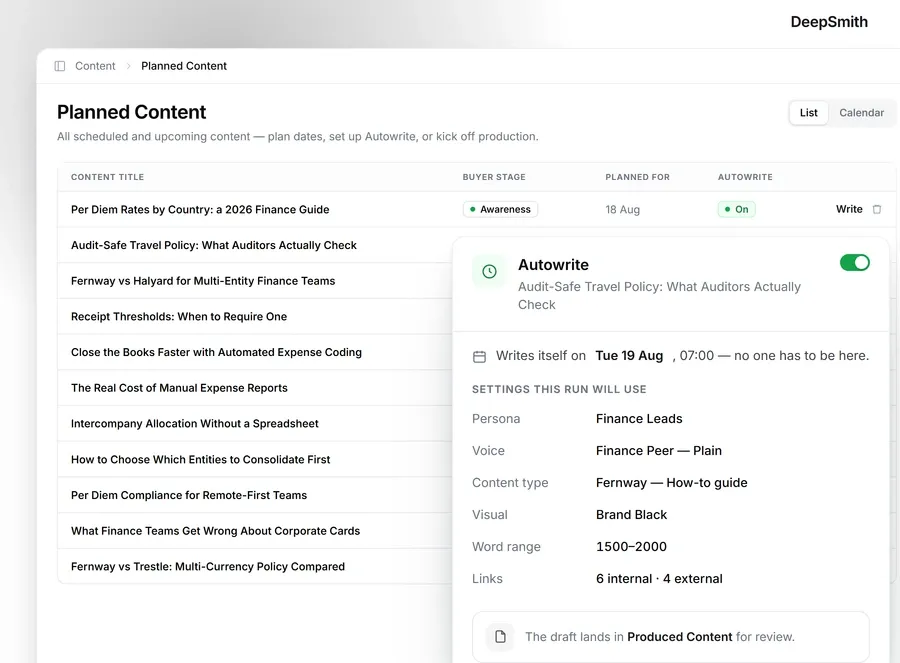
DeepSmith closes that gap inside one platform. The tracking side reports mention rate, citation rate, share of voice and sentiment, keeps the full answer history for every prompt, and shows which of your pages AI actually cites. Opportunity Agents read that data and return content ideas, and every idea carries the data point that justifies it, so you can defend the backlog instead of guessing at it. The Writer then turns a planned idea into a finished article with research, internal and external links, a cover image and metadata, grounded in your Deep IQ brand context. Autowrite can do that on a schedule with nobody in the app, and finished articles publish to WordPress, Webflow, Strapi, Sanity or Contentful, or to your own webhooks.
DeepSmith's plans don't include crawler log analytics or a shopping module, and the lower plans track fewer engines, with all ten on Enterprise. What a small team gets in return is the production side of the work, on published plans: Pro is $99 a month with 20 articles and 50 tracked prompts, Grow is $199 with 40 articles, and Scale is $399 with 90 articles. There is a 7-day free trial and no long-term contract. It is rated 4.8/5 on G2.

Engine coverage
Peec AI wins on engine coverage you can verify, and Bluefish wins on shopping assistants. Peec names its engines: ChatGPT, Google AI Overviews, Google AI Mode, Gemini and Microsoft Copilot sit on every plan, and Starter, Pro and Advanced let you choose three active models at a time. Perplexity is a paid add-on at $30, $70 or $140 a month billed annually, and Claude, Grok, DeepSeek and others appear only on Enterprise and the higher agency plans. The Enterprise plan card says up to 13 models.
Bluefish says it tracks more than 10 AI systems daily and names ChatGPT, Gemini, Perplexity, Google AI Overviews, Claude, Amazon Rufus and Alexa for Shopping. The full list and the per-contract entitlements are not published, so you cannot check what your own contract would cover before you talk to sales. It also does not say whether answers come from official APIs or consumer interfaces. If your buyers shop through Amazon's assistants, that Rufus and Alexa coverage is a real reason to take the demo.
What DeepSmith does: DeepSmith covers ten engines: ChatGPT, Gemini, Perplexity, Claude, Google AI Overviews, Google AI Mode, Grok, Meta AI, Microsoft Copilot and DeepSeek. Pro tracks ChatGPT, Grow adds Perplexity, Scale adds Gemini, and Enterprise covers all ten. The tracking results feed straight into the content ideas, so more engines means more gaps found and more articles proposed.
Tracking depth and data method
Peec AI is the more transparent of the two, and Bluefish has the more unusual measurement features. Peec documents that it scrapes consumer AI interfaces with local infrastructure, runs each prompt once every 24 hours per model, stores the raw answers, and reports cited sources at domain and URL level. Its monthly answer allowance is simple arithmetic: prompts times active models times days.
Bluefish measures against a static prompt baseline so it can separate its own tactics from model drift. AI Accuracy extracts the factual claims an AI makes, checks them against the Brand Vault and scores mismatches by severity. Custom Audiences break visibility out by customer persona, and Collections group URLs into one measured signal. These are vendor descriptions and no independent reviews back them up yet, and Bluefish does not publish how long it keeps answer history.
What DeepSmith does: DeepSmith checks the questions you define on a schedule and reports mention rate, citation rate, share of voice, sentiment and visibility trend. Each prompt keeps its full answer history, and the Pages view shows which of your pages AI cites and which prompts drive those citations. The Content Map adds a view of how your coverage compares with competitor sites topic by topic.
Pricing and value
Peec AI wins on pricing because it is the only one of the two that publishes any. Starter is $95 a month, Pro is $245 and Advanced is $495, with a 15 percent discount for annual billing that works out to $80, $205 and $420 a month as of early September 2026. Users, languages and competitors are unlimited on every plan. Enterprise is custom, and Peec offers a self-serve free trial, though it does not state the length.
Bluefish publishes no price, no plan limits and no trial. Access is a demo request and a negotiated order form. Its terms, as read by a third party, renew automatically unless you give notice at least 30 days before expiry, and fees already paid are non-refundable, though the order form controls. Strategy services are a separate line item, and you should ask for them to be priced out in the first call.
What DeepSmith does: DeepSmith's prices are on its pricing page: $99, $199 and $399 a month, or $80, $160 and $299 billed annually. Each plan includes articles as well as tracking, so the cost of production is part of the subscription instead of a second contract with a writer or an agency. There are no cancellation fees.
Security and integrations
Bluefish is stronger on paper here and Peec AI is stronger in documentation. Bluefish lists SOC 2 Type 2, SSO and MFA as badges in its site footer, though it has no public trust center or API documentation to back them. Peec has SAML SSO on Enterprise only and says it is pursuing SOC 2, which it did not have as of September 2026. On the other side, Peec documents its MCP server, CSV exports, a Looker Studio connector and a beta API, and Bluefish names only MCP and says it has 15-plus integrations without listing them. Neither lists a CMS connector.
From insight to action
Neither tool writes the article, so this is a tie, and the difference is in what each hands you. Peec's Actions give prioritized on-page and off-page steps with an opportunity score, and its help pages say you create the content yourself. Bluefish generates content briefs and Agentic Campaigns, which produce page-specific tactics that your marketers carry out, and its site says it provides the direction while you stay the author. Both can feed an AI assistant over MCP, but publishing is still your job.
For a team with no writers to spare, that last step is where the plan stalls. A managed service closes it with people, which is the Bluefish model, and it only makes sense at enterprise budgets. A self-serve tool leaves it with you, which is the Peec model.
What DeepSmith does: DeepSmith turns the gap into a published page. Opportunity Agents propose evidence-backed ideas, you give an idea a date to plan it, and Autowrite produces a publish-ready article on that date and lands it in Produced Content. You review it, or publish straight to your CMS. A small team gets the output of the tracking data without hiring an agency.
Which should you choose
- DeepSmith fits teams that want to see where they are missing from AI answers and fix it with content they can publish every week, without a writing team or an agency retainer. It works for in-house marketers, founders and agencies that want tracking and production on one self-serve plan.
- Peec AI fits teams that already have writers, or an agency, and want a clear, published-price analytics tool to point them at what to write. It is the better of the two for an SEO or content manager who wants to be running within a day.
- Bluefish fits Fortune 500 and large enterprise brands with several marketing teams to coordinate, especially in retail and ecommerce, that want strategists and analysts included and have the budget and patience for a sales-led contract.
Start a 7-day DeepSmith free trial to see tracking and publish-ready articles on your own site.


