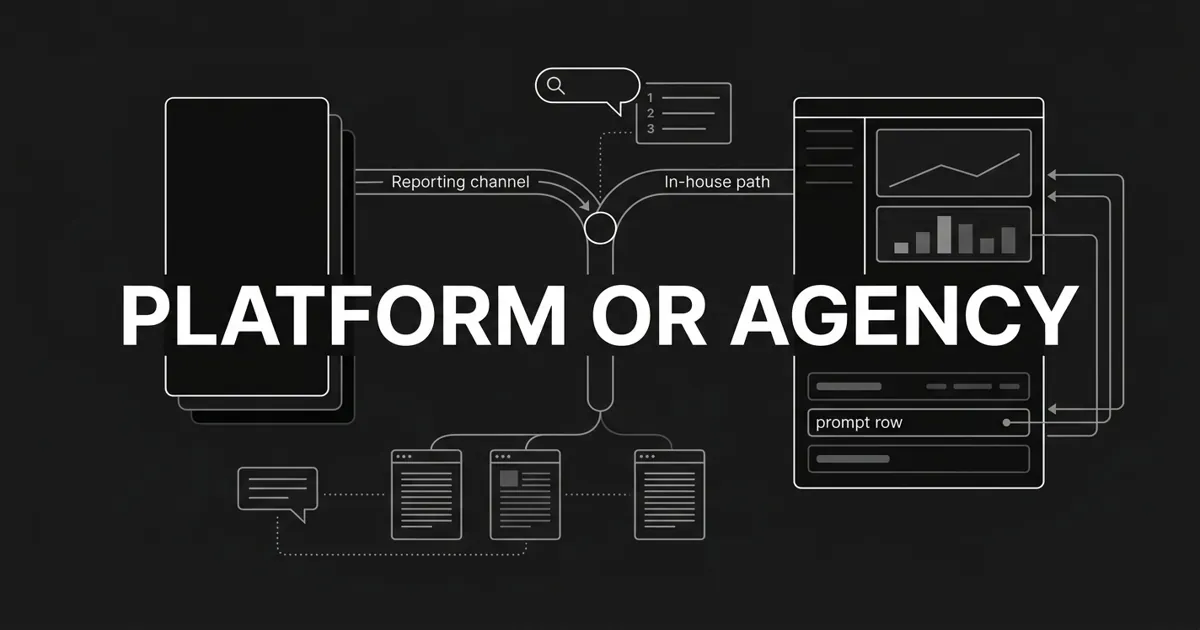
The question tends to arrive the same way. A client asks why a competitor appears in ChatGPT and the brand does not, or an executive reads that AI-powered search captured roughly 12 to 15 percent of global search share by mid-2026, up from around 5 to 6 percent at the start of 2025, and answer engine visibility becomes someone's responsibility by the end of the week. What follows is an operating-model choice rather than a product choice. The AI visibility agency vs platform decision separates into two paths: pay a specialist firm to run strategy, production, and reporting as a managed service, or license software an internal operator runs against the brand's own prompt set. Framed as outsource AEO or in-house, the choice turns on five variables: cost at volume, data ownership, how fast the loop closes, who produces the content that earns citations, and whether an operator exists at all.
The Two Paths, Side by Side
The AEO agency vs software comparison is easiest to read as a table before the reasoning behind each row is unpacked. The figures below describe typical market patterns rather than universal terms, and vendors on both sides sit outside them.
| Dimension | AEO agency (outsource) | AEO platform (in-house) |
|---|---|---|
| Typical monthly cost | $10,000 to $20,000 retainer | $99 to $399 subscription |
| Setup or onboarding fee | $2,500 to $12,000 and above | Usually none, trial common |
| Contract length | 6 to 12 months typical | Month-to-month or annual discount |
| Who produces content | Agency writers and editors | Internal team, working from platform drafts |
| Reporting cadence | Monthly | On-demand |
| Prompt and scoring transparency | Usually proprietary | Full visibility into prompts, scoring, logs |
| Iteration speed | Monthly cycles | Same-day to weekly |
| Data ownership | Vendor-held | Brand-held, exportable |
| Brand voice consistency | Shared, can drift as teams rotate | Encoded in stored context |
| Scaling across brands or clients | Linear with retainer cost | Roughly flat to a usage ceiling |
| Best fit | No in-house operator, hands-off execution preferred | Operator exists or can be hired, ownership matters |
Two rows carry most of the weight. Cost sets the budget conversation, and the operator question determines whether the platform path is available at all. A team without someone to curate prompts, review drafts, and publish on a cadence does not have a cheaper option; it has a different problem.
What an AEO Agency Retainer Actually Buys
A generative engine optimization agency typically bundles five workstreams that would otherwise be assembled separately: an AEO audit and roadmap, monthly visibility tracking across a defined prompt set, schema and structured-data implementation, content production aimed at earning citations, and digital PR or entity work intended to grow the third-party mentions engines draw on. Retainers cluster in the $10,000 to $20,000 per month range, with setup fees commonly running $2,500 to $12,000 or higher and contract terms of six to twelve months. Those bands are not universal. One specialist firm, Discovered Labs, publicly lists at roughly 5,495 euros per month with no setup fee and month-to-month terms, which suggests the market is wider than the headline range implies.
The strengths are real and should not be discounted. Agencies solve for strategy and prioritization when a brand has no internal AEO expertise, and prioritization is genuinely the harder half of the work early on. They carry pattern recognition from running the same playbook across many sites, which shortens the period when a team is guessing. They produce at a steady cadence without the brand adding headcount, and they bundle tracking and writing under one vendor relationship, removing a coordination cost in-house teams frequently underestimate.
The most defensible agency advantage sits in the part of the job software does not touch. Roughly 85 percent of brand mentions in AI answers come from third-party pages rather than owned channels, which makes earned media, community presence, and entity building a material input rather than a nice-to-have. Digital PR is agency territory, and no tracking or production tool substitutes for it.
That advantage has a boundary worth naming. Earned media is one input among several, and the owned-content formats that reliably earn citations are comparison pages, FAQs, glossary entries, how-to articles, and best-of listicles, all of which a production platform makes cheaply and repeatedly. The evidence that owned pages remain a live lever is direct: about 76 percent of cited URLs rank in Google's top 10 for the related query, while roughly 60 percent do not rank in the top 20, which indicates citation is partially independent of classic ranking and therefore reachable through structure and clarity rather than only through accumulated authority.
The weaknesses are structural rather than a matter of vendor quality. Prompt lists and scoring rubrics are generally treated as proprietary intellectual property, which makes switching expensive and cross-vendor comparison difficult. Reporting runs monthly, so the iteration loop is one cycle per month. Cost per article at volume is the worst of any operating model, and voice drift is common when account teams rotate.
What an AEO Platform Actually Buys
A consolidated AEO platform covers five jobs: visibility tracking with share of voice, mention rate, citation rate, per-prompt history, and a competitor leaderboard; prompt discovery and scheduled tracking; content production grounded in stored brand context with publish-ready metadata and linking; repurposing into channel-native formats; and multi-workspace isolation for teams running more than one brand.
Public pricing sits in three observable bands as of mid-2026. Entry tiers run roughly $29 to $99 per month with limited prompts, limited engines, and a single seat. Mid tiers run roughly $189 to $399 per month with more engines, prompts, and seats. Top tiers begin around $399 per month or move to custom pricing, adding full engine coverage and white-label reporting. Agency add-ons commonly layer a per-workspace fee on top of the base subscription.
Platform strengths concentrate in granularity and speed. Visibility data arrives per prompt, per engine, and per page rather than as a monthly summary, and prompt edits or scheduling changes take effect the same day. Marginal cost falls as volume rises, because the subscription is fixed and additional articles consume operator time rather than vendor fees.
The limitations are real. A platform shows what is cited; it does not decide what to do about it, so strategy interpretation stays with the operator. Drafts still need human review for facts and claims. White-label depth varies between vendors. Pure-play tracking tools have longer track records and deeper prompt coverage in some categories than consolidated platforms do, though tracking-only tools stop at measurement, which leaves the production half of the job to a second vendor or to the retainer this decision was meant to replace.
Cost Over Twelve Months
Cost is where the AEO agency vs software gap is widest, and where the comparison is most often made incorrectly by setting a retainer against a subscription and stopping there. A retainer at $15,000 per month annualizes to roughly $180,000 plus setup. A mid-tier platform averaging around $250 per month annualizes to roughly $3,000, plus the fully loaded cost of an operator's time, which runs from part-time to full-time depending on volume. The honest comparison includes that operator, and once it does, the gap narrows to something arguable rather than absurd.
Per-piece economics make the crossover point visible. Published-article costs in 2026 cluster around $90 to $140 for do-it-yourself production with AI tooling, $180 to $320 for a freelancer working with AI tooling, and $450 to $900 for agency-managed production bundled into a retainer. Highly automated content engines report figures as low as $8 to $12 per piece at scale, though that band assumes conditions most teams do not have.
Volume determines the answer more cleanly than any other single variable. Below roughly ten pieces per month, agency economics are competitive, and the strategy and coordination the retainer buys is worth the premium. Above ten pieces per month, in-house production on a platform usually wins on both unit cost and turnaround, and above thirty pieces per month, per-piece retainer economics become punitive. Turnaround follows the same shape: agency production typically runs two to four weeks per piece from brief to publish, while a platform with an operator produces drafts same-day to next-day.
Hidden costs sit on both sides. On the agency side, setup fees are not always credited against the retainer, and auto-renewal or early-termination clauses are common enough to warrant reading. On the platform side, overage charges for tracked prompts, seats, or workspaces are the usual surprise, and unlimited content tiers frequently throttle quality or turnaround in practice.
Control, Transparency, and the Length of the Iteration Loop
Five control dimensions separate the paths: who owns the prompt set and citation history, who decides voice and claim boundaries, who approves publication, who selects which prompts and competitors matter, and what happens to the data and methodology when the relationship ends.
The general pattern is consistent even though individual vendors vary. Agency arrangements hold data on the vendor side, share voice ownership in a way that drifts as account teams change, keep strategy vendor-led with periodic check-ins, and offer low to medium portability. Platform arrangements hold data on the brand side with exports typical, encode voice in stored context, place editorial control directly with the team, and score high on portability.
Transparency differs in kind rather than degree. Agencies report aggregate metrics inside a curated narrative, built on scoring rubrics that are usually proprietary. Platforms expose per-prompt, per-engine time series with exportable logs and, in many cases, API access. Buyers who intend to stay with an agency long term should ask whether the prompt list and scoring rubric are disclosed, exportable, and re-runnable against their own data, because the answer determines what remains after the contract ends.
The single largest qualitative difference is who decides. Agencies choose what to track and how to score it, then report upward; platforms present the data and leave interpretation with the brand. Neither is inherently better, and the right one depends on whether judgment about AI visibility is a capability the organization wants to build or one it wants to rent.
The Multi-Client Version of the Same Decision
For an agency serving a roster rather than a single brand, the same question appears in a different form: subcontract AEO to a specialist firm, or license a platform and productize the service internally. The math is unforgiving in a way single-brand math is not.
Per-client tooling cost is the constraint. One prominent tracking platform prices agency use at roughly $99 base plus roughly $399 per client workspace, landing near $498 per client per month before seat costs. Against a typical client retainer of $2,000 to $5,000 per month, a $400 to $500 per-client tool cost cannot be absorbed without bundling it into service pricing or marking it up explicitly, and at twenty or more clients that cost begins to dominate delivery margin.
Three operational requirements follow. Multi-workspace isolation is non-negotiable, because voice bleed between client accounts damages trust faster than any reporting gap. Per-client context covering positioning, personas, products, and claim boundaries has to be configured once and reused, or onboarding cost repeats with every account. Reporting templates that auto-populate per-client data cut monthly reporting from hours to minutes, and white-label reporting is the lever that converts a tool line item into client-perceived service value.
Buyers who search some variant of "hire AEO agency or buy tool" from the agency side are usually asking whether AEO can become a repeatable service line rather than a per-account improvisation. Subcontracting answers the delivery question and leaves the margin question open; licensing answers the margin question and leaves the strategist's time as the binding constraint.
What Neither Path Changes
Certain foundations apply regardless of who runs the program, and neither an agency nor a platform removes them.
Structured data is one. FAQ, HowTo, Organization, Product, and Article schema correlate with higher citation rates, and pages carrying valid structured data show roughly 20 to 30 percent more appearances in AI summaries in some studies, with variance by source and methodology. Schema is necessary without being sufficient, since content clarity and extractability still drive whether a passage is usable in an answer.
Placement within the page is another. Analysis of ChatGPT citations found 44.2 percent drawn from the first 30 percent of a page's text, 31.1 percent from the middle band, and roughly 24.7 percent from the bottom 30 percent. Substance held back until the conclusion is materially less likely to be cited, which makes crisp answers near the top a structural requirement rather than a stylistic preference.
One further point deserves stating plainly. AEO does not replace SEO; technical SEO, schema, and on-page structure underpin citation readiness, and Google still holds roughly 90 percent of traditional search globally.
Timelines and What Counts as Working
Expectations are where both paths get oversold, so the ranges matter. First measurable signals typically appear in five to eight weeks on the platform path, where prompt expansion and publishing are under direct control, and in eight to twelve weeks on the agency path, where the reporting cycle governs pace. Meaningful share-of-voice shifts generally take three to six months, and answer engines update on weekly to monthly cycles, which makes compounding more relevant than any single spike.
Effort footprints differ by roughly an order of magnitude. Agency engagements consume around two to five hours per month per client in approvals and strategy calls, while platform operation consumes roughly ten to twenty hours per week per operator across prompt curation, draft review, publishing, and reporting. That difference is the actual price of the control the platform path provides, and it belongs in the budget as labor rather than assumed away.
Working looks like citation share trending upward on tracked prompts, share-of-voice gains against a named competitor set, referral traffic from AI sources where measurable, and pipeline influence where attribution exists. No vendor of either type can guarantee any of it, and any that does should be treated as a signal about the vendor rather than the channel.
Which Path Fits Which Situation
The outsource AEO or in-house question resolves differently depending on four conditions, and the honest answer is situational rather than categorical.
An agency is the better choice when no internal AEO operator exists and none can be hired in the relevant timeframe, when strategy and prioritization rather than execution capacity are the bottleneck, when a fixed monthly deliverable under a single vendor relationship is operationally preferable, or when the brand sits in a specialized niche requiring editorial expertise that cannot be staffed internally. Under those conditions the retainer buys something the subscription genuinely cannot supply.
A platform is the better choice when an operator exists or can be hired, when owning the prompt set, citation history, and editorial voice matters strategically, when volume needs exceed roughly ten pieces per month, when multiple brands or clients require isolated context, or when iteration speed matters more than a monthly deliverable cycle.
The AEO agency vs software framing also obscures a third option common in practice. Many programs run a platform for tracking and draft production, retain an agency or freelancer for high-stakes content, digital PR, and entity building, and keep an internal operator for review and publishing. That configuration concedes the earned-media advantage to the agency while keeping owned-content economics and citation data in-house, and it is frequently the most defensible budget allocation for a mid-sized program.
Where DeepSmith Fits

The platform side of this decision comes down to a seam. Tracking tools show which prompts a brand loses and which pages get cited, and producing the content that closes those gaps moves to another tool, another team, or back to a retainer. That gap between seeing a problem and fixing it is where AI visibility programs stall.
DeepSmith is built to remove the seam. It tracks how ten AI engines answer questions about a brand, ChatGPT, Gemini, Perplexity, Claude, Google AI Overviews, Google AI Mode, Grok, Meta AI, Microsoft Copilot, and DeepSeek, reporting mention rate, citation rate, share of voice, sentiment, and per-page citation attribution. It then produces publish-ready on-brand articles from the same stored context, with SEO and AEO structure, internal linking, metadata, and a cover image built into the pipeline rather than added afterward. Opportunity Agents close the interpretation step a dashboard leaves open: they read the brand's own visibility data or its Content Map, which puts its site and unlimited competitor sites on one topic taxonomy, and return ideas each carrying the data point that justifies it. Autowrite runs production on a schedule without anyone in the app, and Produced Content publishes to WordPress, Webflow, Strapi, Sanity, Contentful, or webhooks. For agencies, Multi-Workspace isolates each client's context, content, and billing, and Deep IQ stores each account's positioning, personas, product facts, and voice so drafts arrive in that client's voice, not a generic one.

Coverage rises by tier: Pro at $99 per month tracks ChatGPT, Grow at $199 adds Perplexity, Scale at $399 adds Gemini, and Enterprise and Custom cover all ten, with annual billing at $80, $160, and $299. Entry-tier coverage is ChatGPT only, which bites less than it looks, since ChatGPT takes roughly 60.7 percent of generative-AI web traffic and is where most buyer research begins. No platform guarantees rankings, citations, traffic, or revenue. What DeepSmith supplies is tracking and production, owned by the team that uses it.

A 7-day free trial runs on real data and real drafts before payment, with no long-term contracts or cancellation fees. Start a free DeepSmith trial and weigh a month of owned tracking and production against the retainer quote already on the table.