Three names dominate the shortlist when a marketing team decides to start measuring how AI engines answer questions about its brand: Profound, Peec AI, and Otterly.AI. All three are monitoring-first platforms that run a defined prompt set against generative engines on a schedule, log the answers, and report mention rate, citation rate, share of voice, and which URLs the engines cite. The differences that decide a Profound vs Peec vs Otterly evaluation are operational rather than conceptual: how many engines each platform covers, what the entry tier actually buys in prompts and seats, whether procurement will clear the vendor, and how long it takes to see the first real data. This AI visibility tracker comparison sorts the three by those axes and names the buyer each one genuinely fits.
The short answer
- Profound suits enterprise and regulated-industry teams. It tracks the widest engine set of the three, eight to nine surfaces, and it is the only one of the three that publicly advertises SOC 2 Type II, SSO, RBAC, and audit logs.
- Peec AI suits mid-market B2B SaaS teams and agencies that care most about share of voice against a named competitor set, and that value a fast interface over raw engine breadth.
- Otterly.AI suits solopreneurs, small teams, and agencies with many SMB clients. It has the lowest entry price at $29 per month and the only self-serve free trial of the three.
None of the three writes or publishes content. Each one surfaces the prompts where a brand is missing; closing those gaps remains a separate job worth pricing into the decision.
Profound vs Peec vs Otterly at a glance
| Dimension | Profound | Peec AI | Otterly.AI |
|---|---|---|---|
| Starting price (annual billing) | $99/mo | $49/mo | $29/mo |
| Entry-tier prompts | 50/mo | 50/mo | 15/mo |
| Entry-tier brands | 1 | 1 | 1 |
| Entry-tier seats | 1 | 1 | Unlimited |
| Engines tracked | 8 to 9 | 3 to 5 | 4 core plus 3 paid add-ons |
| Share-of-voice metric | Yes (Answer Engine Insights) | Yes (named SOV) | Yes (Brand Visibility Index) |
| Competitor benchmarking | Yes | Yes | Yes |
| Sentiment analysis | Yes | Yes | Yes |
| Citation and link tracking | Yes | Yes | Yes, weekly |
| Prompt discovery | Yes (Prompt Volumes plus Discover) | Yes | Yes (AI Prompt Research) |
| API access | REST API, Enterprise tier | JSON API, Enterprise only | Public API, limited endpoints |
| SOC 2 / SSO / RBAC | SOC 2 Type II, SSO, RBAC, audit logs | Not publicly advertised | Not publicly advertised |
| Free trial | No, demo-gated | No, demo-gated | Yes, 14 days, no credit card |
| Headquarters | New York | Berlin | Vienna |
| Best for | Enterprise and regulated industries | Mid-market B2B SaaS and agencies | SMBs, solopreneurs, budget buyers |
Profound: the deepest analytics, behind the highest threshold
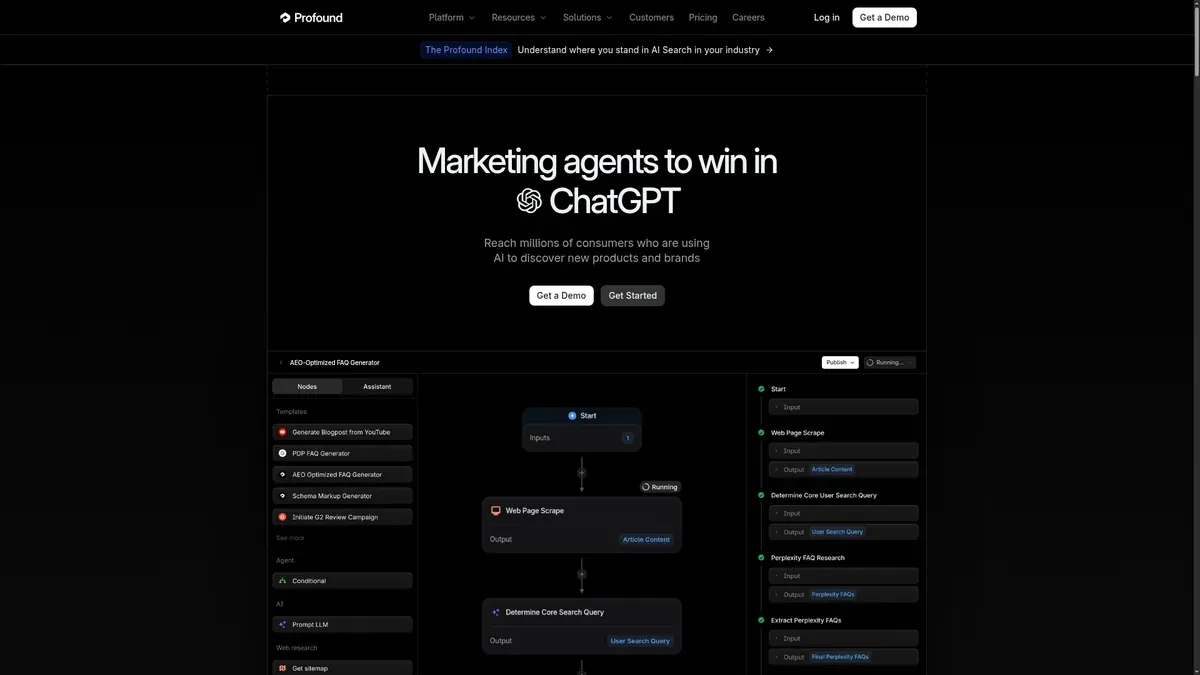
Profound is the enterprise option in this set, and the evidence supports the positioning rather than merely the marketing. The platform tracks eight to nine engines, including ChatGPT, Perplexity, Gemini, Claude, Microsoft Copilot, SearchGPT, Grok, Meta AI, and DeepSeek. That is the widest surface list among the three by a substantial margin, and it is the only one of them that reaches Meta AI and DeepSeek at all.
Two features have no equivalent in either competitor. Prompt Volumes estimates real-world AI-search demand per topic, which functions as the AI-era analogue of keyword volume and gives a prioritization signal that mention counts alone do not provide. Shopping Agent Analytics tracks brand mentions inside ChatGPT Shopping and agentic checkout flows, which makes Profound the default choice for e-commerce brands whose buyers are beginning to transact inside an assistant rather than on a product page. Profound Agents can also trigger automated workflows when tracking changes, such as a Slack alert when the citation set behind a tracked prompt shifts; the Slack integration itself shipped in February 2026.
Security posture is the other separator. Profound publicly advertises SOC 2 Type II, SSO via SAML, role-based access control, and audit logs, which is what a Fortune 500 procurement review generally requires before a tool touches brand data. Neither Peec nor Otterly publicly advertises an equivalent posture.
The constraints are mostly about threshold rather than capability. Profound carries the highest entry price in the category: $99 per month on annual billing, with monthly billing cited in some reviews at roughly $499 per month. The entry tier is narrower than the headline engine count implies, covering 50 prompts, one brand, one seat, and ChatGPT only; the full eight-to-nine-engine coverage sits at the Enterprise tier, where pricing is custom. Onboarding is demo-gated, so a team cannot self-serve in and see its own data the same afternoon. The analytics depth that justifies the price carries a steeper learning curve, and for a solo marketer or a single-brand SMB the platform is more instrumentation than the question warrants. Profound raised a $20 million Series A in June 2025 led by Kleiner Perkins, with participation from Sequoia, Khosla, Saga, and South Park Commons, a reasonable continuity signal for a buyer signing a multi-year agreement.
Peec AI: share of voice for the mid-market

Peec AI, headquartered in Berlin and founded in 2024, positions itself around a single metric rather than around breadth. Share of voice is the flagship number, it sits at the center of every dashboard, and the competitor leaderboards track share movement over time rather than reporting a static snapshot. For a mid-market B2B SaaS team whose real question is which named rival is winning the prompts its buyers ask, that focus produces a faster answer than a broader platform generally does. The company reports more than 2,500 marketing teams on its homepage.
The mid-tier economics are the strongest argument for Peec. Starter runs $49 per month on annual billing (€89 per month on monthly billing) with 50 prompts, one brand, three competitors, and one seat. The Growth tier at $149 per month on annual billing (€199 per month monthly) raises that to three brands, ten competitors, and approximately five seats, which is multi-brand tracking at a price point where Profound is still selling a single-brand plan. Peec also adds per-prompt brand sentiment scoring, weekly suggested prompts through its AI prompt research, CSV export, and a community-built Looker Studio connector. Support runs through Slack and is consistently described as responsive.
The limits follow from the same focus. Peec tracks the narrowest baseline engine list of the three: ChatGPT, Perplexity, and Gemini are confirmed across sources, while Claude and Microsoft Copilot appear in some coverage but are not consistently listed on the official pricing page. A team that needs certainty about Claude or Copilot coverage should confirm it directly before purchase. API access is gated to the Enterprise tier, which puts programmatic reporting out of reach for the mid-market buyer the product otherwise serves best, and the community Looker Studio connector plus CSV export are the practical substitutes. Peec offers no self-serve trial; access runs through a sales conversation. The narrower engine list bites less than the raw number suggests for most mid-market B2B buyers, since ChatGPT, Perplexity, and Gemini are where the majority of business research traffic currently sits, but it bites hard for any brand whose audience has moved toward Copilot inside a Microsoft estate.
Peec's USD annual and EUR monthly figures do not convert cleanly into each other, so anyone weighing Profound or Peec on budget alone should price both on the same billing basis first.
Otterly.AI: the lowest-friction entry point

Otterly.AI, based in Vienna, is the most accessible of the three by both price and onboarding friction. Lite starts at $29 per month with 15 prompts, one brand, unlimited seats, and four core engines: ChatGPT, Perplexity, Google AI Overviews, and Microsoft Copilot. Unlimited seats at the entry tier is a genuine outlier in this comparison, since both Profound and Peec cap the entry plan at a single seat, and it matters for an agency that wants account managers and clients looking at the same dashboard without a per-user upgrade.
The trial policy is the second real advantage. Otterly is the only tool of the three offering a 14-day free trial with no credit card required, while Peec and Profound both route new buyers through a demo. For a team that has not yet proven internally that AI visibility deserves a line item, a real dashboard before the budget ask changes the conversation.
Otterly also carries features that are unusual at its price. The GEO Audit tool analyzes content for AI-citation readiness across structured data, crawlability, content depth, and gap analysis, which is the only content-side capability in this comparison. Weekly link citation tracking shows which URLs are cited and how often. Country coverage extends past 50 markets, the broadest geographic footprint here. The Looker Studio connector is free and public rather than community-maintained, a limited public API is available without an Enterprise contract, and MCP support is included on Standard and Premium.
The trade-offs are concentrated in capacity and engine economics. Fifteen prompts on Lite is the smallest budget in the comparison, and few serious tracking programs fit inside it; the practical plan for most teams is Standard, cited by the vendor at $189 per month with 100 prompts and five brands, though some third-party reviews cite $149 for the same tier. Engine coverage is à la carte rather than bundled: Claude, Google AI-Mode, and Gemini are paid add-ons on Standard and Premium, so a brand that needs Gemini pays for it separately, and the add-on prices are not consistently published. The feature set is the lightest of the three, and the public API is limited relative to Profound's enterprise-grade REST API. Otterly Premium does support up to 20 brands, the strongest multi-brand allowance below enterprise pricing in this set.
Engine coverage compared
Engine breadth is the axis where the three tools separate most cleanly, and the one where what a platform charges to widen the net varies most.
- Profound: eight to nine engines, including Meta AI, Grok, and DeepSeek, which neither of the others reaches. Full coverage sits at the Enterprise tier; the entry tier is ChatGPT only.
- Otterly: four core engines bundled (ChatGPT, Perplexity, Google AI Overviews, Microsoft Copilot) plus up to three paid add-ons, for a practical ceiling of seven.
- Peec: three confirmed engines (ChatGPT, Perplexity, Gemini), with Claude and Copilot reported inconsistently.
The correct weighting depends on where a brand's buyers actually ask questions and on what the coverage costs to reach. For a B2B SaaS company whose prospects research inside ChatGPT and Perplexity, paying enterprise pricing to add DeepSeek is difficult to justify. For a global consumer or e-commerce brand with meaningful audiences where Meta AI or DeepSeek carry real usage, that same breadth is the whole argument. The useful test is to establish which engines the target audience uses, then compare what each platform charges to reach them.
One caveat applies across all three: none publicly discloses how it calculates share of voice. The numbers are comparable within a single tool's dashboard over time but not across tools, so a mid-flight migration resets the baseline rather than continuing it.
Pricing and what the entry tiers actually buy
Headline prices rank cleanly: Otterly at $29 per month, Peec at $49, Profound at $99, all on annual billing, with an annual discount of roughly 20 percent across all three vendors. That ranking reverses in usefulness once prompt budgets enter the calculation. Otterly Lite provides 15 prompts against Peec Starter's 50 and Profound Lite's 50, so the cheapest plan is also the one most likely to be outgrown inside a quarter.
On an Otterly vs Profound comparison at the entry tier, the honest framing is that the two plans are not the same product. Profound Lite delivers 50 prompts on a single engine with a single seat and demo-gated access; Otterly Lite delivers 15 prompts across four engines with unlimited seats and a self-serve trial. Neither is strictly better. The Otterly vs Profound decision turns on whether prompt depth on one engine or shallow coverage across four engines answers the question a team is asking first.
The most common budgeting error here is comparing entry-tier prices when the realistic plan is one tier up. A mid-market team needing multiple brands lands on Peec Growth at $149 per month or Otterly Standard at $189, where the price gap narrows considerably while the feature profiles stay quite different. Anyone deciding between Profound or Peec should also note the billing-term asymmetry: Profound's $99 figure requires an annual commitment, and monthly billing has been cited at a substantially higher rate.
Security, compliance, and procurement
For regulated buyers this section decides the evaluation before any feature comparison begins. Profound publicly advertises SOC 2 Type II, SSO through SAML, role-based access control, and audit logs, and the product is explicitly designed against Fortune 500 procurement requirements. Peec and Otterly do not publicly advertise equivalent certifications.
That gap does not automatically disqualify either tool, since public advertisement and actual compliance status are different things, and a buyer in finance or healthcare should ask both vendors directly rather than infer from a website. What it does mean in practice is a shorter procurement cycle with Profound, because the documentation a security review requests already exists in public form. For a team without a formal vendor-review process, this dimension carries close to zero weight, and paying an enterprise premium for compliance artifacts nobody will read is a poor allocation.
Multi-brand and agency use
Agencies and multi-brand marketing teams face a different constraint than single-brand buyers, since the binding limit is usually brand count rather than engine count.
- Otterly allows five brands on Standard and 20 on Premium, the strongest multi-brand allowance below enterprise pricing, with unlimited seats throughout.
- Peec Growth allows three brands and ten tracked competitors at $149 per month, and publishes a separate agency pricing page.
- Profound Enterprise allows unlimited brands, at enterprise pricing and with a demo-gated entry.
For an agency serving many small clients, Otterly's combination of brand allowance, unlimited seats, a free Looker Studio connector, and a public API generally produces client-ready reporting at the lowest cost per account. For an agency serving fewer, larger clients where the deliverable is competitive share-of-voice analysis rather than a raw dashboard, Peec's leaderboards tend to be the faster path to a report a client will actually read.
The gap all three leave open
The important structural point in this AI visibility tracker comparison is what none of the three tools does. Profound, Peec, and Otterly all measure; none produces the content that changes what they measure. Tracking surfaces the prompt where a brand is absent, the competitor page winning the citation, and the topic where coverage is thin, and every one of those findings converts into a writing task that lands back on a content team already at capacity. Otterly's GEO Audit comes closest by scoring existing pages for citation readiness, though scoring a page and writing a new one remain different problems.
The true cost of an AEO program is therefore the tracker plus whatever produces the content, whether that is a freelancer roster, an agency retainer, or internal writer hours. Teams that would rather not run two systems can look at a platform where both live together: DeepSmith reports mention rate, citation rate, share of voice, and sentiment across ten engines, ChatGPT, Gemini, Perplexity, Claude, Google AI Overviews, Google AI Mode, Grok, Meta AI, Microsoft Copilot, and DeepSeek, with coverage rising by plan and all ten on Enterprise, and pairs that tracking with publish-ready article production in the same workspace. Its Opportunity Agents turn that visibility data into content ideas, each carrying the data point that justifies it, so a tracked prompt with no coverage becomes a scheduled article without a second workflow. That is a note about the seam these three trackers leave open, not a fourth entry in this comparison.


Teams that want to see tracking and production working from the same brand context can start a free trial and review real data before committing budget.
Which should you choose
Choose Profound if the organization is an enterprise or regulated-industry brand where SOC 2, SSO, RBAC, and audit logs are procurement prerequisites; if the buyer journey runs through engines the other two do not reach, such as Meta AI or DeepSeek; or if the brand sells into ChatGPT Shopping, where Shopping Agent Analytics has no substitute here. Budget for the Enterprise tier rather than the $99 entry plan, since the headline engine coverage lives there.
Choose Peec if the organization is a mid-market B2B SaaS company tracking share of voice against a defined competitor set, if multi-brand tracking is needed at mid-tier pricing, or if speed of reporting matters more than engine breadth. The comparison between Profound or Peec usually resolves on procurement requirements and engine breadth: absent a compliance mandate and absent audiences on the long-tail engines, Peec delivers the more relevant analysis per dollar.
Choose Otterly if the budget is tight, if the priority is proving the category is worth funding before requesting a line item, if many small client brands need basic coverage, or if unlimited seats and a free public Looker Studio connector matter to how reporting gets distributed. Plan for Standard rather than Lite once tracking moves past an initial pilot, and price the engine add-ons separately.
The best AEO tracking tool in this category is the one whose constraint profile matches the program being run, not the one with the longest spec sheet. Establish the prompt volume the program actually needs, the engines the audience actually uses, and the compliance bar the organization actually enforces; the choice usually narrows to one tool once those three numbers are written down.