You searched your topic in Claude, saw a competitor's page show up as the source, and thought: which tool would have caught that for me? Fair question. Claude citation tracking is one of the hardest things to monitor well, and the shortlist of tools that actually do it is short. That is not a gap in your research. It is the state of the market.
Here is the good news. A handful of platforms do track citations in Claude at the URL level, and you only need one. This guide names them, shows what each is best for, and is honest about which one to pick when your budget or stack points elsewhere. We put DeepSmith first because it pairs Claude source tracking with the pipeline that closes the gaps it finds, but we tell you exactly who should choose a competitor instead.
Let's start with why this is such a small field, because that context is what makes the list make sense.
Why Claude citation tracking is uncommon
Most AI visibility tools were built for ChatGPT and Perplexity. Those engines browse the web by default and return a tidy numbered list of sources at the bottom of an answer. A tracker can parse that footer and read off the citations. Easy to build, easy to monitor.
Claude works differently, and that difference is the whole story.
Claude does not browse the web by default. It answers from what it already knows, unless you invoke its Research mode, which pulls live sources through Brave Search. So a page can be cited in one session and invisible in the next, depending on whether the reader triggered a web lookup.
Claude also cites differently. Instead of a footer list, it uses inline bracket links inside the answer, and when you feed it documents, it can point to the exact passage it drew from. Anthropic's Citations API, which launched in 2025, made that source attribution far more reliable for developers building on Claude. That is a real improvement, but it is a builder feature, not a dashboard for a content team.
The practical result: a tracker built around footer parsing misses Claude almost entirely. To monitor Claude, a platform has to add a Claude-specific layer or lean on Brave results as a proxy. Studies of thousands of Claude-cited URLs found heavy overlap, roughly nine in ten, between what Claude cites and what Brave ranks near the top. Useful signal, but a proxy is still a proxy. Only a few vendors have done the deeper work of watching Claude itself.
There is a pattern worth knowing before you shop. Analyses of Claude-cited URLs show the sources cluster in a predictable shape: most sit under a /blog/ path, a large share are listicle-style pages, and very few are homepages. Recency shows up too, with a notable slice of cited URLs carrying a year in the address. Claude leans toward specific, current, answer-shaped pages from a fairly narrow set of authority domains. That tells you two things. When you track citations in Claude, you are watching a concentrated field, and to win in it, your own pages have to be shaped that way and cleanly formatted so a tracker can even match them back to you.
That is why the honest list is short. Now let's use it.
How we picked these tools
A roundup is only as trustworthy as its criteria, so here are ours. A tool earned a spot only if all three held true.
First, it explicitly tracks Claude. Not "coming soon," not ChatGPT-only, not by special request. Where Claude sits behind a higher plan, we name the tier so there are no surprises at checkout.
Second, it tracks at the URL level, not just mentions. A mention tells you Claude named your brand. A citation tells you Claude linked to your page as a source. This guide is about the second one. Brand-mention-only monitors did not qualify.
Third, it ties citations back to prompts or pages, so you can trace a source back to the question that surfaced it. That is what turns a number into an action.
We then weighted the ranking by depth of Claude-specific features, how well the tool fits a real content workflow, pricing you can actually plan around, and how fresh the data stays. One more thing to know up front: pricing in this space shifts monthly, so treat every figure below as a starting point and confirm on the vendor's page before you buy.
The 7 tools at a glance
| Rank | Tool | Best for | Claude coverage | Starting price |
|---|---|---|---|---|
| 1 | DeepSmith | Teams that want Claude citation visibility on the same platform that produces the content to win it | All ten engines on Enterprise, including Claude | $99/mo (Pro) |
| 2 | Profound | Enterprise AEO teams that need deep share-of-voice reporting | Claude supported | $499/mo |
| 3 | Peec AI | European teams tracking several engines on a mid-tier budget | Claude supported | Around €89/mo |
| 4 | Ryze AI | Teams focused on ChatGPT and Claude in one dashboard | Claude supported | Quote only |
| 5 | LLM Pulse | Marketers who want Claude depth in tiers | Claude on higher tiers | From around €49/mo |
| 6 | AIclicks | Solo operators and small teams on a tight budget | Claude supported | $59 to $499/mo |
| 7 | AirOps | Content ops teams pairing tracking with automation | Claude supported | Quote only |
A few tools you might expect to see are missing on purpose. Otterly.AI does not support Claude. Semrush's AI visibility toolkit and Ahrefs Brand Radar center on Google's AI surfaces rather than Claude. Scrunch and Promptmonitor did not confirm Claude coverage in their materials, so we left them out rather than guess. When we could not verify Claude support, the tool did not make the list. That is the point of the list.
The tools, in depth
1. DeepSmith

Best for: content and marketing teams that want to see which sources Claude cites and then produce the content to close those gaps, without switching tools.
Most trackers stop at the chart. They show you the gap and leave the hard part, actually writing and shipping the pages that earn citations, to you and next quarter's calendar. DeepSmith runs both halves in one platform. On the analytics side it measures mention rate, citation rate, share of voice against competitors, and how each moves over time. On the production side it turns a surfaced gap into a finished, on-brand article.
For Claude specifically, the visibility side gives you a per-prompt view with full answer history, so you can see whether Claude cited anyone at all for a given question and who won when it did. The Pages view shows which of your own URLs Claude actually cites and the prompts driving each one. Competitor citations show you the exact competitor page winning a prompt you care about. And Discover Prompts suggests questions to track based on your product, persona, and buyer stage, so you are not starting from a blank prompt list.

Here is where it separates from a pure Claude AI citation monitor. Once the data surfaces a gap, the Writer produces a publish-ready article tied to it, with keyword coverage, headings, internal links pulled from your Content Map, schema, a cover image, and metadata built in during writing, not bolted on after. Deep IQ stores your brand voice, positioning, and the claims you will and will not make, so every draft sounds like you. Autowrite can even schedule that article to write itself on a set date. The loop from "Claude is citing a competitor here" to "we published the page that answers it" becomes a system, not a someday.

Pricing is $99/mo Pro, $199/mo Grow, and $399/mo Scale, or $80, $160, and $299 respectively when billed annually, plus custom Enterprise. There is a 7-day free trial and no long-term contract.
One honest limitation: Claude coverage lives on the Enterprise tier, where all ten engines run together. If Claude is your single most urgent engine and you want it on a flat self-serve plan, that is a real trade-off to weigh. It reflects a deliberate call, since Claude's citation footprint is smaller than ChatGPT's or Perplexity's, so enterprise-grade collection earns its place once your strategy genuinely leans on it. When it does, that one workspace tracks Claude alongside nine other engines, the widest coverage on this list, and it stays the only pick here that also ships the page to close each gap it finds, so the tracking never dead-ends at a chart.
2. Profound

Best for: enterprise AEO teams that need deep share-of-voice reporting and want Claude inside a multi-engine deck.
Profound is analytics-heavy and sits at the top of the market on price. It covers a broad set of engines with Claude among them, and its reporting goes deep: domain-level and URL-level citation share, plus prompt history showing how often a given URL wins over time. If your job is to hand leadership a rigorous visibility report every month, this is built for that.
Pricing starts around $499/mo, with custom enterprise tiers above it.
The limitation to know: Profound is a measurement tool, not a producer. When the data shows a gap, you still need a separate stack to write and publish the fix. Some teams also find the lower answer-engine tiers thinner than the fuller enterprise product.
3. Peec AI

Best for: European marketing teams running several engines, including Claude, on a mid-tier budget.
Peec AI tracks brand performance across ChatGPT, Claude, Perplexity, and other surfaces, with mention and citation rates reported per prompt and per source URL. You also get side-by-side competitor benchmarking and clean trend lines. For a team that wants honest multi-engine coverage without an enterprise invoice, it is a sensible pick.
Pricing sits around €89/mo.
The limitation: the production layer is thin. Peec AI tells you where you stand, but you will pair it with a separate writing tool to act on what it shows.
4. Ryze AI

Best for: teams whose two engines that matter are ChatGPT and Claude, and who want them in a single dashboard.
Ryze AI focuses on AI search analytics and tracks mentions, citations, and share of voice across ChatGPT and Claude at the prompt level, with source URL attribution. If Perplexity and Gemini are lower priorities for you, the tighter focus can feel like a feature rather than a gap.
Pricing is not published; you request a quote.
The limitation: coverage narrows outside ChatGPT and Claude, and the quote-only model means no quick self-serve number when you are comparing options on a deadline.
5. LLM Pulse
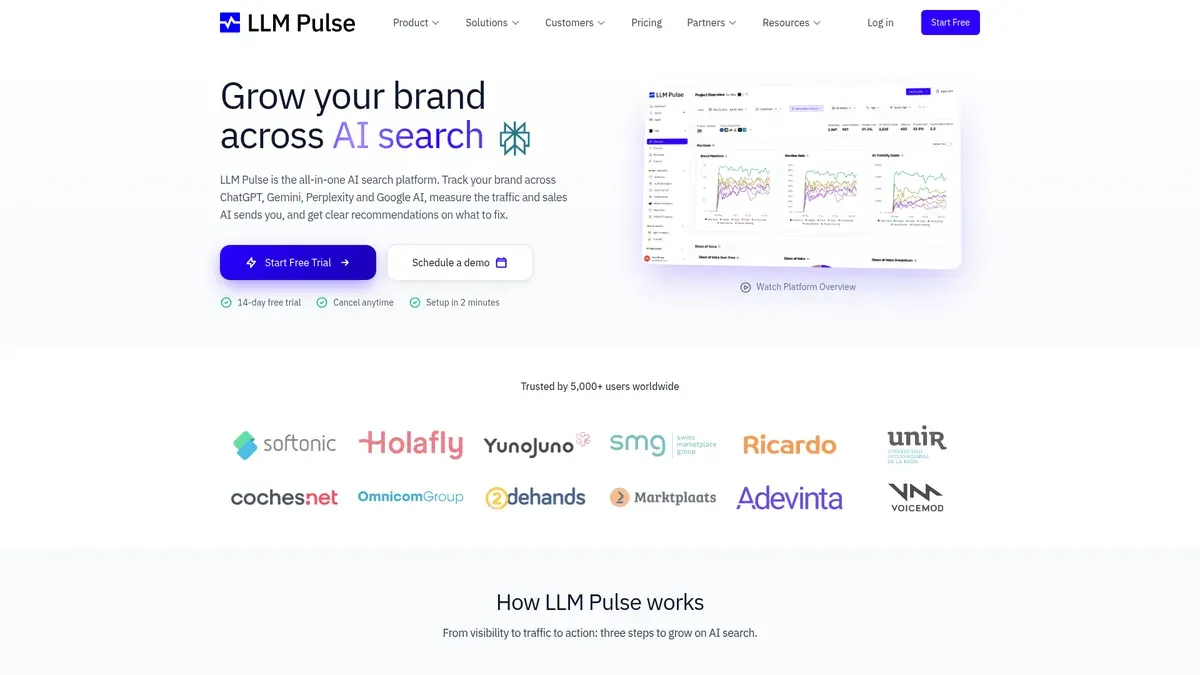
Best for: marketers who want Claude-specific tracking and are fine growing into the depth through tiers.
LLM Pulse tracks Claude at the prompt level and keeps a citation log per query, with deeper brand and competitor analysis unlocking on higher tiers. It also publishes its own periodic Claude tracker leaderboard, which is a decent sign the team pays attention to this engine specifically.
Pricing starts around €49/mo, with fuller Claude citation detail higher up the plan ladder.
The limitation: the entry tier is a glimpse, not the full picture. Real URL-level granularity means sizing up, so plan for that if depth is what you are after.
6. AIclicks

Best for: solo operators and small teams who want to test Claude source tracking without a big commitment.
AIclicks is a straightforward AI visibility tracker with Claude coverage and a wide tier range, from an accessible entry plan up to enterprise pricing. Higher tiers add URL-level citation logs. For a lean team validating whether Claude visibility is even worth chasing in their category, the low entry point is genuinely useful.
Pricing runs from about $59 to $499/mo across tiers.
The limitation: the cheapest tier is shallow, and full prompt and URL depth live higher up. It is a tracker, not a production system, so it will not write the fix for you.
7. AirOps

Best for: content operations teams that want citation tracking sitting next to workflow automation and an editorial calendar.
AirOps combines AI content workflow tooling with visibility tracking, and Claude is among its supported engines. If your team already lives in workflow automation and wants visibility data in the same place rather than a separate tab, that consolidation has real value.
Pricing is not published and the process is sales-led.
The limitation: visibility is one feature among many here, so Claude-specific citation depth may not match an analytics-first platform. Sales-led buying also adds time before you see data.
Reading your Claude citation data once you're tracking
Picking the tool is step one. Reading it well is what turns a dashboard into decisions, so here are three things to keep in mind once the data starts flowing.
Watch for Research mode. Claude only pulls live web sources when a reader triggers its Research feature, so the same prompt can cite a page one time and cite nothing the next. A good tracker shows you the full answer history per prompt, which lets you separate "Claude cited a competitor" from "Claude did not go to the web at all." Both are useful, but they mean very different things for your next move.
Collect often. Citation positions shift week to week as Claude's model selection and the underlying Brave index update. If you only check monthly, you will miss the movement that matters. Weekly collection is a reasonable floor for meaningful trends, and the better platforms let you set that cadence per workspace.
Format for the match. If you want to track citations in Claude and see your own URLs appear, those pages have to be clean and answer-shaped. Malformed or buried answers are hard for any engine to pull and hard for a monitor to attribute back to you. The measurement and the content quality are the same problem wearing two hats.
How to choose your Claude citation tracker
Feeling the options blur together? Let's make it simple. The right pick depends on one question: do you just need to measure, or do you need to measure and fix?
Pick DeepSmith if you publish on a regular cadence and want to close citation gaps in the same product that surfaces them, with your brand voice and product facts baked in, and your strategy is ready to cover Claude at the Enterprise tier.
Pick Profound if you are analytics-first, deep Claude share-of-voice reporting matters more to you than a production pipeline, your budget clears $499/mo, and you already have a writing stack.
Pick Peec AI if your budget caps around €89/mo, Claude is one of several engines you watch, and you are comfortable pairing a tracker with your own content workflow.
Pick Ryze AI if ChatGPT and Claude are your two engines and one dashboard beats switching between tools, and quote-based buying is no obstacle.
Pick LLM Pulse if Claude-specific tracking is your main requirement and the tiered path to depth fits your budget.
Pick AIclicks if you want to test Claude visibility cheaply first, with room to grow into deeper tiers later.
Pick AirOps if your content ops already run on workflow automation and you want visibility bolted into that same system.
Notice the pattern. Every tool here works as a Claude AI citation monitor and can tell you what Claude cites. Only one also writes and ships the pages that change the answer. If measurement is all you need today, several of these will serve you well. If you are tired of watching gaps you never have time to close, that is the line that should decide it.
Start tracking and closing the gap
You do not need to solve Claude visibility all at once. You need to see one real answer, for one prompt that matters, and then close one gap. That is a doable first step, and it is the whole loop in miniature. Claude citation tracking stops being a research project the moment you can watch one prompt and act on it, and that is the point where a tool starts paying for itself.
Start a 7-day free trial and get real data and real drafts before you pay. Plans start at $99/mo, with annual billing lowering the effective rate. See where Claude cites you, where it does not, and publish the page that fixes it.