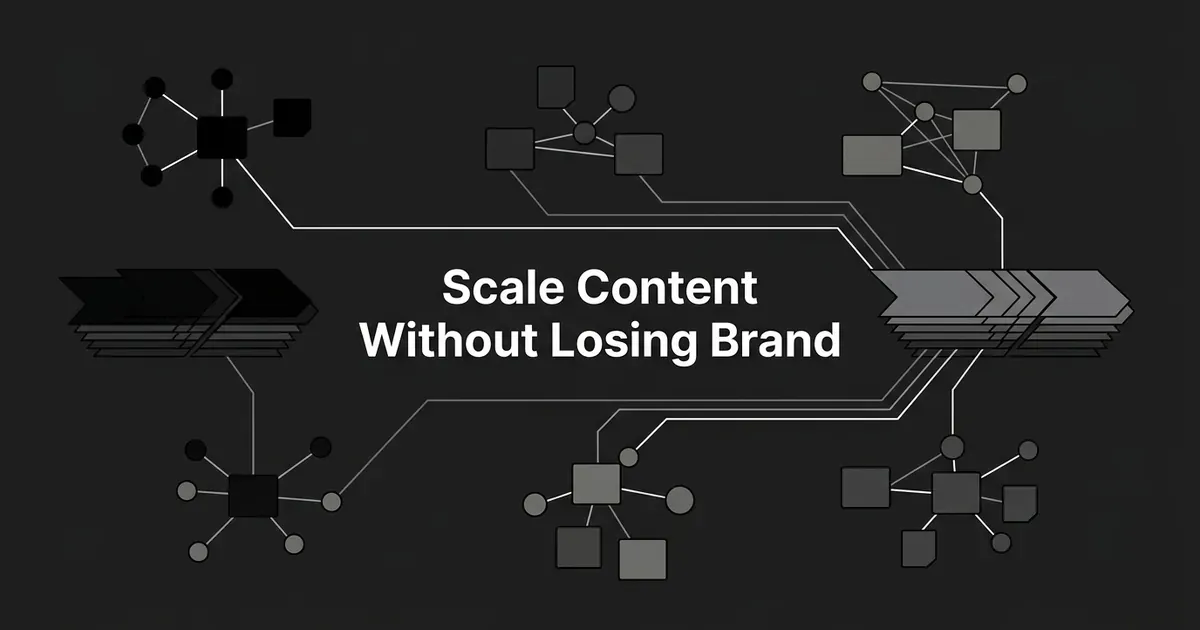
If you run content for more than one client or brand, you already know the real problem isn't writing more articles. It's writing more articles that still sound like the right brand, still make correct claims, and still earn a citation instead of getting skipped. This guide walks through how to scale AI content multiple clients or brands can run through at once, without the pages starting to blur together. By the end, you'll have a repeatable way to keep each piece grounded in its own brand while reusing the parts of the process that don't need to change per client.
The mistake most teams make first is trying to scale the wrong layer. They standardize the writing itself, so every article starts to read the same no matter which brand it's for. What you actually want to standardize is the process around the writing: how you gather research, how you brief an assignment, how you check quality, how you measure what worked. The brand facts, the voice, and the claims stay separate for every client. Keep that distinction in mind as you go through the steps below, because it's the difference between multi-brand content production that holds up and a page factory that quietly damages every brand it touches. The steps here apply whether you scale AI content multiple clients need served this month or you're producing across several product lines inside one company.
Define the production unit before you batch anything
Before you build a single template, decide what the smallest unit of your portfolio actually is. It's not "the portfolio." It's each client, brand, or product line, and each one needs its own audience definition, its own competitive set, its own approved claims, and its own trusted sources. Set up a production record for every one of these units and don't let anything cross between them.
For each planned article inside that unit, write a short assignment record: who it's for, what buyer stage they're at, the one buyer question this piece answers, the intended one-sentence answer, the angle that makes it different from what's already published, the evidence it needs, and where it should link internally and externally. This is the part that actually protects you from sameness. A shared production format across your whole roster is fine and even useful. A shared brand context is not.
A writer or a production system should be able to pick up this assignment and start work without asking which brand it belongs to, which persona it's for, or which claims are off limits. If someone has to ask, the record isn't ready.
Common mistake: starting from one shared spreadsheet of keywords and handing every client the same brief structure with the company name swapped. That's how cross-brand contamination starts, usually without anyone noticing until a client asks why their competitor's example showed up in their own article.
Lock each brand's context before you generate anything
A style guide PDF doesn't stop voice drift. Nobody rereads it before every draft, and even when they do, phrases like "professional" or "friendly" don't tell a writer or a system what to actually do differently. What holds up at volume is a structured context record for each brand: its positioning and differentiators, its products and features, its buyer personas with their goals and objections, its voice down to sentence patterns and words to avoid, its visual guidelines, its approved content formats, and its trusted sources. Write down concrete behavior, not adjectives.
This is the layer DeepSmith's Deep IQ exists to hold. It stores a brand's positioning, products, personas, voice, approved sources, visual guidelines, and content-type rules as structured context that every draft pulls from, so you're not re-briefing the same facts by hand every time you sit down to write. For agencies running several clients from one account, DeepSmith's Multi-Workspace setup keeps each client in its own workspace with its own brand context, competitors, tracked questions, and content queue, so nothing from one client's workspace bleeds into another's by accident. That isolation is a production safeguard, not a governance system on its own; if you also need approval gates and sign-off policy across the portfolio, that's a separate concern from what this guide covers.

To check whether a context record is actually ready, pull five sentences from a planned draft and ask: can you point to the fact that supports each one? Would this still sound like the right brand if you removed the logo and company name? If you can't answer clearly, the context isn't locked yet, and batching from it will just spread the gaps across more articles.
Pro tip: a context record isn't there to prove that AI wrote the piece correctly. It's there so a human reviewer can trace every claim back to a specific fact, which is what actually catches an invented statistic or a claim that belongs to a different client.
Choose what to write from evidence, not from a quota
A page count target is not a content plan. Before anything goes into the queue, it should carry a reason: a real buyer question, a place where the brand shows up in AI answers but doesn't get cited, a topic where competitors publish more than you do, or a gap where a competitor page is winning a citation you could reasonably take. Four inputs feed this: the questions buyers actually ask AI engines, where your AI visibility is thin or losing to a rival, where your topic and funnel coverage has gaps, and what the competitor pages that do get cited are actually doing well.
DeepSmith's AI Visibility tracks the prompts you define and reports mention rate, citation rate, and share of voice, with a breakdown of which pages are earning citations and which competitors are winning the ones you're not. Its Content Map crawls your site and your competitors' sites into one shared taxonomy of topics and funnel stages, so a coverage gap is something you can point to instead of something you sense. Opportunity Agents then read that data and return ideas with the specific reason attached: get cited for a tracked prompt, close a coverage gap, or take back a citation a competitor currently holds.
For every idea in the queue, you should be able to answer "why should this brand publish this now" with something more specific than "it has search volume." That's the bar that keeps the queue from turning into a keyword list with a due date attached.
Build reusable research packets without reusing the claims inside them
The part of research that's safe to standardize is the process, not the conclusion. Build a research packet template with fields like the assignment and its reader, the primary and related questions, definitions, first-party product facts, sources and their relevance, the specific claim each source supports, contradictions or open uncertainty, competitor pages worth understanding, and the internal pages this piece should link to. What goes inside those fields changes every time. The shape of the packet doesn't.
Keep three layers separate in your head as you build this out. Reusable research covers your research questions, your evidence standards, and your formatting conventions, and it travels across every client. Brand-specific truth covers a client's product facts, positioning, pricing, and approved terminology, and it never travels anywhere else. Article-specific interpretation is the argument and recommendation you're making for this one reader, and it's written fresh every time.
Before a draft goes forward, every material claim in it should land in one of three buckets: supported by a named source or a first-party fact, clearly framed as your own interpretation, or removed because nothing backs it up. That third bucket matters as much as the first two.
Common mistake: copying a research paragraph into several clients' articles and only changing the company name. Even a factually correct paragraph can be wrong for the new audience, incompatible with that brand's approved claims, or a near-duplicate of something you already published somewhere else.
Batch by production stage, not by one long prompt
Batching works when it removes repeated setup, not when it removes the decisions that actually need a person. Group the work by stage instead of by client: select and classify ideas together, gather sources together while keeping each article's evidence packet separate, complete assignment records together, draft together within a content type, run the same optimization checks together, review together, build distribution assets together, then check the results together once the content's had time to be seen. A batch manifest with one row per article, tracking its workspace, brand, status, and quality checks, keeps this from turning into a pile of drafts nobody can account for.
Inside DeepSmith's Content Studio, ideas move from New Ideas to Planned Content to the Writer to Produced Content, and you can plan individually or in bulk. Autowrite can generate a planned article on its scheduled date and drop it into Produced Content automatically, which is genuinely useful for keeping a queue moving through a busy week. It doesn't replace looking at what came out the other end.
Common mistake: running one long prompt to generate dozens of articles with only the title swapped between them. It produces predictable openings, the same explanations reworded, and a much higher chance that one client's language ends up in another client's piece.
Give every page the same skeleton, a different argument
Readers and AI systems both find an answer faster when the page follows a predictable shape: state the problem and who it's for, give a direct answer early instead of burying it under scene-setting, define terms before using them, break the task into steps a reader can actually follow, explain what commonly goes wrong at each one, back real claims with real evidence, link to deeper pages where it helps, and close with a next step. That structure can be identical across your entire content at scale without quality loss suffering for it, because the structure isn't the thing that makes a page interchangeable. The argument, the examples, and the evidence inside it are what has to change every time.
Before a page ships, check that its title matches the actual task, its first answer is direct rather than delayed, its examples are specific to that brand and audience rather than generic, its claims carry appropriate support, and it adds something a reader couldn't already get by reading three other pages on the topic. DeepSmith builds keyword coverage, heading structure, schema, internal linking, and answer-first formatting into the writing step itself rather than leaving them for a cleanup pass after the draft is done, which is worth having, but it's a production capability, not a promise that the formatting alone earns a citation.
Common mistake: scaling word count instead of scaling evidence and editorial judgment. A page factory that outputs more pages but fewer useful answers per page isn't actually a quality production system, no matter how the dashboard looks.
Run a portfolio check that catches drift, not just typos
A single article can look fine in isolation and still be part of a problem you can only see across the batch. Once a set of articles is drafted, check six things: brand accuracy (correct names, no claims borrowed from another workspace), evidence quality (claims that are actually supported, not just adjacent to a source), reader value (does it solve the stated problem, not just talk around it), originality (a distinct angle, not the same intro and conclusion repeated across five articles), citation readiness (a direct answer near the top, precise and appropriately scoped claims), and editorial quality (a recognizable voice with no generic AI transitions or filler).
Then compare a sample side by side across brands and content types. This is where portfolio-level problems actually show up: three unrelated clients whose "how to get started" sections read almost identically, or an example that got carried from one brand's article into a competitor's by mistake. Reviewing the first few completed pieces from each brand and content type before letting the rest of that batch move forward catches most of this before it multiplies.
Common mistake: judging quality by output volume, turnaround time, or how many keywords made it in. Those are production metrics. None of them tell you whether the page is actually useful, and no single "citation score" reliably predicts whether any AI engine will cite it.
Distribute, measure, and feed the results back in
Publishing isn't the end of the process, it's the point where you start finding out whether the work was any good. For each finished piece, build the channel assets while the argument is still fresh, adapting the message to each channel instead of pasting the article in unedited. Record where it published, track the buyer prompts it was meant to answer, and check whether the brand actually got mentioned or cited for those prompts, or whether a competitor took the spot instead.
DeepSmith's Repurpose and Apps Library turn a finished article into LinkedIn posts, newsletter sections, and other channel-specific formats without starting a separate project for it, though it's still worth a quick check for channel fit before anything goes out. On the measurement side, AI Visibility gives you the prompt history, citation rate, and source data you need to see whether a piece is working, with the range of engines tracked depending on plan: Pro covers ChatGPT, Grow adds Perplexity, Scale adds Gemini, and Enterprise covers all ten engines DeepSmith tracks.
A single answer from one engine on one day isn't proof of anything permanent. AI results shift by engine, by prompt phrasing, and over time, so look for a pattern across repeated checks before deciding a page has "won" or "lost" a citation, and feed whatever you learn back into the next batch of ideas rather than letting it sit in a report nobody opens again.
Common mistake: treating one good or bad citation check as the final verdict on a page, then either over-investing in a fluke win or abandoning a page that just needs another few weeks of observation.
Building your own portfolio operating system
Once you've run through the steps above a few times, the pieces turn into templates you can reuse: a brand context card for onboarding a new client fast, an article assignment card for briefing without a meeting, an evidence packet format for research that's easy to audit later, a batch manifest for tracking where every article actually stands, and a quality comparison sheet for the side-by-side check across your roster. None of these force sameness onto the writing itself. They just mean you're not rebuilding the scaffolding from scratch every time a new brand joins the AI content portfolio, which is what actually makes scaling citation-worthy content possible instead of just scaling word count.

If you're starting from nothing, don't try to stand this up across your whole roster at once. Pick one brand or client, formalize its context record and one evidence packet, run a single controlled batch of articles through the full process, and compare the results side by side before you expand the same system to the rest of your AI content portfolio. You'll catch the gaps in your own process on a batch of five before they show up on a batch of fifty.
If your team is already stretched thin doing this by hand, a DeepSmith free trial gives you seven days to run real brand context, real research, and real drafts through the system before you commit to anything.