
Writesonic writes full articles and pushes them to a CMS, while Scrunch finds the missing content and turns it into a brief, so Writesonic is the closer fit when the goal is a published article. Scrunch suits teams that want the gap list and plan to write the pages themselves. DeepSmith is a strong alternative on how the work gets done: Autowrite writes publish-ready, Deep IQ-grounded articles on their scheduled date, and each one arrives with social posts.
If you track your brand in AI answers, you end up with a list of prompts where a competitor is cited and you are not. The next question is how much of the work of turning each one into a published article the platform does for you. This comparison of Scrunch vs Writesonic for content creation looks only at that job. Writesonic writes and publishes. Scrunch stops earlier, at the brief. DeepSmith also tracks, writes and publishes, so it is judged on how that happens.
Scrunch vs Writesonic for content creation: the short answer
- Choose DeepSmith if you want one self-serve plan that tracks AI answers, plans the missing articles, writes them on a schedule in your brand voice, and sends them to your CMS with social posts already written, from $99 a month.
- Choose Scrunch if you mainly need monitoring and a clear list of content gaps, and your own writers or agency will write the pages.
- Choose Writesonic if you want the article written and exported to a CMS inside the same tool that tracks you, and you can live with three engines on the self-serve plans.
Scrunch vs Writesonic at a glance
| DeepSmith | Scrunch | Writesonic | |
|---|---|---|---|
| Entry price (monthly) | $99 | $250 | $99, per its comparison page |
| Entry price (billed annually, per month) | $80 | Not listed | $79 |
| Articles per month at entry tier | 20 | Not listed | 15 |
| Free trial | Yes, 7 days | Yes, 7 days, card required | Yes, 7 days, no card |
| Recommended actions from visibility data | Yes | Yes | Yes, full on Enterprise |
| Content generation | Yes | Partial | Yes |
| Brand-context grounding | Yes | Partial | Yes |
| CMS publishing | Yes | Not listed | Yes |
| Content repurposing | Yes | Not listed | Partial |
| Review rating | 4.8/5 on G2 | 4.6/5 on G2 | 4.7/5 on G2 |
Pricing and features as of September 2026, from each vendor's site and public reviews.
Scrunch

Scrunch is an AI search visibility platform that also audits how AI agents read your site and can serve optimized page versions to them at the edge. It is built for mid-market and enterprise marketing and web teams, and for agencies. For the job here, its standout is the part between data and action. Signals point out what changed and what to do about it, and Content Gaps find the prompts where your content is missing and turn each gap into a content brief.
The limit is what happens after the brief. The pricing grid lists content generation as Basic on Core and Advanced on Enterprise, but Scrunch's own comparison page says it does not offer AI-generated content, and no CMS connector is described. Its page optimizer produces optimized versions of existing pages, one a month on Core. Core costs $250 a month and covers four engines. On G2 it holds 4.6/5 from 73 reviews, with praise for ease of use and actionable recommendations.
Writesonic

Writesonic began as an AI writer and now sells tracking and execution together, so it is the closest of the two to a full gap-to-article path. Its Article Writer produces long-form pieces of 3,000 to 8,000 words, which Writesonic describes as publish-ready with citations, FAQs, schema, internal links and images. Output is grounded in brand kits and uploaded data, and one-click export covers WordPress, Sanity, Contentful, Webflow and Ghost.
The limits sit on the gap side. The Action Center, which ranks fixes and drafts new topics from competitor citations, is full only on Enterprise, limited to five on-page actions a month on Growth, and absent on Starter and Basic. Self-serve plans track three engines. On G2 Writesonic holds 4.7/5 from 2,133 reviews, though most of those describe the older writing product, and reviewers raise pricing, credit limits and editing needed on generated text.
DeepSmith: the alternative that tracks, plans and writes on a schedule

Writesonic already writes and publishes, so the difference worth weighing is how the work reaches a finished page and how much of it you have to start by hand.
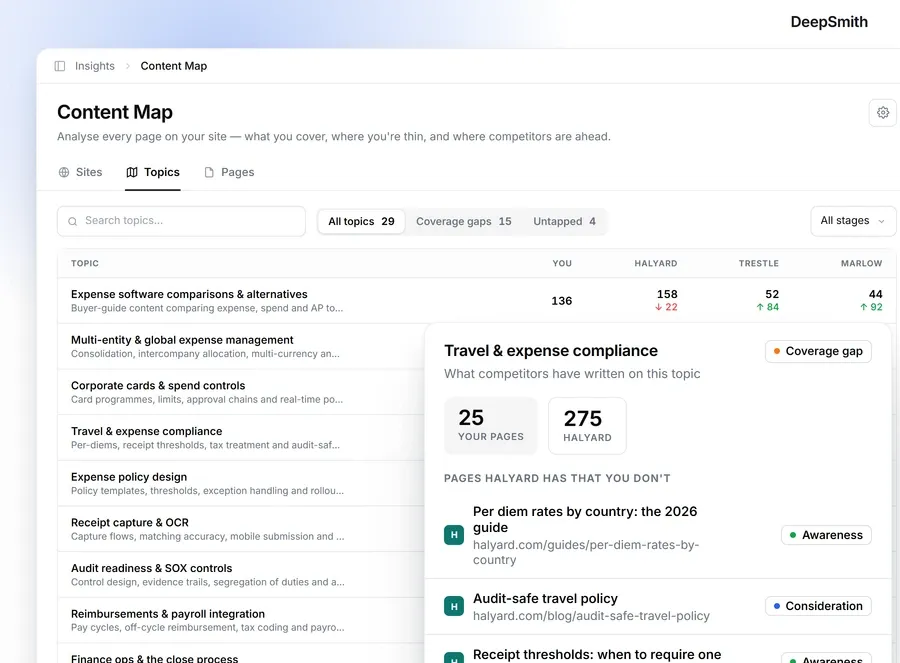
DeepSmith tracks how AI engines answer your prompts, then Opportunity Agents read that data and return content ideas, each one carrying the data point that justifies it. Content Map adds the other half, showing the topics where a competitor publishes and you do not. You give an idea a date, and Autowrite writes it on that date with no one in the app. The article follows the persona, voice, content type and link targets stored in Deep IQ, so it arrives publish-ready rather than as a draft to rescue. It lands in Produced Content, where you review it and publish to WordPress, Webflow, Strapi, Sanity or Contentful, or to your own webhooks.
Distribution comes with the article. Every finished piece arrives with social posts already written, and the Apps Library turns it into versions for LinkedIn, X, Medium, Substack, email, Reddit and more.

Plans run from Pro at $99 a month ($80 billed annually, 20 articles and 50 tracked prompts) to Scale at $399 ($299 annually, 90 articles and 200 prompts), with a 7-day free trial.
From gap to brief
Scrunch is stronger here. Content Gaps detect the missing content for a tracked prompt and produce the brief, and Signals say why a change matters, and both are on Core. Writesonic ranks its fixes by impact, confidence and effort, but only Enterprise gets the whole Action Center, and its record does not describe a standalone brief. For a team that wants a clean list of what to write, Scrunch is the easier read.
What DeepSmith does: Opportunity Agents return ideas with the evidence attached, such as the competitor page winning the citation and the gap on your own site. Content Map lists every topic where a competitor out-publishes you. Both feed the same planning queue, so an idea goes from evidence to a dated article without moving to another tool.
Writing the article
Writesonic wins this one. It writes the article on every plan, 15 a month on Starter, 25 on Basic and 50 on Growth, grounded in brand kits and uploaded product documents. Scrunch lists basic content generation on Core without describing it, so full articles are not something you can count on from it today. Writesonic's own claim of publish-ready output is the vendor's, and reviewers say generated text can need editing.
What DeepSmith does: the Writer researches each piece, links it to your own pages and to outside sources, adds a cover image and metadata, and grounds everything in Deep IQ, which holds your company, products, personas, voice and visual guidelines. With Autowrite the run starts itself on the planned date, so a month of ideas turns into a month of drafts without someone opening the app each time.
Publishing and repurposing
Writesonic is ahead of Scrunch again. It exports to several CMSs in one click and its Content Agent writes LinkedIn posts, emails and threads from a brief, though repurposing an existing article into channel formats is not described. Scrunch delivers optimized pages to AI agents at the edge, which is a different job from publishing a new article, and it lists no CMS connection or repurposing.
What DeepSmith does: Produced Content publishes straight to your CMS or webhook, and the social posts are already written when the article arrives. The Apps Library covers more than ten channels in each channel's own tone and length.
Pricing and article allowances
Writesonic prices written articles in self-serve tiers: Starter is $79 a month billed annually for 15 articles, 50 prompts and three engines, rising to $399 for 50 articles on Growth. Scrunch's Core plan is $250 a month with no article allowance listed, and no annual price is published.
What DeepSmith does: a published price with a fixed monthly article allowance, on a single self-serve plan that also tracks. Grow at $199 a month covers 40 articles and 100 prompts on two engines, and Scale at $399 covers 90 articles on three.
Which should you choose
- DeepSmith: teams that want to see where AI engines ignore them and have the missing articles written and published on a schedule, in their own voice, with distribution included.
- Scrunch: teams with writers already in place who need the gap list, the briefs and site-level work on how AI agents read their pages.
- Writesonic: teams that want tracking and an AI writer in one tool, will use the self-serve plans on three engines, and are comfortable editing what the writer produces.
Start a DeepSmith free trial and see a tracked gap turn into a scheduled article on your own data.