You opened ChatGPT, asked the question your best buyers ask, and someone else's name came back. That stings. If you are now hunting for Searchify alternatives, you are not behind. You are exactly where most marketing leads are right now.
Here is the good news. This category is young, the tools are real, and you can pick one this week.
The hard part is that these products look identical from the outside. Every homepage promises mentions, citations, and share of voice. What actually separates them is which AI engines they check, how many prompts you get, and whether anything happens after the dashboard tells you the bad news.
That last one matters more than people expect. A tracker shows you the gap. It does not close it.
This guide covers the eight best Searchify alternatives, ranked with DeepSmith first, and it tells you plainly where a competitor is the better call. Take it one section at a time.
How we picked these Searchify alternatives
Roundups are only useful when you can see the ruler. Here is the one we used to sort the alternatives to Searchify below.
Engine coverage. Which surfaces the tool actually checks: ChatGPT, Perplexity, Gemini, Google AI Overviews, Google AI Mode, and the rest. Coverage almost always changes by plan, so we looked at what each tier includes, not what the homepage markets.
Prompt depth. How many questions you can track, and how often they refresh. Fifteen prompts and 500 prompts are different products at different prices.
Attribution. Does the tool tell you which of your pages got cited, or only that your brand got named? Those are two very different jobs.
Competitive view. Share of voice, competitor leaderboards, and which rival pages are winning your prompts.
Pricing transparency. Published numbers beat a demo request. Credit models get a closer look, because credits make two tools hard to compare on price.
What happens next. Whether the product connects insight to ideas, articles, publishing, and distribution, or hands you a CSV and wishes you luck.
If you came here after checking Searchify pricing and wondering what else exists, these six filters are how to compare anything you shortlist, including tools not on this list. They also work as a scorecard when you line up searchify.ai competitors side by side in a spreadsheet.
The best Searchify alternatives at a glance
| Tool | Public entry price | Relevant AI coverage | Main strength | Main trade-off |
|---|---|---|---|---|
| DeepSmith | $99/mo Pro, $199 Grow, $399 Scale | ChatGPT on Pro, Perplexity on Grow, Gemini on Scale, ten engines on Enterprise | Visibility data wired straight into ideation, production, publishing, and repurposing | The full ten-engine set sits on Enterprise |
| LLMrefs | $79/mo, one plan | Eleven engines including ChatGPT, Gemini, Perplexity, Claude, Grok, Copilot | Broad monitoring and keyword discovery at a low published price | No documented article production or CMS workflow |
| AthenaHQ | Free Essential, $295/mo Starter | Five engines on Essential, ten on Starter | Optimization actions, source analysis, and enterprise governance | Credits and add-ons make cost comparison harder |
| Rankscale | From $20/mo, $99 Pro | 17+ engines | High-volume tracking, audits, dashboards, and API | Credit consumption, no documented production pipeline |
| Scrunch | $250/mo Core | Four engines on Core, nine on Enterprise | Prompt and citation monitoring with site diagnostics | Broad coverage and APIs are Enterprise features |
| Profound | $99/mo Starter billed yearly | ChatGPT on Starter, three on Growth, up to nine on Enterprise | Crawler analytics, shopping visibility, agency workspaces | Lower tiers cap engines, regions, and languages |
| OtterlyAI | $29/mo Lite | ChatGPT, AI Overviews, Perplexity, Copilot in the base bundle | Cheap daily tracking, alerts, and GEO audits | Gemini, AI Mode, and Claude are paid add-ons |
| Peec AI | $95/mo Starter | Six engines including ChatGPT, Gemini, AI Mode, AI Overviews | Focused visibility, position, and sentiment analytics | Public plan detail is incomplete |
1. DeepSmith
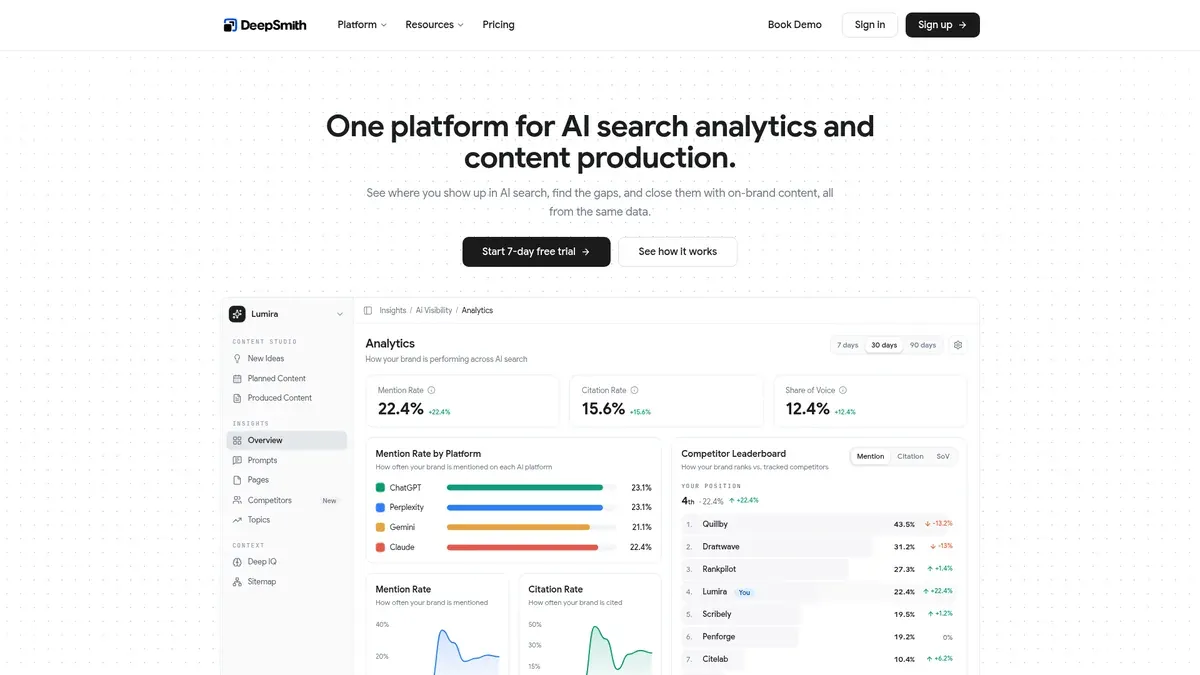
Best for: Marketing teams that need the measurement and the content that fixes it, from one platform and one set of brand context.
We are the publisher here, so read this entry with that in mind. The case still has to be made on facts, and here it is.
Most tools on this list stop at the dashboard. DeepSmith tracks how AI engines answer the questions your buyers ask, finds where you are invisible or losing, and then produces the on-brand content that closes those gaps. Same data, same workspace, one loop.
What you get on the measurement side. AI Visibility reports mention rate, citation rate, share of voice, and trend, broken out per platform, with a competitor leaderboard and the sources AI cites most. Prompts shows per-prompt mention and citation rates plus full answer history. Pages tells you which of your own URLs get cited, each page's share of your total citations, and the prompts driving them. Competitor Citations shows who is beating you, on which exact page, on which engine. Discover Prompts builds your starting prompt set from your product, persona, and buyer-stage context, so you are not staring at an empty tracking list on day one.

What you get on the content side. Content Map crawls your site and unlimited competitor sites and sorts every page onto one shared topic taxonomy with Awareness, Consideration, and Decision stages. That gives you coverage gaps, untapped topics, and per-topic depth as a measurement instead of a hunch. Sitemaps are rechecked every 24 hours, so new pages fold in on their own.
Opportunity Agents read that data and hand back ideas with the evidence attached. Win a tracked prompt you keep losing. Turn a mention into a citation. Take a competitor's citation. Close a funnel-stage gap against up to four rivals at once. Every idea carries the data point that justifies it, which is what lets you defend a backlog in a planning meeting instead of guessing.
Content Studio moves an idea through New Ideas, Planned Content, and Produced Content. The Writer turns one planned idea into a researched, brand-grounded article with keyword coverage, headings, schema, internal and external links, a cover image, and publish-ready metadata. Autowrite writes it on its scheduled date with nobody in the app. You publish straight to WordPress, Webflow, Strapi, Sanity, or Contentful, or to your own webhooks. Repurpose and the Apps Library turn the finished piece into LinkedIn, X, newsletter, Reddit, and more.

Deep IQ holds the layer that keeps all of it sounding like you: positioning, claims to make and avoid, products, personas, brand voice, visual guidelines, and reusable content types.
Pricing. Pro is $99 a month, Grow is $199, Scale is $399, with annual billing bringing those to $80, $160, and $299 a month. Pro includes 20 articles and 50 tracked prompts, Grow 40 and 100, Scale 90 and 200. Enterprise is custom. There is a 7-day free trial, no long-term contracts, and no cancellation fees.
Honest limitation. Engine coverage rises with the plan. Pro tracks ChatGPT, Grow adds Perplexity, Scale adds Gemini, and the full ten-engine set including Claude, Grok, Copilot, Meta AI, DeepSeek, and both Google AI surfaces is Enterprise. If your board wants all ten engines on a chart next quarter, that is an Enterprise conversation. If your buyers mostly live in ChatGPT and Perplexity, which is true for a lot of B2B teams, Grow covers you and the tiering never comes up. The tiers are published, which is more than several tools here can say.
2. LLMrefs
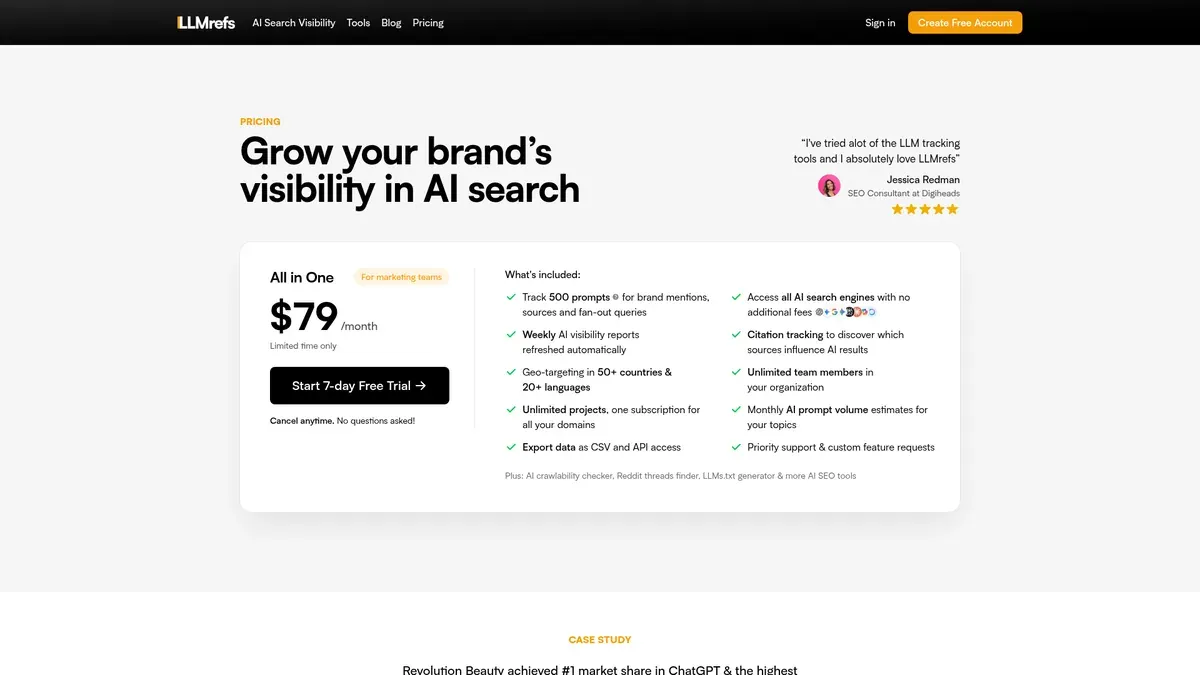
Best for: Teams that want wide monitoring and keyword-driven discovery at the lowest published price on this list.
LLMrefs runs one public plan at $79 a month. That gets you 500 tracked prompts for brand mentions, sources, and fan-out queries, unlimited team members, unlimited projects and domains, weekly visibility reports, and CSV plus API access. A seven-day free trial is included. Annual pricing is not publicly confirmed.
Key features. Coverage spans ChatGPT, ChatGPT Search, Google AI Overviews, Google AI Mode, Gemini, Perplexity, Claude, Grok, Copilot, Meta AI, and DeepSeek. You work from keyword lists, and the tool generates fan-out prompts from them, then reports brand rankings, position, share of voice, citations, and source URLs. Competitor rankings are weighted across every prompt for a keyword. It estimates monthly prompt volume, covers 50+ countries and 20+ languages, and throws in an AI crawlability checker, a Reddit thread finder, and an LLMs.txt generator.
That engine list at that price is genuinely strong, and if breadth is your first filter, LLMrefs deserves a trial.
Honest limitation. It is a monitoring and benchmarking layer. Public materials do not document evidence-backed idea generation, scheduled article writing, CMS publishing, or built-in distribution, so plan for a second tool or a manual process to act on what you find.
3. AthenaHQ

Best for: Organizations that need prescriptive optimization actions, source analysis, and enterprise governance and reporting.
Essential is free with $25 in credit and 300 credits, and it lists ChatGPT, Perplexity, Google AI Overviews, Gemini, and Copilot. Starter is $295 a month with $300 free credit and 3,600 credits, and it adds Google AI Mode, Claude, Grok, DeepSeek, and Meta AI for ten named engines. API access and extra credits are paid add-ons on Starter. Annual billing advertises 17% off without showing the annual dollar figure. Enterprise is custom.
Key features. Cross-platform monitoring, visibility and ROI reporting, competitive summaries, citation-source analysis, content gaps and templates, hallucination detection, on-page and off-page actions, and self-learning improvement. Enterprise adds claim review, discrepancy detection through the Athena Citation Engine, audit logs, multi-region and multilingual support, SAML/OIDC, personas, and a recommendation engine. Public integrations include GA4, Google Search Console, Shopify, and Webflow, which is a real advantage if you want visibility sitting next to traffic and conversions.
One note on reading their site: the homepage markets 11+ LLMs, while the Starter table names ten. Compare the plan table, not the banner.
Honest limitation. The credit model plus paid add-ons makes true monthly cost harder to predict than a flat plan. The public material leans on optimization actions and enterprise controls rather than a hands-off calendar, article pipeline, and multi-CMS publishing.
4. Rankscale
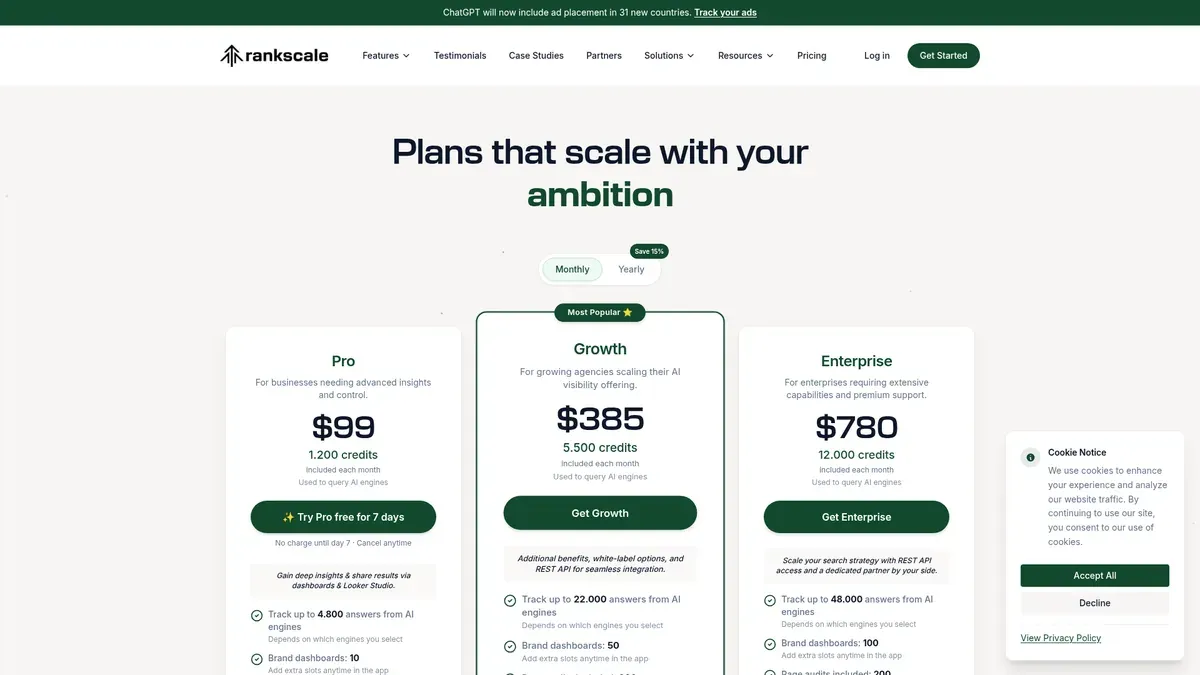
Best for: Teams and agencies that need volume: lots of prompts, lots of dashboards, audits, API access, and detailed regional reporting.
Essentials starts from $20 a month. Pro is $99 with 1,200 credits, up to 4,800 AI-engine answers, 10 brand dashboards, 50 page audits a month, unlimited search terms, and a seven-day trial. Growth is $385 with 5,500 credits, up to 22,000 answers, 50 dashboards, 200 audits, white label, and REST API. Enterprise is $780 with 12,000 credits, up to 48,000 answers, 100 dashboards, and a dedicated partner. Annual billing advertises 15% off, though annual prices are not published.
Key features. Rankscale lists 17+ engines, including ChatGPT, Perplexity, Claude, Gemini, both Google AI surfaces, Copilot, DeepSeek, Grok, and Mistral. You get brand and product tracking, ad tracking, visibility dashboards, rank and competitor tracking, citation and sentiment analysis, page audits, prompt research, GEO insights, CSV and Google Sheets export, Looker Studio, custom dashboards, and share links. Queries burn fractions of a credit, roughly 0.25 per engine per prompt, credits roll over, and top-ups exist.
For an agency reporting to ten clients, that dashboard count and white label option are the whole pitch.
Honest limitation. Credits make like-for-like pricing dependent on how many engines and prompts you run, so model your real volume before you buy. Public material does not establish a built-in production pipeline.
5. Scrunch
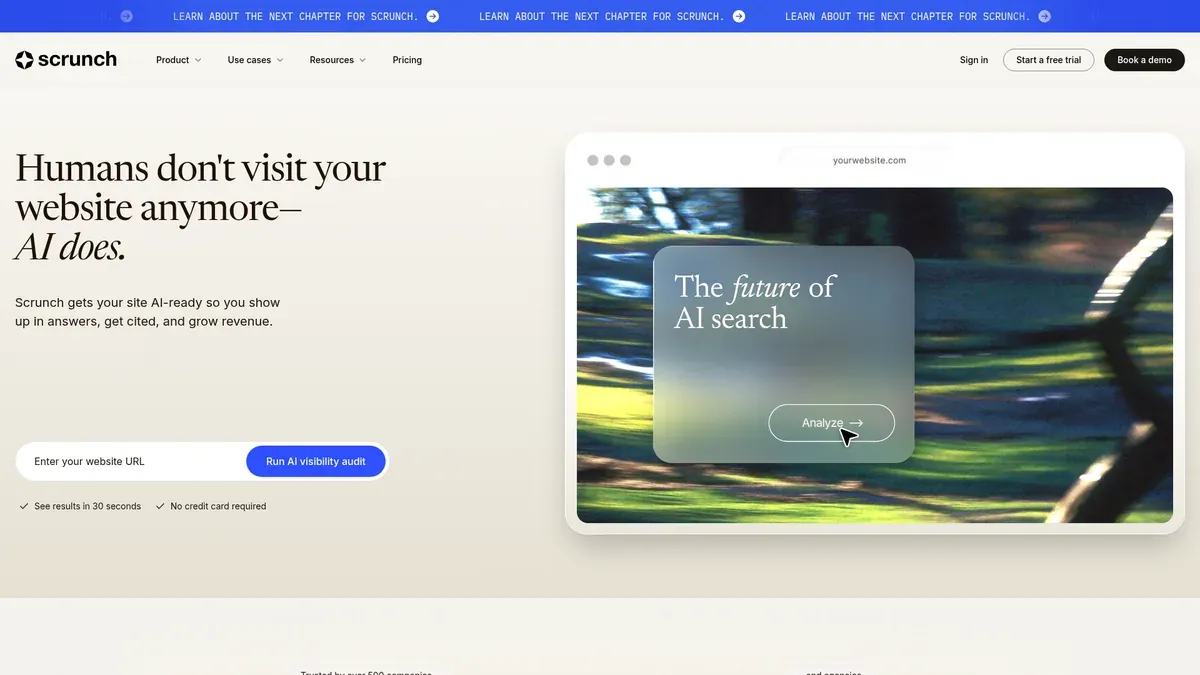
Best for: Enterprise marketing, SEO, and product teams that want monitoring plus site diagnostics, observability, and custom APIs.
Core is $250 a month with 125 unique prompts, one brand workspace, five user licenses, five site audits a month, and coverage of ChatGPT, Perplexity, Google AI Overviews, and Copilot. Enterprise is custom, lists nine models, and unlocks query API, Looker, MCP, CLI, advanced API, complete site audits, executive and board reporting, SSO through SAML, OIDC, or Google, observability, and multi-domain bot tracking.
Key features. Prompt result, citation, and brand performance monitoring, with Signals for trends and estimated prompt volume. The product markets hidden topics and opportunities, keyword volume estimation, Site Diagnostics recommendations, AI-optimized content delivery, and multi-model orchestration. SOC 2 Type II, RBAC, and SAML/OAuth are publicly stated, which matters when procurement gets involved.
One thing to read carefully: Scrunch publishes company-scale figures like 6 million citations and 1.5 million prompts weekly. That describes their platform's activity, not your quota or your result.
Honest limitation. Core leaves out Gemini, AI Mode, and the wider Enterprise model set, along with the advanced APIs. If you need those, you are budgeting for Enterprise. A full editorial calendar and CMS publishing workflow is not documented.
6. Profound
Best for: Enterprise brands, agencies, and PR teams that need crawler analytics, shopping visibility, and multiple client workspaces.
Starter is $99 a month billed yearly with 50 prompts, ChatGPT only, 100 agent credits, 1,500 responses a month, one language and region, one seat, and no export or API. Growth is $399 billed yearly with 100 prompts, three answer engines, 400 agent credits, 9,000 responses, three seats, and CSV/JSON export but no API. Enterprise is custom with up to nine answer engines, multiple companies and projects, API, SSO/SAML, SOC 2, and ChatGPT Shopping. Both paid tiers advertise two months free on annual billing. Agency pricing is not published.
Key features. Prompt Volumes, Answer Engine Insights, Agent Analytics, Shopping, Agents, and Aim. Agent Analytics is the standout: it examines crawler access, bot frequency, which pages get referenced, and human traffic arriving from AI. If you want to know whether the bots can even read your site, that view is hard to get elsewhere. Shopping tracks product placement, retailers, reviews, and ChatGPT Shopping keywords, which makes Profound a natural fit for ecommerce.
Honest limitation. Starter and Growth restrict engines and lock you to one language and region, so the crawler and shopping strengths that make Profound interesting mostly live above those tiers. Scheduled article production and multi-channel repurposing are not part of the public offering.
7. OtterlyAI

Best for: Small teams that want daily prompt tracking, alerts, and GEO audits for the price of a couple of lunches.
Lite is $29 a month, or $25 on annual, with 15 prompts, one workspace, unlimited members, daily tracking, and 1,000 GEO audits a month. Standard is $189, or $160 annual, with 100 prompts, unlimited workspaces, 5,000 audits, a Looker Studio connector, and 2,000 API requests. Premium is $489, or $422 annual, with 400 prompts, 10,000 audits, and 5,000 API requests. Base engine coverage is ChatGPT, Google AI Overviews, Perplexity, and Copilot.
Key features. Mentions, citations, sources, competitors, brand coverage, and share of voice, plus platform trends, competitive reports, alerts, prompt research, GEO recommendations, audits, prediction, content briefs, and a public API for brand reports, prompts, citations, and workspaces. For a founder who wants a number on a screen by Friday, $29 is a very low bar to clear.
Honest limitation. Gemini and Google AI Mode are add-ons, and so is Claude. The published add-on schedule runs AI Mode and Gemini at $59 a month on Standard and $149 on Premium, and Claude at $109 on Standard and $439 on Premium. Extra prompts run $99 per 100 on Standard and Premium, and Standard caps at 300 extra prompts before you have to move up. Price the add-ons before you treat Lite as equivalent coverage.
8. Peec AI

Best for: Buyers who want clean visibility, position, and sentiment analytics across the main conversational and Google AI surfaces.
Starter is $95 a month with 50 prompts and one project. Pro is $245. Advanced is $495 with 350 prompts and five projects. Enterprise is custom. The pricing page indicates three countries per project.
Key features. Peec measures visibility, position, and sentiment, benchmarks competitors, and helps you optimize your AI-search presence. The publicly identified engine set is ChatGPT, Google AI Mode, Google AI Overviews, Microsoft Copilot, Perplexity, and Gemini. That is a tidy list covering the surfaces most B2B buyers actually use, without the noise of engines nobody on your team has opened.
Honest limitation. Public plan detail is thin. Pro's prompt allocation is not clearly published, and annual terms, user limits, trial terms, support, and API availability are not confirmed. Looker, API, and MCP appear as headings on the pricing page without a clear mapping to tiers. Verify all of it in writing before you compare Peec on total cost.
How to choose your Searchify alternative
Take a breath. You do not need to trial all eight. Answer one question first: do you already have a way to produce content, or is that the actual bottleneck? That single answer splits the searchify.ai competitors above into two very different shortlists.
If your team can write but cannot see, you need a tracker. Pick on engine coverage and prompt volume. LLMrefs at $79 with eleven engines is the value play. Rankscale is the volume play. OtterlyAI at $29 is the smallest first step, and there is nothing wrong with starting small.
If procurement and governance drive the decision, look at AthenaHQ, Scrunch, and Profound. Audit logs, SSO, SOC 2, board reporting, and multi-region support live at their enterprise tiers, and those tiers exist because large companies genuinely need them.
If you run an agency, Rankscale's dashboard counts and white label, or Profound's client workspaces, will fit better than a single-brand plan.
If you sell products online, Profound's ChatGPT Shopping tracking is the differentiated feature in this set.
If you need focused reporting and nothing else, Peec AI is clean and readable, as long as you confirm the plan details.
If the gap between knowing and fixing is the real problem, that is where DeepSmith sits. You will see the prompt you are losing, get an idea with the evidence attached, and have the article written, linked, and published without leaving the platform.
One more piece of advice, whichever of the best Searchify alternatives you pick. Compare definitions, not just headline scores. A mention means AI named you. A citation means AI linked your page as a source. Share of voice compares you to rivals. Two tools can report wildly different numbers because they run different prompt sets on different schedules across different engines. Ask each vendor exactly what they measure and how often before you trust a chart.
Start with one prompt you keep losing
You do not need a six-month plan. You need one prompt, one gap, and one page.
Pick the question your best buyer asks an AI engine. Check who gets named. If it is not you, that is your first piece of work, and now you know which tool can help you do it.
Start a 7-day DeepSmith free trial and see real data and real drafts before you pay. No long-term contract, no cancellation fee.