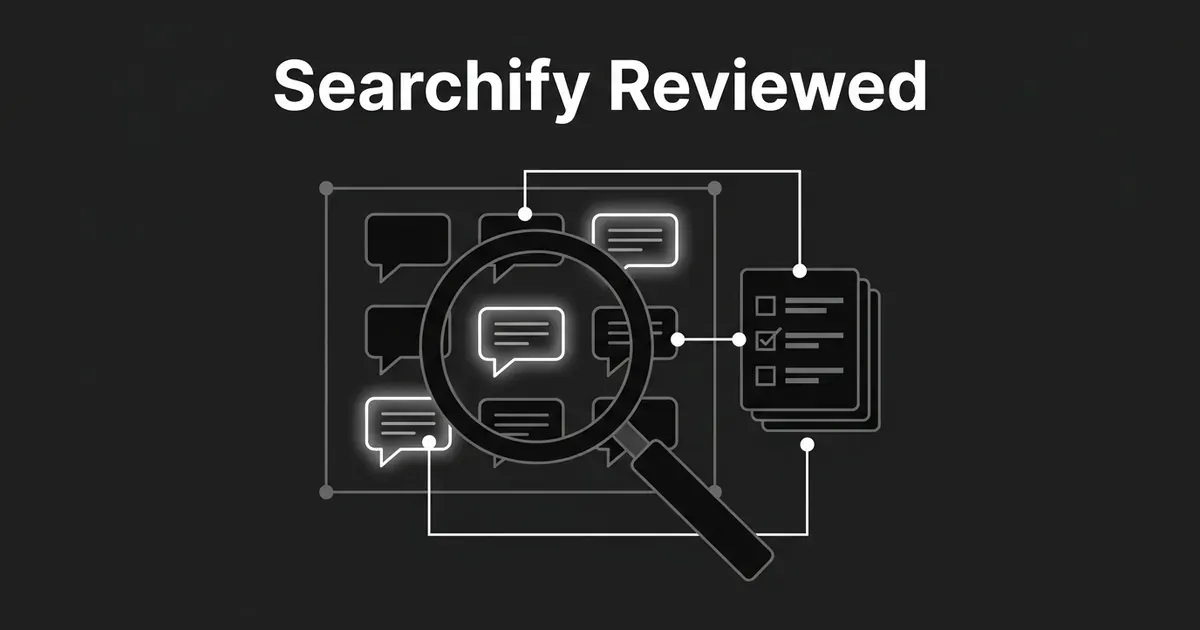
This Searchify review looks at what the Searchify AI-search visibility platform actually does for small and medium-sized businesses. It watches how ChatGPT, Google AI Overview, and a handful of other AI engines describe your brand, compares that against competitors, and turns the findings into a list of things to fix. The part that sets it apart from a plain monitoring dashboard is the Action Center, which converts visibility data into prioritized tasks, and an optional managed service that will do some of that work for you.
Searchify is worth a look if you are an SMB or small agency that has no AI-search tracking today and wants both the data and a nudge on what to do with it. It is a harder sell if your budget is thin, if you need broad engine coverage on the cheapest plan, or if you are really shopping for a self-serve content-production system rather than a visibility tool, which is where something like DeepSmith covers both the tracking and the content. This review judges it on five things: how much of AI search it actually covers, how useful its recommendations are, how far the monitoring scales, how much execution help you get, and how clear the pricing is.
What Searchify Does
Searchify tracks brand presence across AI search engines and reports back on how those engines represent and recommend your business. The company was built for smaller businesses that want the kind of AI-search visibility work that used to require a bigger marketing budget. It is based in San Francisco, founded by Noah Moscovici, and operated under the legal name Bot Test Inc.
Getting started is low friction. You submit your website and get a free AI Visibility One-Pager, no credit card required, and Searchify says it can put that report together in minutes. That is a free diagnostic, not a confirmed trial period, since the public pages do not say how long you get before it asks for payment or what happens to the report after that.
Once you are in, the core loop is monitoring, comparing, and acting. Searchify's AI Search Score and competitor visibility tracking sit on the homepage as the headline features, and the pricing page is where the real detail lives.

Engine Coverage and Question Monitoring
Anyone weighing Searchify AI engine visibility against a cheaper option should start here, since the pricing page is the clearest source on which AI engines each plan actually tracks, and it matters more than the broader homepage language about covering all major AI platforms. Starter tracks ChatGPT and Google AI Overview only. Basic steps up to five: ChatGPT, Google AI Overview, Perplexity, Claude, and Gemini. Pro tracks the same five engines as Basic, so the jump from Basic to Pro buys you scale, not new engines.
Monitoring capacity is measured in questions, meaning the buyer prompts and conversational queries Searchify checks on your behalf. Starter covers up to 30 questions, Basic goes to 100, and Pro goes up to 1,000. The product also talks about simulating realistic conversations that match your ideal customer profile, which is a reasonable way to test how your brand shows up in the kinds of questions a real buyer would ask rather than plain keywords. What is not spelled out anywhere in the public materials is whether that question count resets monthly or accumulates, how many answer variations get pulled per question, or how far back the historical data goes.
If your brand only cares about ChatGPT and Google AI Overview, Starter is enough engine coverage. If you need Perplexity, Claude, or Gemini in the mix, you are on Basic or Pro either way, since neither adds engines the other lacks.
Competitor Tracking and Citations
Competitor comparison is one of the more concrete parts of the product. Starter allows up to four competitors, Basic goes to ten, and Pro is unlimited. That scaling makes sense for an agency running visibility work across a roster of accounts on Pro, and it is one of the few places Searchify draws a firm, checkable line between plans.
Every plan, including Starter, includes citation and referral tracking. That is a meaningful inclusion because it means the product is not just counting how often your brand gets mentioned, it is also trying to show where those mentions turn into a citation or a referral. The public pricing page does not explain the exact difference between a citation and a referral in its own counting, or which attribution window it uses, so treat the terminology as directional rather than a fixed, audited metric. The product materials also describe a Citations Analysis report and talk about finding authoritative third-party sites that AI models trust, which points toward a source-and-outreach workflow rather than a pure dashboard.
The Action Center
The Action Center is the feature that separates Searchify from a plain visibility tracker, and it is worth spending the most time on because it is the reason a marketing lead with no AI-search process yet would consider this product over a cheaper monitoring tool. Instead of leaving you with a stack of scores and letting you figure out what to do, Searchify automatically turns the monitoring data into a prioritized list of specific tasks.
The public examples of what shows up in that task list include fixing technical issues like schema-markup errors or slow page speed, flagging content gaps where a competitor gets cited for a question your brand does not answer at all, pointing to authoritative third-party sites worth pursuing for mentions, surfacing blog-post opportunities tied to trending topics, and calling out sites AI systems lean on for recommendations where your brand is simply absent.
That is a genuinely useful shape for a team that already knows competitors are winning in AI answers but has not built a process to respond to it. The caveat is that Searchify shows you examples of these recommendations rather than a full explanation of how it scores or prioritizes them, so you cannot fully audit the logic before you commit, and the public materials do not describe task ownership or completion tracking once a recommendation lands in your queue.
Recommendation frequency also scales by plan: biweekly on Starter, weekly on Basic, and daily on Pro. The homepage lists a fuller menu of report types, including a Language Report, Sentiment Report, Funnel Analytics, and a Landscape Report, but those examples describe the kinds of reports Searchify wants you to expect rather than a guarantee that every type ships on every plan.
Managed Service and Content Production
Each plan can add a Fully Managed Service for an extra monthly fee. According to the product materials, that service can cover implementing the technical fixes the platform finds, creating and publishing content, and running outreach aimed at earning mentions and citations from sites AI engines already trust. That optional layer is what pushes Searchify past a dashboard-only product into something closer to a part-time agency, if you choose to pay for it.
What is not published is any service-level detail: turnaround times, how many pieces of content or how many outreach efforts are included, which channels it publishes to, or how many strategy hours you get. Treat the managed service as an optional execution add-on you would need to scope directly with Searchify, not as an unlimited replacement for an in-house or agency team.
This also answers a question a lot of content-minded readers will have going in: does Searchify write and publish content on its own, self-serve, the way a production platform does? Based on the public materials, no. Content creation and publication are described only as part of the paid managed service. There is no documented self-serve content studio, automated article generation, internal-linking system, or CMS publishing integration inside the core product. If content production is your actual problem and visibility tracking is secondary, that is worth clocking before you evaluate the rest of the plans.
Pricing
Searchify pricing runs three self-serve monthly plans, each with an optional managed-service add-on priced separately.

| Plan | Monthly price | Managed service add-on | Engines | Questions | Competitors | Recommendations |
|---|---|---|---|---|---|---|
| Starter | $149/mo | +$200/mo | ChatGPT, Google AI Overview | Up to 30 | Up to 4 | Biweekly |
| Basic | $399/mo | +$400/mo | ChatGPT, Google AI Overview, Perplexity, Claude, Gemini | Up to 100 | Up to 10 | Weekly |
| Pro | $999/mo | +$800/mo | Same 5 as Basic | Up to 1,000 | Unlimited | Daily |
Add the managed service and the combined monthly cost runs to $349 on Starter, $799 on Basic, and $1,799 on Pro. Those totals are simple addition; Searchify does not display them as a bundled line item on its own pricing page.
Yearly billing is advertised as saving up to 20 percent, but the exact annual prices are not shown in the public pricing details, so budget planning has to wait for a quote rather than a published number. That gap matters more here than it would on a cheaper product, since the difference between guessing at 20 percent and confirming the real annual rate on a $999 monthly plan is not small change.
Looked at plainly, Starter is the least expensive way into two-engine monitoring, but 30 questions will feel tight fast for a brand with more than one product line or buyer segment. Basic, marked as the most popular tier, is the meaningful jump in engine coverage and adds a dedicated account manager, though $399 a month is still a real commitment for a small team. Pro buys scale and speed, not new engines, and is positioned for agencies running visibility work across several client accounts at once.
Where It Falls Short
No product is complete, and a few gaps here are worth naming plainly rather than glossing over.
The self-serve price range, $149 to $999 a month before any managed-service add-on, is a real budget line for a small business, and the entry tier's 30-question, two-engine ceiling limits how much you can actually learn before upgrading. Basic and Pro track the same five engines, so the extra $600 a month buying Pro over Basic is paying for scale and speed, not broader coverage.
The public materials do not document an API, CSV export, BI connector, CMS integration, Slack integration, or webhook, which matters if your team wants to pull this data into an existing reporting stack rather than living inside Searchify's own dashboard. Independent proof is also thin: G2 shows a single review, a 5.0 rating from a verified user at a mid-market software company, and G2 itself notes there are not yet enough reviews to offer real buying insight. Searchify's case-studies page currently shows placeholders marked as coming soon rather than completed customer stories, so there is no public before-and-after data to check the marketing claims against yet.
Finally, the Action Center's scoring and prioritization logic is not explained beyond a handful of examples, so you are trusting the recommendations somewhat blind until you have used the product long enough to judge them yourself.
Privacy and Commercial Terms
Searchify's privacy policy, dated August 16, 2025, says it may process personal information to run and improve the service, communicate with users, prevent fraud, protect security, meet legal obligations, and support internal research. It also discloses that user inputs, outputs, and personal information may be shared with third-party AI service providers to power the product, which is worth flagging to anyone planning to feed customer or proprietary data into it. The policy commits to reasonable security measures without guaranteeing that any transmission or storage is fully secure, and it says data is kept only as long as needed for its stated purposes before deletion or anonymization, subject to legal exceptions.
On the commercial side, the service is hosted in the United States, subscriptions renew automatically unless canceled, cancellation takes effect at the end of the current paid term, prices are subject to change, and billing runs in U.S. dollars with sales tax where applicable. Refund terms are not stated in the material reviewed. None of this is unusual for a SaaS subscription, but a regulated or security-conscious buyer should confirm current data-processing and security details directly before committing to a larger plan.
Who Should Use It
Searchify fits an SMB marketing team that has no AI-search visibility process today and wants a straightforward way in, particularly one that mainly cares about ChatGPT and Google AI Overview at the Starter level. It also fits a team that wants competitor and citation tracking tied to a concrete task list rather than a scores-only dashboard, a multilingual business curious how it shows up across more than 30 supported languages, and an agency that needs the larger question and competitor ceilings on Pro across several accounts.
It is a weaker fit for a very small business that cannot justify at least $149 a month for monitoring alone, a team that needs hundreds of questions but only has budget for Starter or Basic, or a company that requires a documented API, data export, or CMS integration as a baseline requirement. It also is not the right tool for a content team specifically shopping for a self-serve AI writing and publishing platform, since content work here lives inside the paid managed service rather than the core product. A procurement team that needs a deep bench of independent reviews, public case studies, or a detailed security package before signing should plan on asking Searchify directly, since that evidence is not public yet.
Alternatives to Consider
-
DeepSmith. DeepSmith tracks the same AI-search visibility data Searchify does, mention rate, citation rate, share of voice, sentiment, and which competitor pages win your prompts, and then produces the publish-ready articles that close the gaps it finds, inside the same platform rather than through a separate managed-service fee. Its Content Map turns your site and your competitors' sites into one topic map so coverage gaps and untapped topics are measured instead of guessed, and Opportunity Agents attach the data point that justifies each idea. Plans run $99, $199, and $399 a month with engine coverage rising by tier, all ten engines on Enterprise, and a 7-day free trial.

-
Otterly.AI. Otterly publishes a $29 a month entry tier with 15 tracked prompts, which makes it the cheaper way in for a small business that cannot justify Searchify's $149 floor, though its listed extra engines are paid add-ons on every self-serve plan.
-
Peec AI. Peec is a focused daily visibility tracker with published pricing from $95 a month and unlimited users on its brand plans, a fit for a small team that wants a clean read on AI answers and is content to do the content work itself.
-
Profound. Profound targets enterprise and well-funded growth teams that need audit-grade data across many engines, so it is the option to look at if Searchify's depth is the constraint and budget is not.
Is Searchify Worth It?
Searchify is worth it if your actual problem is "we do not know how we show up in AI answers, who is beating us, or what to do about it," and you can afford the entry price point or are ready to add the managed service for hands-on help. The combination of monitoring, competitor comparison, citation tracking, and an action list gives it a coherent case for an SMB or small agency that wants both the data and a next step, not just the data.
It is harder to justify if your real need is content production rather than measurement, if you need wide engine coverage and a high question volume on a cheaper plan, or if data portability and integrations are a procurement requirement rather than a nice-to-have. Before you commit, use the free One-Pager as your first look, then get specific written answers on engine coverage, how question counts reset, historical data retention, integrations, exactly what the managed service delivers, real annual pricing, and cancellation terms. Based on what is public today, Searchify looks like a reasonable investment for the right SMB or agency, but it is not yet a proven one: the independent evidence is thin and a fair number of operational details are still undocumented.
The specific gap this review keeps landing on is the one between the task list and the work: Searchify will tell you a competitor is cited for a question you do not answer, but the article that answers it either comes from your team or from the managed service at $200 to $800 a month on top of the plan. DeepSmith is the alternative on that axis. It tracks the same visibility data, mention rate, citation rate, share of voice, sentiment, and the competitor pages winning your prompts, then produces the publish-ready article against each gap from your stored brand context, with research, internal and external links, a cover image, and metadata already done, and publishes it straight to WordPress, Webflow, Strapi, Sanity, or Contentful. That is measurement and production on one bill rather than a dashboard plus a retainer.
Ready to see where your own brand shows up in AI answers and put the content behind fixing the gaps? Start a free trial and find out in minutes.