You typed your own category into ChatGPT last week. A competitor came back. You did not.
That stings. It also means your buyers are seeing the same thing.
Here's the good news: this is a fixable problem, and you're earlier than you think. B2B buying moved into AI assistants fast, but almost nobody has this figured out yet. The window is open.
This guide ranks the best AI visibility tools for B2B companies, the platforms that show you which prompts your buyers ask, whether AI names you, and whether it links to you. We'll be honest about where each one fits, including where a competitor beats us.
Take a breath. Let's find the one that matches your situation.
Why B2B AI search visibility is different
Your buyers aren't asking AI what shoes to buy. They're asking which vendor handles SOC 2, which platform integrates with their CRM, and who the top three options are in your category.
Those are considered, high-stakes questions. They come from a buying committee, not one person, and they stretch across a long evaluation cycle.
Three things make B2B AI search visibility its own problem.
The shortlist got shorter. Forrester's 2026 research found the average B2B software shortlist has shrunk from about three vendors to roughly two and a half. AI does the first cut now. If you're not in the answer, you're not in the room.
Most buyers now start here. The large majority of B2B buyers use a generative AI tool somewhere in their purchase, and roughly half say they now open a chatbot before Google. Vendor research is the exact moment AI gets asked.
About half of B2B tech brands earn zero AI citations. Not low ones. Zero. That's the gap, and it's also the opportunity.
The category has three names floating around: AEO (Answer Engine Optimization), GEO (Generative Engine Optimization), and LLMO. Don't get stuck on vocabulary. The job is the same. Measure whether AI mentions and cites your brand, then fix what it says.
That's also what makes AI visibility tracking B2B teams need different from consumer brand monitoring. You're watching a shortlist form, not counting mentions.
How we picked these tools
Every tool below clears three bars.
- Multi-engine coverage. It tracks more than one assistant. Single-engine checkers and social-listening suites are out.
- B2B-appropriate. It's built for brand and buyer-research prompt tracking, not retail shopping visibility.
- Live in 2026, with real pricing. Public pricing or credible third-party pricing, plus a current product page.
Ranking weighs four things: engine coverage that matches where B2B buyers actually research, per-prompt mention and citation reporting, page-level attribution so you know why you're winning or losing, and whether the tool helps you act on what it finds.
That last one carries real weight, and it's why our order looks different from a pure analytics roundup. Tracking tells you where you're invisible. It doesn't make you visible. Fair warning: DeepSmith is our product, and it's first. Read the analysis and judge for yourself.
The 10 best AI visibility tools for B2B at a glance
| # | Tool | Entry price (monthly) | Engines tracked | Best for |
|---|---|---|---|---|
| 1 | DeepSmith | $99 (Pro) | All 10 on Enterprise (ChatGPT, Perplexity, Gemini, Claude, AI Overviews, AI Mode, Grok, Meta AI, Copilot, DeepSeek); Pro tracks ChatGPT | B2B teams who want tracking plus publish-ready content in one platform |
| 2 | Profound | $99 (Starter) | ChatGPT, Perplexity, Google AI Overviews; Growth adds Gemini, Claude, Copilot, Meta, Grok | Analytics-led teams wanting the deepest measurement data |
| 3 | XFunnel | Free audit, Enterprise custom | ChatGPT, Gemini, Claude, Perplexity, AI Overviews, AI Mode, Copilot, Grok | Strategy-led teams wanting experiments layered on tracking |
| 4 | Otterly.AI | $29 (Lite) | ChatGPT, AI Overviews, Perplexity, Copilot; add-ons for Claude, Gemini, AI Mode, Grok | Solo marketers and budget-conscious teams |
| 5 | Peec AI | From about €89 (Starter) | ChatGPT, Perplexity, Gemini, AI Mode/Overviews, Copilot | European teams and project-led agencies |
| 6 | Semrush AI Visibility Toolkit | $99 add-on | ChatGPT, AI Overviews, Gemini, Perplexity | Existing Semrush subscribers |
| 7 | Conductor Intelligence | Custom | ChatGPT plus enterprise surfaces | Global enterprises unifying AEO, SEO, and analytics |
| 8 | Ahrefs Brand Radar | $199/engine, $699 all six | AI Overviews, AI Mode, ChatGPT, Perplexity, Gemini, Copilot | Existing Ahrefs users wanting the largest prompt dataset |
| 9 | Scrunch AI | $250 (Core) | ChatGPT, Gemini, Perplexity, AI Mode, AI Overviews, Meta AI, Claude | Brands focused on AI agent and crawler traffic |
| 10 | Writesonic | From $245 | ChatGPT, Perplexity, Gemini, Claude, AI Overviews | Teams already using Writesonic for content |
1. DeepSmith

Best for: B2B teams who need to measure AI visibility and then actually close the gaps, without adding a second tool and a third handoff.
Most tools on this list stop at the dashboard. You learn you're missing from eleven buyer prompts, then you're back where you started, briefing a writer. Your gap usually isn't only visibility, it's capacity. Seeing eleven gaps you can't fill is stress, not a solution.
DeepSmith is an AI search analytics and content production platform in one, so the prompts you're losing feed straight into the thing that writes the articles to win them.
The AEO module tracks mention rate, citation rate, share of voice, and visibility trend, with per-prompt history and a competitor leaderboard. The Pages view shows which of your URLs AI actually cites. Discover Prompts builds your starter prompt set from your product, persona, and buyer-stage context, so you're not staring at a blank prompt list on day one.

Then the loop closes. Content Studio takes a missed prompt to a finished, brand-grounded article, and Autowrite runs it on a schedule. Deep IQ stores your positioning, personas, brand voice, and claim boundaries, so every draft sounds like you.

Key features:
- Mention rate, citation rate, share of voice, sentiment, and visibility trend across ten engines by tier: ChatGPT, Perplexity, Gemini, Claude, Google AI Overviews, Google AI Mode, Grok, Meta AI, Microsoft Copilot, and DeepSeek
- Per-prompt tracking with full answer history, plus Discover Prompts for a starter set
- Page-level citation attribution and competitor citation tracking
- Publish-ready article production, with Autowrite scheduling and direct publishing to WordPress, Webflow, Strapi, Sanity, Contentful, or webhooks
- Apps Library for LinkedIn, X, newsletter, Reddit, Substack, and more
- Multi-workspace for agencies and multi-brand teams
Pricing: Pro $99/mo (20 articles, 50 prompts, ChatGPT). Grow $199/mo (40 articles, 100 prompts, adds Perplexity). Scale $399/mo (90 articles, 200 prompts, adds Gemini). Enterprise custom, all ten engines. Annual billing drops these to $80, $160, and $299. There's a 7-day free trial and no long-term contracts.
Honest limitation: Engine coverage scales with price. All ten engines are there, but the full set sits on Enterprise: Pro tracks ChatGPT, Grow adds Perplexity, Scale adds Gemini. Here's the honest counterweight, though. Most B2B buyer research today runs through ChatGPT and Perplexity, the two engines Grow covers at $199, so the tier ladder matters less than it looks for where your buyers actually ask. If you want four engines at $29 without an Enterprise conversation, Otterly will fit you better. Article output is also capped by tier, so heavy publishers need Scale or above.
2. Profound
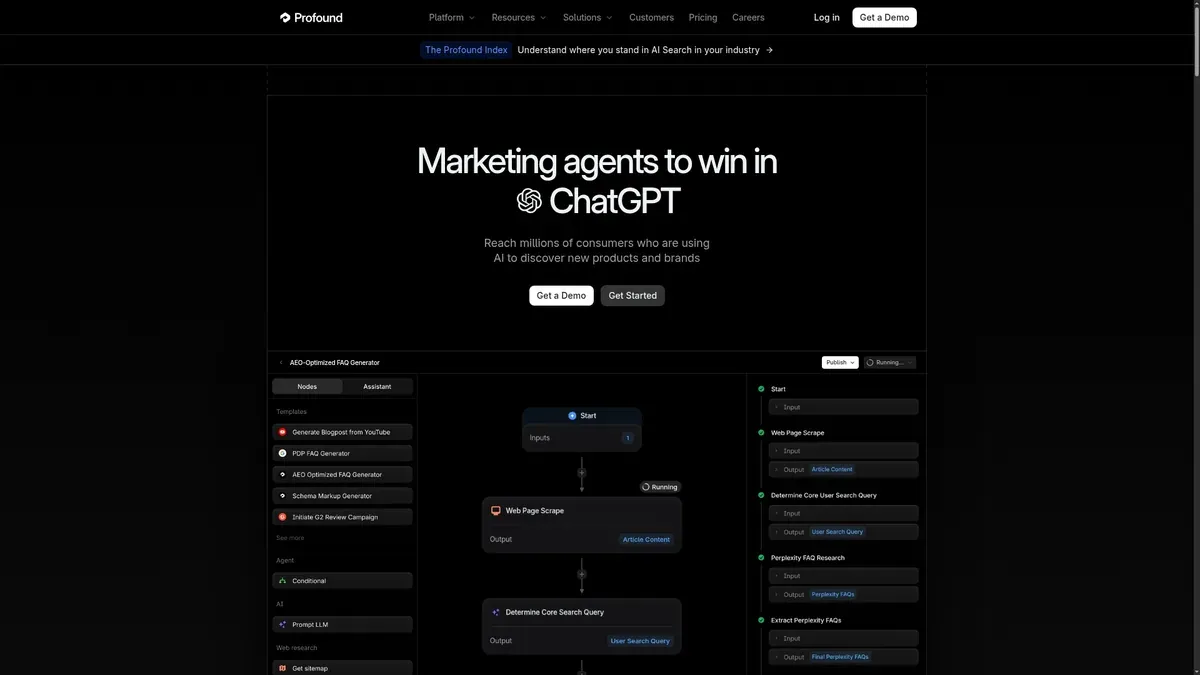
Best for: Analytics-led enterprise teams who want the deepest measurement data across a broad engine set, and have budget to match.
Profound is the measurement specialist on this list. Answer Engine Insights covers visibility scoring, share of voice, and sentiment. Prompt Volumes forecasts demand for prompts buyers will ask, which is genuinely useful for planning.
Agent Analytics tracks AI bots crawling your site, and FactCheck surfaces inaccurate claims AI makes about your brand. That second one matters more than teams expect. AI gets facts wrong about vendors constantly.
Key features:
- Visibility scoring, share of voice, and sentiment analysis
- Prompt Volumes for search demand forecasting
- Agent Analytics for AI bot and crawler activity
- FactCheck for AI misinformation about your brand
- Daily crawl cadence and per-prompt competitor tracking
- Integrations with WordPress, Slack, Google Analytics, Cloudflare, and Vercel
Pricing: Starter $99/mo annual (ChatGPT only, 50 prompts, 1 user). Growth $399/mo annual (3 engines, 100 prompts). Enterprise custom, up to 10 engines with SSO and SOC 2.
Honest limitation: The jump from Starter to Growth is steep, and most teams land at $399. Content features exist as Agents, but production isn't the center of the product. You'll likely pair Profound with a separate writing workflow, which means the handoff problem stays yours.
3. XFunnel

Best for: Strategy-led teams who want a partner running experiments, not just a dashboard to check.
XFunnel does something most trackers don't. Its AI Query Simulation models the queries people ask across nine data sources and maps them to buyer journey stages. For B2B, that mapping is the interesting part, since a category prompt and a comparison prompt need completely different content.
Strategic Experiments go past measurement into testing changes. The customer list skews large: Wix, Monday.com, HubSpot, LastPass, and Deel.
Key features:
- AI Query Simulation across nine data sources, mapped to buyer stages
- Competitive intelligence on mentions, rankings, and sentiment
- Strategic Experiments that test visibility changes
- AI Content Wizard for recommendations and rewrites
- Enterprise tier tracks roughly ten engines
Pricing: Free Starter gives you a one-time AI search analysis, not a subscription. Enterprise is custom.
Honest limitation: There's no transparent self-serve pricing beyond that free audit, so you're entering a sales cycle to find out what it costs. The experiments framing also implies a longer engagement rhythm. If you want a weekly report you check on your own, this isn't it.
4. Otterly.AI

Best for: Solo marketers and small teams who need a real baseline without a $200 monthly commitment.
At $29/month, Otterly is the easiest yes on this list. You get 15 prompts across four engines with daily tracking and unlimited team members. For a lot of teams, that's genuinely enough to answer the question keeping you up at night: are we in the answer or not?
Start here if budget is the blocker. A small tracked prompt set you actually review beats a big platform nobody logs into.
Key features:
- Prompt research and daily prompt tracking
- Brand mention monitoring with sentiment and ranking position
- Share of voice and link citation analytics
- Content optimization recommendations
- Unlimited team members on every tier
Pricing: Lite $29/mo (15 prompts, 4 engines). Standard $189/mo (100 prompts, add-ons for Claude, Gemini, AI Mode, Grok). Premium is custom.
Honest limitation: Engine breadth is the thinnest of the paid tools here. Four engines in the base tier, and Claude, Gemini, Grok, and AI Mode all cost extra. Analytics depth trails Profound and DeepSmith, and there's no production pipeline. Otterly tells you the score. Fixing it stays on you.
5. Peec AI

Best for: European teams who want EUR billing, and agencies who need prompts tagged by client, persona, or funnel stage.
Peec's tagging and project structure is the standout. You can group prompts by persona, funnel stage, or campaign, then report on each separately. Your awareness prompts and your comparison prompts are different jobs.
The company reports over 2,500 marketing teams using it.
Key features:
- Visibility, position, and sentiment analytics on tracked prompts
- Tagging and projects for grouping by persona, stage, or campaign
- Brand and source analytics showing which URLs AI cites
- Daily collection cadence
- Strategy recommendations and content tools
Pricing: Starter from about €89/mo. Pro and Advanced add prompts and engines. Enterprise and agency tiers are custom.
Honest limitation: Tier details and feature limits aren't fully public, so you'll talk to sales for specifics. Analytics are strong, but Peec doesn't ship finished articles, so production stays a separate line item.
6. Semrush AI Visibility Toolkit

Best for: Teams already paying for Semrush who want AI visibility without onboarding another vendor.
Sometimes the right tool is the one your team already opens every morning. The Semrush AI Visibility Toolkit adds visibility tracking to a suite you know, which quietly solves the adoption problem that kills most tool rollouts.
Site Audit also flags technical issues blocking AI crawlers, which sits naturally beside the SEO work you're already doing.
Key features:
- Visibility overview across ChatGPT, AI Overviews, Gemini, and Perplexity
- Brand Performance reports with sentiment, share of voice, and prompt-level rankings
- Prompt Research and Competitor Research reports
- Site Audit checks for AI crawler blocks
- Sits alongside existing keyword, backlink, and content tooling
Pricing: $99/month as an add-on, covering one folder and one domain for Brand Performance.
Honest limitation: Pricing is per folder and per domain, so multi-brand programs get expensive fast. AI visibility is also a feature inside a larger SEO product, and depth trails specialists like Profound.
7. Conductor Intelligence

Best for: Global enterprise brands who need AEO data tied to traffic, conversions, and revenue.
Conductor answers the question your CFO asks: what did this do for the business? It unifies AEO, SEO, and web analytics, so visibility data connects to outcomes instead of living in its own dashboard. For teams who have to defend budget, that connection is the point.
It also handles the unglamorous work: site health monitoring and workflow tooling for content teams spread across regions.
Key features:
- AI visibility tracking with competitor benchmarking
- Unified AEO, SEO, and business analytics tied to conversions
- Topic and content ideation from opportunity signals
- Workflow tooling for global enterprise teams
- 24/7 site health and AI bot crawl monitoring
Pricing: Custom enterprise pricing, not published.
Honest limitation: This is an enterprise sales motion, full stop. If you're a two-person team, you'll spend weeks in procurement for a platform built for a different org. Pricing isn't public, so comparison shopping is hard.
8. Ahrefs Brand Radar

Best for: SEO-led teams already in Ahrefs who want the biggest prompt dataset in the category.
Brand Radar's advantage is data volume. It tracks across roughly 405 million search-backed prompts, the largest prompt database cited in this category. If your worry is that a tracker only samples a thin slice of what buyers ask, this addresses it directly.
Everything connects to the Ahrefs toolkit you already use for keywords and backlinks.
Key features:
- Roughly 405M+ search-backed prompts tracked
- Share of voice and brand mentions per engine
- Citation source analysis showing which URLs AI pulls from
- Sentiment scoring per mention and competitor benchmarking
- Connects to the broader Ahrefs keyword and backlink toolkit
Pricing: $199 per engine per month, or $699/month for all six. Available as an add-on to Ahrefs Standard, Advanced, or Enterprise.
Honest limitation: Per-engine pricing punishes exactly what you want, which is full coverage. Getting all six engines means $699/month on top of your Ahrefs subscription. The content tooling is optimization assistance, not a production pipeline.
9. Scrunch AI

Best for: Mid-market and enterprise brands with technical SEO teams who care about AI agent traffic.
Scrunch takes seriously something most tools treat as a footnote: AI agents are crawling your site right now, and how they read it decides what they say about you. Agent Analytics tracks that crawler activity, and Real-Time Content Optimization fixes pages against it.
Brand presence monitoring spans nine AI platforms, and the AI Content Engine generates and publishes content aimed at AI search.
Key features:
- Brand presence monitoring across nine AI platforms
- Agent Analytics for AI crawler and bot activity
- AI Content Engine for generating and publishing optimized content
- Real-Time Content Optimization for existing pages
- Enterprise controls: SSO, SAML, SOC 2, role-based access
Pricing: Core starts at $250/month. Enterprise is custom.
Honest limitation: The $250 floor rules out budget-conscious buyers, and the content engine is newer than the monitoring core, so output quality varies by use case.
10. Writesonic

Best for: Teams already using Writesonic's content tools who want tracking layered onto the same subscription.
Writesonic bundles an AI Visibility Tracker into its broader content suite, covering five engines with daily tracking. If Writesonic already writes your articles, adding visibility data in the same place is a reasonable move.
Key features:
- AI visibility tracking across five major engines
- Brand mention and citation analysis
- Competitor benchmarking
- Integration with Writesonic's article writer and SEO mode
- Daily tracking cadence
Pricing: From $245/month on annual billing, with higher Standard and Enterprise tiers. A free tier exists.
Honest limitation: Visibility is one module inside a large content platform, and the analytics depth is lighter than specialists like Profound. The free tier is tight enough that serious tracking needs a paid plan.
What actually matters when you compare AI visibility tracking B2B teams can run
Feature lists blur together fast. These are the axes that change the decision.
Mention rate versus citation rate. Mention rate says AI named you. Citation rate says AI linked to you. B2B buyers click through to evaluate, so citation rate is the one closest to pipeline. Track both, and don't let a tool show you only one.
Page-level attribution. When AI cites you, which page won? When it cites a rival, which page of theirs won? Without that, you can't answer why, and why is the only thing you can act on.
Pricing model fit. Per-engine pricing punishes coverage. Ahrefs at $199 per engine reaches about $1,200/month for everything. Per-prompt tiers scale with the number of buyer questions you track, which is usually more predictable.
Beware the engine-count arms race. ChatGPT, Perplexity, Google AI Overviews, and Google AI Mode carry most B2B buyer research today. Cover what your buyers use, then expand.
One more thing. There's no metric standard in this category yet. One vendor's share of voice is calculated differently from another's. Compare within a tool over time, not across tools.
How to choose the right tool for your team
No single tool wins for everyone. Find your situation.
You're a solo marketer or a small team with no baseline. Start with Otterly Lite at $29 or DeepSmith Pro. Get a baseline first. You can't improve a number you've never measured.
You're a mid-market B2B SaaS team with a production bottleneck. DeepSmith Grow or Scale, because your gap isn't only measurement, it's capacity. If you have writers and only need the data, Profound Growth is a strong measurement-only pick.
You want the deepest analytics and have the budget. Profound. It's the measurement specialist, and we'd rather say that plainly than pretend otherwise.
You already live in Semrush or Ahrefs. Add the Semrush AI Visibility Toolkit or Ahrefs Brand Radar. Adoption beats features. A tool your team opens daily wins over a better one they forget.
You're an enterprise with multi-brand governance needs. DeepSmith Enterprise covers all ten engines with isolated multi-workspace brands. Profound Enterprise, Conductor, Scrunch Enterprise, or XFunnel Enterprise for SSO, SOC 2, and multi-brand controls.
You're an agency running client programs. DeepSmith multi-workspace, Peec AI for tagged prompts per client, or Scrunch.
Your team is European or prefers EUR billing. Peec AI.
Whatever you pick, the honest truth is that tracking alone won't move your B2B brand visibility AI engines decide to show. It tells you where you're absent. Closing that gap means publishing content built to be cited, with structured answers and real sources. That's the work. The tool just tells you where to point it.
Start with one prompt set this week
You don't need a perfect stack. You need a baseline.
Pick ten prompts your buyers actually ask. Category questions, comparison questions, the "best X for Y" ones. Track them for two weeks. You'll learn more from that than from three months of reading about AEO.
If you want the tracking and the content engine in one place, start a free DeepSmith trial. Seven days, no contract, real data and real drafts before you pay.
One step. That's all this needs to start.