You know the feeling. You have thirty topic gaps mapped, a publishing cadence that slips every busy week, and a nagging sense that AI search is quietly rewriting how buyers find you. Meanwhile every article still eats eight to twelve hours across briefing, drafting, SEO review, linking, imaging, and publishing. That is not a writing problem. It is an operations problem.
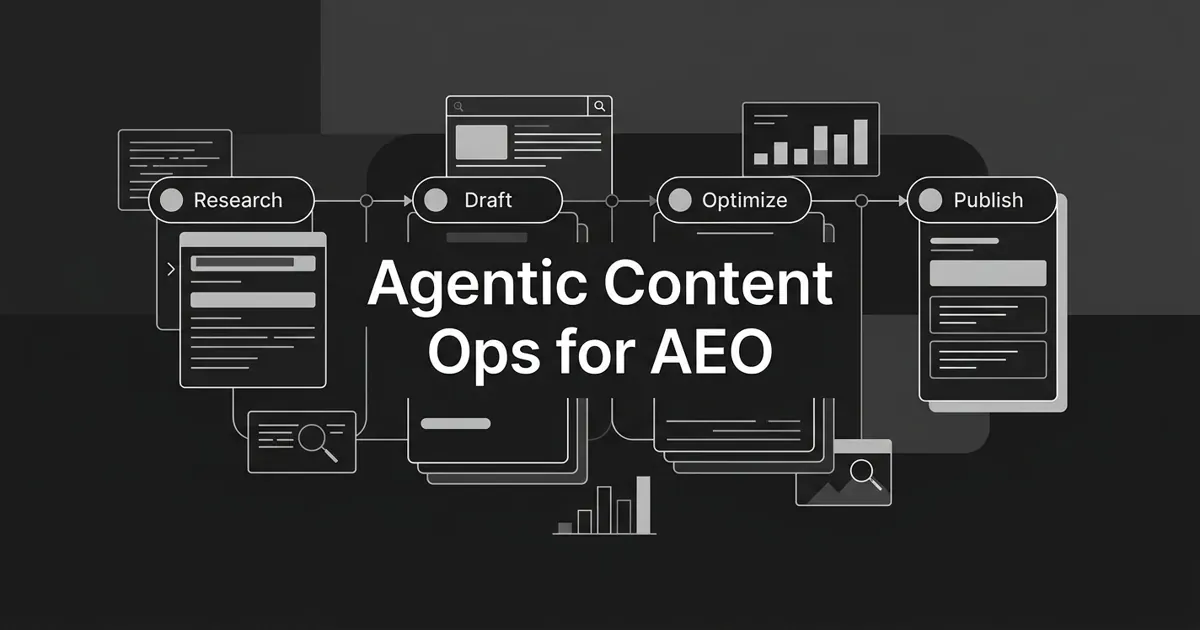
The good news is that a new category of software was built for exactly this. Agentic content operations tools chain specialized steps (research, draft, optimize, publish) so work flows from one to the next without you hand-carrying every article. Some also expose or consume MCP, the open standard for connecting AI systems to external tools, so you can wire custom pipelines. And the sharpest ones add an answer engine optimization layer, because ranking on Google is no longer the only game.
This guide compares seven platforms that actually run content operations as workflows, not single prompts. Let's find the one that fits how your team works.
How we chose these platforms
A tool earned a spot only if it does three things. First, it orchestrates multi-step content work as agent chains, not one-shot generation. Second, it targets content operations with a real SEO or AEO focus. Third, it either exposes agents and MCP for custom pipelines or runs those workflows internally as managed automation.
Single-shot AI writers are out. So are generic no-code automation builders with no content or AEO focus. What stays is the short list of platforms doing genuine ai content workflow automation for teams that care about being found in AI answers. Some of these are best thought of as agentic seo tools that happen to add an AEO layer; others are AEO-native platforms that added production. The distinction shapes which one fits you, and we will flag it for each.
One honest note before we start. "Agentic" is claimed everywhere right now, and "MCP" support is still emerging across this category. So for each tool, ask three questions: Does the workflow chain multiple steps automatically? Does one step feed the next? And is there a human checkpoint, or is the chain fully hands-off? Those questions cut through the marketing fast.
What "agentic" and "MCP" actually mean here
Before you compare tools, let's get the two buzzwords straight, because vendors blur them.
Agentic AI, in plain terms, describes systems that can perceive, reason, and act toward a goal with limited step-by-step prompting from you. In a content workflow, that means specialized agents (a researcher, a drafter, an editor, an SEO or AEO optimizer, a publisher) hand work to each other while you own direction and final approval. You are not copy-pasting between six tabs anymore. That is the real payoff of ai content workflow automation: the orchestration you used to do by hand becomes the software's job. Marketing analysts now describe this shift as autonomous systems that learn, decide, and act alongside human teams, which is why so many content vendors have rebranded as agentic platforms.
MCP (Model Context Protocol) is a different thing. It is an open standard, introduced by Anthropic in late 2024, for connecting AI applications to external data sources, tools, and workflows through one uniform interface. When a content platform exposes an MCP server, outside agents (Claude, ChatGPT, or your own custom agent) can call it as a tool. When a platform consumes MCP servers, its own agents can reach out to external tools. Both directions let you assemble custom pipelines without hand-writing API glue.
Here is the honest state of play. Most tools in this space compete on ai content workflow automation and orchestration today, not on published MCP servers. So when you see "MCP-enabled" in a pitch, ask what data and actions are actually exposed before you count on it. Genuine agentic content operations tools show you the workflow; they do not just say the word.
Agentic content-ops platforms at a glance
DeepSmith leads the list because it pairs AEO analytics with publish-ready production in one workflow. The rest are ordered by fit for a marketing lead scaling content, not alphabetically. Read the table as a shortlist of ai agents for content ops, then dig into the detail below to see which matches your bottleneck.
| # | Platform | Best for | Free tier or trial | Entry paid tier | AEO focus |
|---|---|---|---|---|---|
| 1 | DeepSmith | AEO analytics plus content production in one platform | 7-day free trial | $80/mo annual ($99 monthly): 20 articles, 50 prompts, 5 seats | Native: mention and citation rates (ChatGPT on Pro, up to ten engines on Enterprise), competitor citations, share of voice |
| 2 | AirOps | SEO/AEO teams wanting workflow orchestration and CMS publishing | Free Insights tier (1,000 tasks) | Solo $200/mo, 20,000 tasks, ChatGPT-only insights | AI search visibility insights plus content-refresh workflows |
| 3 | Yarnit | Marketing and ecommerce teams wanting multi-agent content, design, and campaigns | Free tier plus 14-day trial | Per-user pricing (verify on vendor site) | Marketing-led; AEO is one use case of several |
| 4 | Relato | B2B teams and agencies wanting agent-led research-to-publish | Free tier (1 workspace) | Starter paid tier (pricing not public) | Built around content ops; AEO fit emerging |
| 5 | Averi | Lean startups wanting strategy, SEO/GEO scoring, and production together | Solo free plan | Team/Agency paid tiers, 14-day trial | Includes GEO scoring alongside SEO |
| 6 | Allable | Marketers consolidating SEO, content, competitor, and ad tools | Free (30 credits/mo) | Pro tier, EUR pricing, credit-based | SEO-led; AEO included as a feature |
| 7 | AskLantern | Teams wanting agentic monitoring plus response, not just dashboards | 7-day free trial | Starter $47/mo annual ($59 monthly) | GEO Agent focused on generative surfaces |
Now let's look at each one in detail.
1. DeepSmith

DeepSmith is one platform for AI search analytics and content production. The stance matters: it is a production engine, not a writing assistant. The output is a finished, on-brand article, not a first draft you have to rescue. If your bottleneck is both measuring AI visibility and producing the content to fix it, this is the tool built for that exact loop.
Here is what runs under the hood. The AEO module tracks mention rate, citation rate, share of voice, sentiment, and trends across the ten engines it covers (ChatGPT, Gemini, Perplexity, Claude, Google AI Overviews, Google AI Mode, Grok, Meta AI, Microsoft Copilot, and DeepSeek), with a per-platform breakdown, a competitor leaderboard, and the sources AI cites most. You define the prompts your buyers actually ask, and the platform checks them on a schedule. The Pages view shows which of your pages AI cites and what share of your citations each one earns.

Content Map tells you what to write next by turning your site and your competitors' sites into one topic map, so coverage gaps and untapped topics are measured instead of guessed, and Opportunity Agents read that map and return ideas with the justifying data point attached. Content Studio is where those ideas become articles: New Ideas holds the single backlog, and the Writer researches, links internally and externally, adds a cover image, and writes publish-ready metadata. Autowrite takes it hands-off, writing a planned article on its scheduled date and landing it in Produced Content with no one in the app. That is the difference between content as a task you run and content as a system that runs itself.

Distribution is built in, not bolted on. Every finished article arrives with social posts already written, and the Apps Library reshapes one piece into platform-native versions for LinkedIn, X, newsletters, Reddit, and more. Underneath everything sits Deep IQ, the brand-context layer (about-company, products, personas, brand voice, visual guidelines, content types) that keeps output sounding like you and referencing your real products. You can publish straight to WordPress, Webflow, Strapi, Sanity, Contentful, or your own webhooks, with Markdown and HTML export as a fallback.
Pricing is straightforward. Pro is $99/mo ($80 billed annually) for 20 articles, 50 tracked prompts, and 5 seats. Grow is $199/mo ($160 annually) and adds Perplexity. Scale is $399/mo ($299 annually) and adds Gemini. Enterprise is custom and covers all ten engines, with 1:1 onboarding and a dedicated account manager. There is a 7-day free trial and no long-term contract.
Best for: teams that want AEO measurement and content production in one opinionated workflow.
One honest limitation: engine coverage rises by tier, so the entry Pro plan tracks ChatGPT only. Here is the counterweight. Pro still includes the full production engine and the complete AEO framework (mention rate, citation rate, share of voice, competitor leaderboard), just scoped to ChatGPT, and AirOps' entry Solo tier is also ChatGPT-only at more than twice the price. If ChatGPT is your priority engine, Pro covers it today, and Grow adds Perplexity and Scale adds Gemini when you are ready to widen.
2. AirOps

AirOps positions itself as the growth platform for AI search and AEO, and its strength is the workflow builder. You compose multi-step LLM workflows (research, then write, then optimize, then publish) with a brand kit for voice grounding and a knowledge base that ingests your owned sources. Behind those workflows sit 30-plus AI models, 10-plus data providers, and 10-plus CMS integrations for direct publishing.
Best for: SEO and AEO teams that already juggle multiple LLMs and want orchestration with brand grounding and CMS publishing.
Pricing starts with a free Insights tier (1,000 tasks) and a $200/mo Solo plan with 20,000 tasks. The catch at that entry point is that Solo insights cover ChatGPT only, and the richer AI-search visibility features live on the Pro tier at $2,000/mo. This is a capable orchestration layer, but it is priced for teams ready to invest in workflow building, and the deeper AEO tracking is gated behind higher tiers.
3. Yarnit

Yarnit is an agentic AI platform for marketing and ecommerce, and it casts a wider net than pure content ops. Alongside content production you get creative design, campaign management, and analytics, all in one agent-driven workspace. Ask Yarnit is the chat interface, and a library of AI apps covers common marketing use cases, with everything grounded in your brand voice and audience.
Best for: marketing and ecommerce teams that want content, design, and campaign operations in a single app rather than a stack of point tools.
Pricing has historically run in the per-user range with a free tier and a 14-day trial on paid plans, though you should verify current numbers on the vendor site before committing. The trade-off to weigh: because Yarnit spans so many marketing jobs, its AI citation tracking is not as deep or dedicated as an AEO-native platform. If per-engine citation measurement is your priority, confirm what Yarnit exposes before you rely on it.
4. Relato

Relato is built around AI content agents that research, draft, review, and publish from one workspace, with a clear human-in-the-loop model. Specialized agents handle the in-between work while your team keeps creative direction and final approval. It is aimed squarely at B2B marketing teams and agencies that want the labor automated without giving up editorial control.
Best for: B2B teams and agencies that want a multi-agent workspace where humans own direction and sign-off.
Pricing runs across Free, Starter, Pro, Business, and Enterprise tiers, with workspaces scaling from one on the free plan up through team and enterprise limits. Specific dollar figures for the paid tiers are not published publicly, so you will need to sign in or talk to sales. Public materials also do not spell out per-engine AEO tracking or MCP server exposure, so if measurement or custom pipelines matter to you, ask directly.
5. Averi

Averi calls itself the AI content engine for startups, with a promise to help you rank on Google, get cited by AI, and turn content into customers. It combines a Strategy Map for planning, SEO and GEO scoring baked into drafting, analytics, and a proactive content queue that keeps feeding ideas into production. The appeal is having strategy, creation, and measurement in one workspace instead of three.
Best for: founders and lean marketing teams that want strategy, SEO/GEO scoring, and production under one roof.
All plans include a 14-day free trial and cancel-anytime terms. Solo is free, while Team and Agency are paid, with the Agency plan built for running multiple client brands. Exact pricing for the paid tiers requires a sales conversation. And a fair caveat: Averi's GEO scoring is proprietary and not benchmarked publicly, and its engine coverage for citation tracking is not as deep as AEO-native platforms. Treat the GEO score as a helpful signal, not an audited number.
6. Allable
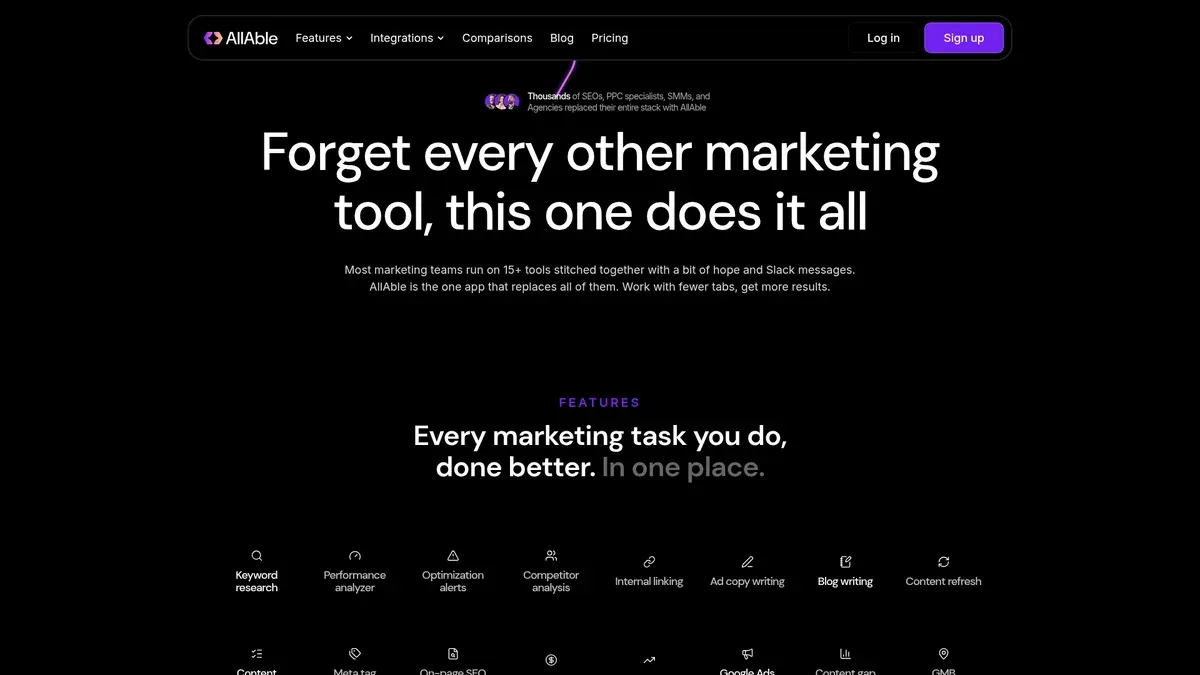
Allable takes the consolidation route, promising to replace a whole stack of marketing tools with one workspace. You get AI keyword research with volume, difficulty, and intent, an on-page SEO optimizer with a score gauge, competitor analysis, ad management, and AI content writing templates with a scheduler for blogs, ads, and social. It is breadth-first, and the credit-based pricing rewards teams that want everything in one login.
Best for: marketers who want to consolidate SEO, content, competitor, and ad tools behind a single credit-based workspace.
There is a free tier (one project, 30 credits a month, no card required), and Pro unlocks unlimited projects and expanded credits with a 15% saving on yearly billing. Two things to weigh: pricing is billed in EUR, which adds conversion friction for US teams, and the platform is SEO-led rather than AEO-first. AEO shows up as a feature here, not as the dedicated citation-tracking layer you would get from a purpose-built visibility platform.
7. AskLantern

AskLantern (Lantern) tracks brand representation across search engines and then deploys agents that act on what they find, which is its distinguishing pitch. Instead of a passive dashboard, it frames itself around agents that respond to visibility signals to protect traffic and revenue, with competitor monitoring and a GEO Agent focused on generative surfaces.
Best for: teams that want AI search monitoring plus autonomous response, not just reporting.
Pricing is refreshingly transparent for this category: Starter is $47/mo billed annually (or $59 monthly), Pro is $143/mo annually (or $179 monthly) for multi-brand teams, and Enterprise is custom. There is a 7-day free trial with no card required. The one thing to verify: "agents that act" is the marketing frame, so confirm the concrete actions and integrations on the live site before you count on them for anything specific.
How to choose the right platform for you
Feeling like several of these could work? That is normal, because they overlap. The trick is to match the tool to your actual bottleneck, not to the longest feature list. Here is the honest breakdown.
Choose DeepSmith if your problem is both sides of the loop: you need to see where you show up in AI answers and produce the content to close those gaps, in one place, with publish-ready output rather than drafts to fix.
Choose AirOps if you are an SEO or AEO team that already runs multiple LLMs and wants a flexible workflow builder with brand grounding and deep CMS publishing, and the pricing fits your budget.
Choose Yarnit if content is only part of the job and you want agentic seo tools sitting next to design and campaign management in one marketing app.
Choose Relato if human control over creative direction is non-negotiable and you want a B2B-focused, multi-agent research-to-publish workspace.
Choose Averi if you are a startup that wants strategy, SEO and GEO scoring, and production together, and you can live with a proprietary GEO score.
Choose Allable if consolidating a sprawling tool stack matters more than AEO depth and EUR credit-based pricing works for you.
Choose AskLantern if you want monitoring plus autonomous response on a transparent, affordable plan and you are content to verify the agent actions yourself.
Notice the pattern? A measure-first team and a produce-first team will land on different tools. Write down your single biggest bottleneck before you book a demo. It will save you a month of trials.
Start with one workflow, not the whole stack
You do not need to rebuild your entire operation this quarter. You need one workflow that runs without you touching every step. That is the whole promise of ai agents for content ops: the manual orchestration disappears, and your time moves from production to strategy. Whether you land on a full production engine or lighter agentic seo tools, the win is the same. You stop being the bottleneck in your own process.
If you want the measurement and the production in one place, DeepSmith gives you a 7-day free trial with real data and real drafts before you pay. Start there, run a handful of prompts and one article through it, and see how it feels to get a publish-ready piece back. Momentum matters more than perfection. Pick one, start this week, and let the system carry the parts you have been carrying by hand.