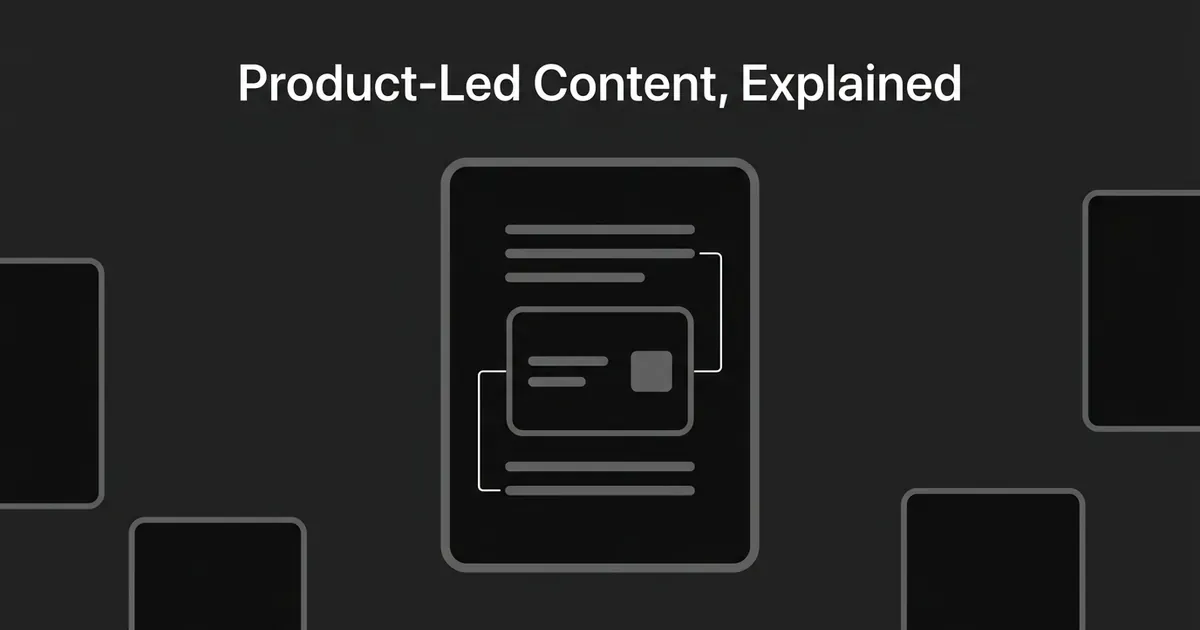
Product-led content is content that uses your product as part of the explanation, not just as a mention at the end. It shows the reader how the product handles the problem you're teaching them about, instead of naming the product once and moving on. That's the whole idea, and it's worth sitting with before you decide whether it belongs in your own plan.
Traditional content marketing is the bigger category this sits inside. It means creating and distributing content that's genuinely useful to a defined audience, with the goal of eventually driving some kind of action, a signup, a purchase, a habit. Some people call the product-integrated version of this "product-led content marketing" instead of product-led content, and the two terms mean the same thing. Whichever name you use, it adds one more requirement on top of general content marketing: the product has to do real work in the piece. A screenshot, a workflow, a template, an example built from the product itself. If you pulled the product out and the piece would teach exactly the same lesson, it wasn't product-led to begin with.
What Product-Led Content Actually Is
The test isn't whether your product gets named. It's whether the product is doing something in the piece. A blog post that explains a marketing concept and then says "you can do this in [product name]" at the very end hasn't used the product to teach anything. The reader learned the concept from the prose, and the product just showed up at the door as they were leaving.
Product-led content looks different. The product is inside the explanation itself: a screenshot showing exactly where a setting lives, a template the reader can copy into their own account, a walk-through of how a specific workflow actually runs. The reader learns the underlying idea and sees, in the same breath, how your product carries it out.
A simple way to check whether something is genuinely product-led is to score it from zero to three. Zero means the product makes no sense here at all. One means you could mention it, but the piece would be just as useful without it. Two means the product gives a real way to solve the problem you're describing. Three means the reader can't really finish the task without seeing the product do it. Anything that scores a two or three is a real candidate. Anything at zero or one is probably fine as general content, but forcing the product in will just make the piece feel like a pitch wearing a lesson's clothes.
It also helps to know what product-led content is not. It's not a product page with an educational intro bolted on the front. It's not documentation, which teaches existing users how to operate what they already bought, while product-led content is usually aimed at a wider audience still working out whether the product is even relevant. And it's not the same as content with a call to action. Adding "start a free trial" to the bottom of an article doesn't make anything above it product-led. The product has to contribute to the substance, not just close the piece.
How Product-Led Content Differs From Traditional Content Marketing
The two aren't opposites, and traditional content marketing isn't the outdated version of this. Plenty of strong traditional content is already useful, well-researched, and honest. The real difference is narrower than "old versus new." It's about where the product sits in the reader's experience of the piece.
| Traditional content marketing | Product-led content | |
|---|---|---|
| Where topics come from | Audience needs, keyword research, market demand | Audience problems and the specific workflows the product can genuinely help with |
| Where the product shows up | Absent from the body, maybe named in a closing CTA | Woven into the explanation, demonstration, or example |
| What the reader takes away | An understanding of a problem or method | The same understanding, plus a look at how the product applies it |
| What counts as proof | Research, expertise, data, examples | The same, plus screenshots, workflows, templates, or implementation detail |
| What it's measured by | Traffic, rankings, engagement, leads | The same, plus signups, activation, feature adoption, and expansion |
The term isn't standardized across the industry, so you'll see writers use product-led content, product-led content marketing, and product-led storytelling more or less interchangeably. Read the table as a practical difference, not a scorecard for which approach is smarter. A general content-marketing team can absolutely write a piece that would score a three on the test above, and a product-led piece can still fail if the product doesn't earn its place in it. The strongest way to think about it is that product-led content is a stricter, product-integrated tactic living inside the larger practice of content marketing, not a rival discipline trying to replace it.
One distinction that trips people up: product-led content is not the same thing as bottom-of-funnel content. Bottom-of-funnel describes how close the reader is to buying. Product-led describes what role the product plays in the piece itself. A comparison or migration guide is often both bottom-of-funnel and product-led, but an early-stage explainer can be product-led too, if it teaches a concept while genuinely showing the product apply it. The two ideas sit on different axes, and collapsing them into one leads teams to assume every product-led piece has to be a hard sell, when plenty of the best examples sit much earlier in the journey.
What Product-Led Content Looks Like in Practice
The pattern is easiest to see in real pieces. Ahrefs publishes beginner guides to marketing concepts that use an annotated screenshot of one of its own tools to show exactly how you'd apply the idea, rather than describing the concept in the abstract and stopping there. Notion does something similar with templates: it shows you how to solve a real planning or tracking problem, and the template itself is both the lesson and a working piece of the product you can drop straight into your own workspace.
Zapier's integration guides are a clean case because the product is doing the actual work being described. An article on connecting two tools together isn't illustrating a concept with the product, it's showing the product perform the exact task the reader searched for. Typeform's survey-design guide teaches the reader how to think about good survey questions, then offers a "start creating" step once the lesson has actually landed, not before. Miro's stakeholder-mapping guide teaches the underlying method for identifying who needs to be involved in a decision, then shows how a shared board makes that collaboration visible in a way a spreadsheet can't.
None of these pieces read as a pitch. They read as a genuinely useful explanation that happens to use the product to make the explanation concrete. That's the difference worth noticing: the product isn't decorating the lesson, it's carrying part of the weight of teaching it. A company can also run a large educational library where only some of it works this way. HubSpot's academy and resource hub, for instance, cover a huge amount of inbound marketing territory with barely a product mention in most of it, which is a useful reminder that a product-led content program doesn't require every single asset to hit the same bar.
How Product-Led Content Fits a PLG Content Strategy
Product-led growth is a company-wide model where the product itself, not a sales team, is the main engine behind getting new users, getting them to their first real value, and eventually getting them to pay and expand. Product-led content is a tactic that can support that model, but the two aren't interchangeable. You can run a PLG company without much product-led content, and you can publish plenty of product-led content without your company being PLG in the way it sells.
Where the two connect is the bridge between someone discovering your company and actually engaging with what you've built. A PLG content strategy treats that bridge as a full sequence: a reader finds you through search or a recommendation, understands the problem well enough to see your product as a plausible answer, tries it, reaches a first real outcome inside it, and eventually pays and grows their usage. Product-led content is strongest at the acquire-to-engage step, giving someone problem-aware enough to become product-aware, but it keeps paying off further down the line too. Existing customers who are already paying can use the same kind of guide to find a workflow or feature they hadn't tried yet, which is a retention and expansion lever as much as an acquisition one.
That's a more coordinated system than "publish a blog with the product mentioned here and there." Each piece in a real PLG content library has a job: some are aimed at people who don't yet know they have the problem you solve, some are aimed at people evaluating you against alternatives, and some are aimed at customers you already have who haven't found their way to a feature that would make their life easier. Product-led content can live at any of those stages. It just has to genuinely earn its spot at whichever one it's written for.
When It Applies, and When It Doesn't
The decision rule is simpler than it sounds: could this piece show your product solving the reader's problem without interrupting the explanation. If the answer is yes, you've got a real candidate for product-led treatment. If the product would only fit as a forced paragraph in the middle or a pitch at the end, you're looking at regular content marketing with a product mention, and that's fine, but don't call it something it isn't.
Product-led content works well when your product has a workflow or capability that's genuinely easier to understand by watching it happen than by reading about it in the abstract, when you can show a credible example or template rather than a hypothetical one, and when your team actually has the product knowledge to write from rather than guessing at how a feature behaves. It also works better when you can connect what someone reads to what they do next in the product, even loosely, because that's what tells you whether the piece is doing its job beyond just getting read.
It's the wrong tool when you're still working out who your audience even is or what problem matters most to them, when the feature you'd want to show isn't stable enough to demonstrate honestly, or when the topic is one your audience needs independent, non-commercial education on before they're ready to look at any vendor at all. Forcing a product into a piece that doesn't want it rarely earns a signup. It just makes the piece read like an advertisement that interrupted itself with a tutorial, and readers notice that faster than most teams expect.
None of this makes product-led content a replacement for the rest of your content plan. A lot of genuinely important topics, category education, original thinking, honest coverage of a problem where your product isn't the right fit yet, are better served by general content that doesn't try to make the product do anything. The two approaches work side by side. The skill is knowing which one a given topic is actually asking for.
If you're building out a content operation and want the production side to run from the same stored context every time, rather than re-explaining your product to a new writer for every article, that's the kind of thing a platform like DeepSmith is built to remove: it keeps your product, persona, and voice details in one place and produces articles grounded in them instead of starting from a blank prompt each time. You can try it during a free trial if that's the piece you're missing.
The short version to carry away: traditional content marketing delivers something useful to an audience. Product-led content delivers that same value while letting the reader watch your product actually help create or apply it. Neither one makes the other obsolete. You just need to be honest with yourself about which job a given piece of content is really there to do.