You already did the hard part. Your positioning statement is approved, your value proposition is written down, and everyone on the team agrees on what the product does and who it's for. Then you sit down to plan the blog and the page is blank again, because a positioning statement isn't a list of article titles.
This guide walks you through building a positioning statement content strategy: taking that approved positioning statement and value proposition content plan and turning it into a short list of content pillars and a ranked list of topics to write first. It assumes the positioning work is done, so it won't ask you to touch your messaging. And it stops at the pillar and topic list, not a full editorial calendar with dates on it, because that's a separate decision once you know what you're writing about.
You'll get seven steps, in the order a founder would actually work through them: pull the claims out of your positioning, turn each one into a question a buyer would ask, group those questions into pillars, write specific topics under each pillar, check what's already covered, rank what's left, and write it all down somewhere someone else could follow.
Step 1: Extract the claims your content needs to support
Open your approved positioning statement and value proposition next to a blank table. You're going to pull out five things: who the buyer is and what situation they're in, what they'd do instead of buying your product, what outcome you're promising them, what makes you different, and what you can actually prove.
Go field by field. Who is this for, and when does the problem show up for them, meaning what's actually happening in their day when this starts to matter? What's the relevant alternative, whether that's a direct competitor, a manual process they're already running, or just doing nothing and living with the problem? What change are you promising them, stated as something they'd notice, not as an internal metric? Why would someone pick you over that alternative, specifically, not in general terms? And for each of those, what evidence backs it up, and just as important, what should you never claim because you can't actually back it up yet?
If a field comes up blank, don't fill it in with something that sounds good. Flag it and go back to whoever owns the positioning. A gap here is useful information, not a failure.
This is also where messaging to content pillars starts to take shape, because the fields you just filled in are the raw material for everything that follows. If you're using a tool like Deep IQ to store your positioning, product details, personas, and voice as shared context, this step is where that context earns its keep: it keeps every later step anchored to what you actually said, instead of drifting toward whatever sounds impressive that week. You still decide which claims are approved and which ones need more proof before you write about them.
Common mistake: treating every feature as its own pillar, or writing "grow faster" as if it were a measured result instead of the promise it actually is. A feature supports a claim. It isn't a claim by itself.
Step 2: Translate each claim into a buyer question
A positioning statement talks about your product. A buyer talks about their problem. This step bridges the two.
For each outcome or differentiator from step one, ask three things: what problem would make someone go looking for this, what would they want to know before they trusted it, and what would they compare it against? Pull the actual wording from sales calls, support tickets, customer interviews, and CRM notes if you have them. If you don't have much of that yet, that's fine, just mark the resulting questions as hypotheses rather than confirmed demand.
A useful row to fill in looks like this: positioning claim, then buyer situation or question, then a demonstrable answer, then the buying stage it fits. Someone might ask "how do we keep AI-written content accurate to our product" long before they know your category exists, and only ask "how does this compare to briefing a freelancer" once they're close to deciding.
Write down where each question's wording came from. A question sourced from an actual sales call is worth more than one you guessed at, and knowing which is which matters later when you're ranking topics.
Common mistake: turning your own headline into a keyword without checking whether a real buyer would ever phrase it that way. Your positioning statement is written for internal alignment. A buyer's question is written for their own problem, in their own words, and those two things often don't match.
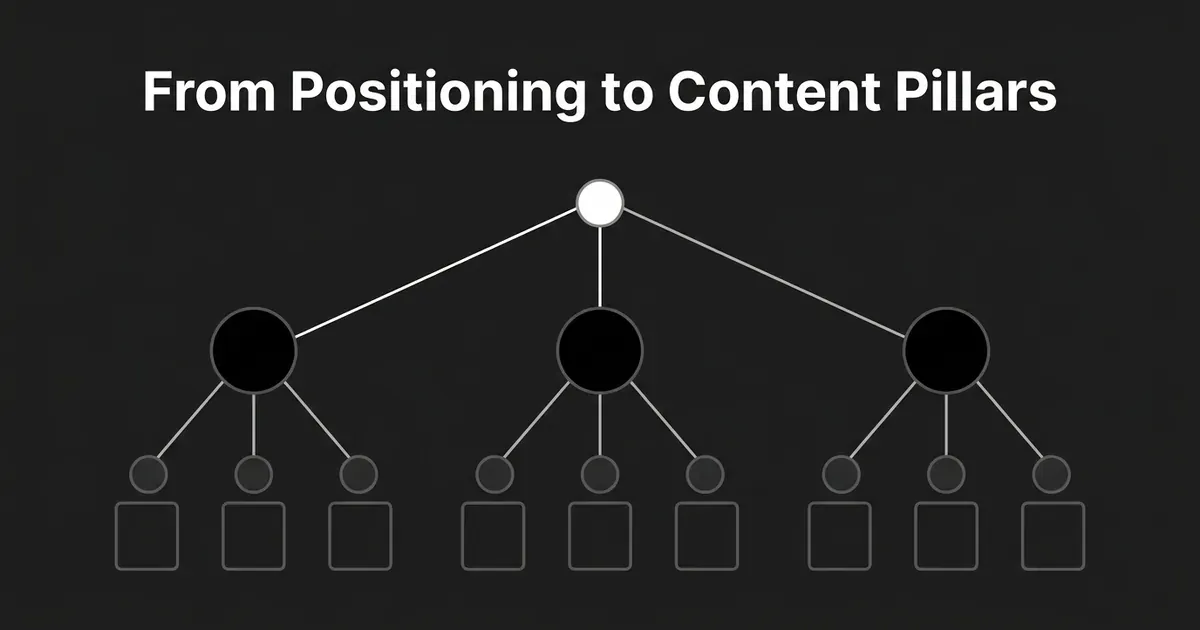
Step 3: Group related questions into a short list of pillars
Now take the questions you wrote in step two and cluster them by the problem or outcome they share, not by which feature they happen to mention. Give each cluster a name a buyer would actually recognize, something like "keeping SaaS content accurate and on-brand" rather than "product features."
Three to five pillars is a reasonable starting range for a small team. It isn't a rule, just a practical size: enough to cover the ground your positioning claims, not so many that you're spread thin before you've published anything. One way to sanity-check a pillar's size is to ask whether it could support ten to fifteen distinct subtopics. If you can't come up with anywhere near that many, the pillar is probably too narrow. If the subtopics you list don't feel related to each other, it's probably too broad. You don't need to plan all of those pieces now, the test is just there to catch a pillar that's the wrong size.
Run each candidate pillar through three checks: does your audience actually care about this, can you credibly help with it, and does it connect back to your approved positioning? Merge anything that overlaps, and drop a topic if the only reason it's on the list is that a competitor covers it. Grouping this way is what turns messaging to content pillars from a nice phrase into an actual, repeatable step: the pillars come from the buyer questions you already collected, not from a brainstorm.
Common mistake: calling awareness, consideration, and decision your three pillars. Those are stages a buyer moves through inside a pillar, not subjects worth owning on their own. Your pillars should be built around content pillars and buckets that a buyer recognizes as their problem, not around your own funnel labels.
Step 4: Write candidate topics at the right decision stage
Under each pillar, write a handful of specific questions rather than a long list of loosely related keywords. Some should help a buyer understand the problem for the first time, some should help them compare approaches, and some should help them validate a decision they're close to making. Not every pillar needs an even split across those, the mix depends on what that pillar is actually for.
The form of the answer follows from the question, not the other way around. A task calls for a how-to. A comparison between approaches calls for a comparison piece. A capability calls for a demonstration. A claim that needs proof calls for a documented example, not another paragraph asserting it. Decide the format only after you're clear on what the reader is actually asking.
Write down what the reader should know or be able to do by the end of each topic. For anything closer to a buying decision, be specific about what evidence you can actually show. The goal is to own a niche with topics you can genuinely answer, not to pad the list with entries that are mostly wishful thinking. This is also where you map buyer stages across the cluster, so you can see whether a pillar is thin at the stage that matters most for your funnel.
Common mistake: answering a problem-solving question with a product pitch, or building a comparison page that doesn't fairly represent the alternative. Both erode the trust you're trying to build with the same piece of content.
Step 5: Check demand, intent, and your existing coverage
Before you commit to a topic, look at what's actually showing up in search results for that question today. If every top result is a comparison and you planned a how-to, that's a search intent mismatch worth noticing before you write, not after.
Search volume and difficulty scores can help you weigh effort against opportunity, but they can't tell you whether a topic fits your buyer. If you already have a website with traffic, Google Search Console's Search results Performance report is worth a look: the Queries tab shows what's actually bringing people in, and clicking into a query shows you which of your pages already show up for it. Use the Pages tab on its own too, to inventory what you've already published: note the URL, the question or pain point it addresses, its stage, whether the information is still accurate, and whether it needs improving or replacing.
A new site won't have much query data yet, and that's expected. Sparse data means you don't have evidence either way, not that the topic lacks demand. Give it time rather than concluding a topic is dead because your own site has no history to show for it yet.
This step also catches a subtler problem: a topic that looks untapped on your blog but is already answered somewhere else on your site. A pricing page, a docs page, or a product page can already be doing the job a new blog post would try to do, and writing a second answer to the same question just splits your own traffic and confuses which page should rank.
Sort each shortlisted topic into one of three buckets: covered adequately, existing page needs work, or a genuine gap. Competitor coverage can point you toward a topic worth checking, but it's a clue, not a reason to publish on its own. If a tool like Content Map is available to you, it can classify your own pages and a competitor's onto the same topic map and show where the gaps actually sit, which speeds up a content gap analysis considerably. The judgment about whether a gap is worth filling still belongs to you.

Common mistake: calling a topic untapped just because the blog doesn't have a post on it, when a product page or a docs page already answers the question well.
Step 6: Rank topics by strategic fit before chasing volume
Start by removing anything that doesn't serve your actual buyer, that you can't answer responsibly, that contradicts your approved positioning, or that just duplicates a page you already have covered.
For what's left, weigh five things: how urgent the question is for the buyer, how directly it connects to a real differentiator, how much proof you have on hand, whether there's a genuine coverage gap, and whether the search or distribution opportunity is realistic. Put the topics that score well across all five first.
A simple three-tier system works for most small teams: priority one is a clear buyer question with strong positioning fit, a demonstrable answer, and a real gap; priority two is credible but has weaker evidence or a smaller opportunity; everything else waits until it's validated. These are editorial judgment calls, not a formula, so don't manufacture false precision by scoring things to two decimal places. Some teams score topics for business potential on a simple numeric scale and prioritize the higher scores because that's where a product mention fits naturally without feeling forced, which is one reasonable way to structure the same judgment call.
A narrow, decision-stage question can and often should outrank a broad, high-volume term, if it serves the buyer better and connects more directly to what actually makes you different. It's tempting to sort by the biggest number in the search-volume column first, but that number doesn't know anything about your positioning, and a topic you can't credibly answer well won't help you no matter how many people search for it.
Common mistake: treating a bigger keyword volume, a longer competitor page count, or a wider AI-visibility gap as proof of business priority by itself. If a tool surfaces ideas backed by that kind of evidence, that evidence is useful context, not a decision. Filter every suggestion, generated or not, against your approved claims, your buyer fit, and what you can actually prove.
Step 7: Record the pillar list and the first topics to pursue
Close the exercise with a short document, not a spreadsheet nobody opens again. For each pillar, write down the buyer problem it addresses, the positioning claim it supports, the proof you have, the first ranked question or two under it, the buyer stage it sits at, and whether there's an existing page or a real gap.
Name the single highest-priority topic across the whole list. That's the one you write next.
A useful one-page content strategy document does this well precisely because it's short: someone else on the team should be able to read it, pick the next topic, and understand why it's next without needing you to explain the product from scratch. That's the actual test of whether a positioning statement content strategy actually worked, not just whether it looks tidy.
Common mistake: ending with a list of nice-sounding pillar names and no ranked, evidence-linked questions underneath them. A pillar name without a first topic under it isn't a plan yet, it's a heading.
What this looks like in practice
Here's what a value proposition content plan looks like once you've run through all seven steps. Say your positioning centers on keeping AI-assisted content accurate to your product without a founder rewriting every draft. That claim could translate into a pillar like "accurate, on-brand SaaS content," with a first question along the lines of "how do we keep AI-written articles factually correct without a manual review pass on every one." If your positioning also leans on finding where you're invisible in search or in AI answers, that could become a pillar like "finding content and visibility gaps," anchored by a question like "which topics does a competitor own that we don't, and do they actually fit our buyer." These are illustrations of the reasoning, not a claim about what any specific company's search demand or results will look like. Your own customer evidence, existing pages, and search data decide your actual order, not an example in a guide.
Once you've got a ranked topic in hand, DeepSmith's Writer can take it from a planned idea to a finished, linked article with a cover image and metadata already handled, and Autowrite can run that on a schedule once you've configured it, so a saas content strategy that maps to the full buyer journey doesn't stall out waiting for someone to find the time to write it.
If you want to see where this approach could take you, start a free trial and run your own top-ranked topic through it.