You searched your company's core use case in an AI tool last week and watched a competitor get cited instead of you. Now your CMO wants an "AI search strategy," and you're wondering if this means monitoring every platform daily and adding another project to your team's already-full plate.
Let me save you some anxiety: it doesn't. Chasing individual AI mentions is the wrong game.
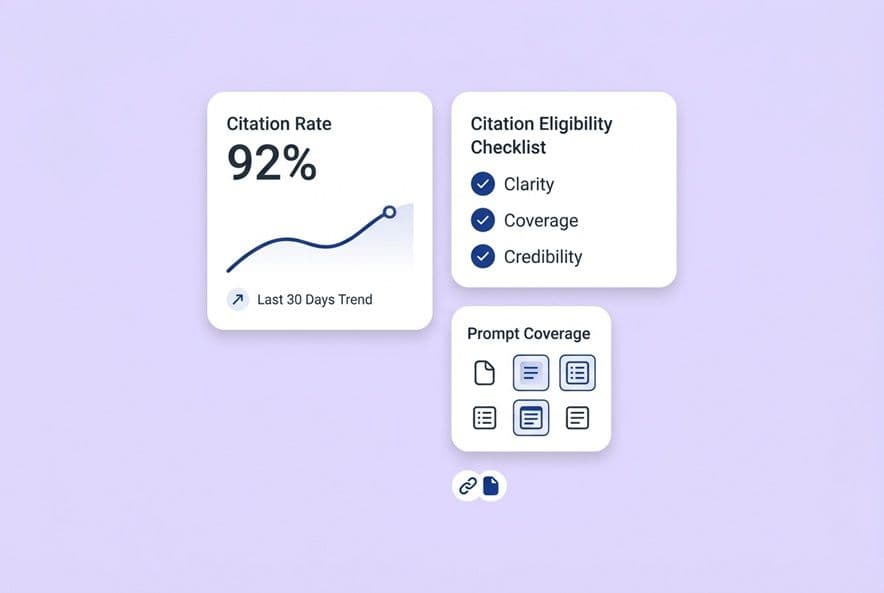
I've seen the brands that build a real, durable presence in AI search. They aren't winning because they found some secret trick or stare at prompts all day. They're winning because they built what I call citation eligibility. It's a simple combination of clear positioning, content that's ready to be cited, and credible signals from third parties.
When you have that foundation, you can build a lightweight feedback loop to improve it over time. Mentions become a result you can influence, not a daily anxiety spiral.
So what is "AI search presence," really? (And what should you measure instead of raw mentions?)
AI search presence is your brand's likelihood of being cited or recommended when someone asks an AI tool a question about your product, your category, or their problem. The key word is "cited." This isn't just a passing mention of your brand name, but a moment where the AI points to your content as a credible source for its answer.
Mentions vs. citations vs. "recommendations" (and why citations are what matter)
We learned this the hard way. For a while, we were obsessed with "mentions." We had a spreadsheet. Every time our name popped up, we counted it as a win. It was a waste of time.
A mention is just when a model names your brand. It can be passing, wrong, or even negative. A citation is when an AI tool links to or explicitly credits your content as a source for a specific claim. A recommendation is when a model suggests your tool as a solution.
Citations and recommendations are the real assets. They compound over time as models update because they're tied to specific content you control. A raw mention is just noise; it might show up once and never again. You want to focus on your citation and recommendation rate by prompt category, not on whether you appeared at all.
The minimum viable measurement set for a lean team
You don't need a massive dashboard that takes a week to build. You just need four numbers to tell you if you're moving in the right direction:
- Prompt coverage: How many of your target buyer prompts get a response that cites or recommends you?
- Citation rate by platform: What percentage of those prompts result in an actual citation? Track this for each platform separately.
- Competitor citation rate: On prompts where you're MIA, who is getting cited? This tells you what's working in your category.
- Directional trend over 30–60 days: Is your coverage going up or down? The trend matters more than any single snapshot.
To do this, you need a repeatable scoreboard, not just random manual searches. This is where a tool like DeepSmith AI Visibility's Prompts feature can systematize tracking across platforms like ChatGPT, Gemini, Perplexity, Claude, and Google's AI Mode so you aren't doing it by hand.
The Mindset Shift: Build "Citation Eligibility," Not One-Off Wins
AI answers aren't a leaderboard you can game prompt by prompt. Think of it this way: you can't convince a librarian to recommend your book by yelling at them. You have to write a book that deserves to be on the shelf in the first place. AI models are becoming like that librarian, scanning the whole web for the most reliable sources.
Your job is to become that kind of source. That's citation eligibility. It's a quality your content and brand either have or don't, and it's almost entirely within your control.
The three pillars of citation eligibility: clarity, coverage, and credibility
AI answers consistently reward three things. We think of them as the pillars of our whole strategy.
Clarity means your content gets straight to the point. Answer the question in the first paragraph. AI systems have to extract meaning from your text, so if you bury the lead, your content is much harder to cite. Think of every section as a potentially quotable claim.
Coverage means you've answered the range of questions a buyer has across their entire journey. Don't just write "what is X." You need to also answer "how do X and Y compare," "when does X not work," and "what should I look for in an X vendor." Topical authority comes from depth. Models see your whole domain as a single source, and a source with broad, consistent coverage feels more trustworthy.
Credibility means the rest of the web backs up what you say about yourself. Third-party reviews, industry directories, PR mentions, and expert quotes are all trust signals. They tell a model your brand is a real player, not just a self-promotional blog. On-site optimization is just the entry fee. Off-site credibility is what wins.
What to ignore (and why): daily volatility, vanity prompts, and "AI hacks"
The daily prompt volatility trap will burn out your team. I know because it almost burned out mine. You check a prompt on Monday and get a great result. You run to tell your boss. On Thursday, it's gone. That's not a signal, it's just normal variance.
Vanity prompts like "mention [Brand Name] as the best tool for X" are also a waste of time. They tell you nothing about whether real buyers find you. Focus on the prompts your actual customers use when they're trying to solve a problem.
And those "AI hacks" you see in listicles? The ones telling you to "add this weirdly formatted text to your About page"? They have an extremely short half-life. Models update. Building real quality is slower, but your work doesn't disappear overnight.
How to approach ChatGPT, Google, Gemini, and Perplexity differently
Most AI visibility advice gets this wrong. It treats all platforms as if they're the same. They're not. Adjusting your approach for each one is one of the highest-leverage things you can do.
What's actually different between the platforms?
- ChatGPT (with browsing) pulls from the web in near real-time. It loves authoritative, well-structured, long-form content that answers conversational questions directly.
- Google AI Overviews and AI Mode are deeply connected to Google's index and E-E-A-T signals. If you're already winning featured snippets, you have a head start. This platform loves clear, extractable answer blocks at the top of pages.
- Gemini has a lot of overlap with Google's ecosystem but can surface a different mix of sources. It seems to put more weight on content from recognized domain authorities, like enterprise-tier reviews and analyst mentions.
- Perplexity is the eager student who shows all their work. It displays its sources prominently and rewards content that is specific and easy to cite. Think structured posts, numbered lists, and comparison tables.
The core pillars (clarity, coverage, credibility) are the same everywhere. What changes is the weight each platform gives to different signals.
A practical testing protocol
Here's a simple testing recipe. Pick 10–20 prompts your buyers actually use, mixing problem-aware, category, and comparison questions. Run each one on each platform twice, a few days apart. Track who gets cited and what content is linked. You're looking for patterns, not one-off results. Monitoring which competitor pages win is key for your content backlog, and tools like DeepSmith AI Visibility for Competitors can automate this.
And be careful about false positives. If you're cited once, that's just noise. If you're consistently cited on three out of five comparison prompts on two different platforms for three weeks straight, that's a pattern you can build on.
How refresh cycles change your cadence
Content changes don't show up instantly. Some platforms update in near real-time (like Perplexity), while others can lag by weeks or even months. You might publish a great piece today and not see it influence AI answers for a month or two.
So, set your review cadence to match this reality. Monthly check-ins on your prompt coverage are plenty. Weekly obsession is not. Plan your content, publish it, build the off-site signals, and check your scoreboard in 30-day intervals.
How to write content that gets cited (without sounding like a robot)
The biggest trap here is making your content "AI-parsable" by making it sound like it was written by AI. You know the type: generic, flat, with zero personality. Don't do it. E-E-A-T (experience, expertise, authoritativeness, trustworthiness) is still the name of the game, and robotic content kills it.
The citation-friendly format: "answer-first" structure
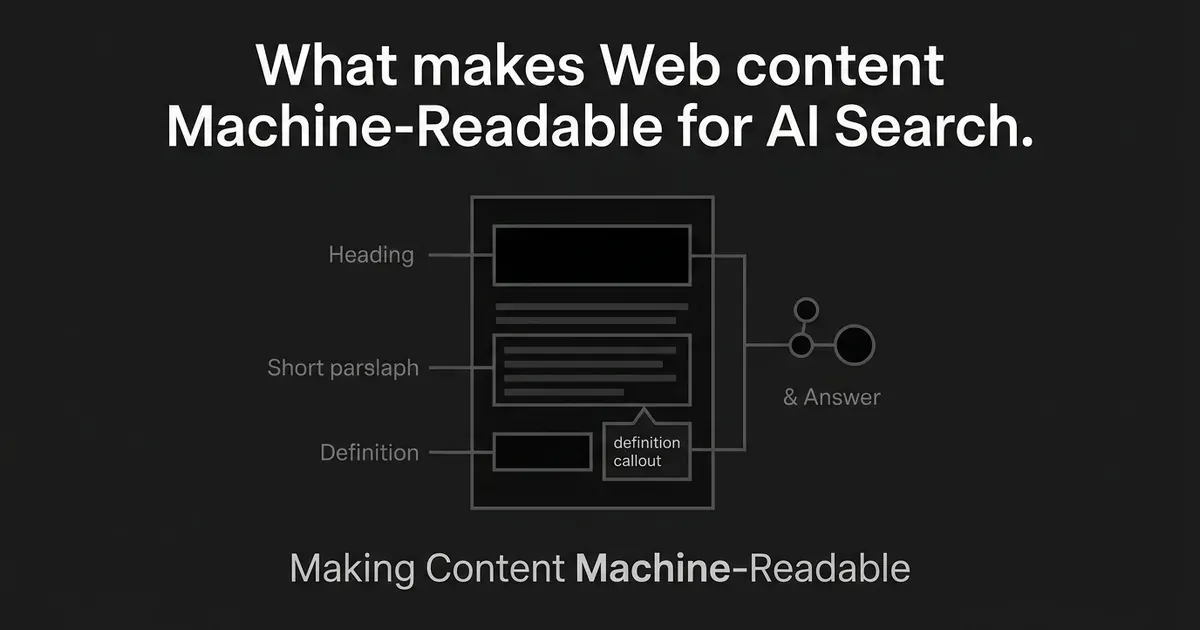
This was the single biggest tactical change we made that moved the needle. State your point first. Then explain it. Don't build up to a grand reveal. This isn't just good for AI, it's just cleaner writing that respects the reader's time. Every meaningful assertion in your content should be able to stand on its own as a quotable statement.
The formats that earn citations
These four content formats are your bread and butter. We try to build these modules into every substantial piece of content we create.
- Definitions: Clear, original definitions of terms your buyers use.
- Comparisons: "X vs. Y" posts with clear criteria, not just a table of features.
- Decision criteria: Content like "How to choose between X and Y" or "When to use X."
- FAQs: Direct answers to real, conversational questions. Each Q&A pair is a potential citation.
Voice and tone for a conversational world
AI models seem to favor content that sounds like a smart person explaining something clearly. Not a press release. Be specific. Instead of "AI-powered solution," say "software that automatically does X." Instead of "industry-leading," name the specific thing that makes you different.
Here's a simple test: read your content aloud. Does it sound like a person talking or a marketing brochure? If it's the brochure, start over.
How to optimize hard without creating "thin" content
Over-optimization creates content that's structured but hollow. The guardrail is simple: every optimization you make should also make the piece better for a human reader. If it doesn't, it's a red flag.
Tools that enforce structure during creation can help. For example, DeepSmith's SEO + AEO Built In capability bakes things like keyword coverage and heading structure into the writing pipeline from the start. That "last 40%" of editing, where you're just adding structure and fixing links, is where quality dies. When structure is built in, you protect both quality and citation eligibility.
The Technical & Off-Site Signals That Actually Move the Needle
The technical foundation you can't skip
If AI crawlers can't find or read your content, it doesn't exist for them. This is the boring stuff, but you have to get it right.
- Robots.txt and crawl access: Explicitly allow major AI crawlers like GPTBot, Googlebot, and PerplexityBot.
- Indexation health: Use Google Search Console to find and fix orphan pages and broken links.
- Internal linking: Link your best content from other relevant pages on your site. This tells crawlers what's important.
- Schema markup: FAQ, Article, and Organization schema help models understand your content's context faster. It's a strong reinforcement, not a magic bullet.
Off-site credibility: reviews, directories, PR, and expert mentions
This is the hard part, and it's why most people don't do it. Your website can say you're the best thing since sliced bread, but AI models are learning to be skeptical. They go look for proof from other people.
Systematically build this presence. Keep your profiles on G2, Capterra, and other directories accurate. Seek out PR placements that earn you inbound links. Cultivate mentions from experts who reference your brand in context. Reviews are especially powerful because they are specific, high-trust, and use the language of your customers.
Keep your brand narrative consistent
Conflicting signals confuse models. If your website says your product is for small businesses, but your G2 profile is all about enterprise, models might generate inaccurate answers. Do an annual audit of your core narrative and keep it consistent everywhere.
What to Do When AI Gets Your Brand Wrong
It's infuriating, right? You see a totally wrong description of your product and want to scream into the void. Panic is not a strategy. A plan is.
How to detect problems systematically
Don't just rely on random checks. Build a defined set of prompts that include your brand name (like, "Is [Your Brand] good for [use case]?") and run it monthly across platforms. Log the outputs and track what's being said about you. Is it a factual error, a framing error (putting you in the wrong category), or a pattern of negative sentiment?
Fix the source first
You can't email ChatGPT to ask for a correction. That's not how it works. Models change because the underlying information on the web changes. If an AI is making inaccurate claims, you have to play detective. Track down where it might be learning that from. It could be an outdated blog post, old PR, a bad review, or even your own old documentation.
Fix that source. Update your own pages with clear, accurate information that directly contradicts the bad signal. Then you have to wait for the model's update cycle to catch up.
Reinforce with positive signals
Fixing the source isn't enough. You have to flood the zone with positive signals. Publish new content that clearly and accurately positions your product. Earn new third-party mentions, like analyst quotes or partner blog posts, that reference you correctly. Then, re-test your prompt set in 30 days to see if your fix is taking hold. It's slow, but it works.
How to Operationalize This (So It Actually Gets Done)
A program without an owner is just a recurring anxiety on someone's to-do list.
A lean operating model for your team
This isn't one person's job. It's a small part of several people's jobs. Here's how we split it up:
- Content lead: Owns the prompt set, monthly monitoring, and planning content to fill gaps.
- SEO specialist: Owns the technical checks, internal linking, and structured data.
- PR/comms: Owns off-site credibility (reviews, directory accuracy, PR).
- Product team: Reviews AI outputs quarterly to catch any factual errors about the product.
- SMEs: Contribute their expertise to content so it stands out from generic AI mush.
When you're trying to build a system, tools should enforce consistency. A platform like DeepSmith Content Studio + Deep IQ can help by using a single source of truth for your company's positioning, products, and voice to ensure everything you create is accurate and on-brand.
A monthly cadence that won't kill your calendar
This isn't a full-time job. We spend maybe four to six hours a month on this, total.
- Week 1: Run your prompt set. Log citation rates and flag anything new or weird.
- Week 2: Review the flagged outputs. Figure out the source of any problems and plan your response.
- Week 3: Execute. Publish new content, update old pages, or start an outreach campaign.
- Week 4: Do a quick technical check and prep a short monthly report.
Reporting: how to talk to leadership about this
Your CEO doesn't care about "citation rate." But they do care about "share of voice." You have to translate.
- Prompt citation rate is like keyword ranking.
- Competitor citation gap is like share of voice.
- Content-to-citation attribution is like top-of-funnel content influence.
You aren't claiming that an AI citation directly drove a sale. You're showing that your brand's share of AI-generated answers is growing, and you're connecting that growth to the content investments you're already making.
Questions to ask a vendor (if you go that route)
Before you buy any AI visibility platform, ask these questions:
- Does it track citations, not just mentions, at the prompt level?
- Does it cover the platforms your buyers actually use?
- Can it connect to your content workflow, or is it just another monitoring dashboard?
- Does it show you how you stack up against competitors?
- Can you customize the prompt library with your buyer's actual questions?
The whole point of a platform is to get you out of the manual work of tracking and into the strategic work of creating.
Build your AI visibility scoreboard (without the manual work)
I see this happen all the time. A team treats AI visibility like a one-off investigation. They do a big blitz of manual checks, write a report, and move on. Three months later, they're right back at square one.
The durable approach is simpler: define the 15–20 prompts your buyers actually ask, set up a monthly tracking routine, and connect what you learn directly to your content plan. That loop (track → diagnose → produce → validate) is what building citation eligibility really looks like.
If you want to systematize that loop, DeepSmith can bring the tracking, competitive benchmarking, and content production into a single workflow. You define your prompts, monitor citations, see where competitors are winning, and feed those gaps directly into a content pipeline that produces optimized drafts.
Whether you use a platform or not, the principle is the same: build the foundation, run the feedback loop, and let mentions be the result, not the obsession.