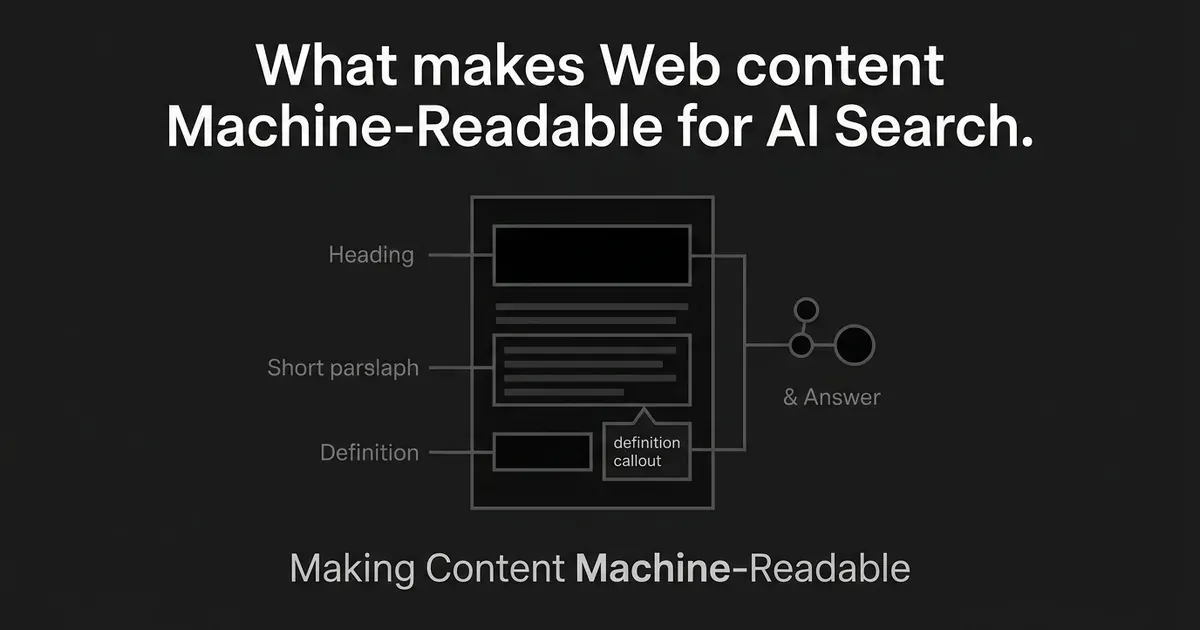
Machine-readable content means the page's main ideas sit in plain text, each section has a clear subject, and the passages make sense even when a reader (or a system) lands on just one of them without the rest of the page. That is different from machine-readable content structure being some special file you attach for AI, or a rule about how short a paragraph has to be. It is closer to an editorial standard: can a person, or a system reading on their behalf, tell what each part of your page is about and get a usable answer from it without piecing together clues from three other paragraphs.
This matters more now because AI search tools do not just rank your page, they pull specific passages out of it to build an answer. A page that reads fine top to bottom but hides its actual answer behind a vague heading, or splits a claim from the condition that limits it, gives a person less trouble than it gives a system trying to lift one clean piece.
What machine-readable content actually means on a page
The short version: content is machine-readable when its meaning is available as visible text, its sections have honest subjects, and its statements hold together without needing the rest of the page to make sense.
This is different from structured content, which is about how you arrange your ideas across the page. Structure is the container, headings, sections, paragraph breaks, that tells a reader where one topic ends and the next begins. Machine-readable content is what happens inside that container: does the text itself say what it means, plainly, or does it rely on context the reader has to reconstruct.
Neither one is about adding a special AI file to your site or writing in some machine-only format. Google is explicit that its generative Search features do not require a new AI-specific file, special markup, or Markdown to work. You do not need an ideal page length either. What you need is ordinary good writing: organized paragraphs, honest headings, and information that lives in text instead of only in an image or a video a system cannot read.
A page can also cover more than one topic and still be machine-readable. Google says its systems can understand the nuance of multiple topics on a single page and show the piece that matches a given question. So this is not an argument for chopping every article into one-question fragments. It is an argument for making sure that, wherever your page answers something, that answer is stated plainly and attached to a heading that actually says what it is about.
Getting content structure for AI search right is mostly a matter of separating two things people tend to blur together. One is where information sits, which page, which section, which heading. The other is whether the information itself, once you land on it, actually says what it means. This piece is about the second one. Where things live on your site is a different, larger question, worth its own attention, but it will not fix a passage that does not carry its own meaning. It also sits apart from the broader practice some people call generative engine optimization, which covers a wider set of tactics for showing up in AI answers, not just how a single page is written.
How a search system finds the answer inside a page
When an AI system builds an answer, it is not reading your whole site in order. It retrieves the pages and passages that seem relevant to the question, then pulls specific information out of them. Microsoft's documentation on building retrieval systems describes this directly: a document gets divided into meaningful chunks, and the system works with those chunks somewhat independently rather than the document as one continuous whole. That is a description of one implementation, not a rule every AI search engine follows the same way, but it explains why a passage's own clarity matters separately from the page's overall quality.
Google also says its AI features may use something it calls query fan-out: breaking one question into several related searches across subtopics before assembling a response. The useful takeaway for a writer is restrained. It means a page can end up answering a narrower question than its title suggests, so a section that is clearly labeled and self-contained has a better shot at being the piece that gets picked up, compared to the same information buried inside a paragraph about something else.
None of this means clean structure guarantees a citation. Being read correctly and being selected are two different things. A system still has to judge whether your page is relevant, reliable, and actually useful for the question being asked. Structure gets you understood. It does not guarantee a citation on its own.
There is research pointing at a related problem worth knowing about even though it does not map directly onto blog writing. A 2024 study on how language models use long context, Lost in the Middle, found that these systems were less reliable at using information placed in the middle of a long input than information placed near the start or the end. That finding comes from testing model behavior on specific benchmark tasks, not from watching a live search engine cite web pages, so it is not proof that moving a paragraph higher on your page wins you more citations. What it does support, carefully, is the general idea behind this whole piece: information that is easy to find and does not depend on everything around it is easier for a system to use well, wherever that system happens to be looking.
Why section structure and context matter
A heading tells a reader what a section is about. It does not answer the question by itself, the sentences below it still have to do that work. W3C's accessibility guidance makes the same point for a different audience: headings exist to communicate how the content is organized, not to replace the content.
The part that trips writers up is what happens when a passage gets pulled out and read on its own. Take a weak example: a section titled "The brief" that says, "It tells them what to cover. This keeps things consistent." Read in isolation, neither "it" nor "this" points anywhere. Compare that with a section titled "What is a content brief?" that opens, "A content brief tells a writer who the page serves, which question it answers, and which evidence it can use." The subject is named, the definition is stated, and nothing depends on a sentence three paragraphs up.
The same problem shows up with qualifications. If your opening line makes a bold claim and the condition that limits it shows up two sections later, a system (or a skimming reader) that only catches the opening line walks away with something misleading. Keep the claim and its limit close together. You are not writing shorter for the sake of it, you are keeping the parts that belong together actually together.
This is also where definitions earn their place. Define a term when the argument needs it, right where the reader meets it, not in a glossary bolted onto the end. A section should stand up reasonably well on its own, but that does not mean re-explaining the whole article inside every paragraph.
Why AI search raises the stakes on this
A regular search result sends someone to your page and lets your page do the explaining. An AI answer often does that explaining itself, drawing specific information straight from the pages it retrieves and showing them as supporting links. That changes what "good enough" content structure means. In a ranked list, an unclear paragraph costs you a little bit of reader patience. In an AI answer, an unclear paragraph is either skipped in favor of a page that says the same thing more plainly, or worse, it gets lifted and it says less than it should because the important qualifier was three sentences away.
Bing's webmaster guidance backs this up in plain terms: grounded answers depend on material Bing can clearly interpret and verify, important information needs to be visible on the page, and key statements should not lean on context the reader has to infer. It also recommends putting the essential information early instead of making the reader wait through a long introduction to get to the point.
That is an opportunity, not a promise. Being interpretable does not override whether your information is accurate, original, or actually useful for the question. It just means that when your content is genuinely good, its structure should not be the reason it gets missed.
Think about the difference between two pages that both cover the same product feature accurately. One states the feature, what it does, and the one condition that limits it, all in the same short passage under a heading that names the feature. The other spreads the same three facts across an intro paragraph, a mid-article aside, and a caveat buried in the FAQ. A person reading start to finish eventually gets the full picture from either page. A system trying to answer one narrow question about that feature is far more likely to come away with the complete, accurate picture from the first page than the second, simply because everything it needed was in one place.
What good structure does not require
A few ideas about this circulate that go further than what the search engines actually say, so it is worth being specific about what is not required.
You do not need to chop every paragraph into a tiny fragment. Google explicitly rejects a tiny-chunk requirement, and Microsoft's own retrieval guidance warns that chunks without enough context around them can perform worse, not better, because the system loses the information it needed to interpret them.
You do not need one topic per page or one page per question. A page can hold several related subjects, as long as each one is clearly labeled and each answer is where its label says it will be.
You do not need a special AI-only file or new markup added just for this. Structured data and technical markup solve different problems and belong in a different conversation, this is about what a human reader sees on the page.
You do not need to put a boxed mini-answer in front of every section. An early, direct answer earns its place where a section is genuinely posing a question. Stacking repetitive answer boxes with no explanation behind them does not make a page more citable, it just makes it thinner.
And you do not need to treat length as the enemy. There is no ideal page length according to Google's own guidance. A long, thorough article is fine as long as its explanations are findable and complete. The test is whether the relevant answer is easy to locate and understand, not how many words sit around it.
None of this covers the mechanics of the individual elements on the page. Formatting headers, bullets, and tables so they hold together cleanly is its own practical skill, and so is choosing the right heading tags and nesting them correctly in your HTML. Both are worth doing well, and both are a layer on top of what this piece covers, not a substitute for it.
What to check before you publish
Before a piece goes out, it helps to read it the way a system trying to extract one answer would. A few questions do most of the work. Can you point to the exact sentence that answers each section's heading. Does that sentence show up early in the section rather than after several paragraphs of setup. If you pulled just that section out and handed it to someone with no other context, would it still make sense, definition included, exception included. Is the important information actually written as text, not locked inside an image. And underneath all of it, is the content accurate and worth reading in the first place, since no amount of clean formatting rescues a weak or wrong answer.
This is not a new production step bolted onto your process. It is closer to a different lens on the same editorial review you already do, applied at the level of each section rather than only the whole page.
If you want this built into how content gets produced instead of checked after the fact, DeepSmith's writing pipeline writes citation-ready structure, clear headings, and answer-first sections into every draft from the start, so this review is confirming what is already there rather than fixing it after the fact.