You wrote a genuinely good page. It ranks. And when you ask ChatGPT the exact question it answers, the engine cites someone else.
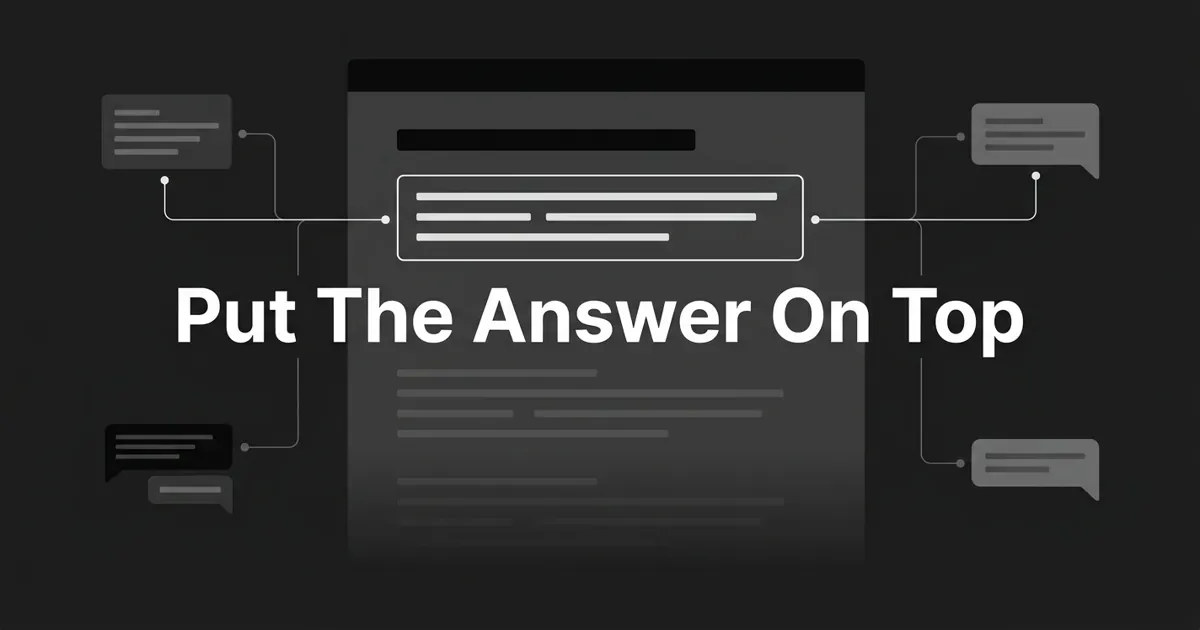
That gap is usually not a quality problem. It is a placement problem, and the fix is smaller than you think: one short block at the top of the page, written so an engine can lift it whole. This guide walks you through writing a summary for AI citation, step by step, from picking the question to checking whether the engines echo you back.
Give it one page to start. You will feel the difference before you finish the third step.
Why the top of your page decides whether you get cited
Writing a TL;DR for SEO used to be a courtesy to skimmers. It was optional. That changed when engines started answering questions instead of listing links, and the same little block became the thing that decides whether you get quoted.
AI engines do not read your article the way your reader does.
They break it into passages, score each passage on its own against the question, and cite the ones that score highest. Your beautiful third section is not competing with other websites. It is competing with your own opening.
Three things make the top block win more often than anything else on the page.
Passages get scored independently. Each heading section, each FAQ answer, each block stands alone in the index. Your opening block is reliably one of the strongest passages you own.
Position carries weight. Models learned from the web that the important part sits near the top. Your first hundred to two hundred words get read harder than the rest.
The middle gets forgotten. Even with huge context windows, engines hold onto beginnings and endings better than middles. A summary buried at the halfway mark lands in the weakest zone you have.
Pages with clean heading structure and a real top-of-page summary earn meaningfully more AI citations than pages without them. That is the whole bet here. You are not writing more. You are moving your best sentence to where the engine actually looks.
So the job is narrow: build one summary block AI search engines can lift without editing it. Not a better intro. Not a longer page. One liftable block.
Here is the good news: you have already written the answer somewhere in that page. You just have to move it up and tighten it.
Step 1: Pick the one question your page answers
Before you write a single word of the block, finish this sentence: "This page answers the question ___."
One question. No "and."
If two questions feel equally central, that is your signal the page should be two pages. A summary block cannot serve two intents at once. It goes vague trying, and extracts poorly for either.
You know it is done when you can say the page's question out loud in one sentence, with no conjunction holding two ideas together.
Where people go wrong: trying to summarize a multi-intent page with one block. The result reads fine to a human and like mush to an engine. If your page answers three things, pick the dominant one and let the others go.
People skip this step because it feels too obvious. Do not. Every later step inherits this decision.
Step 2: Draft the answer in two to four declarative sentences
Now answer the question. Plainly, in the flattest language you can manage.
No hook. No anecdote. No setup. Two to four sentences, roughly 40 to 60 words, with the subject, verb, and object sitting close together in each one.
This is the spine of the block. Everything else is refinement.
A TL;DR for SEO and a summary for AI citation want the same thing, which makes this easier than it sounds. Both reward the answer arriving first. You are not writing two blocks for two audiences.
Length matters more than it feels like it should. The practical range for a paragraph summary is 40 to 60 words. If you are writing a bulleted TL;DR instead, aim for 60 to 120 words across three to six bullets, each bullet 10 to 20 words. The ceiling to respect is around 150 words, because engines lift contiguous passages up to roughly that length. Go longer and your block gets fragmented or summarized rather than quoted. The floor is around 25 words. Go shorter and there is not enough there for an engine to cite with confidence.
Which format should you pick? Match what the engine already does for your query. Ask your target question in ChatGPT or Perplexity and look at the shape of the answer. Bulleted answer, bulleted block. Paragraph answer, paragraph block. Make the lift easy.
You know it is done when a reader could absorb those sentences alone and walk away with the right mental model of the topic.
Where people go wrong: adding a fifth sentence that hedges. "It depends," "however," "in some cases." Cut it. A hedge makes the passage less confident, and the engine simply picks a more confident passage from somewhere else.
One more thing, and it is the tip that changes the most drafts: write this block after you write the body. Reverse the order that feels natural. A summary written last reflects what the page actually concluded, not what you guessed before you argued it through.
Step 3: Swap your jargon for the words buyers actually search
Read your draft block again. Circle every noun and verb that a buyer would never type.
"Unlock." "Supercharge." "Robust." "Leverage." Those words came from your marketing brain, not from anyone's search bar.
Now go find the real language. Open the People Also Ask box on your target query. Scan Reddit threads where people ask this in their own words. Pull the prompts you already track. Then mirror three to five of those phrases into the block, in the places they already fit.
Perplexity in particular rewards phrasing that matches how people actually ask. Mirroring the search language is not keyword stuffing. It is writing in your reader's vocabulary instead of your own.
You know it is done when every noun and verb in the block is a word a buyer would type, not an internal term you inherited from a positioning doc.
Where people go wrong: drifting back into brand-voice jargon on the second pass, usually because the plain version "sounds too simple." Plain is the point. Plain extracts.
If you already track the prompts your buyers ask an AI, this step takes five minutes instead of an hour. That is what a tool like DeepSmith does in the background: it tracks the questions that matter in your space across ChatGPT, Perplexity, Gemini, Claude, and Google AI Mode, and shows the phrasing each engine sees. With that list open beside your draft, you stop guessing at buyer language and start copying it.
Step 4: Add one named entity or one real number
A block with no proper noun and no numeral is a block an engine can safely ignore.
Add at least one. A brand name, a framework name, a year, a percentage, a dollar figure, a version number, a count of days. Anything specific and checkable.
Engines favor passages carrying a named entity or a concrete number, because those answer with substance. "Many teams see improvement" is unciteable. "Teams tracking five engines" is citeable.
You know it is done when the block contains a proper noun or a numeral. Read it and point at one.
Where people go wrong: reaching for vague filler when the specific fact sits right there in the article. "Many customers" instead of the actual figure. The engine finds a competitor passage with a real number and cites that instead.
You do not need to invent a stat. Pull the specific thing your page already proves.
Step 5: Move the block directly under your H1
This is the step with a hard rule attached, and the one most teams quietly break.
The summary goes directly under the H1. Before the first paragraph. Before the hero image. Before the byline, the audio player, the share buttons, the subscribe box, and the "what's inside" table.
First readable thing after the title. That is the rule.
When you add TLDR to blog post templates, this is where the CMS fights you. Your theme wants a hero image under the title. Your growth team wants a subscribe CTA. Every one of those elements pushes your summary down the passage stack, and a competitor whose block sits first wins the citation with worse content than yours.
A few placement failures worth naming:
- Do not put the summary at the bottom. A bottom-of-page summary is a conclusion, and conclusions do not get extracted as answers.
- Do not put it inside a hero image. Engines cannot read your graphic.
- Do not hide it behind a tab, an accordion, or a JavaScript-only component. If it does not render as text, it does not exist.
- Do not lead with a quote, a rhetorical question, or an "in this article we will cover" preamble before the block.
You know it is done when you load the live page on a phone and the summary is visible above the fold, right under the title.
Where people go wrong: leaving a long intro paragraph above the summary because "it flows better." It probably does flow better. Position still wins over flow. Move the block up and let the intro follow it.
If it helps, stop thinking of this as the intro and start thinking of it as a key takeaways section AEO engines can find without hunting. The intro can still exist. It just sits second now.
Step 6: Mirror the summary in your Article schema
You have a good visible block. Now give the engine a second copy of the same signal.
Open your page's JSON-LD. Find the Article or BlogPosting schema. Set the description field to a near-verbatim version of your visible summary. Keep it under about 200 characters so it renders cleanly in previews.
Two matching signals of the same answer beat one strong signal on its own.
While you are in there, a few things worth knowing:
- mainEntityOfPage points at the core thing the page is about. It clarifies the subject for engines.
- Author and Organization tie the page to a real person or brand. Engines use identity as a trust signal.
- FAQPage only if the page has a visible FAQ with real question and answer pairs. The markup must match the page. Mismatched markup gets treated as spam.
- HowTo only if the page is genuinely a step-by-step guide with named steps.
And one trap, because it costs teams real implementation hours: Speakable schema is not an AI-snippet signal. It marks passages for text-to-speech playback on voice assistants and does nothing for AI Overview or LLM citation rates. People recommend it constantly by misreading the documentation. Skip it.
The visible block itself needs no special schema. It inherits your page-level Article markup automatically.
You know it is done when the schema description and the visible block convey the same answer in the same words.
Where people go wrong: writing the schema description as marketing copy. "Learn how to master AI citations today." That is a pitch, not an answer. Put the answer there.
Pro tip while you have the page open: mirror the same sentence into your meta description tag too. Visible block, schema description, meta description. Three consistent signals saying the same thing.
Step 7: Validate, publish, then ask the engines
You are almost done. Two checks and one loop.
Validate the markup. Run the page through Google's Rich Results Test. Confirm Article, plus FAQPage or HowTo if you used them, come back with no errors.
Check the render. Load the live page on a phone. The summary should be the first text after the title. If something crept in above it, fix that first.
Then ask the engines. This is the step almost nobody does, and it is the only one that tells you the truth. Ask ChatGPT, Perplexity, Gemini, and Google AI Mode the exact question your page targets. Read the answer. Is your wording echoed back?
If yes, you have a working block. Do it again on the next page.
If no, your block is too vague, too long, or still sitting in the wrong position. Tighten it and check again in a couple of weeks.
You know it is done when the Rich Results Test passes, mobile shows the summary above the fold, and the engine returns your wording when asked your question.
Checking one page by hand is easy. Checking sixty pages across five engines every month is where this quietly becomes a job. That is the part worth automating: DeepSmith tracks mention and citation rates per prompt across the engines on your plan and shows which pages are actually cited, so you can see whether a rewrite moved anything. It reports what engines say and cite. It does not control rankings or citations, and no tool can promise those.
Weak versus strong: three summaries side by side
Rules land better with examples. Here are three page types, each with the block most teams write and the block that actually gets lifted.
A how-to page
Weak:
"In today's fast-moving content landscape, discovery has shifted toward AI engines. Have you ever wondered why some sites get cited and others do not? In this article, we dive deep into the method that drives AI citations."
Three sentences, zero answers. It burns the block on setup and a rhetorical question. "Fast-moving" and "deep" are filler. "Some sites" and "others" are pronouns where named entities belong. An engine finds nothing here to quote.
Strong:
"To get cited by ChatGPT, Perplexity, and Google AI Overviews, place a 40 to 60 word direct-answer TL;DR directly under the H1. Use the same words your buyers search, name the engines and the action in sentence one, and pair the page with Article schema whose description field mirrors the summary text."
Fifty-two words, two sentences. It names the engines, the action, the length, the placement, and the schema. Sentence one is the answer. Nothing here is decoration.
A product or definition page
Weak:
"Many tools claim to help with content. As you can see, the market is crowded. We will explore what makes a content platform different."
No definition. No named entity. No number. The verdict gets deferred to "we will explore," which is another way of saying "not yet."
Strong:
"DeepSmith is an AI search analytics and content production platform that tracks how ChatGPT, Gemini, Perplexity, Claude, and Google AI Mode answer questions about a brand, then produces publish-ready articles to close the gaps. It tracks mention and citation rates, not rankings or revenue."
It defines the thing, names all five engines, names the two metrics, and states the negative scope. That last part matters more than people expect. Saying what you do not do makes the passage more trustworthy to quote, not less.
A comparison page
Weak:
"Let's take a look at the various AEO frameworks. Each has its merits. There are many things to consider."
Three sentences that compare nothing. No frameworks named, no verdict, no reason to prefer this passage over any other.
Strong:
"The AEO guidance on summary blocks converges on three rules: place the block directly under the H1, keep it between 40 and 120 words depending on format, and write it as a declarative answer rather than a setup. Practitioners disagree on schema depth. They agree on placement."
It states the comparison, gives the numbers, names the consensus, and names the disagreement. An engine can lift that whole thing and be correct.
Look at what the weak blocks share. Every one of them fails on at least three of the five rules: lead with the answer, name entities, use concrete numbers, write declaratively, stay under the length ceiling. The strong blocks hit all five. That is really the entire test.
Read your own block against those five. If it passes, you have a summary block AI search engines can quote. If it fails one, you know exactly which sentence to fix.
What to do next
Do not go rewrite forty pages this week. You will burn out and the pages will get worse.
Pick one page. Ideally your highest-traffic page that is not getting cited, because that gap is where the fastest win lives. Give it the seven steps, then add TLDR to blog post templates only once you have seen the pattern work on something real. Publish. Wait two weeks. Ask the engines your question and see whether your wording comes back.
That one loop teaches you more than any checklist can, including this one. Then do the next page. Momentum matters more than volume.
If you want this built in from the start rather than retrofitted page by page, that is what DeepSmith's writing pipeline is for: AEO formatting, heading structure, schema, internal links, and metadata are part of how the article gets produced, not a cleanup pass afterward. You can start a free trial and see what it produces on your own topics.
Either way, move your best sentence to the top of the page. That part is free.