

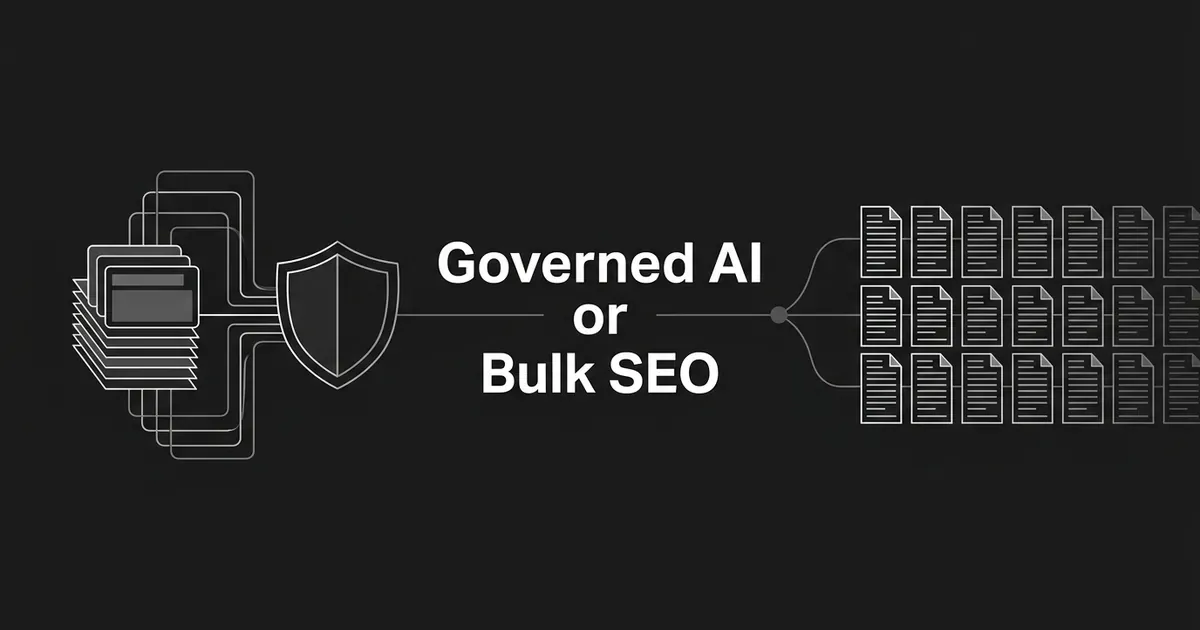
Writer is an enterprise AI platform that governs content and other work across teams, while Byword is a self-serve tool that researches keywords and publishes SEO articles in bulk at published per-article prices. Writer suits large organizations with IT and compliance needs, and Byword suits SEO teams and agencies that want volume. DeepSmith matches Byword on production volume and adds the part both leave thin: it tracks where AI answers miss your brand and writes the articles that close those gaps.
Writer AI vs Byword comes down to what is actually holding your content back. If the problem is getting many teams to use AI safely under one set of brand and security rules, Writer is built for that. If the problem is turning a keyword list into published articles quickly, Byword is built for that. DeepSmith sits beside both for teams whose real question is which topics deserve the volume in the first place.
Writer vs Byword: the short answer
- Choose DeepSmith if you want one platform that tracks your brand across AI engines, finds the prompts where you are missing, and produces publish-ready articles for them, starting at $99 a month with a 7-day free trial.
- Choose Writer if you are a large organization that needs governed AI workflows grounded in company knowledge, with SOC 2 Type II, SSO and approvals, and you are fine with a sales-led contract.
- Choose Byword if you are an SEO team, agency or publisher that wants keyword research, bulk campaigns and scheduled publishing at public prices from $99 a month, and you will edit and fact-check the output yourself.
Side-by-side comparison
| DeepSmith | Writer | Byword | |
|---|---|---|---|
| Entry price (monthly) | $99/mo (Pro) | Not published | $99/mo (Starter) |
| Annual price (per month) | $80/mo | Not published | $83/mo |
| Articles at entry tier | 20 per month | Credit-metered, amount not published | 25 per month |
| Free trial | 7-day trial | 14-day trial, no card | 5 free articles, no card |
| Long-form article generation | Yes | Yes | Yes |
| Brand voice and knowledge grounding | Yes | Yes | Yes |
| SERP-based content scoring | - | Not listed | Yes |
| Internal linking | Yes | Partial, legacy editor only | Yes |
| Bulk generation | Yes | Partial | Yes |
| Scheduled write and publish | Yes | Partial | Yes |
| AI visibility tracking | Yes | Partial, playbook use case | Partial, via MCP |
| Collaboration and approval steps | Partial | Yes | Partial |
| Security certifications | Yes, SOC 2, GDPR, ISO | Yes, SOC 2 Type II, ISO | Not listed |
| G2 rating | 4.8/5 | 4.4/5 | 3.5/5 |
Pricing and features as of September 2026, from each vendor's site and public reviews.
Writer

Writer is an enterprise AI platform. It was founded in 2020 in San Francisco and is built around WRITER Agent, Playbooks, a graph-based Knowledge Graph and its own Palmyra models. Content is one use among several. The same platform covers campaign work, sales prep and analysis, and the company calls itself an end-to-end platform for scaling agentic AI in the enterprise. Marketing and revenue teams at large organizations are its lead audience.
The standout is governance. Voice profiles link to style guides and banned terms, Playbooks can pause for a named reviewer's sign-off, and Enterprise adds SAML SSO, SCIM, audit logs and a published 99.9% availability target for qualifying deployments. Writer reports SOC 2 Type II and ISO 27001, 27701 and 42001 certifications.
The limits show up on the SEO and pricing side. Writer has no keyword database of its own, and keyword data comes through a Semrush connector. Starter is a 14-day trial tier for up to 5 users, but the plans page shows no seat price or credit amount, and Enterprise is quote-only. Reviewers praise ease of use and brand consistency, and some describe generic output that needs editing. Writer holds 4.4/5 on G2 from 130 reviews, and TrustRadius rates it 5.7/10.
Byword

Byword is a self-serve AI article writer run by a small London company and founded by Mack Grenfell. It launched in late 2022 and rebuilt itself as version 2 in January 2026. Its tagline is "the AI article writer built for SEO at scale," and the product follows that. You give it a keyword, a title or a template, and it researches the search results, drafts the article, adds internal links and images, and publishes to WordPress, Webflow, Ghost, HubSpot or Medium.
The standout is volume with public pricing. Campaigns run batches of articles, and programmatic templates fill variables from a CSV to produce hundreds or thousands of pages. Plans run from $99 a month for 25 articles to $999 for 300, with extra articles at $2.50 to $3.50 depending on the plan, and credits roll over.
The limits are in security, reviews and depth. Byword's pages describe no SOC 2, SSO or service-level commitment. Independent reviews are few and mixed: G2 shows 3.5/5 from 3 reviews and Trustpilot 2.8/5 from 7, with the latest Trustpilot review from June 2025. Reviewers have reported repetitive passages and weak link choices, so the output needs a human check.
DeepSmith: the alternative that tracks AI answers and writes the fix

Writer and Byword both start from the work to be done. Writer begins with a task someone hands to an agent, and Byword begins with a keyword someone picked. In both cases a person decides what to write using something outside the tool. That is fine when the topic list is settled. It matters more when buyers now ask ChatGPT, Perplexity and Gemini the questions your articles are meant to answer, because a keyword list does not tell you which of those answers leave your brand out.
DeepSmith tracks and produces in one platform. AI Visibility checks the prompts you define on a schedule and reports mention rate, citation rate and share of voice, with a per-platform breakdown, the pages AI cites, and which competitor pages win the citations you miss. The Content Map compares your coverage against competitor sites, and Opportunity Agents turn those findings into content ideas that each carry the data point behind them.
Production then runs on the same data. The Writer turns a planned idea into a finished article with research, internal and external links, a cover image and publish-ready metadata, grounded in your Deep IQ brand context. AEO formatting, which means crisp answers near the top and clear headings, is part of the writing pipeline, and Autowrite can generate an article on its scheduled date with nobody in the app. Finished pieces publish to WordPress, Webflow, Strapi, Sanity or Contentful, or to your own webhooks.


Pricing is published: Pro is $99 a month with 20 articles, 50 tracked prompts and ChatGPT tracking, Grow is $199 with 40 articles and adds Perplexity, and Scale is $399 with 90 articles and adds Gemini. Annual billing lowers these to $80, $160 and $299, and Enterprise covers all ten tracked engines. The platform is SOC 2, GDPR and ISO certified and rated 4.8/5 on G2.
Governance and security
Writer wins this one clearly. It documents SOC 2 Type II, ISO certifications, SAML SSO and SCIM on Enterprise, step approvals in workflows, audit logs and an MCP gateway with tool-level permissions. Byword documents team seats with Owner, Editor and Viewer roles from its Standard plan, and its MCP server has optional review gates, but it lists no certifications or SSO.
For a regulated company, that difference usually decides the purchase before features are compared. Writer's own Enterprise-only gating also matters: SSO, SCIM, audit logs and the SOC 2 report are not on Starter.
What DeepSmith does: DeepSmith stores your brand context once in Deep IQ, covering company positioning, products, personas, brand voice, content types and visual guidelines, and every article is written against it. It is SOC 2, GDPR and ISO certified, and Multi-Workspace keeps each brand or client isolated with its own context, content and plan. Reviewing and editing happens in Produced Content before anything goes live.
SEO research and optimization
Byword wins this one. It documents a keyword explorer with volume, difficulty and intent, SERP insights, content gap analysis and an optimizer that compares a page to the top 10 results. Its feature page claims a live score across 147 factors, though its own Surfer SEO comparison describes its scoring as implicit and concedes that Surfer's analyzer gives deeper competitive detail. Writer reaches search data through the Semrush connector, and its internal link suggestions exist only in a legacy editor that the help center says is no longer available after migration.
If your process starts with keyword research and ends with a score against ranking pages, Byword puts that in one place. Writer fits better when SEO is one task among many and your team already pays for a dedicated SEO suite.
Bulk generation and publishing
Byword wins here as well. Campaigns process roughly three articles at a time and are best for batches of 5 to 100. Programmatic templates cover 100 to over 10,000 pages from CSV data. Scheduled generation and auto-publish are documented, and credits roll over. Writer can run playbooks in bulk and on schedules, and its connectors publish to Webflow, Adobe Experience Manager and Contentful, but bulk article generation is something you assemble from those pieces and has no documented limits.
Volume comes with a quality question, and the evidence on it is mixed. Byword's own March 2026 experiment reports about 13,000 pages and a rise in weekly clicks from roughly 1,000 to 6,000, but that is a self-reported result, and reviewers describe the need to fact-check generated content.
What DeepSmith does: DeepSmith plans articles individually or in bulk, and Autowrite writes each one on its scheduled date and lands it in Produced Content. Output is publish-ready, and the monthly allowance of 20, 40 or 90 articles on Pro, Grow and Scale sets the ceiling. What changes is where the volume goes, since Opportunity Agents point it at prompts where you are not yet cited.
Pricing and value
Byword vs Writer AI on price is mostly a question of openness, and Byword wins it. Starter is $99 a month for 25 articles, Standard is $299 for 80 with API access and three seats, Scale is $999 for 300 with ten seats, and the Unlimited plan is a $1,999 monthly platform fee plus your own model keys. New accounts get 5 free articles with no card. Writer's Starter has a 14-day trial and a limit of 5 users, but no published price, and Enterprise is credit-metered and set by contract. A third-party article reported a Starter seat price, which Writer's current page does not confirm, so treat any number you hear as unverified until you get a quote.
In most cases the cost question for Writer is a total contract question, since credits are pooled across users and metered by model use. For Byword it is simply how many articles you will publish each month.
What DeepSmith does: DeepSmith publishes four plans with fixed monthly article and prompt allowances, billed monthly or annually, with no long-term contracts or cancellation fees. A single plan covers AI visibility tracking and article production, so you are not paying for a research tool and a separate tracker.
From insight to action
Neither tool is a dedicated AI visibility tracker, and on this axis they come out close to even. Writer describes scheduled visibility monitoring of mentions, citations and sentiment across ChatGPT, Claude and Perplexity as a use case you build with agents and playbooks, and its records do not document engines per plan, prompt counts or how the data is collected. Byword does not track AI answers natively. Its site links to a separate product, Trakkr, and only its MCP documentation mentions AI-search citation data.
So both vendors leave a gap between knowing where your brand is missing in AI answers and writing something that fixes it. For Writer that gap is closed by your own playbook work, and for Byword it is closed by a second subscription and your own judgment.
What DeepSmith does: DeepSmith runs that loop inside one platform. AI Visibility finds the prompts where competitors are cited and you are not, Opportunity Agents return ideas with the evidence attached, the Writer produces the article with AEO formatting, and the same tracking shows whether citations move afterward. Over a few months of the same prompts you can see the overall direction, which is more reliable than any single week.
Which should you choose
- DeepSmith fits marketing teams and agencies that want to know which prompts to win in AI search and produce the content for them without stitching tools together. It covers tracking, planning, writing, scheduling and publishing, with published prices and a free trial.
- Writer fits a large company where marketing is one of several departments using AI, IT is a stakeholder, and SOC 2, SSO, approvals and company knowledge grounding are requirements. Writer AI or Byword is an easy call here, because Byword's pages list no SOC 2 report or SSO.
- Byword fits an SEO team, agency or niche-site publisher whose plan is already a keyword list and who wants batch generation, programmatic pages and scheduled publishing at public prices. Choose it over Writer when volume and search research matter more than governance.
For a closer look at the first pair, see DeepSmith vs Writer. The second pair is covered in DeepSmith vs Byword.
Start a 7-day DeepSmith trial at app.deepsmith.ai and see which of your tracked prompts leave you out.


