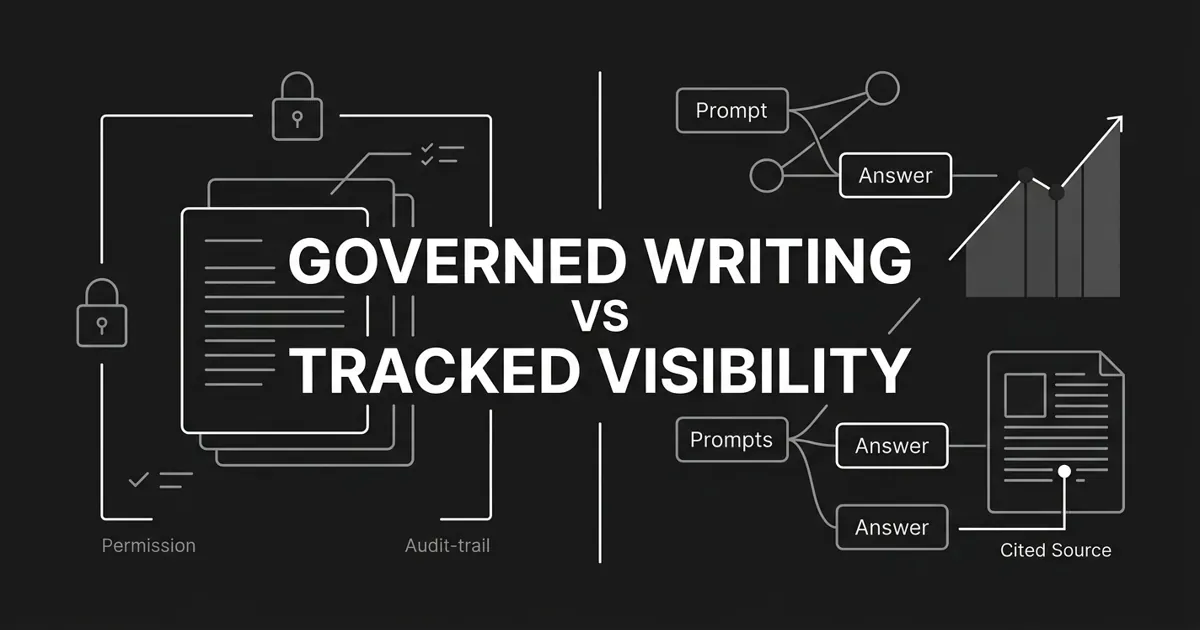
Most buyers who evaluate DeepSmith vs Writer are not comparing two versions of the same product. They are comparing two answers to the question of what an AI content investment should return. Writer answers with governed AI capability across an organization: agents that execute codified workflows inside enterprise systems, under audit logs, permissions, and a certification stack a security review can process. DeepSmith answers with a measured outcome: whether a brand appears when AI engines answer the questions its buyers ask, and the publish-ready content that closes the gaps the tracking exposes.
That difference decides most evaluations before any feature comparison begins. A content team asking whether to pick DeepSmith or Writer is usually asking one of two narrower questions: whether the organization needs to standardize AI usage across many functions under strict controls, or whether the marketing function needs to see and improve its position inside AI answers. What follows is a decision aid for a buyer at the point of purchase, not a roundup of every writer.com alternative on the market.
DeepSmith vs Writer at a glance
The table below summarizes the two platforms on the dimensions that separate them in a real evaluation.
| Dimension | DeepSmith | Writer |
|---|---|---|
| Category | AI search analytics and content production in one | Enterprise AI platform for agentic work |
| Primary motion | Find AEO gaps, then produce articles that close them | Deploy agents across enterprise systems |
| Output | Publish-ready articles with links, cover image, metadata | Documents, slides, dashboards, code, other deliverables |
| AI-search tracking | Native across ten engines, including ChatGPT, Gemini, Perplexity, Claude, Google AI Overviews, and Google AI Mode, by tier | No productized mention or citation tracker |
| Visibility metrics | Mention Rate, Citation Rate, Share of Voice, Sentiment, Visibility Trend | Not applicable |
| Model layer | Frontier models, not user-selectable | Owns Palmyra; can run open-weight or external models |
| Brand context | Deep IQ: company, products, personas, voice, visuals, content types | Brand module plus Knowledge Graph retrieval |
| Governance | Standard B2B SaaS terms; certifications not publicly enumerated | SOC 2 Type II, ISO 27001/27701/42001, HIPAA Type 1, PCI, GDPR, CCPA, DPF |
| Publishing | WordPress, Webflow, Strapi, Sanity, Contentful, webhooks, Markdown and HTML export | Native bi-directional Salesforce plus broad connectors |
| Pricing | Per workspace: $99, $199, $399 per month, Enterprise custom | Per seat; Starter and Enterprise named, list pricing largely unpublished |
| Trial | 7 days, workspace populated before payment | 14 days, no credit card |
| Best fit | Content teams measured on citations and share of voice | Large organizations standardizing governed AI use |
What Writer is in 2026

Writer positions itself as the enterprise AI platform for agentic work. The framing is deliberate: the product is an agent an organization delegates to, not a tool an individual prompts. Writer Agent is the unified agent experience, Playbooks are codified workflows the agent executes, Routines schedule those Playbooks, and Connectors give the agent bi-directional reach into third-party systems. AI Studio supports building custom AI applications, Brand holds voice, terminology, and style-guide enforcement, and Knowledge Graph provides graph-based retrieval so the agent reasons over enterprise data with grounding.
The product line has moved quickly. The Agent experience launched in November 2025, a Skills creator and an enhanced Playbook builder followed in March 2026, and April 2026 added more agent autonomy along with admin controls and new Playbook triggers. Any evaluation of the Writer AI content platform should account for a platform in active expansion rather than a static feature set.
The Palmyra model layer
Writer owns its model stack. The Palmyra family is Writer's proprietary set of large language models, with Palmyra X 004 released on May 22, 2026 as the current frontier model. Its published capabilities include a 128K context window, support for more than thirty languages, multimodal inputs across image, audio, and video, built-in retrieval-augmented generation with chain-of-thought reasoning and source transparency, tool calling, and code generation. Palmyra is available through the API and the Writer Framework, through no-code applications, through the Ask Writer chat experience, and inside Slack, and Writer can also run open-weight or external models behind the same governance layer.
Model ownership is a real differentiator, and a real argument for enterprises concerned with data sovereignty and vendor concentration. It is also worth being precise about what it does not address. Owning the model layer determines where inference runs and under what terms; it does not determine whether AI answer engines cite a brand's pages, which is a function of what is published and how retrievable it is.
Governance is Writer's strongest axis
Writer's compliance posture is the most concrete reason large organizations select it. The published attestations include SOC 2 Type II, ISO 27001, ISO 27701, ISO 42001, HIPAA Type 1, PCI, GDPR, CCPA, and the Data Privacy Framework. The stated data practices are equally specific: no training on customer data, inputs, or outputs; customer ownership of all data and generated outputs; zero data retention by default; encryption at rest and in transit; isolated production projects; least-privilege access with periodic reviews; audit logs and decision logs; automated deletion schedules; and single sign-on with multi-factor authentication.
For a regulated enterprise, that list is the entry condition for a security review, and it is an axis on which DeepSmith does not currently compete on public evidence. The adjacent limit is one of scope rather than quality: governance controls how AI is used inside the organization, and it produces no signal about how the organization appears outside it, in the AI answers where buyers now form shortlists.
Where Writer is genuinely strong
Writer suits organizations with several characteristics. Its named customer base includes Vanguard, Salesforce, KPMG, Qualcomm, Uber, Dropbox, Marriott, Comcast, TikTok, and Accenture, a reference base that materially de-risks a large procurement decision. Its native bi-directional Salesforce connector is Writer-built rather than assembled from generic middleware, and the broader ecosystem covers Snowflake, Databricks, Slack, HubSpot, Google Workspace, Microsoft 365, GitHub, Atlassian, Notion, Webflow, Semrush, Gong, Zoom, and Workday. The Agent, Playbook, and Routine model fits recurring multi-system work that extends well past content, including campaign operations, account-based personalization, and sales enablement. Its rating sits at 4.4 out of 5 across 127 reviews on G2.
The documented constraints are the ones a buyer should price in rather than discover later. Non-trivial deployments typically take two to six months to roll out, published review commentary puts internal adoption near forty percent in the first year, and output style skews conservative and brand-safe, so a distinctive editorial voice requires deliberate tuning. None of these invalidate the platform; they describe the operating conditions under which its strengths are realized.
What Writer does not do
Writer does not ship a productized AI-search visibility tracker. There is no mention or citation tracker across ChatGPT, Gemini, Perplexity, or Google AI Overviews inside the product, no per-prompt rates, no page-level citation attribution, and no competitor citation leaderboard. Writer publishes content-marketing guidance on generative and answer engine optimization, but guidance is not instrumentation. A team buying Writer for AEO would need to pair it with a separate visibility tracker and accept that the tracking data and the production surface live in different tools. That gap is the most common reason a content team inside a Writer-standardized organization starts evaluating a writer.com alternative for the AEO half of the job.
What DeepSmith is

DeepSmith is an AI search analytics and content production platform in one. The operating idea is direct: see where a brand shows up in AI search, find the gaps, and close them with on-brand content, all from the same data. The production stance is a production engine, not a writing assistant, and the output is a finished article rather than a first draft to rescue.
Seven modules run off a shared brand context established once during onboarding. AI Search Visibility reports mention rate, citation rate, and share of voice with trends, a per-platform breakdown, a competitor leaderboard, and the sources AI cites most. Content Map turns the brand's site and unlimited competitor sites into one topic taxonomy, exposing coverage gaps where a rival publishes more and untapped topics where the brand has nothing at all, refreshed every 24 hours. Opportunity Agents read that map and the visibility data and return ideas, each carrying the data point that justifies it. Content Studio moves ideas from New Ideas through Planned Content to Produced Content. Repurpose and the Apps Library convert a finished article into platform-native versions for LinkedIn, X, Medium, Substack, newsletter email, Reddit, Slack, and other channels. Deep IQ holds brand context, and a platform layer supports isolated multi-brand workspaces.
Tracking is the primary object, not a dashboard
The AEO module is where the two products diverge most sharply. DeepSmith tracks brand mentions and citations in AI-generated answers across ten engines, ChatGPT, Gemini, Perplexity, Claude, Google AI Overviews, Google AI Mode, Grok, Meta AI, Microsoft Copilot, and DeepSeek, with per-engine breakdowns and time-series trends. Tracked prompts are organized by buyer stage, and Discover Prompts generates a starter set from product, persona, and stage context rather than requiring a team to invent one. Each prompt carries its own mention and citation rates with full answer history, the Pages view shows which pages AI engines actually cite and which prompts drive those citations, and a competitor leaderboard shows which rivals win citations, on which pages, and on which platform.
Five metrics anchor the analytics: Mention Rate, how often AI names the brand; Citation Rate, how often AI links to the brand's pages as sources; Share of Voice, visibility relative to competitors; Sentiment, whether AI describes the brand positively, neutrally, or negatively; and Visibility Trend, the period-over-period change. The distinction between the first two is not cosmetic, because a brand can be named frequently while its pages are never cited as the source, and the two conditions call for different interventions.

Engine coverage rises by tier. Pro tracks ChatGPT, Grow adds Perplexity, Scale adds Gemini, and Enterprise covers all ten. Pro's single engine is the narrowest rung, and it is also where most buyer research starts; a team that requires more than one from day one starts at Grow, at $199 per month, which remains an order of magnitude below the contract levels that governed enterprise platforms typically involve.
How DeepSmith produces an article
Naming here can confuse a buyer, since Writer is a company and DeepSmith's article generator is also called the Writer. Inside Content Studio, that component turns one planned idea into a finished, brand-grounded article: research, draft, SEO and AEO optimization, internal and external links, cover image, and publish-ready metadata. Keyword coverage, heading structure, and schema markup are part of the pipeline rather than tasks bolted on after the draft. Internal links are inserted during generation from the Content Map, which removes the manual cross-referencing that otherwise consumes thirty to sixty minutes per piece.
Autowrite is the mechanism that changes throughput. An article is configured at planning time and writes itself on its scheduled date, landing in Produced Content with no one in the application. There a human reviews, edits body and metadata, regenerates the cover image if needed, and publishes directly to WordPress, Webflow, Strapi, Sanity, Contentful, or a custom webhook, with Markdown and HTML export as a fallback.

DeepSmith's real limits
Two constraints genuinely bear on this decision. Article volume is tier-capped at twenty, forty, and ninety per month before Enterprise, so a program publishing beyond that needs a custom plan. More significantly for regulated buyers, DeepSmith does not publicly enumerate SOC 2, ISO, or HIPAA attestations, and that gap should be treated as unstated rather than assumed either way; the Enterprise tier, with custom terms, one-to-one onboarding, and a dedicated account manager, is where such requirements get addressed.
DeepSmith is also the newer entrant, and a procurement committee weighting vendor tenure will register that. The counterweight is structural: DeepSmith is self-serve with no long-term contracts, and the workspace arrives populated with a brand brief, competitors, starter prompts, and a first batch of ideas before payment, so the evaluation cost is a seven-day trial rather than a procurement cycle.
Enterprise AI writing vs AEO: the axis that decides this
The enterprise AI writing vs AEO framing is the most useful way to reduce this decision to one question, because the two platforms optimize different variables. Writer optimizes the safety and consistency of AI output produced inside an organization, across functions, systems, and roles. DeepSmith optimizes the visibility of the organization inside AI answers, and treats the article as the action that closes a measured gap.
Those objectives are not in conflict, and they are not substitutes. The practical consequence is that the enterprise AI writing vs AEO choice depends on which variable is currently unmeasured and unowned. If AI usage is spreading through the company with no controls, no audit trail, and no approved model, the governance gap is the live risk and Writer addresses it directly. If leadership is asking why a competitor appears in ChatGPT answers for the category's core questions and no one can produce a number, the visibility gap is the live risk, and no amount of governance will close it. Governance is a precondition for scale rather than a growth channel; visibility is a growth channel, and it degrades quietly, because a brand absent from AI answers receives no error message.
Cost structure: per workspace versus per seat plus rollout
Comparing headline prices misleads here, because the two products meter differently. DeepSmith is priced per workspace: Pro at $99 per month covers five seats, twenty articles, and fifty tracked prompts; Grow at $199 covers seven seats, forty articles, and one hundred prompts; Scale at $399 covers ten seats, ninety articles, and two hundred prompts, with annual billing lowering the effective monthly rate to $80, $160, and $299. Enterprise is custom, and there are no long-term contracts or cancellation fees.
The Writer AI content platform is priced per seat, and its plans page names Starter and Enterprise as the SKUs, with Enterprise adding regular seats plus unlimited free users. Clean list pricing for the intermediate tiers is not published. Third-party marketplace estimates put Starter near $29 per seat per month billed monthly, Team between $18 and $25 billed annually, and Business between $25 and $30, with Enterprise custom-quoted. Those figures are estimates rather than official pricing, and any buyer should confirm them in a quote rather than in a comparison table, including this one.
The per-seat headline reads cheaper, and for a small pilot it often is. The number that decides budget approval is different. Third-party commentary places typical first-year cost for a ten-person team at $15,000 to $25,000 or more once implementation services, training, and integration are included. Set against a two-to-six-month rollout and roughly forty percent first-year adoption, the effective cost per active user runs well above the per-seat sticker, so the comparison a finance reviewer should run is total first-year cost against the work each platform actually removes.
Brand grounding: Deep IQ versus Writer's Brand module
Both platforms solve the same underlying problem, keeping output on-brand without re-briefing every asset, through different mechanisms. Writer's Brand module enforces voice profiles, terminology, and style guides, and the Knowledge Graph adds graph-based retrieval over enterprise data so the agent reasons against real company information. That enforcement model suits large organizations where the primary risk is drift across many contributors, and where terminology compliance carries legal weight.
DeepSmith's Deep IQ is structured rather than enforcement-oriented. It holds About Company with positioning and the claims to make and avoid, Products and Services with a profile per product, Buyer Persona with goals and challenges, Brand Voice with tone settings, Visual Guidelines for on-brand covers, and Content Types as reusable formats. Every draft is shaped by those inputs, which makes output predictable across many articles rather than dependent on the quality of a per-article brief.
The honest read is that Writer's approach is stronger where the requirement is organization-wide compliance with a controlled vocabulary, and DeepSmith's is stronger where the requirement is a repeatable editorial product that reads like a specific brand. The deciding question is whether the actual failure mode is off-message terminology or generic, undifferentiated articles.
Which should you choose
Choose DeepSmith when AI citations are the objective. Content teams measured on being named and cited in AI answers need instrumentation and production in one loop: tracked prompts, per-page citation attribution, a competitor leaderboard, and a pipeline that turns each identified gap into a publish-ready article. Teams running a calendar that stalls during busy weeks benefit from Autowrite specifically, and budgets that prefer predictable per-workspace costs over procurement cycles fit the pricing model.
Choose Writer when governed AI across the organization is the objective. Enterprises standardizing AI usage across marketing, sales, support, and operations, under audit trails, single sign-on, and a formal certification stack, are describing Writer's core competence. The same applies to organizations that need deep Salesforce integration through a native bi-directional connector, that want to own the model layer through Palmyra, and that have the budget and internal champions for a multi-month rollout with professional services.
Consider both when the mandate spans governance and visibility. Large organizations often hold both requirements, and the deciding factor is sequence rather than preference: whether AEO tracking across the named engines is a near-term commitment with a deadline attached, or whether the immediate exposure is ungoverned AI use across functions. Writer plus a separate AEO tracker is a coherent architecture, at the cost of two contracts and a manual handoff between the data and the production surface.
For a content team weighing DeepSmith or Writer with AI visibility as the deciding requirement, real data resolves it faster than a feature grid. Start a 7-day DeepSmith trial and see which prompts the brand already wins, which competitors are taking the citations, and what a publish-ready article looks like against a tracked gap.