

Writesonic and Koala AI both write articles, but they decide what to write from different data. Koala's SEO agent plans from Google Search Console and Analytics and publishes to your CMS with internal links, while Writesonic plans from AI visibility tracking and a ranked Action Center. DeepSmith is a strong alternative when you want both jobs in one place: it tracks citations and share of voice across AI engines, joins them to Content Map competitor gaps, and repurposes every article into channel formats.
Writesonic vs Koala AI comes down to where you want your content plan to start. Koala looks at what your site already earns in Google and plans the next articles from that. Writesonic looks at how AI assistants talk about your brand and plans from the gaps it finds there. Both then write the articles, so the real choice is which data you trust to steer a content calendar, and what each plan costs once you want that data. DeepSmith sits next to the two, because it tracks AI answers and writes the content that closes the gaps on one plan.
Writesonic vs Koala: the short answer
- Choose DeepSmith if you want to track how AI engines cite you, see which topics competitors cover that you don't, and get publish-ready articles for those gaps from one plan, starting at $99 a month with a 7-day free trial.
- Choose Writesonic if you want AI visibility tracking and a ranked list of fixes in one product, and you are fine with ChatGPT, Gemini and Google AI Overviews on self-serve plans, from $79 a month billed annually.
- Choose Koala if you want to plan articles from your own Search Console and Analytics data and publish them in volume, from $25 a month.
| Criterion | DeepSmith | Writesonic | Koala |
|---|---|---|---|
| Entry price (monthly) | $99 (Pro) | $99 (Starter, vendor-stated, Sept 2026) | $25 (Starter) |
| Annual price (per month) | $80 | $79 | Not listed |
| Free trial | 7-day free trial | 7-day free trial, no card | Free account with 5,000 words and 25 credits, no card |
| Articles at entry tier | 20 per month | 15 per month | 45,000 words per month |
| Most engines on any plan | 10 (Enterprise) | 10 (Enterprise) | 1 (Google AI Overviews, on-demand checks) |
| AI visibility tracking | Yes | Yes | Partial, on-demand checks |
| Citation tracking | Yes | Yes | Not listed |
| Search Console and Analytics integration | - | Yes, GA4 Enterprise only | Yes |
| Competitor content gap analysis | Yes | Not listed | Yes |
| Content briefs or outlines | Partial | Partial | Yes |
| CMS publishing | Yes | Yes | Yes |
| Repurposing into channel formats | Yes | Partial | Partial |
| SOC 2 | Yes | Yes, vendor claim | Not listed |
| Review rating | 4.8/5 on G2 | 4.7/5 on G2 | 4.5/5 on G2 |
Pricing and features as of September 2026, from each vendor's site and public reviews.
Writesonic

Writesonic started in 2021 as an AI writing tool, is backed by Y Combinator, and now sells itself as an AI search growth engine. It is built for marketing, SEO and content teams and for agencies that want AI visibility tracking and content work in one tool. It tracks prompts daily and reports brand mentions, citations, share of voice and sentiment, and it adds AI crawler analytics, AI ads tracking and shopping tracking on top.
The standout is the Action Center, which ranks on-page, off-page and technical fixes by an impact, confidence and effort score, and the Article Writer then produces long-form pieces for the gaps. Writesonic says those articles run 3,000 to 8,000 words and come out publish-ready, which is a vendor claim.
The real limit is packaging. Starter, Basic and Growth track only ChatGPT, Gemini and Google AI Overviews, and the full ten-engine set sits on custom Enterprise plans. The full Action Center is Enterprise only too, with Growth getting five on-page and five off-page actions a month and Starter and Basic getting none.
On reviews, Writesonic shows 4.7/5 on G2 from 2,133 reviews, checked in late September 2026. Capterra adds 4.8/5 from 2,102 reviews. Most of that history reflects the older writing product, and reviewers of the newer visibility product mention a learning curve and some unclear scoring.
Koala
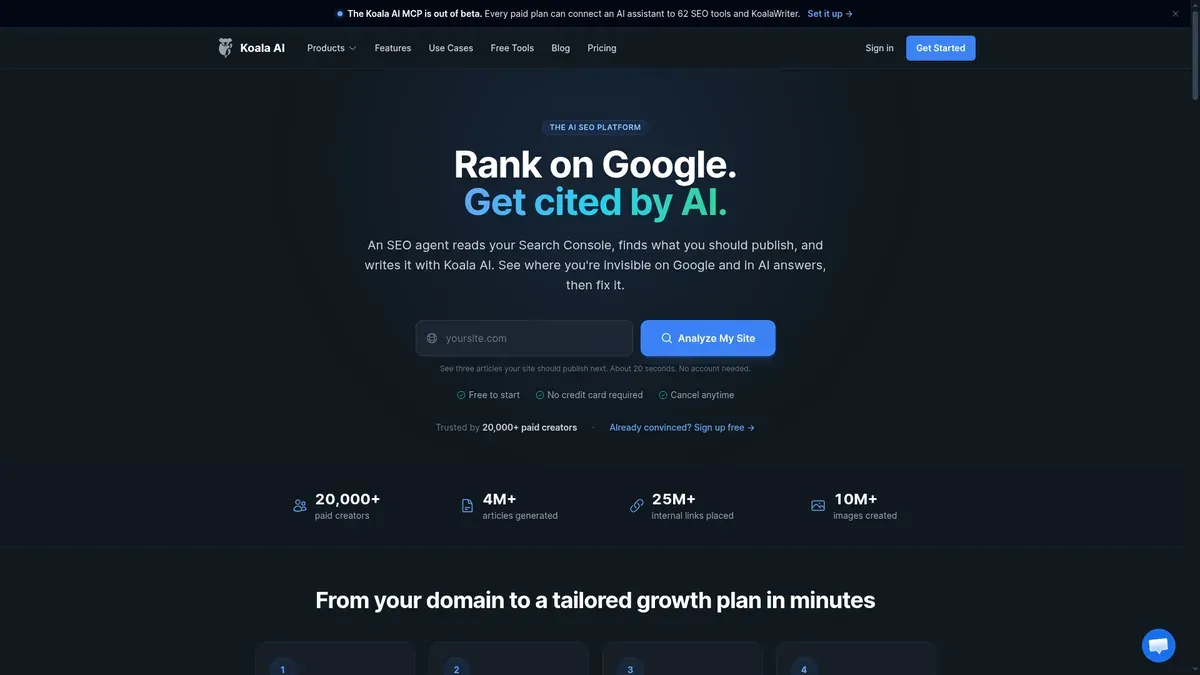
Koala AI is run by F5 Media, LLC in Gainesville, Florida, and was founded by Connor Smith in 2020. One subscription covers six products: Brand DNA (a knowledge base plus an SEO agent), KoalaWriter, KoalaChat, KoalaImages, KoalaLinks and KoalaMagnets. Every paid plan also includes a public API and a 62-tool MCP server. It is built for bloggers, affiliate and niche publishers, local businesses and agencies that want to produce a lot of SEO articles.
The standout is the planning loop. The SEO agent reads Search Console and Analytics, finds topics and striking-distance queries, hands them to KoalaWriter, and the finished article publishes to WordPress, Shopify, Webflow or Ghost with internal links. Pricing is public, from $25 to $2,000 a month.
The limits are in AI search and in the paperwork around it. Its AI visibility is limited to on-demand checks of whether Google AI Overviews cite a domain, with no recurring tracking, and no SOC 2 or other security certification is published.
Reviewers on Capterra give Koala 4.5/5 from 70 reviews. G2 shows 4.5/5 from 2 reviews, and Trustpilot shows 3/5 from 22. They praise fast, SEO-structured drafts, and complaints cover editing, slow support and disputes about credits and refunds.
DeepSmith: the alternative that tracks AI answers and plans from the gaps

Writesonic and Koala AI each leave a gap for the reader who wants to plan from AI answers and competitor coverage together. Writesonic tracks AI answers across engines, but its full action list and most execution features sit on Enterprise. Koala plans well from your own Google data and can find topics competitors rank for, but its AI search side is limited to on-demand Google AI Overviews checks.
DeepSmith joins those pieces. Its AEO module checks the questions you track on a schedule and reports mention rate, citation rate, share of voice and sentiment, with per-platform results, a competitor leaderboard and the full answer history for each prompt. Its Pages view shows which of your pages AI actually cites. Content Map crawls your site and your competitors' sites onto one topic map, so coverage gaps and untapped topics are measured instead of guessed. Opportunity Agents read that visibility data or that map and return ideas, and every idea carries the data point that justifies it.
From there the Writer turns a planned idea into an article that is researched, linked inside and outside the site, and comes with a cover image and publish-ready metadata. Autowrite can run that on its scheduled date with nobody in the app, and Produced Content publishes straight to WordPress, Webflow, Strapi, Sanity or Contentful, or to your own webhooks. Everything is grounded in Deep IQ, the brand context you set up once from your website, so a hundredth article sounds like the first.

Distribution is part of the same system. Every finished article arrives with social posts already written, and the Apps Library turns one article into platform-native versions for LinkedIn, X, Medium, Substack, email, Reddit and more.

Plans are published: Pro is $99 a month, Grow is $199 and Scale is $399, or $80, $160 and $299 a month billed annually, with 20, 40 and 90 articles a month, 50, 100 and 200 tracked prompts, and a 7-day free trial with no long-term contracts. DeepSmith is rated 4.8/5 on G2 and is SOC 2, GDPR and ISO certified.
Planning inputs: Search Console or AI visibility
Koala is stronger when the plan should start from your own Google data, and Writesonic is stronger when it should start from AI answers, so on this axis they split by design.
Koala's agent reads Search Console and Analytics together with built-in keyword data. It flags ranking drops, keyword cannibalization, striking-distance queries and topics competitors rank for that you don't cover, and it can plan a content calendar from all of that. The Analytics dashboard starts at the Professional plan ($49), and the agent is capped at 25 messages a month on Starter and 50 on Professional, with no cap from Boost ($99).
Writesonic plans from the other side. Its prompt suggestions draw on a claimed dataset of more than 2 billion AI conversations plus Search Console, Keyword Planner and Reddit, and its dashboards show where AI ignores your brand. Search Console connects on every plan, though GA4 is Enterprise only, and the prompt volume tool gives self-serve plans just five one-time runs.
What DeepSmith does: Opportunity Agents start from your own AI visibility data or from the Content Map, and you can pick a 30, 90 or 180 day window. You can ask one to take a competitor's citations, turn mentions into citations, or close the awareness, consideration or decision-stage gap against up to four competitors at once. The ideas land in New Ideas with their evidence attached, so a marketer can defend the backlog.
AI visibility and engine coverage
Writesonic wins this one clearly, because Koala does not track AI visibility on a schedule at all.
Writesonic tracks prompts daily on every plan, at 50, 100 or 200 prompts on Starter, Basic and Growth, and reports mentions, citations, share of voice and benchmarks against named competitors. Sentiment starts at Growth. Self-serve plans cover three engines, and Enterprise covers ten. It also records AI crawler visits to your site, which most trackers leave out.
Koala's marketing promises citations in Google AI Overviews, ChatGPT, Perplexity and Claude, but the documented tools check Google AI Overviews only. You can ask whether a domain is cited for a keyword and compare competitor citations, and that is useful as a spot check. No recurring sampling or answer history is described.
What DeepSmith does: DeepSmith keeps the full answer history for every tracked prompt and shows per-prompt mention and citation rates, which of your pages earn citations, and who wins them instead. Pro tracks ChatGPT, Grow adds Perplexity, Scale adds Gemini, and Enterprise covers all ten named engines, including Claude, Google AI Overviews, Google AI Mode, Grok, Meta AI, Microsoft Copilot and DeepSeek.
Writing, linking and publishing
Koala has the stronger writing side, with more article types and more control over volume and linking.
KoalaWriter produces eight article types, including listicles, how-to guides, service pages and topical clusters, in more than 100 languages. Bulk mode writes from a keyword list, KoalaLinks adds internal links across a whole site from one snippet on Professional and above, and Content Calendar Autopilot writes and publishes an approved calendar from Boost. Reviewers still say drafts can sound robotic and need editing and fact-checking.
Writesonic's Article Writer is included in every plan at 15, 25 or 50 articles a month, with brand kits and uploaded knowledge for voice. It publishes in one click to WordPress, Sanity, Contentful, Webflow and Ghost. Review complaints about generic or inaccurate output and editing effort come mostly from the writing product's long history.
What DeepSmith does: The Writer's output is meant to be publish-ready, so the article arrives with its research, links, cover image and metadata done. SEO and AEO formatting, meaning keyword coverage, heading structure, schema markup and crisp answers near the top, is built into the writing pipeline instead of added afterward.
Pricing and value
Koala AI vs Writesonic on price is easy to call at the entry point, because Koala starts at $25 a month and Writesonic at $79 billed annually, so Koala wins for a small budget.
Koala's nine public tiers run from Starter at $25 to Scale III at $2,000, metered in words, shared credits and brands. The metering is the catch. Premium models use two or three times the words, chat, images, links and agent work draw from one credit pool, and monthly credits expire. Reviewers dispute credit economics.
Writesonic publishes $79, $199 and $399 a month billed annually, with prompts, daily answers, articles and audits listed per tier. Month-to-month prices are not shown on its pricing page. Starter at $99 comes from a Writesonic comparison page, and $249 for Basic and $499 for Growth follow from its annual savings badges, so confirm them before you buy. A 7-day free trial needs no card.
What DeepSmith does: Tracking and writing share one self-serve plan with a published monthly price. Compare Writesonic's Growth plan at $399 a month billed annually, with 200 prompts and 50 articles, to DeepSmith's Scale at $299 a month billed annually, with 200 prompts and 90 articles. There are no long-term contracts and no cancellation fees.
From insight to action
Writesonic wins this axis between the two, and it also carries the biggest gating caveat.
Its Action Center turns tracking into a ranked list: new topics grouped by intent from competitor citations, refreshes of existing pages, third-party sites to approach for citations, and technical fixes such as robots.txt problems for AI bots. On Enterprise the full list is available, and Growth gets a limited version. Koala's agent in AI Search Focus mode recommends extraction-friendly rewrites, FAQ blocks and schema, which the dossier describes as structural guidance with no measured citation outcome behind it.
Repurposing is thin on both sides. Writesonic's Content Agent writes LinkedIn posts, emails and threads from a brief, and Koala turns videos into blog posts, but neither clearly turns a finished article into channel formats.
What DeepSmith does: The loop runs in one product. Tracking finds the gap, Content Map confirms what competitors cover, an Opportunity Agent returns the idea with its evidence, the Writer produces the article, and the Apps Library turns it into versions for each channel. Every finished article already includes social posts, so distribution doesn't wait for a second tool.
Which should you choose
- DeepSmith fits a content or marketing team that wants to see where it shows up in AI answers, find the topics competitors own, and ship publish-ready articles for those gaps on one self-serve plan. It also fits agencies running several brands, since each workspace is isolated with its own context and plan.
- Writesonic fits a team choosing Writesonic or Koala AI mainly for AI visibility, with an action list on top and the budget to move to Enterprise for the ten-engine set and the full Action Center.
- Koala fits a publisher, affiliate site, local business or agency choosing between the two for high-volume SEO article production planned from Search Console data, where Google AI Overviews spot checks are enough for AI search.
Start a free trial of DeepSmith to see your own AI visibility and competitor gaps with real data before you pay: start your free trial.


