Let’s be honest. If you’re running content at a bootstrapped company, the actual writing is rarely the hard part.
The real soul-crushing work is the other 40%. The part where you’re restructuring sections, writing a brief from scratch, hunting for internal links, sourcing a cover image, and wrestling with the CMS. For every article, it’s another two to four hours of invisible work. That’s where the burnout happens. And that’s where AI, used correctly, can actually help.
Forget the hype about prompt engineering and complex automation. This isn't about replacing your brain with a chatbot. It's about getting a smart assistant to handle the repetitive grunt work.
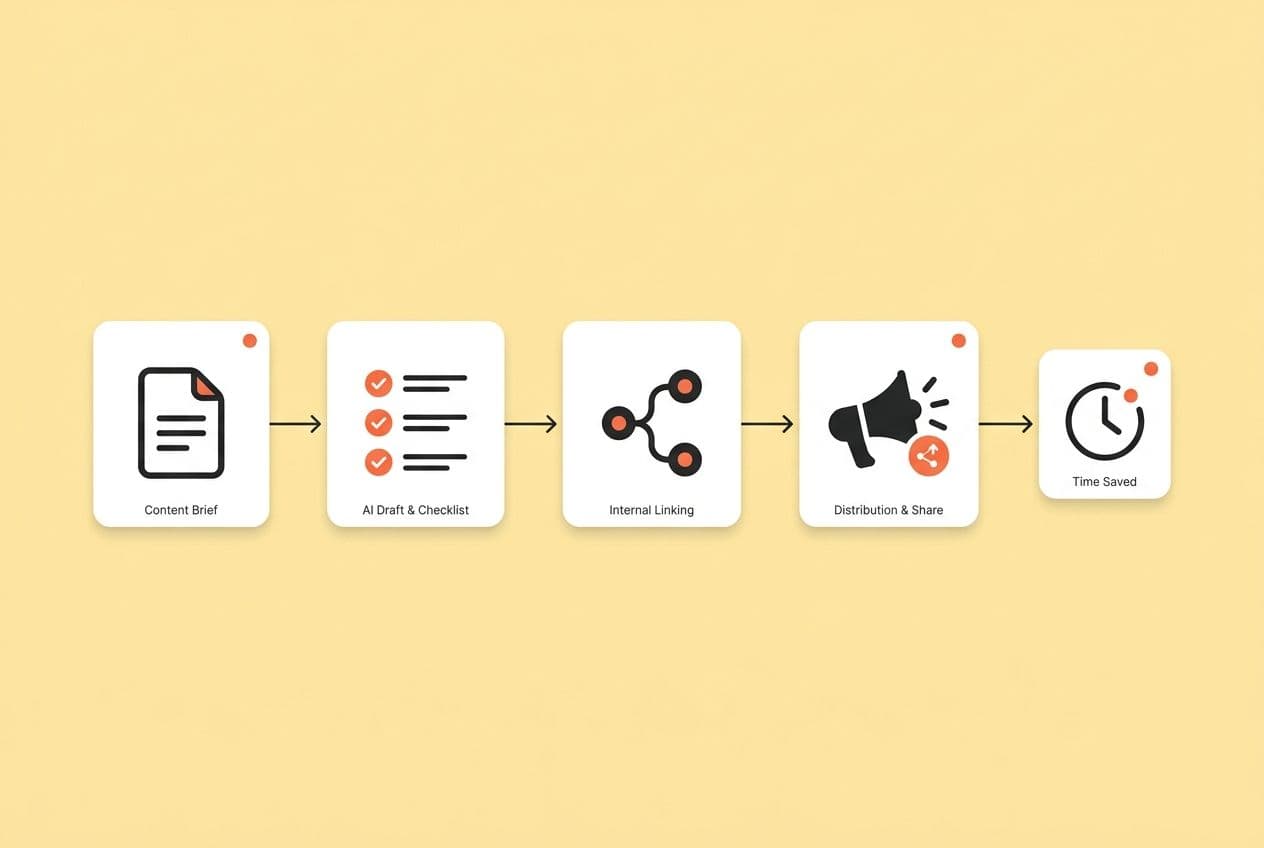
My whole approach boils down to three moves: AI-assisted topic and brief creation, AI-assisted SEO polish and internal linking, and AI-assisted repurposing and distribution. Run those three in order, measure the time you get back, and you’ll have an AI content strategy that actually compounds.
Everything else can wait until you've proven the loop works. Here’s the playbook I use.
What Does "AI Content Strategy" Actually Mean for a Bootstrapped Startup?
An AI content strategy just means deciding where AI can cut down cycle time and improve consistency in your content workflow. It’s not about handing your voice or your thinking over to a machine.
The strategy part, what you write, why you write it, and the position you take, that all stays human. AI just handles the operations: the throughput, the formatting, the pattern-matching, the first-pass outlines.
Most small teams I see fall into the same trap. They think “AI content strategy” means “use ChatGPT to write faster.” That gets you a draft, sure. But now you’re stuck editing for brand voice, rebuilding the structure, hunting for internal linking opportunities, and manually creating social posts. You just traded one bottleneck for a slightly different one.
For a bootstrapped team, success isn't about more drafts. It’s about:
-
More publishable assets per week (not just drafts that need a heavy rewrite).
-
Lower cost per asset (in hours, tool spend, and freelancer budget combined).
-
More consistent on-brand output, so the 10th article sounds like the first.
-
Real movement in your leading indicators (rankings, engagement) and lagging ones (pipeline, trials).
I run everything through a simple filter. Here's my "AI should / shouldn't" list.
AI should:
-
Generate outlines and starter briefs.
-
Audit old content for gaps, structure issues, and missing links.
-
Repurpose a published article into social and newsletter content.
-
Apply formatting and QA rules so you don’t have to.
AI shouldn't:
-
Invent product capabilities or make up metrics.
-
Replace your subject matter expert's point of view.
-
Make the final call on positioning or brand-sensitive claims.
-
Write your "why we're different" sections.
What Problems Does AI Solve Best in Small Teams?
AI earns its keep on the repetitive, rules-based work. Think: summarizing a source into bullet points, reformatting a draft into a scannable structure, or running a first-pass QA against a checklist.
It’s also surprisingly good at pattern detection. It can spot topic gaps in your content cluster, find old posts that should be linked together, and show you where your coverage is thin.
The third thing, and this one is huge for small teams, is consistency enforcement. Applying the same brief template, the same formatting, the same intro pattern across every single piece, even with different writers. We used to lose so many hours just re-explaining our standards.
What Should Stay Human (Even If AI Can Do It)?
Your editorial stance and point of view. Those are yours. The reason readers come back (and the reason other AIs will eventually cite you) is because your content says something specific, not just something plausible.
You can't prompt original research, lived experience, or deep product knowledge into existence. When an AI generates a scenario, it's mashing up patterns from the web. When you write from a real situation you actually navigated, it just hits different. You can feel it as a reader.
And ultimately, the accountability for accuracy, positioning, and brand risk belongs to a person. If a claim is wrong or a product is misrepresented, the AI isn’t taking that angry customer call. You are.
Which AI Content Use Cases Should You Prioritize First to Get Clear ROI?
You get ROI by prioritizing the right things. I use four factors: business impact, feasibility with your current team, reusability as an SOP, and governance risk. Pick two or three use cases that score well on all four, not the ones that just sound cool.
I've seen so many AI content pilots fail because a team gets excited about a flashy use case like fully automated blog production. Two months later, they have a folder of unpublishable drafts and no data to show for it. Don’t be that team.
Use this filter instead:
-
Impact: Does this help us publish more, convert better, or reduce our time-to-publish?
-
Feasibility: Can we do this this week with the tools and people we already have?
-
Reusability: Can this become a documented process we run every single time?
-
Governance risk: How likely is it that AI will produce something off-brand or just plain wrong here?
For most bootstrapped teams, the quick wins are always in these three categories:
-
Content audit + topic gap discovery: Find out what to update or write next. This is high impact, fast, and low risk.
-
Brief + outline generation: Cut down your own prep time per article by 40–60%. This is incredibly reusable.
-
Repurposing + distribution: Squeeze more value out of content you’ve already published. This is often the highest-leverage move you can make.
And here are three areas that teams consistently underestimate, but where AI can be a huge help:
-
Internal linking: This takes me 30–60 minutes per article if I do it manually. It’s a perfect task for an AI assistant and has huge SEO value.
-
Metadata and on-page structure: Title tags, meta descriptions, heading hierarchy. It’s repetitive, rules-based work that AI handles beautifully.
-
Turning one article into 5–10 distribution assets: A LinkedIn post, a newsletter blurb, a thread, a community post. You’ve already done the hard work; this is free leverage.
A Simple Prioritization Table You Can Copy
Use this to score your ideas before you commit any time. Score 1–5 for each factor. If the total is 16 or more, it's probably worth doing now.
| Use Case | Impact (1–5) | Feasibility (1–5) | Reusability (1–5) | Risk (1–5, lower = safer) | Start Now? |
|---|---|---|---|---|---|
| Refresh old posts | 4 | 5 | 5 | 5 | ✅ Yes |
| Internal linking pass | 4 | 4 | 5 | 5 | ✅ Yes |
| Newsletter repurpose | 3 | 5 | 5 | 5 | ✅ Yes |
| New article drafting | 4 | 3 | 4 | 3 | ⚠️ Later |
| Full automation | 3 | 2 | 3 | 2 | ❌ Not yet |
See the pattern? The boring, low-risk, high-reusability tasks come first. Full automation is something to think about way later, after you've got your guardrails in place.
What Are the Lowest-Effort AI Moves That Improve Your Content Output Immediately?
The fastest gains don't come from asking AI to write for you. They come from using AI as an assistant for the audits, briefs, and editing passes, because that’s where all our time actually goes.
Here are five moves you can make this week.
Quick win #1: The AI-assisted content audit. Take your top 20 published posts and run them through a structured audit prompt. Have it flag each post for outdated info, thin sections, weak internal links, and a missing CTA. The output is a prioritized refresh list. This alone tells you what to work on next without any guesswork.
Quick win #2: AI-assisted topic ideation. Feed the AI your customer's top five frustrations and ask for 20 potential topics. Then, you do the human filtering: Does this match search intent? Can I add a specific story no one else has? Can I link it to three other posts? I usually find six to eight solid topics this way, which is a great backlog for a month.
Quick win #3: AI-assisted brief creation. A good brief can take me an hour or more to write from scratch. With AI, I’m just reviewing and refining. Your brief should always have fields for: target reader, intent, editorial stance, outline, objections to address, and examples to include. The brief is where quality is decided before a single word of the draft gets written.
Quick win #4: The AI-assisted editing pass (not writing). After a draft is written, use AI to improve section openings, check the structure, and improve skimmability. This isn't asking it to write. You're using it as a structural editor with consistent rules, which is a genuinely valuable and low-risk role.
Quick win #5: AI-assisted distribution. After you publish, run the article through a repurposing prompt to generate a LinkedIn post, a newsletter blurb, a thread, and a community post. This takes about 30 minutes of tedious work and turns it into a 10-minute review cycle.
Realistic time savings: Once all five are running, you should save 1.5–3 hours per article. Use that time for more strategic work, like finally tackling that backlog of posts that need updating.
"Copy/Paste" Prompt Templates (Minimal Prompting, Maximum Leverage)
These are my starting points. You'll need to tweak them for your own topics and audience, but the guardrails are built-in.
Content audit prompt:
"Review the following list of article titles and URLs. For each, identify: (1) likely outdated sections based on topic, (2) whether the structure supports scanning, (3) whether a clear CTA is present. Do not invent facts. Flag any uncertainty. Output a table ranking them by update priority."
Brief creation prompt:
"Create a content brief for an article on [topic] targeting [ICP role]. Include: target reader, search intent, editorial stance (what this article argues), section outline with key point per section, 2–3 objections to address, examples to include, and a 'what to avoid' list. Lead every section with a direct answer. Use short paragraphs."
Answer-first rewrite prompt:
"Rewrite the following section openings so each one leads with a direct, specific answer in 1–2 sentences before adding context. Do not add claims that aren't in the original. Flag any section where the original source content is too vague to rewrite accurately."
Distribution repurposing prompt:
"Using only the content in this article, create five distribution assets: a LinkedIn post with a clear takeaway, a newsletter blurb (3–4 sentences), a short 4-post thread, a Reddit-style community question, and a plain-text Slack announcement. Match the original article's voice. Do not invent statistics or capabilities not mentioned in the article."
How Do You Build a Lean AI Content Workflow from Topic to Distribution (Without Adding Chaos)?
An AI-powered content workflow only works if it’s a repeatable pipeline with clear handoffs. It can't just be ad-hoc chatbot usage whenever someone has a spare 20 minutes. That's how you get chaos.
Here's the full pipeline. Each stage has one clear output that signals it's done.
-
Topic selection → Output: Chosen topic with target intent confirmed.
-
Brief + outline → Output: Approved brief with stance and structure defined.
-
Drafting → Output: Complete draft reviewed for accuracy and voice.
-
SEO/AEO pass → Output: Headings, snippet-ready answers, and metadata finalized.
-
Internal linking → Output: 3–5 internal links placed. (Don't skip this.)
-
Image + formatting → Output: Cover image, alt text, and CMS formatting done.
-
Publish → Output: Live URL confirmed.
-
Repurpose + distribute → Output: LinkedIn, newsletter, and one other channel deployed.
-
Measure + backlog updates → Output: Post added to tracking sheet.
On a small team, stages 1–3 are usually shared. Stages 4–6 are the common bottleneck; they fall on one person and don't get done consistently. And when things get busy, stages 8–9 get skipped entirely. Sound familiar?
The biggest failure mode I see is when AI adds steps instead of removing them. If you’re generating drafts with one AI, editing for SEO with another, then manually linking, then using a third tool for social posts… you’ve made the process worse. The fix is to standardize the output of each stage so the work moves forward, not sideways.
Where Teams Lose Time (and How to Remove the "Last 40%")
The invisible time sinks are always the same stuff: internal linking (30–60 minutes), metadata (10–15 minutes), CMS formatting (15–20 minutes), cover image (20–30 minutes), and distribution (30–45 minutes).
The fix is standardization before automation. Make a simple checklist for each of these tasks:
-
Internal linking: Minimum of three links, target anchor text defined in the brief.
-
Metadata: Title tag formula and meta description length are locked in.
-
Formatting: One agreed-upon CMS template, not reinvented for every article.
-
Distribution: A standard set of four assets, created from the same repurposing prompt.
A checklist takes 20 minutes to build once and saves you from reinventing the wheel every single time.
What to Standardize First (So Freelancers Stop Creating Chaos)
A one-page SOP is enough. Trust me, a 10-page style guide never gets read. Cover these six things, and you’ll eliminate 80% of the revision cycles with freelancers.
-
Intro pattern: Every article opens with a direct answer, then gives context.
-
Section opening standard: Every section leads with a specific claim, not a vague setup.
-
Claim boundaries: What AI and writers can and can't say without a source.
-
"Examples required": Every section needs at least one concrete example. No abstract advice.
-
Internal link rules: When to add them, how many, what anchor text looks like.
-
Distribution outputs: The four standard assets every published article must generate.
Keep it to one page. A checklist gets used. A tome gathers dust.
How Do You Keep AI-Assisted Content from Sounding Generic or Damaging Your Brand?
Quality comes from constraints. A strong editorial stance, concrete examples in every section, and clear rules are what stop your content from sounding like every other generic blog post out there.
You can spot generic AI content from a mile away. It always:
-
Opens with broad context instead of a direct answer.
-
Gives advice with no tradeoffs ("use AI to scale content" but never mentions the risks).
-
Has zero examples, only abstractions.
-
Uses inconsistent terms (the "buyer journey" becomes the "customer path" then the "sales funnel" in the same article).
-
Could have been written for any company in any industry.
The antidote has three parts:
-
Stance-first writing. Every article, and every section, needs a position. Not "there are different approaches to X," but "the fastest approach to X is Y, and here's when it's the wrong choice." Your stance is what makes your content worth sharing and remembering.
-
Stance and evidence. Ground every recommendation in something real. I once wrote a post that was all abstract advice, and it flopped. I rewrote it starting with "The first time I completely screwed this up..." and it became our most shared article. "Internal linking is important for SEO" is a useless statement. "When your team finds 30 posts with no internal links, the refresh list writes itself" is a real scenario.
-
A governance checklist. A human runs through this before any article goes live.
When you're editing, focus your energy on the section openings and the clarity of your claims. These are the two places where generic AI content falls apart and where a 20-minute human review has the most impact.
And please, don't use AI at all for sensitive topics: competitive positioning, pricing claims, legal language, or anything where a single wrong word could cause real damage.
A Lightweight Governance Checklist for Small Teams
This is our five-minute pre-flight check. Run it before any article goes live. It prevents the problems that take five hours to fix.
-
☐ No invented metrics or capabilities: Every number and product claim is verified by a human.
-
☐ Every recommendation includes when it doesn't apply: No universal advice without a condition.
-
☐ At least one concrete example per section: No abstract guidance without a story.
-
☐ Paragraphs are 2–4 sentences: No walls of text.
-
☐ Terms are defined once and reused consistently: No synonym drift.
-
☐ Section openings lead with a direct answer: No throat-clearing.
-
☐ Brand voice matches our tone: A human has read it and it feels right.
What Should You Measure in the First 30 Days to Prove Content ROI (and Justify AI)?
You prove content ROI with a mix of efficiency metrics and performance metrics. The key is to track them from day one, even when the numbers feel tiny.
You need to answer two separate questions: "Did we get faster?" and "Did it actually work?"
Efficiency metrics (you'll see these in weeks):
-
Hours per article (your baseline vs. now)
-
Revision cycles per article
-
Time from brief to publish
-
Cost per asset (your time + writer + tools)
Leading indicators (visible in 30–90 days):
-
Impressions and CTR from Search Console
-
Engagement rate on social posts
-
Email subscriber growth
-
AI citation rate (if you're tracking it)
Lagging indicators (60–180 days):
-
Demo requests and trials influenced by content
-
Pipeline touched by organic content
-
AI citation rate (if you're tracking it)
You don't need a complicated dashboard. A single spreadsheet with a 15-minute check-in each week is enough for the first month. And let's be honest: SEO takes time. Your sample sizes will be small at first. Focus on efficiency gains and distribution consistency as your primary proof points early on. They're real, they're fast, and they build the case for continuing the work.
The "AI Content ROI Scorecard" (Copy/Paste)
Track this weekly for a month. It will tell you if the system is working before the traffic data even shows up.
| Metric | Baseline | Week 2 | Week 4 | Notes |
|---|---|---|---|---|
| Articles shipped | — | — | — | New + refreshes |
| Avg hours/article | — | — | — | Brief through publish |
| Distribution assets/article | — | — | — | LinkedIn, newsletter, etc. |
| Refreshes completed | — | — | — | From your audit backlog |
| Top pages by clicks (GSC) | — | — | — | Track top 5 |
| Revision cycles reduced? | — | — | — | Note what changed |
Fill in your baseline in week one before you change anything. The before-and-after story is your ROI case.
What's a Realistic "First 30 Days" AI Content Strategy Plan for a Bootstrapped Team?
You win by sequencing. Lock in your workflow first, run a small pilot, document what worked, and then increase your volume. Don't try to transform everything at once. I've made that mistake so you don't have to.
Here’s your week-by-week plan:
Week 1 — Setup
-
Define your editorial stance. What do you believe that others don't?
-
Build your brief template and governance checklist.
-
Run the AI-assisted audit on your top 20 posts and pick five to refresh.
-
Generate a backlog of 10-15 topic ideas from your customer pain points.
-
Set your baseline metrics in the ROI scorecard. Don't skip this!
Week 2 — Pilot
-
Ship one new article using your new workflow.
-
Ship one refresh from your audit list.
-
Repurpose both using your distribution prompt.
-
Pay attention to where the process felt clunky or slow. That's your next optimization target.
Week 3 — Systemize
-
Fix the friction points from week two. Standardize your internal linking checklist or your distribution SOP.
-
Reduce handoffs. Make sure every stage has a clear "definition of done" so work doesn't bounce back and forth.
-
Document your one-page SOP for any writers or freelancers.
Week 4 — Scale (Modestly)
-
Increase your cadence from two pieces to three or four.
-
Review your scorecard. What's saving you time? Which distribution format got the most engagement?
-
Decide on the next one or two use cases to layer in.
Traps to avoid (I've fallen into all of them):
-
Over-automating before you have a process. Automating a broken process just helps you create garbage faster.
-
Changing tools every week. The time you spend learning a new tool in the first month almost always cancels out its benefits.
-
Measuring only traffic. Traffic is a lagging indicator. Track time saved and distribution consistency first.
An AI content strategy is a compounding system. The brief template from week one reduces rework in week four. The repurposing prompt from week two doubles your distribution in month two. The teams that win aren't the ones with the flashiest tools; they're the ones who built the loop and ran it over and over.