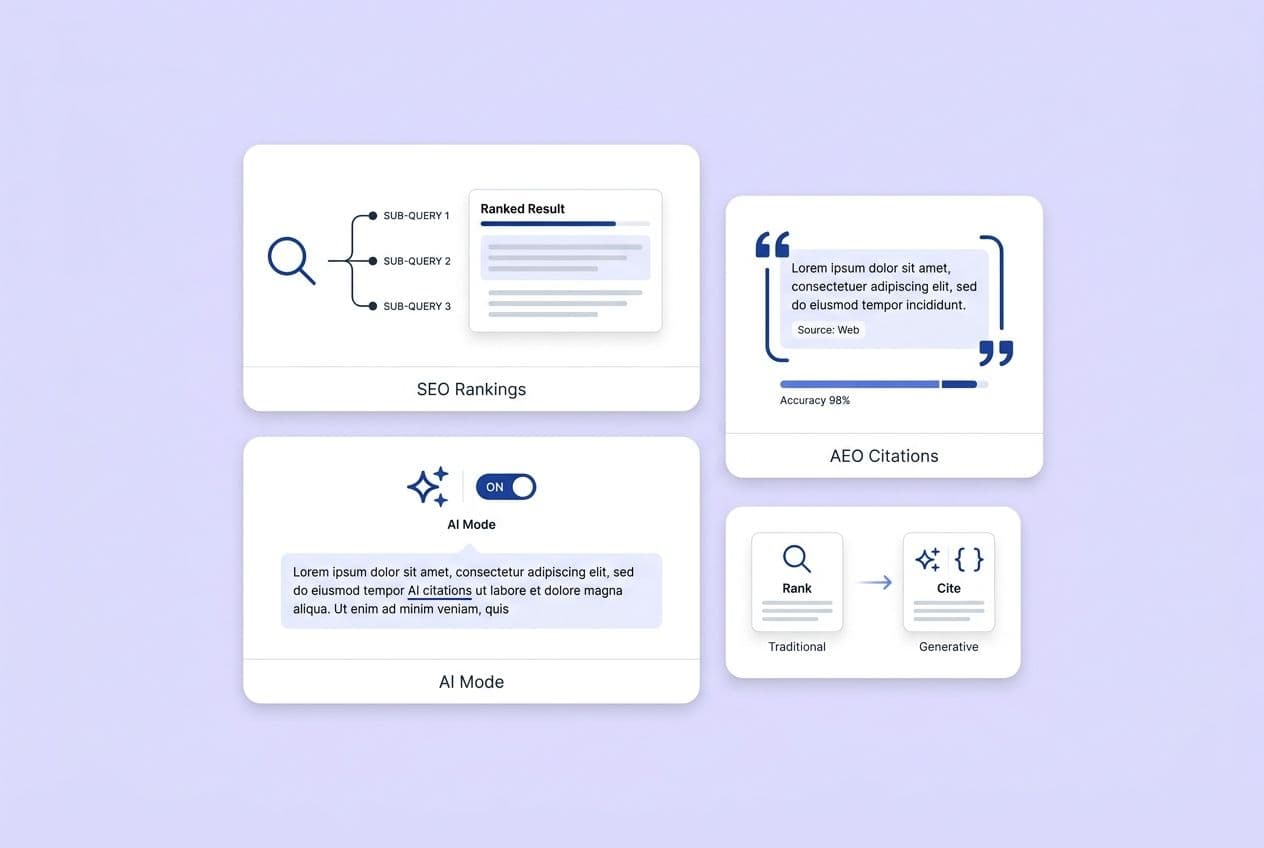
Let's set the record straight: Google I/O 2026 didn't kill SEO. It just fractured it into two distinct jobs you now have to manage completely differently. Gemini is the standard search experience today. AI Mode is baked into everything. Folks are typing out lengthier, highly conversational questions, while AI agents quietly track topics for them behind the scenes. But the massive shift? AI citations are now grabbing answers from specific passages and sub-queries, rather than just defaulting to whatever page sits at #1. Your traditional rankings and your AI visibility are entirely separate beasts now. If you want to master both, you need a brand-new playbook.
If you’re a content or SEO lead at a Series A or B SaaS company, I bet you’re feeling this right now. Your CEO asks, “What’s our AI search strategy?” and you have that sinking feeling. You go manually check Gemini for your main use case. Your competitor is cited. You’re not. So you try to build a system. Which prompts do we track? How do we structure content now? What do we even refresh? But there’s no playbook. The tutorials just rehash the keynote, and the social media threads are all just people yelling about schema. Nobody is telling you what to actually do on Monday morning.
Here's what your Monday morning should look like.
This guide is my attempt to give you the mental model we use. We’ll cover what actually changed at I/O 2026, why citations and rankings are two different scoreboards now, and a realistic 30-day plan to start closing the gap without burning out your team.
So, what actually changed at Google I/O 2026?
Four massive shifts happened all at once, and they're compounding on top of each other. But if you pull them apart and look at them individually, the new landscape makes a lot more sense.
1. AI is the default, not the exception. Running Gemini 3.5 Flash is simply faster and more cost-effective for Google. When people are researching a problem or looking to buy, their first interaction is now an AI answer instead of ten blue links. The traditional organic results are still around, sure, but they sit below the fold—and let's be real, almost no one scrolls down.
2. People are asking better, longer questions. Buyers figured out that AI understands normal, conversational language, so they stopped typing like machines. A prompt like "best project management tool for a 10-person SaaS team under $50/month" is a completely standard query now. So is uploading a screenshot of a competitor's pricing and asking "how does this compare?" Your content must speak directly to these hyper-specific, deeply contextual scenarios, not just blindly target a broad short-tail keyword.
3. Search can run in the background. This idea of "agentic search" sounds vaguely like sci-fi, but it’s actually very straightforward. A user can just tell Gemini to monitor a topic for them. If a potential buyer is evaluating your category, they can set an agent loose on it. That means the AI is constantly scanning your content in the background, rather than just pulling it up during a single search session. If your pages get stale, you don't just drop in the rankings—the agent entirely stops viewing you as a reliable source.
4. Everything is getting personalized. Thanks to Google's Personal Intelligence layer, two people can enter the exact same prompt and get completely different answers, complete with different citations. The whole output changes based on their individual search history and context. That old idea of "we rank #3, so we win" was always a comforting little lie we told ourselves, but now? It's entirely dead.
A few quick definitions to keep handy:
-
AI Mode: Google's conversational search experience powered by Gemini. It synthesizes answers and provides source citations.
-
AI Overviews: The AI-generated summary boxes you see at the top of the regular search results.
-
Citations vs. rankings: Rankings are your spot in the organic blue-link list. Citations are when your page gets sourced inside an AI answer. You have to measure and work on them separately.
-
Agentic search: Search that runs on its own in the background, not just when a user types something.
What you’ll see in your analytics: more sessions that don't click anywhere, unstable traffic from branded searches you thought you owned, and a growing gap between a good ranking and actually getting cited.
What's the "new user behavior" to design content for?
The shape of questions has changed. Instead of typing "AEO strategy," a real person now types "what's an AEO strategy for a B2B SaaS team with one content manager." Instead of "project management software," they type "compare Asana vs Linear for an engineering team that already uses Notion."
These long, constrained, scenario-based questions force you into specific formats. Think Q&A sections that answer the exact question, comparison blocks that are framed as A vs. B, and openings that give the answer in the first two sentences. If your articles are still built around broad keywords with a slow, narrative buildup, you're getting beaten by tighter content that an AI can easily grab.
Why don't AI Overview citations match the top organic results?
Because AI answers are built from many small queries, not pulled from a ranked list. This was the single biggest "aha" moment for our team. Getting this is the key to everything else.
When someone asks a complex question, the AI model doesn't just look at the top 10 results for that phrase. It acts like a junior researcher. It breaks the question down and runs several parallel searches behind the scenes, what engineers call "fan-out sub-queries." If the main question is "what's the best CRM for a startup sales team using HubSpot Marketing," the AI might quietly search for "best CRM for startups," "CRM that integrates with HubSpot," and "CRM for small sales teams." It then pulls the best bits and pieces from each search and stitches them together into one answer.
This means a page ranked #12 can absolutely get cited if it has the clearest, most direct answer to one of those hidden sub-queries. And a page sitting at #1 for the main term might get ignored completely because its answer is buried in paragraph eight of a giant guide.
The other piece of this is passage-level extraction. The AI doesn't read your whole article. It scans for self-contained blocks of text that answer one specific question. If your answer needs three paragraphs of setup, it's not getting picked. If your answer is clear and direct in the first couple of sentences, it’s a prime candidate for extraction.
Citation volatility is a feature, not a bug. Your citation presence will fluctuate, even if you do nothing. That’s not a sign your strategy is broken; it’s the new operational reality. You have to plan for ongoing monitoring and tweaks, not a one-and-done optimization project.
| Dimension | SEO (Rankings) | AEO (Citations / Answers) |
|---|---|---|
| Unit of optimization | The whole page | A specific passage or claim |
| Primary success metric | Rank position + traffic | Citation rate + mention rate |
| Research method | Keywords + search volume | Prompts + sub-queries |
| Maintenance cadence | Periodic big updates | Continuous small refreshes |
What "counts" as an optimizable unit in AEO?
The thing you're optimizing for in AEO is what I call a "citable block." It’s a self-contained passage of 1-3 sentences, or a short list, that answers a single sub-question perfectly without needing any other context.
Here's a good rule of thumb: could you copy and paste a sentence or list item from your article into a Slack message, and would it still make sense on its own? If yes, you've written a citable unit. If it depends on the paragraph before it, it probably won't get extracted.
How do you change content structure so AI engines can cite you?
Write for extractability, not for word count. The formats that get cited have nothing to do with old-school SEO scores. It's all about structural clarity, direct answers, and covering the sub-queries an AI is likely to run.
These are the formats we see earning citations again and again:
-
Ranked lists (Top-N): Perfect for comparisons. "Top 5 CRMs for early-stage SaaS teams" is way more extractable than a long story comparing them.
-
Side-by-side comparison tables: AIs love tables. If you're comparing things, a table will beat prose for citation potential every time.
-
"If X, then Y" decision trees: Checklists and conditional advice are great because they're naturally self-contained.
-
Definitions with constraints: "Use X when [condition]. Avoid it when [exception]." This directly answers sub-queries like "when should I use X?"
Front-load the answer in every section. Every H2 should open with one or two sentences that directly answer the question in the heading. Put your best, most citable content in the first 30% of the section, not after a long-winded intro. AIs scan openings for relevance. If yours is vague, they move on.
A few rules for passage design:
-
One sub-question per paragraph or list cluster.
-
Use specifics. Name the tools, the job titles, the scenarios. Don't say "businesses" or "organizations."
-
Kill the throat-clearing intros. Lead with the outcome.
A word on schema: Use it, but don't expect it to be a magic bullet. Standard schema (Article, Organization, FAQ) helps Google parse your content. But trying to game the system with risky schema types is not a reliable path to citations and leaves you exposed. Good, durable structure is always better than schema tricks.
Before / After example:
Before: "The importance of AEO cannot be overstated in today's search landscape. As AI becomes more prevalent, understanding how to optimize for AI-generated answers is becoming increasingly important for content teams."
After: "AEO and SEO now require separate optimization. AEO (Answer Engine Optimization) targets AI-generated citations. Those are driven by passage clarity and sub-query coverage, not page rank. Start by identifying the top 10 questions your buyers ask AI, then write a citable block for each one."
A copy/paste template for a citable section opener
Here are two templates we use all the time. Feel free to steal them.
Template 1: "If you want to [outcome], the most reliable lever is [lever]. Use it when [conditions]. Skip it when [exceptions]."
Example: "If you want to earn AI Overview citations for a comparison query, the most reliable format is a side-by-side table with a direct verdict row. Use it when comparing 2–4 options. Skip it when you're answering a single "what is" question, where a tight definition works better."
Template 2: "The difference between [A] and [B] is [one sentence]. Choose [A] if [condition]. Choose [B] if [condition]."
Example: "The difference between SEO and AEO is the unit of optimization. Focus on SEO when you're building long-term domain authority. Focus on AEO when you need your brand cited in high-intent buyer questions, right now."
What to stop doing (even if it used to work)
Some of our old SEO habits are actively hurting us in the race for AI citations. We had to unlearn a few things, and you probably do too.
-
Writing to a word count. Stop. Length has zero correlation with citations. A tight 400-word article with citable answers will destroy a 2,500-word guide where the answers are buried.
-
Burying the answer. Every paragraph of throat-clearing is a chance for an AI to skip your content and find a competitor who got to the point.
-
Chasing "ultimate guide" coverage. A comprehensive guide isn't helpful if it doesn't answer the right sub-questions in a format that can be extracted.
-
Publishing "me too" content. If ten other sites published the same list last month, you're not going to get cited. The AI already has plenty of options and will just pick the tightest one.
How do information agents change content refresh?
The biggest change from agentic search isn't what you write, it’s how often you maintain it. The classic SEO model was "publish and rank." You write a great piece, it climbs the SERPs, and you maybe poke at it every six months. That's over.
When an AI agent is monitoring a topic, it's periodically re-checking its sources. Is this page still accurate? Is it still the best answer? Content that was citable three months ago can lose its spot just because a competitor updated their post, or your language is slightly out of date.
The good news is that small, targeted edits are much more effective than giant rewrites. You're not trying to overhaul the whole page. You're just updating the specific passages that earned you the citation in the first place.
A realistic refresh cadence for a small SaaS team:
-
Weekly: Manually check your top 10–15 "money prompts" in the big AI tools. See if you're still showing up.
-
Biweekly / Monthly: Refresh your top citation-target pages. Update the summary, refresh any stats, and tighten the passages that get cited most.
-
Quarterly: Re-map your sub-queries. The language people use changes, and so do the questions they ask.
Refresh triggers to watch for:
-
A competitor suddenly starts getting cited where you used to be.
-
Your own product's pricing or features change.
-
You start hearing new objections on sales calls that your content doesn't cover.
-
AI answers start pulling outdated stats from your pages (this is a huge red flag).
A refresh checklist your team can actually run in under an hour:
-
Update the first 30%: the summary block, opening bullets, and comparison table.
-
Add or replace 2–3 citable passages tied to new sub-queries you've found.
-
Check for internal consistency. Make sure your updates don't contradict other parts of the article.
-
Tighten your headings to match how people are actually phrasing their questions now.
For lean teams, having a repeatable workflow here is everything. We built our own tool, DeepSmith, to solve this exact problem because doing it all manually was a nightmare. A refresh cycle shouldn't require rebuilding an article from scratch. The system should handle the research and restructuring so your team can focus on the actual writing and strategy. That's how you make refreshes sustainable instead of something that always gets pushed to next quarter.
What "verification" looks like (without inventing new data)
When you're refreshing, verification isn't about adding tons of new research. It's mostly about removing things that have gone stale.
-
Replace old examples. If you're citing a tool that pivoted or a trend that died in 2024, it kills your credibility with both humans and AIs.
-
Add "as of [month/year]" to anything time-sensitive, like pricing or stats.
-
Prefer durable statements over predictions. "As of mid-2025, most CRMs charge per seat" is solid. "CRM pricing is trending toward flat-rate models" is brittle; it becomes false the moment the trend shifts.
How does personalization (Personal Intelligence) change AEO?
Personalization means there is no single universal search result anymore. "Winning position zero" isn't a stable goal. Two users can ask the same question and see different answers and different sources based on their context.
For B2B SaaS, this isn't a crisis. It just means you shift your strategy from trying to write the one definitive page to covering all the relevant buyer mindsets with modular content blocks.
Here’s a simple way to think about buyer states in SaaS:
| User State | What they need from your content |
|---|---|
| New evaluator (just learning) | Clear definitions, market context, "what is X?" |
| Switching from an incumbent | Migration pains, direct comparisons, "X vs. what we use now" |
| Budget-constrained buyer | ROI framing, cost breakdowns, "how to do this for less" |
| Compliance/security-sensitive buyer | Risk controls, certifications, "what if" scenarios |
You don’t need 20 different pages for this. You just need modular callouts inside your existing articles:
-
Add sections like "If you're evaluating for the first time..." or "If you're switching from [competitor]..."
-
Put state-based rows in your comparison tables. A row for the budget-constrained buyer, for example.
-
Write short sub-sections that directly answer questions for each state.
Here's the honest trade-off: you can't predict exactly which answer a user will see. Your goal isn't control. It's coverage and clarity. The more specific and self-contained your citable blocks are, the better your odds that one of them will be perfect for a specific user's context.
What should you measure now?
Keep your SEO metrics, but add an AEO scoreboard. The biggest mistake is replacing one with the other. They track different parts of the customer journey, and you need both to tell a coherent story to your leadership team.
The AEO metrics that actually matter:
-
Prompt set: The 10–20 questions your buyers are actually asking AI platforms. This is your source of truth.
-
Mention rate: Is your brand name appearing in AI answers to your tracked prompts, even without a link?
-
Citation rate: Are you being sourced with a link inside those answers?
-
Citation share vs. competitors: Are you gaining or losing ground against the other brands being cited?
-
Page attribution: Which of your URLs are actually earning the citations?
How to build your starter prompt set:
-
Category comparison: "best [category] for [your target buyer]"
-
Head-to-head: "[your product] vs [competitor]"
-
How-to: "how to [core use case your product solves]"
-
Definition: "what is [your category]"
-
Tool discovery: "tool for [specific pain point]"
Your 30-day starting plan:
Week 1: Define your prompt set (15–20 prompts). Manually check them across ChatGPT, Gemini, and Perplexity. Pick 5 pages to focus on.
Week 2: Restructure those 5 pages. Rewrite the intros, add tables, and tighten the first 30% of the content.
Week 3: Publish 2 new articles that are explicitly mapped to sub-queries you're currently missing.
Week 4: Refresh 3 existing articles using the quick checklist above. Re-check your prompt set. See what changed.
Platforms like DeepSmith exist to turn this into a real system by tracking prompt-level mention and citation rates across all the major AIs. This turns AEO from a manual chore into a real scoreboard. Whether you do it manually or use a tool, the key is having defined prompts and measuring them consistently.
Reporting guidance: Show both scoreboards in your updates. Tell the story. "We tracked 15 prompts. We're now cited in 6 of them. These 3 pages are doing all the work. Here's what we're refreshing next month." That’s a story leadership can understand and support.
A simple "AEO backlog" rubric
When you have more gaps than time, use this to prioritize:
-
Business value: Is this a question someone asks right before they buy? Or is it top-of-funnel curiosity?
-
Visibility gap: Are you a ghost for this prompt, or are you close and just need a small fix?
-
Competitiveness: Is the citation space super crowded, or is there an opening for you?
-
Content readiness: Can you fix this with a quick edit, or do you need to write a whole new article?
High-value, high-readiness gaps are your fastest wins. Go after those first.
What's the biggest "beginner mistake" after I/O 2026?
The biggest mistake is chasing tactics instead of building a repeatable system. We wasted time on this at first. Teams that start chasing schema tricks, word count targets, or just publishing more frequently are burning budget without actually moving the needle. Here’s why those old instincts fail:
-
"If we rank, we'll be cited" — No. Citations are about sub-query matches and passage clarity, not rank. You can be #1 and get zero citations.
-
"If we add more words, we'll win" — No. Long articles that bury the answer are less citable. The winning format is tight and direct.
-
"If we publish more, the AI will notice" — Nope. Volume without structure is just noise.
The system that actually works:
-
Map out your prompts and sub-queries (what buyers ask, what the AI asks).
-
Write extractable sections with direct answers up front.
-
Use structured formats like lists and tables.
-
Track your citations and refresh on a set cadence.
-
Repurpose every article across 2–3 channels.
On that last point, AI systems draw evidence from everywhere, not just your blog. A LinkedIn post, a newsletter, a social thread all help your ideas show up in more places. As an example, we built DeepSmith's Agent Library to automatically turn any article into LinkedIn posts and newsletter drafts. It’s a standard step in the workflow, not a separate project. The goal isn’t to guarantee citations from social posts, but to make sure your ideas are consistently visible everywhere an AI might look.
When it genuinely depends: If you’re in a highly regulated space like healthcare or fintech, thin content will always underperform, no matter how well-structured it is. And if your category has almost no real difference between competitors, structure alone won't save you. You need real proof and a first-party perspective nobody else has.
FAQ: I/O 2026 SEO and AEO basics
Did Google I/O 2026 kill SEO? No. Organic rankings still matter and still drive traffic. But ranking no longer guarantees visibility. AI answers appear above organic results, and getting cited there is a different game. SEO and AEO are now two separate workstreams you have to manage together.
What's the difference between SEO and AEO after I/O 2026? SEO optimizes pages to rank in organic results. AEO (Answer Engine Optimization) optimizes passages to be cited inside AI-generated answers. They use different units (pages vs. passages), different metrics (rank vs. citation rate), and different research methods (keywords vs. prompts). You need both.
Why am I seeing AI citations from sites that don't rank on page 1? Because AI answers are assembled from "fan-out sub-queries," which are small, parallel searches the AI runs. A page with the best answer to a sub-question can be cited even if it ranks #12 for the main query. Passage quality beats page rank.
What content format is most likely to earn AI Overview citations? Ranked lists, side-by-side comparison tables, and conditional "if-then" statements are consistently citable. The key is making sure each passage is self-contained and answers a specific question on its own. Always put the direct answer in the first 1–2 sentences of any section.
How often should I refresh content for AI Mode and information agents? For your most important pages, a monthly refresh of the key passages is a realistic goal for a small team. Check your main prompts weekly to catch any drops. The trigger for a refresh isn't a date on the calendar; it's seeing a competitor take your spot or realizing your content is out of date.
How do I choose which prompts to track for AEO? Start with 10–20 prompts that reflect how your buyers actually talk. Include category comparisons ("best [category] for [buyer type]"), head-to-heads ("[your product] vs [competitor]"), and how-to questions about your core use cases. Prioritize the questions that directly influence a purchase decision.
Do I need schema markup to get cited in AI Overviews? Basic schema (Article, Organization, FAQ) is good practice and helps with data parsing, so you should use it. But schema is not a shortcut to AI citations. Passage clarity and good structure are far more important. Don't skip schema, but don't bet your strategy on it.
How do I handle personalization if everyone sees different AI answers? You can't control it, so don't try. Instead, aim for coverage + clarity. Write self-contained answer blocks for each key buyer mindset (newbie, switcher, budget-focused, etc.). Add callouts for them within your existing articles. Maximum clarity for each passage gives you the best chance of surfacing for the right person at the right time.