You have a rough draft open and an hour you cannot get back. The question sitting in your chest is simple: is this AI draft too rough to save, or is it twenty minutes of tidying away from being useful? That call is the edit or rewrite AI draft decision, and it has a third answer most people forget. Here is the short version of the AI content decision framework before we walk it properly.
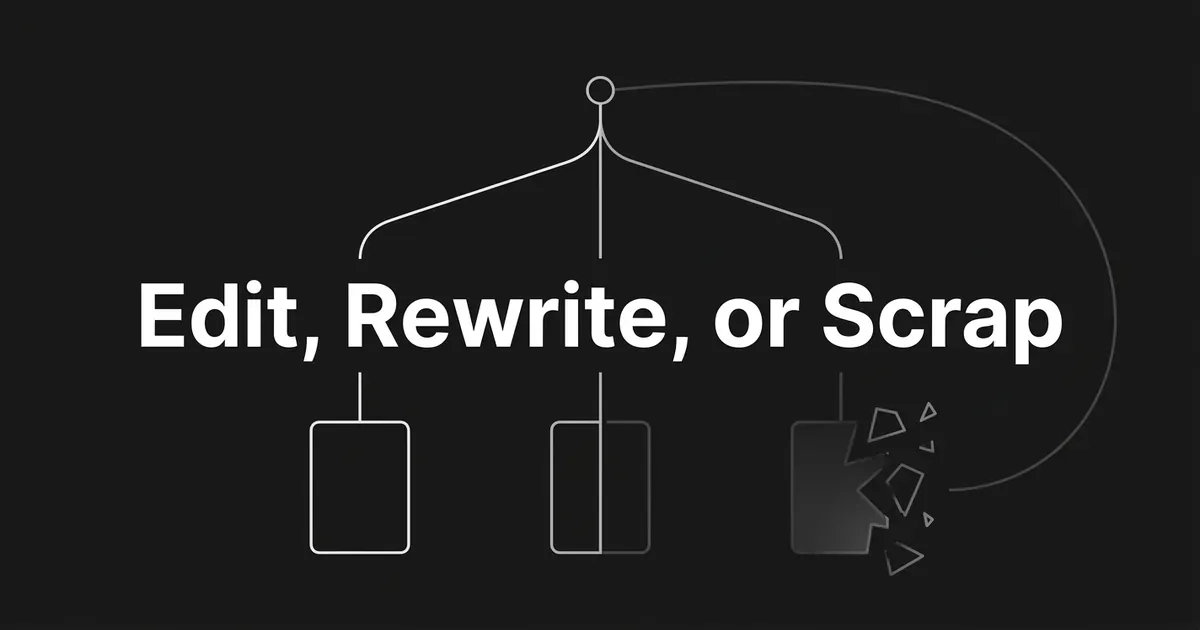
- Edit when the foundations hold and the problems are local.
- Rewrite when the angle is still worth publishing but the argument, evidence, or structure has to be rebuilt.
- Scrap or reframe when there is no real reader, no defensible purpose, or no evidence you can actually get.
Notice what decides it. Not typos. Not word count. The deepest layer that failed. A beautifully polished version of the wrong article is still the wrong article.
This guide is triage, not line editing. By the end you will be able to look at any rough draft, name the route, and hand it off with a reason attached.
Step 1: Name the article's job before you read a single sentence
Close the draft for a moment. Write one sentence that names four things: who this is for, what problem they need solved, what they can do afterward, and why your brand should be the one publishing it.
That last part trips people up. "Get traffic" is not a purpose. A purpose sounds like "help a content lead choose a production model before they sign an agency contract." Ask the question a person-first review would ask: if a reader landed here directly, would they leave with what they came for?
How you know it is done: you can name the reader without saying "everyone," describe their task in concrete terms, and explain why you get to own this topic.
Route signals:
- Edit: the draft already serves that reader and that purpose.
- Rewrite: the job is valid, but the draft answers a neighboring question or aims at the wrong buyer stage.
- Scrap or reframe: you cannot name a reader benefit or a reason to publish. A keyword by itself is not a job.
Where people go wrong: they start fixing the intro, because the intro is the visible problem. That spends real time on a draft before anyone has confirmed the article deserves to exist.
Step 2: Match the draft to the reader's real question
Now say the reader's question out loud in plain words. Then say the article's promise in one sentence. Compare both against what the draft actually delivers.
Do not let the title or the brief answer for you. A title can promise a decision while the body delivers a summary. Intent has to match all the way through: the opening answer, the sequence, and the ending.
Here is the test for this very piece. Its promise is a decision. A draft that explains the general upsides and risks of AI writing, and never tells you how to choose, has failed the promise even if every sentence is true.
This is also where knowing when to scrap AI content gets easier, because you can see the gap between search demand and reader need. A topic can have volume and still have no useful angle behind it.
Data helps you check that before you invest. DeepSmith's AI Visibility shows the buyer prompts you track, your mention and citation rates, and which competitor pages win the answers you are missing. Content Map turns your site and your competitors' sites into one topic map with coverage gaps and untapped topics. That tells you whether an opportunity is worth producing. It does not tell you the draft in front of you is accurate, and it never replaces your judgment about the angle.
How you know it is done: the question, the title, the promise, the format, and the conclusion all point at the same task.
Route signals:
- Edit: right question, right format, local clarity fixes.
- Rewrite: the opportunity is real, but the draft uses the wrong structure or the wrong buyer stage.
- Scrap or reframe: the intent was a search excuse, and the angle cannot answer anything useful without changing the subject.
Step 3: Separate local defects from a broken core argument
Ignore how the sentences sound. Summarize the draft's argument in a few plain statements: the main claim, the claims that support it, the evidence each one needs, and the order the reader has to meet them in.
Then ask one question. If you repaired the visible problems, would the reader end up with the same answer, or a different one?
Same answer means local. Different answer means global, and global is a rewrite. This is the heart of the edit or rewrite AI draft call, and it is why the two routes are not points on one scale. They are different kinds of work.
Pro tip: read the draft twice, once for the reader's decision and once for your evidence burden. Do not make this call while staring at individual sentences. Sentences always look fixable.
How you know it is done: you can state the central promise in your own words, the reasoning is all there, and no missing section would force a new thesis.
Route signals:
- Edit: thesis, reasoning, evidence plan, and order all survive. The damage is bounded.
- Rewrite: there is a good idea in here, but it is buried, out of order, unevenly supported, or missing a step the reader needs.
- Scrap or reframe: there is no coherent argument to save, and making one coherent would need a different premise.
Where people go wrong: they call a rebuild an edit because the draft already contains a lot of words. Word count is not accumulated value. A long draft is sometimes just a short outline for a different article.
Step 4: Test the evidence before you judge the polish
Fluency is presentation, not proof. AI systems produce confabulations, confidently written content that is simply wrong, and a smooth paragraph can be perfectly logical and factually false.
So list every claim that actually matters to your recommendation. Dates, numbers, quotes, named companies, product capabilities, anything about what AI systems do. Check each one against a source you trust. For every citation the draft offers, confirm three things: the source exists, it actually supports the sentence, and it is current enough to.
Scale the effort to the stakes. A claim that touches money, legal exposure, privacy, or a buyer's decision does not get waved through because it reads well.
Common mistake: asking the same AI system to "fix" an unsupported claim, without handing it a verified source. You get a cleaner version of the same uncertainty, and now it sounds even more convincing.
How you know it is done: every publish-critical claim has a real source, no citation is a placeholder, and you can sort the draft into sourced facts, labeled interpretation, and things that have to go.
Route signals:
- Edit: the evidence base is sound and the fix is one verifiable correction.
- Rewrite: the angle is fine, but the factual foundation is thin or badly sourced, and you can go get better evidence for the same angle.
- Scrap or reframe: the central claim cannot be verified, rests on a false premise, or would need you to invent support.
Where people go wrong: checking only statistics and dates. A sweeping "this always works," an invented attribution, or a product capability that does not exist can hurt you just as much.
Step 5: Ask what this draft adds that nothing else does
Put the draft next to three pages a reader could already find. What does yours add? Original analysis, firsthand experience, real data, a specific example, a framework that changes what someone does next.
If the honest answer is "it says the same things in different words," rewording will not save it. Helpful-content guidance asks whether a piece brings original information, substantial depth, and real added value beyond the sources it drew from. That bar does not move because a machine wrote the first pass.
Be fair to yourself here, though. Original does not mean you need proprietary research on every piece. A clear, accurate, genuinely useful explanation earns its place. The question is whether it delivers enough value for this reader and this purpose.
How you know it is done: the draft says something that is not interchangeable with a generic summary, and a qualified person on your team can explain where that insight came from.
Route signals:
- Edit: the point of view and examples are there, just buried.
- Rewrite: the topic matters and your team has real experience or data, but this draft is generic. Rebuild around the material you actually have.
- Scrap or reframe: there is no distinct value available to you, and no realistic way to add any.
Where people go wrong: treating generic tone as proof the whole idea is dead. Generic prose is usually a rewrite signal, not a scrap signal. Knowing when to scrap AI content comes down to whether the missing value can be supplied at all, not to how the sentences read today.
Step 6: Check brand fit, product claims, and who owns the piece
A draft can be accurate and still be unusable. Wrong buyer. Interchangeable voice. A workflow you do not support. A product claim nobody approved.
Read for stance, examples, terminology, and product boundaries. Then ask who signs their name to this. AI production does not remove the need for a human owner who can defend it.
If the angle survives but the draft reads like it came from nowhere, that is a context problem, not a wording problem. This is the one worth fixing at the source. DeepSmith stores your company positioning, product facts, personas, brand voice, visual guidelines, and content types once in Deep IQ, and every writing run is grounded in those records. Producing from the right context is cheaper than rescuing a context-free draft, over and over. It does not make output automatically correct, and it does not remove review.

How you know it is done: the reader is recognizable, the stance is consistent, the product facts are approved, and someone qualified can own it.
Route signals:
- Edit: voice and product facts are right, with limited drift.
- Rewrite: worth keeping, but rebuild it from the correct brand context and persona.
- Scrap or reframe: the angle needs a claim you cannot make or an authority you cannot honestly represent.
Where people go wrong: treating brand voice as a coat of paint. Voice drift across a whole draft usually means the context was missing, not that a few words need swapping.
Step 7: Choose the route by the deepest thing that failed
You have six readings now. Do not add them up into a score. Look for the deepest layer that failed and let that decide, because everything above a broken foundation has to be rebuilt anyway.
| Route | What survives | What it needs | Move on when |
|---|---|---|---|
| Edit | Audience, purpose, angle, promise, evidence, structure, brand fit | Local clarity, bounded corrections, small gaps | The fix would change the argument, evidence, audience, or promise |
| Rewrite | A real audience problem and a defensible angle | New thesis, outline, evidence plan, examples, grounded voice | The angle cannot be made useful, true, or distinctive |
| Scrap or reframe | Verified research and any genuine audience insight | A new brief, audience, purpose, or premise | Never. Stop polishing a premise that failed a foundation test |
Two stop rules make the fix or restart AI draft call fast. If your proposed edit would replace the promise, the structure, the evidence, and the voice, it is a rewrite. If your proposed rewrite also needs a new audience, a new purpose, or a central claim you cannot verify, it is a scrap or reframe.

Here is what each one looks like in practice.
An edit. The reader is defined, the article answers the right question, the evidence and order hold, the stance is right. The intro is generic and one claim needs a verified correction. The job and the architecture survive, so you edit.
A rewrite. The question is worth answering and your team has real workflow evidence. The draft opens with broad AI commentary, drifts between teaching and selling, repeats common advice, and never explains the distinction the reader came for. The angle lives. The execution does not.
A scrap. The draft exists because a keyword looked good. Nobody can name the reader or the purpose, the central claim rests on a number nobody can verify, and there is no experience to add. Polishing it just makes an unsupported premise more convincing.
Where people go wrong: sunk cost. The question is never "how much have we written?" It is "which route gets to a trustworthy article with the least foundational rework?"
Step 8: Commit to one bounded next move
Pick the route, then stop relitigating it every paragraph.
- For an edit: write down the promise that survived and the categories of repair you are allowing. That boundary is what stops an edit from quietly becoming a rewrite.
- For a rewrite: write a clean brief that keeps the audience problem and the angle, and replaces the thesis, structure, and evidence plan. Treat the old draft as input, not as a template you owe anything to.
- For a scrap: go back to the audience problem or the buyer prompt and build a new premise. Keep the research you verified. Throw away the premise, not the work.
Then name the owner. A human stays accountable for the publish decision, and that only means something if the reviewer has the knowledge, the independence, and the authority to say no.
This is also where the production side of the decision lives. DeepSmith's Content Studio takes an approved idea through research, drafting, optimization, linking, and illustration, and Produced Content is where you review, edit, and publish. Autowrite can schedule production once the plan is set. That is the point: the platform carries the repeatable work after you have made the call, so your attention goes to the call itself.
Where people go wrong: using automation to remove the judgment they were trying to protect. The framework exists to move your time to strategy, not to move accountability off your desk.
What to do next
Take the roughest draft you have open right now. Run steps 1 through 3 on it, nothing more. Ten minutes.
Most drafts sort themselves in those three questions, and you will already know whether you are editing, rebuilding, or letting an angle go. That is a better use of the next hour than any tidying pass.
Then write the route down where your team can see it, in one sentence with the reason attached. An AI content decision framework only saves time if the same draft does not get re-triaged by the next person who opens it. Give the fix or restart AI draft call a home: the brief, the ticket, the doc header, wherever your handoffs live.
If you keep landing on "rewrite," and the reason keeps being missing context rather than a bad idea, that is a production problem, not an editing problem. Start a free DeepSmith trial and see what a draft looks like when it is produced from your brand context in the first place.