AirOps and BrandWell (formerly Content at Scale) plan in different ways. BrandWell builds topics and clusters directly, while AirOps is stronger at finding topics competitors cover that you do not and only partly plans topics. DeepSmith does both from one Content Map, and its Opportunity Agents return ideas that each carry the data point that justifies them.
If you are weighing AirOps vs BrandWell for content planning, the useful question is what you want handed to you at the end of planning. One kind of tool gives you a plan of topics and clusters, and the other gives you a list of gaps measured against competitors. Whether AirOps or BrandWell for content planning is the better fit depends on which of those you need first, since both tools write briefs once a topic is chosen. DeepSmith sits next to them because it keeps the gaps and the topic plan on one map. The full comparison of the two is in AirOps vs BrandWell (Content at Scale): Pricing Review, Public Tiers or Sales Call?.
AirOps vs BrandWell for content planning: the short answer
- Choose DeepSmith if you want competitor gaps and topic planning from one Content Map, with the evidence attached to every idea, on a published $99 Pro plan and a 7-day free trial.
- Choose AirOps if competitor and AI-answer gap analysis is the main job, you can live with partial topic planning, and you are fine getting a quote because Solo and Pro prices are not published.
- Choose BrandWell if you want topic clusters, a ranked content plan and an editorial calendar built in, starting at $249 a month for 25 articles, and a partial competitor gap view is acceptable.
| Criterion | DeepSmith | AirOps | BrandWell |
|---|---|---|---|
| Entry price (monthly) | $99/mo (Pro) | Not published | $249/mo (RankWell Essentials) |
| Free trial | 7 days | Yes, 14 days | Partial, terms conflict |
| Topic clusters, content plans or topical maps | Yes | Partial | Yes |
| Finds topics competitors cover that you do not | Yes | Yes | Partial |
| Content briefs or outlines | - | Yes | Yes |
| Keyword research with volume and difficulty data | - | Yes | Yes |
| Writes and publishes on a schedule | Yes | Yes | Partial |
| Tracks mentions or citations in AI answers | Yes | Yes | Yes |
| Review rating | 4.8/5 on G2 | 4.7/5 on G2 | 9.1/10 on TrustRadius |
Pricing and features as of September 2026, from each vendor's site and public reviews.
AirOps

AirOps is an AI search growth platform that tracks brand visibility in AI answers and runs agent workflows to research, write, refresh, review and publish content. It is built for marketing, SEO and content teams, mostly at mid-market and enterprise brands, that are willing to build workflows or have AirOps build them.
For planning, the standout is how it turns signals into work. AirOps says its Opportunities recommend creation, refresh, outreach and community work, and its Campaigns connect an opportunity to briefs, action rows and measurement. It also shows where competitors appear in AI answers and you do not.
The limit is that the pages we read describe no topical map or content calendar, so topic planning is only partial. Solo and Pro prices are not published either. On G2 it holds 4.7/5 from 133 reviews, checked September 30, 2026, and reviewers mention a learning curve and the need to fact-check generated content.
BrandWell

BrandWell (formerly Content at Scale) is a growth automation platform, and RankWell is its content product. RankWell covers a content plan, research briefs, AI drafting, an editor with an SEO score, and publishing to WordPress or Contentful. It is built for content and SEO teams and for agencies that want long-form articles with brand voice in one workspace.
The standout for planning is the content plan itself. BrandWell says it ranks what to create, optimize, merge or monitor, using search performance, keyword demand, AI citations and existing articles. Topic clustering comes with every plan, and an editorial calendar and priority queue sit beside it.
The limit is the competitor side. A dedicated competitor topic-gap report is not described, although its Visibility tool does show competitor ranking keywords and top pages. Public pricing is $249, $499 and $999 a month for 25, 50 and 100 articles. Third-party reviews are few and mostly from 2023, with 4.0/5 from five reviews on Capterra's legacy Content at Scale listing and 9.1/10 from two on TrustRadius.
DeepSmith: the alternative that plans from one map

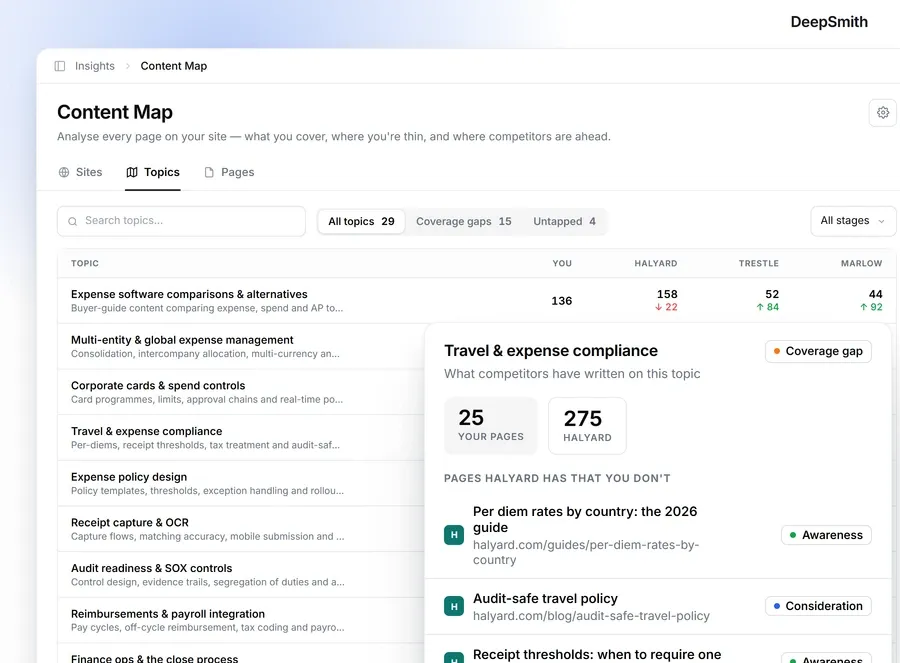
The two tools leave a trade-off in front of you. AirOps is strong on gaps and partial on topic planning, and BrandWell is the other way round. DeepSmith's Content Map treats both as one measurement. Every page on your site is crawled and classified onto a granular topic and a funnel stage (Awareness, Consideration or Decision), and your competitors are mapped onto the same taxonomy, so the comparison is like for like. You can add your own site plus unlimited competitor sites.
From that map you get coverage gaps, which are topics where you publish but a competitor publishes more, and untapped topics, where a competitor publishes and you have nothing. Per-topic depth shows whether a topic is thin, top-heavy, or missing its decision-stage pages. Sitemaps are re-checked every 24 hours, so the map stays current without a re-import.
Opportunity Agents then read the map and return ideas with the reason attached. An agent can build topical authority on a chosen topic, or close the awareness, consideration or decision-stage gap against up to four competitors at once. Each idea carries the specific data point that justifies it, so you can defend the backlog instead of guessing at it. Giving an idea a date in Planned Content plans it, and Autowrite can write it on that date.
Plans are $99 (Pro), $199 (Grow) and $399 (Scale) a month, or $80, $160 and $299 billed annually, with a 7-day free trial and no long-term contracts.

Topic and cluster planning
BrandWell is the stronger of the two here. Its record shows topic planning as a full yes, and AirOps as partial. BrandWell's content plan, topic clustering and editorial calendar come with every RankWell plan, and its strategy check looks at a keyword, topic or buyer question before writing and helps decide whether to create, optimize or merge.
AirOps organizes tracked prompts by topic and shows coverage by topic and intent stage, and its Opportunities point to areas worth work. The pages we read do not describe a topical map or content calendar, so the cluster structure would come from your own planning.
What DeepSmith does: The Content Map classifies every page onto one shared topic taxonomy with a funnel stage, and shows page counts and funnel distribution per topic. Your site defines the taxonomy and competitors are placed on it. Opportunity Agents can then build topical authority on a topic you pick.
Competitor gap analysis
AirOps is the stronger of the two on gaps. Its record shows a full yes for finding topics competitors cover that you do not. It shows where competitors appear in AI answers and you do not, and Opportunities surface owned and external gaps on all plans according to its pricing grid. Its keyword gap work leans on third-party data, with DataForSEO and Moz on all plans and Semrush and Ahrefs integrations on Pro and Enterprise.
BrandWell scores partial. Visibility offers domain and competitor research, including competitor ranking keywords and top pages, and shows AI-answer questions where a competitor is mentioned instead of you. A dedicated competitor topic-gap report is not described, though BrandWell says its AIMEE agent can prepare a gap analysis on request.
What DeepSmith does: Coverage gaps and untapped topics are measured against every competitor you add, topic by topic, and the Opportunity Agents turn a chosen gap into ideas. You can aim an agent at one funnel stage or at up to four competitors at once.
From insight to action
The two tools tie on briefs, and AirOps is ahead on scheduled publishing. Both records show briefs as a yes. AirOps campaign briefs come with editable supporting context before work is accepted into an action. BrandWell's research briefs hold search intent, target terms, competitor context and supporting research.
For scheduling, AirOps says workflows and grid columns can run on a schedule and include CMS publish steps, though its enterprise guidance defaults to draft mode with human review. BrandWell has an editorial calendar with schedule dates, but it states that publishing and scheduling need a separate approved delivery path, so its record shows partial.
What DeepSmith does: An idea moves from New Ideas to Planned Content to Produced Content, and the data point that justified it stays attached. The Writer turns a planned idea into a finished article with research, internal and external links, a cover image and publish-ready metadata. Autowrite does that on the scheduled date with no one in the app, and you can publish to WordPress, Webflow, Strapi, Sanity or Contentful.
Which should you choose
For AirOps vs BrandWell content planning, the choice follows how your planning starts. When you are deciding AirOps or BrandWell for content planning, each option below is described by the situation it fits.
- DeepSmith fits teams that want to see gaps and topics on one map, hand each idea to a writer with its evidence, and have articles produced on a schedule from the same platform. It suits content and marketing teams and agencies that run several brands from separate workspaces.
- AirOps fits teams whose planning starts from competitor and AI-answer gaps and who are comfortable configuring workflows, or paying AirOps to do it, with a quote needed for pricing.
- BrandWell fits content and SEO teams, and agencies, that want a ranked content plan, topic clusters and an editorial calendar in one workspace at a published monthly price, and care less about a competitor gap report.
Want to see the Content Map on your own site? Start a DeepSmith free trial and the first set of ideas is ready before you pay.