Anyword and BrandWell (formerly Content at Scale) solve different problems. Anyword writes short-form channel copy and scores the variations before they go live, while BrandWell researches, writes and publishes long-form SEO articles with AI-answer tracking included. DeepSmith is the stronger option when you want tracking and production on one plan, because its Content Map shows coverage gaps, Opportunity Agents attach evidence to each idea, and Autowrite publishes on schedule without manual steps.
If you are weighing Anyword vs BrandWell, the first thing to settle is what you publish most. Anyword is built around ads, emails, social posts and landing page copy, and its Predictive Performance Score estimates which version is likely to work best. BrandWell is built around long-form articles that rank in search, with research, an SEO score, publishing and AI-answer checks in one workspace. DeepSmith sits next to both as a platform that tracks AI answers and writes the articles that respond to them. This Anyword vs BrandWell review covers content type, workflow, tracking and pricing.
Anyword vs BrandWell: the short answer
- Choose DeepSmith if you want AI-answer tracking, competitor topic gaps and publish-ready articles on one self-serve plan, starting at $99 a month with a 7-day free trial.
- Choose Anyword if most of your writing is short-form copy for ads, email and social, and you want predicted performance scores on it, starting at $49 a month.
- Choose BrandWell if you publish long-form SEO articles at volume and want research, an SEO score, publishing and AI-answer tracking together, starting at $249 a month for 25 articles.
| Criterion | DeepSmith | Anyword | BrandWell |
|---|---|---|---|
| Entry price (monthly) | $99/mo (Pro) | $49/mo (Starter) | $249/mo (RankWell Essentials) |
| Annual price (per month) | $80/mo | $39/mo | Not listed |
| Volume at entry tier | 20 articles/mo | Unlimited words, 50 predictions/mo | 25 articles/mo |
| Free trial | Yes, 7 days | Yes, 7 days, 2,500 words | Partial, terms conflict |
| Long-form article generation | Yes | Yes | Yes |
| Short-form marketing copy | Partial, channel versions | Yes | Partial |
| SERP-based content scoring | - | Partial | Yes |
| Internal linking | Yes | Not listed | Yes |
| CMS publishing | Yes | Partial, Drupal and Sitecore (Beta) | Yes |
| Scheduled publishing | Yes | Not listed | Partial |
| AI visibility tracking | Yes | Not listed | Yes |
| API | Yes, read-only | Yes, Enterprise only | Yes |
| SOC 2 | Yes | Yes | Not listed |
| Review rating | 4.8/5 on G2 | 4.8/5 on G2 | 9.1/10 on TrustRadius |
Pricing and features as of September 2026, from each vendor's site and public reviews.
Anyword

Anyword is an AI marketing-copy platform from Keywee Inc., based in New York. It writes ads, social posts, emails, website copy and blog posts, and it scores variations with a Predictive Performance Score that the company says was trained on millions of A/B tests. Anyword says the score picks the better of two variations 82% of the time, which is a vendor claim that has not been independently checked.
It is built for marketing, demand gen and social teams that produce a lot of short-form channel copy. The standout is that scoring, brand voice and audience controls sit inside the editor on every plan, along with 100+ templates, a Chrome extension and 30+ languages. Starter is $49 a month and Data-Driven is $99, both with unlimited words but a monthly cap on predictions.
The limits show up on long-form and SEO work. Reviewers report that long-form output can be repetitive and needs editing, and the Blog Wizard's SEO score is based on target keywords, readability and originality, with no keyword volume data or internal linking described. Channel integrations, copy analytics and custom models start at the Business plan, which has no public price. Anyword holds 4.8 out of 5 on G2 from 1,228 reviews and 4.8 out of 5 on Capterra from 391, checked in September 2026.
BrandWell

BrandWell is the 2024 rebrand of Content at Scale, so an Anyword vs Content at Scale search lands on the same product. It is a bootstrapped company led by founder and CEO Justin McGill. Its content product, RankWell, plans, researches, writes, optimizes and publishes SEO articles, and it sits inside a wider growth platform that also sells buyer-intent data, visitor identification and outreach.
It suits content and SEO teams and agencies that want long-form drafts from a keyword, URL, video or audio file, with brand voice rules, an SEO score, internal linking and WordPress or Contentful publishing in one workspace. The standout is that Visibility, which tracks answers on ChatGPT, Claude, Gemini and Perplexity, is included in every RankWell plan. Public prices are $249, $499 and $999 a month for 25, 50 and 100 articles.
The real limitation is clarity. BrandWell's pricing page, its registration page and its terms disagree on plans and trial terms, and it does not publish how many AI-answer checks each plan includes or how often they run. Third-party reviews are few and mostly from 2023. Capterra's legacy Content at Scale listing shows 4.0 out of 5 from five reviews, and TrustRadius shows 9.1 out of 10 from two. Older reviewers describe drafts that needed editing and fact checking.
DeepSmith: the alternative that tracks, finds gaps and publishes on schedule
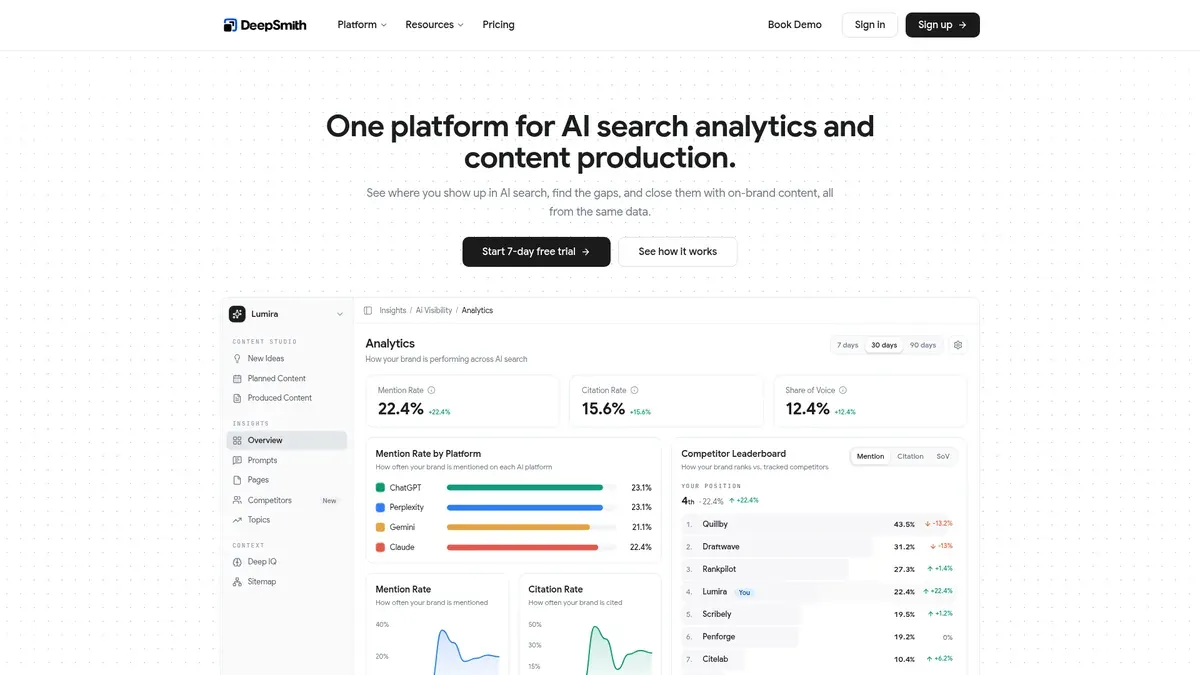
DeepSmith tracks how AI engines answer questions about your brand and produces the articles that close the gaps, all from the same data. BrandWell tracks AI answers too, so the difference between the two is in how the work moves from what you learn to what gets published. Anyword does not describe AI-answer tracking at all, so a team that needs it would be adding a second tool.
Three parts of DeepSmith carry that work. Content Map crawls your site and your competitors' sites onto one shared topic taxonomy, so coverage gaps (topics where a competitor publishes more) and untapped topics (topics where you have nothing) are measured instead of guessed. Opportunity Agents read your visibility data or your Content Map and return content ideas, each with the data point that justifies it, so you can defend the backlog. Autowrite writes a planned article on its scheduled date and lands it in Produced Content, and it can take the piece all the way to published with no one in the app.
The output is publish-ready, which means researched, internally and externally linked, with a cover image and metadata. Deep IQ grounds each article in the company, product, persona and voice context you stored once, and finished pieces publish to WordPress, Webflow, Strapi, Sanity or Contentful, or to your own webhooks.


On price, Pro is $99 a month ($80 billed annually) with 20 articles and 50 tracked prompts on ChatGPT. Grow is $199 ($160 annually) with 40 articles, 100 tracked prompts, ChatGPT and Perplexity. Scale is $399 ($299 annually) with 90 articles, 200 tracked prompts, and Gemini added. Enterprise is custom and covers all ten engines. There is a 7-day free trial and no long-term contract. DeepSmith is rated 4.8/5 on G2 and is SOC 2, GDPR and ISO certified.
Content type and output
Anyword is the stronger fit for short-form copy, and BrandWell is the stronger fit for long-form articles. Anyword ships 100+ templates for ads, social posts, emails, landing pages and product descriptions on every plan, and CSV templates generate copy in bulk. BrandWell does not market short-form copy as part of RankWell, and its email copy is written in a separate Outreach product.
Both can write a full article. Anyword's Blog Wizard writes an outline, intro, body and conclusion from a topic or brief, and BrandWell's RankWell writes from a keyword, URL, YouTube video, podcast or audio file, with a research step before drafting. For a team that publishes mostly articles, BrandWell's setup covers more of the job around the draft.
What DeepSmith does: the Writer produces a finished, brand-grounded article with a cover image and metadata, and every article arrives with social posts already written. The Apps Library then turns it into versions for LinkedIn, X, Medium, Substack, newsletters and more, so the long-form piece also feeds the short-form channels.
Workflow and publishing
BrandWell has the more complete workflow of the two. A project moves from a content plan and research brief to background generation, an editor with an SEO score, a production queue, an editorial calendar and delivery to WordPress, Contentful or Google Docs. BrandWell states that generation creates editable work and that publishing needs a separate approved delivery path, so scheduled publishing is partial rather than hands-off.
Anyword's workflow is built around the editor and the Chrome extension, which brings scoring and brand voice into ChatGPT, Google Docs, Notion, Canva and LinkedIn. Content export to a CMS is listed only for Drupal and Sitecore, both in Beta, and out-of-the-box integrations sit on the Business and Enterprise plans.
What DeepSmith does: content moves from New Ideas to Planned Content to Produced Content, with the Writer in the middle. Giving an idea a date plans it, and Autowrite writes it on that date and can publish without anyone opening the app. You can also review and edit in Produced Content and publish from there.
Performance scoring and SEO guidance
Anyword wins on predicting how copy will perform, and BrandWell wins on scoring an article for search. Anyword's Predictive Performance Score grades variations for a chosen audience, goal and channel, and on Business and Enterprise it compares published content with its A/B-test dataset and your connected channel data. The scores are predictions, not measured results, and the monthly allowance is capped at 50, 100 or 250 depending on the plan.
BrandWell scores a draft live in the editor against ranking pages, with NLP, entity and salience analysis, keyword coverage, a search preview and automatic internal linking on every plan. BrandWell itself says the score is guidance and not a ranking guarantee. If search traffic is the goal, that is the more relevant kind of scoring of the two.
AI-answer tracking
BrandWell wins this one clearly. Visibility runs your tracked buyer questions on ChatGPT, Claude, Gemini and Perplexity, saves each answer with its mentions and citations, and lets you compare checks over time. It also offers historical citation research, kept separate from live checks. The gaps are in the detail, because BrandWell does not publish check quotas per plan, how often checks run, or whether it collects answers through official APIs or consumer interfaces.
Anyword does not describe AI-answer tracking or optimizing content to be cited in AI answers. ChatGPT and Gemini appear in its integrations only as places where you can write.
What DeepSmith does: the AEO module tracks mention rate, citation rate, share of voice and sentiment across ten named engines, with full answer history for each prompt. The Pages view shows which of your pages AI actually cites and which prompts drive those citations, and competitor citations show who wins each prompt and on which pages. Pro tracks ChatGPT, Grow adds Perplexity, Scale adds Gemini, and Enterprise covers all ten.
Pricing and value
Anyword is the cheaper way in, and BrandWell is the one that publishes a price for long-form volume. Anyword's Starter plan is $49 a month ($39 billed yearly) with one seat, and Data-Driven is $99 ($79 yearly) with three seats and extra seats at $59 a month. Business and Enterprise are quoted. Words are unlimited, but predictions are not.
BrandWell's RankWell is $249 a month for 25 articles, $499 for 50 and $999 for 100, with Visibility included and no annual price shown. Programmatic SEO and Link Builder start at Growth. The registration page still shows 12-month commitment plans from $899 to $2,999 a month, and the pricing page's 3-day guarantee applies only if no more than 2 articles were generated and none were published or exported. Confirm what you are buying in writing before you pay.
What DeepSmith does: Grow at $199 a month includes 40 articles and 100 tracked prompts, and the 7-day free trial lets you see real data and real drafts before you pay. There are no long-term contracts and no cancellation fees, so the plan can change as your volume does.
From insight to action
BrandWell is ahead of Anyword here. Its content plan ranks what to create, optimize, merge or monitor using Search Console data and AI citation evidence, and its AIMEE agent runs workflow templates such as Close a visibility gap with named approval points. Anyword's insight is about copy performance, because Content Intelligence points at which messages and channels are working, not which topics your site is missing.
What DeepSmith does: the loop is built into the platform. AI visibility tells you which prompts you are missing, Content Map shows which topics competitors cover that you do not, Opportunity Agents turn both into ideas with the evidence attached, and the Writer and Autowrite produce the article. The REST API and MCP server are read-only, so your own tools and AI assistants can pull visibility, Content Map and content library data, and webhooks can trigger your own publishing workflows.
Which should you choose
- DeepSmith fits marketing and content teams that want to see where they are missing in AI answers, find the topics competitors cover that they do not, and produce on-brand, publish-ready articles for those gaps on one plan, with agencies running several brands from one account.
- Anyword fits marketing, demand gen and social teams that write a lot of ads, emails and social posts and want a predicted performance score on each variation, at a low self-serve entry price.
- BrandWell fits content and SEO teams and agencies that publish long-form articles at volume, want an SEO score and automatic internal linking in the editor, and want AI-answer tracking included in the same plan.
If you are deciding between Anyword or BrandWell alone, the split is short-form copy against long-form SEO, and the Anyword vs Content at Scale question comes down to the same split. If you want to see tracking and production on your own site first, you can start a free DeepSmith trial and use it for 7 days.