The DeepSmith vs Anyword decision is easier to make once the two tools are placed on the right axis, because they are not competing for the same job. Anyword is a performance-scored copywriting platform: it generates ad, email, and landing-page variants and assigns each one a predicted conversion score before anything ships. DeepSmith is an AEO track-and-write platform: it measures how AI engines answer questions about a brand, finds where that brand is missing, and produces the editorial articles built to close those gaps. The choice, then, is less about which tool is better in the abstract and more about which bottleneck a content team is trying to remove.
This comparison gives Anyword full credit for the problem it was designed to solve, and states DeepSmith's own capabilities within the bounds of what the product actually does. The conclusion here is not neutral, because DeepSmith publishes this page; the facts on both sides are stated straight. The question that most often drives this search, whether DeepSmith or Anyword is the better fit for producing content that earns AI citations, has a specific answer, and the sections below explain why, along with the cases where Anyword is the correct choice instead.
DeepSmith vs Anyword at a glance
| Dimension | Anyword | DeepSmith |
|---|---|---|
| Primary job | Performance-scored short-form copywriting | AEO track-and-write: AI visibility tracking plus publish-ready editorial production |
| Core differentiator | Predictive Performance Score (0 to 100) on each variant | Mention rate, citation rate, and share of voice across named AI engines, paired with same-data production |
| Output type | Ad copy, email variants, landing-page sections, blog drafts | Publish-ready articles with cover image, internal and external links, metadata |
| AI search visibility tracking | No | Yes, tiered by plan |
| Engines covered | Not applicable | Ten: ChatGPT, Perplexity, Gemini, Claude, Google AI Overviews, Google AI Mode, Grok, Meta AI, Microsoft Copilot, DeepSeek (tiered) |
| Long-form quality | Weaker spot per third-party reviews | Core strength; output is publish-ready |
| Brand controls | Brand voice profiles; custom AI models on higher tiers | Deep IQ brand context across company, products, persona, voice, visuals |
| Distribution | Push scored copy into ad and CRM platforms | Apps Library: LinkedIn, X, Medium, Substack, email, and more |
| Pricing floor | $49 per month (Starter) | $99 per month (Pro) |
| Free trial | 7 days on Starter | 7 days, real data and real drafts before payment |
| Best fit | Performance and growth marketers, agencies | Content and AEO teams, agencies managing multiple brands |
What Anyword is and where it wins

Anyword is an AI content platform built for marketing and go-to-market teams, and its defining feature is the Predictive Performance Score. Every generated variant receives a number from 0 to 100 that estimates its likelihood to convert, benchmarked against a large set of historically A/B-tested ads and copy. The score is the reason marketers reach for the tool: it offers a way to triage headline and body variants before media budget is committed, rather than waiting for live results to reveal which version performs.
The company positions Anyword AI copy as performance-scored rather than generic. Anyword states that content created in its platform performs 76 percent better than AI content produced elsewhere, a figure drawn from the company's own benchmarking rather than an independent study, so it is best read as a directional claim about the value of scoring rather than a settled result. The underlying idea, that a probabilistic score can rank variants by predicted conversion, is coherent and genuinely useful to teams that test frequently.
Anyword's core capabilities cluster around short-form marketing copy. It generates copy for Google, Meta, and LinkedIn ads, email subject lines and body copy, landing-page hero and subhead and call-to-action blocks, product descriptions, SMS and push notifications, and social captions. A Blog Wizard workflow produces longer drafts through a guided outline-to-conclusion sequence. Brand voice controls let teams set tone and guidelines so output stays reasonably on voice, and higher tiers add custom AI models trained on a brand's own historical copy and performance data, which tunes the predictive score to that brand specifically. A website personalization feature can serve the highest-scoring copy variant to each visitor without a separate testing tool.
The integration story reinforces the performance-marketing focus. Anyword connects to Meta, Google, and LinkedIn ad platforms, to CRMs including HubSpot, Salesforce, Marketo, and Dynamics 365, and to workspace tools such as Notion, Google Drive, and Word. The design intent is clear: generate scored copy, then push it into the channels where ads and emails actually ship.
Where Anyword wins is straightforward. Performance and growth marketers who run many paid experiments get a pre-launch signal on every variant. Agencies juggling many brand voices get scored deliverables. Email-heavy teams get subject-line and preview-text scoring at volume. For those workflows, the Predictive Performance Score is a real advantage that DeepSmith does not attempt to replicate.
What Anyword does not do
Two limitations matter for the reader weighing an AEO strategy. First, long-form editorial output is described as a weaker area in independent reviews; quality tends to be inconsistent and depends heavily on how detailed the brief is, which means editorial cleanup is usually still required before publishing. Second, and more decisive for this comparison, Anyword has no AI search visibility layer. There is no module that monitors mention rate, citation rate, or share of voice inside ChatGPT, Perplexity, Gemini, Claude, or Google AI Mode. Anyword is a copy generation and scoring tool, not an answer-engine measurement tool, and it does not claim to be one.
It is also worth noting that the predictive scores are probabilistic. They correlate with conversion likelihood, but they do not guarantee outcomes, and they are best treated as a triage signal that narrows the field before live testing rather than a substitute for it.
What DeepSmith is and where it wins

DeepSmith is an AI search analytics and content production platform in one workspace. It tracks how AI engines answer the questions that matter in a brand's category, surfaces the gaps where the brand is invisible or losing to competitors, and produces the on-brand articles that close those gaps, all from the same underlying context. The positioning is deliberately narrow: a production engine, not a writing assistant. Output is intended to be publish-ready, meaning a finished, brand-grounded article with research, internal and external links, a cover image, and metadata, rather than a first draft that a human still has to rescue.
The AI search visibility module is what separates the tool from a generic long-form writer. It reports mention rate, how often an AI engine names the brand, citation rate, how often an engine links to the brand's pages as a source, and share of voice relative to competitors, each with a visibility trend over time. A per-platform breakdown, a competitor leaderboard, and a view of the sources AI engines cite most give a content lead the raw material for a strategy. The Pages view shows which specific pages AI engines actually cite and what share of total citations each one earns, which turns visibility from an abstraction into an editable list of pages.

Production sits alongside the tracking rather than in a separate tool. Opportunity Agents read the brand's own visibility data and Content Map and return ideas with the justifying data point attached, and those ideas land in New Ideas, the single backlog behind the calendar. The Writer turns one planned idea into a finished article that is researched, internally and externally linked, and shipped with a cover image and publish-ready metadata. Autowrite extends this to hands-off operation: an article configured at planning time writes itself on its scheduled date and lands in Produced Content with no one in the app, which is the mechanism that converts a content calendar from an aspiration into an operating system. A human can still review and publish from Produced Content, and DeepSmith does not promise guaranteed quality with zero oversight.

Two supporting layers make the output consistent at volume. Deep IQ stores the brand's positioning, product details, buyer personas, brand voice, visual guidelines, and content-type templates as structured context that shapes every draft, so the system writes with full brand context each time instead of relying on a fresh brief per article. The Content Map keeps every published page classified onto a shared topic taxonomy and current, which powers automatic internal linking during generation and feeds coverage analysis and deduplication. Distribution is built into the article as well: every finished piece arrives with social posts drafted, and the Apps Library adapts one article into channel-native versions for LinkedIn, X, Medium, Substack, newsletter and nurture email, and more.
Where DeepSmith wins is the mirror image of Anyword's strength. Teams whose bottleneck is editorial volume, and whose strategy depends on being cited in AI answers, get measurement and production in one place. Agencies running multiple brands get isolated workspaces, each with its own context and plan.
What DeepSmith does not do
DeepSmith tracks mention and citation across the engines it covers; it does not control or guarantee rankings, citations, traffic, or revenue. Engine coverage is tiered rather than universal on every plan: the Pro tier tracks ChatGPT only, Grow adds Perplexity, Scale adds Gemini, and all ten named engines are covered on Enterprise and Custom. The ladder matches spend to the engines a team actually tracks, widening as the AEO program does. Article volume is bounded by tier as well, at 20, 40, and 90 articles per month across Pro, Grow, and Scale, a range that fits most editorial cadences, with Enterprise lifting the ceiling for the heaviest publishers. And it is not a short-form copy scorer: there is no predictive conversion score on an ad variant, because that is not the problem the platform is built to solve.
Performance copy vs AEO content: the core divergence
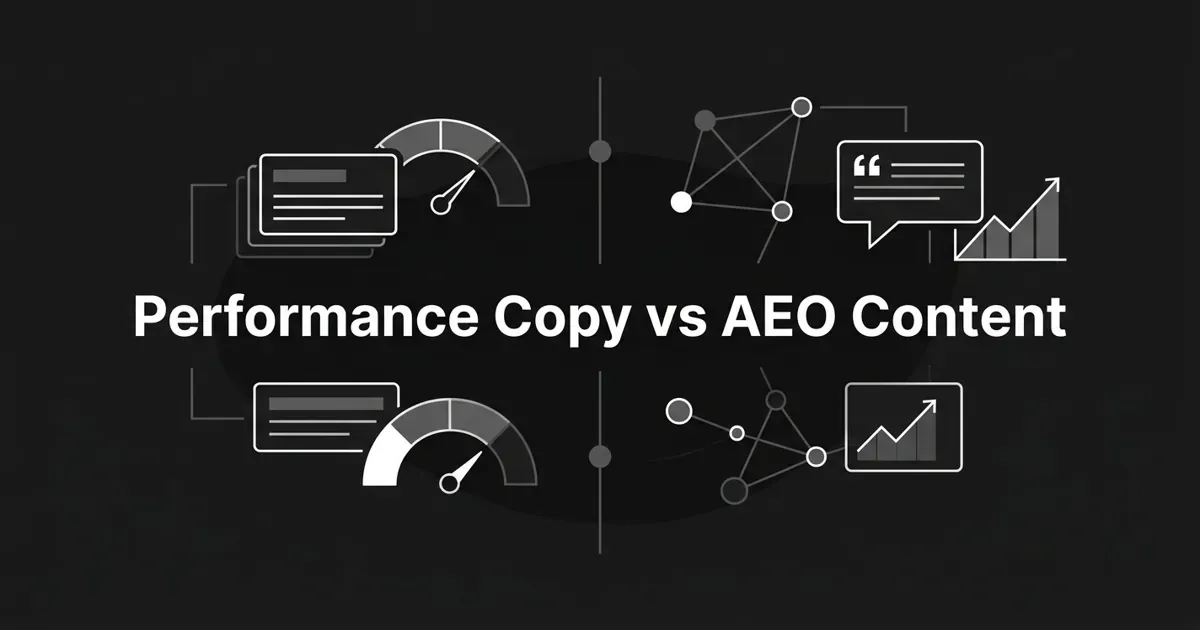
The performance copy vs AEO content distinction is the cleanest way to understand which tool fits. Anyword optimizes a single asset for conversion at the moment of generation: it asks, of these variants, which one is most likely to make a reader click or buy. DeepSmith optimizes a body of editorial content for visibility inside AI answers over time: it asks which questions a brand should be cited for, whether it currently is, and what to publish to change that.
Answer engine optimization, the practice DeepSmith is built around, is distinct from traditional SEO. Where classic SEO competes for position in a ranked list of blue links, AEO competes for inclusion and citation inside a synthesized answer on an engine like ChatGPT or Perplexity. The two disciplines respond to different interventions, and a tool designed to score ad copy is not positioned to measure or improve the second. This is not a knock on Anyword; it is a statement of scope. A team that has identified AI search visibility as a channel needs a tool that watches that channel, and Anyword does not.
The reverse holds too. A performance marketing team that lives in paid social and email does not need citation tracking across answer engines; it needs a fast, defensible way to rank copy variants before spend. For that team, DeepSmith's AEO machinery would go largely unused, and Anyword's Predictive Performance Score is the more relevant instrument.
Feature comparison: output, tracking, brand context, distribution
On output type, the tools diverge sharply. Anyword AI copy comes as discrete assets: ad variants, email lines, landing-page sections, and guided blog drafts. DeepSmith produces complete articles, formatted for citation, with the surrounding assets a publishable piece requires. Teams that have felt the gap between a raw draft and a shippable page will recognize the difference between a first-draft workflow and publish-ready production.
On tracking, there is no overlap. DeepSmith's AI search visibility module has no counterpart in Anyword, which measures predicted conversion rather than answer-engine presence. A team that wants to know whether an AI engine is citing its pages will find that capability only on the DeepSmith side of this comparison.
On brand context, both tools offer voice controls, but at different altitudes. Anyword applies brand voice at the variant and template level and can train custom models on a brand's historical copy at higher tiers. DeepSmith applies an always-on context layer through Deep IQ, which shapes entire articles from stored company, product, persona, and voice data, aimed at keeping brand consistency intact as volume rises. The two approaches suit their respective outputs: template-level voice for short copy, article-level context for long-form editorial.
On internal linking and distribution, DeepSmith folds work that is usually manual into the pipeline. Internal links are inserted automatically during generation by scanning the enriched sitemap, and channel derivatives are produced from the finished article rather than in a separate project. Anyword's distribution model instead pushes scored copy into ad platforms and CRMs, which fits its performance-marketing purpose.
Pricing: two different meters
Anyword and DeepSmith price against different meters, which makes a naive per-month comparison misleading. Anyword's Starter tier is $49 per month with 50 performance predictions, 50 performance data rows, and a single seat. Its Data-Driven tier is $99 per month with 100 predictions and three seats, and Business and Enterprise tiers move to custom pricing with custom AI models and expanded governance. A 7-day free trial is available on Starter. The unit that scales here is predictions and seats, which is the right meter for a copy-scoring workflow.
DeepSmith prices around articles and tracked prompts. The Pro plan is $99 per month, or $80 per month billed annually, and includes 20 articles, 50 tracked prompts, five seats, and ChatGPT tracking. Grow is $199 per month, or $160 annually, with 40 articles, 100 prompts, seven seats, and Perplexity added. Scale is $399 per month, or $299 annually, with 90 articles, 200 prompts, ten seats, and Gemini added. Enterprise is custom and covers all ten engines. A 7-day free trial applies, with no long-term contracts and no cancellation fees.
The honest framing is that neither tool is categorically cheaper. Anyword has the lower floor at $49, but the two are metered for different workloads, so the true cost per article or per tracked prompt depends entirely on how a team works. A performance team scoring ad copy will find Anyword sized for its usage; a content team running an editorial AEO program will find DeepSmith sized for its own. Comparing the headline numbers without a workload assumption produces a false conclusion.
Which should you choose
Choose Anyword when the bottleneck is short-form marketing copy and the team wants a predicted-conversion score before launch. That includes paid social and paid search teams that want pre-launch scoring of headline and body variants, high-volume email programs that want subject-line scoring, and agencies whose deliverable is scored copy across many brand voices. When the operative metrics are conversion rate, click-through rate, and return on ad spend, Anyword is built for that work.
Choose DeepSmith when the bottleneck is editorial content and the strategy depends on AI search visibility. That includes teams that need to ship more articles per month without adding headcount, teams that must measure mention rate, citation rate, and share of voice across the ten engines DeepSmith tracks, from ChatGPT and Perplexity to Google AI Overviews, Microsoft Copilot, and Grok, and teams that want publish-ready output with internal linking, external linking, a cover image, and metadata already in place. It also fits agencies managing multiple brands from one login and teams that want distribution assets generated from the same article rather than as a second workflow. For the specific question of whether DeepSmith or Anyword is the better fit for AEO content production, DeepSmith is the only option in this comparison that tracks and writes for answer engines.
Running both is reasonable for organizations that need scored short-form copy and measured editorial content at the same time, since the tools do not meaningfully overlap. One handles the ad and email layer; the other handles the editorial and visibility layer. Using DeepSmith as an Anyword alternative only makes sense when the actual need was editorial AEO production all along and the short-form scoring was never the priority.
Start closing your AI visibility gaps
For teams that came to this comparison looking for an Anyword alternative because their real problem is editorial production and AI citations rather than ad-copy scoring, the fastest way to judge fit is on real data. DeepSmith offers a 7-day free trial that surfaces where a brand shows up in AI answers and produces publish-ready drafts before any payment, so the decision can rest on output rather than on a feature list.