You opened a tracking tool, saw your mention rate, and then sat there wondering what to actually do about it. That gap between seeing a number and shipping the work is why most people start looking at asklantern alternatives in the first place.
Here is the good news. The category has grown up fast. You can now pick a tool that matches how your team really works, not just one that produces a dashboard.
This guide walks you through eight alternatives to Asklantern. Some are pure measurement. Some add audits and agents. One connects the tracking straight to the articles you publish. You will finish knowing which shape fits you.
We are not reviewing Asklantern here. We are looking at what you would move to, and why. Standalone AI agents with no visibility tracking are out of scope, because if a tool cannot measure, it cannot tell you whether anything worked.
How we picked these Asklantern alternatives
A roundup is only useful if you know the yardstick. Here is ours.
Visibility coverage. Which AI engines and surfaces the tool watches, whether you can control country or language, and how often it refreshes. A monthly index is a different product from daily monitoring, even when both say "AI visibility" on the homepage.
Measurement depth. Mention rate, citation rate, share of voice, position, sentiment, source pages, prompt-level history, and competitor comparisons. Depth is what turns a score into a diagnosis.
Actionability. Does the tool hand you recommendations, audits, briefs, optimization, or agents? A gap you cannot act on is just a worry.
Production fit. Whether the tool writes content, runs a calendar, stores brand context, publishes, and repurposes. This is the axis most trackers skip entirely.
Scale and operations. Prompts, responses, credits, workspaces, seats, dashboards, API access, SSO, and agency support.
Commercial clarity. Public pricing, billing basis, trial terms, and the limits that actually bite.
Persona fit. Whether it takes work off a marketing lead's plate rather than adding a tab to check on Monday morning.
One honest note before the list. This ranking of asklantern.com competitors reflects documented capability and buyer fit, not a live head to head benchmark of every product. Prices and limits are published snapshots, so confirm at checkout before you buy.
The 8 best Asklantern alternatives at a glance
| Rank | Tool | Best for | Published entry price | Core coverage | Production posture | Main tradeoff |
|---|---|---|---|---|---|---|
| 1 | DeepSmith | Visibility plus publish-ready content production | Pro $99/mo, Grow $199/mo, Scale $399/mo, Enterprise custom | ChatGPT up to all ten named engines by Enterprise | Content Studio, Opportunity Agents, Autowrite, Deep IQ, publishing and repurposing | Engine coverage is tiered, broadest on Enterprise |
| 2 | Profound | Enterprise visibility intelligence and marketing agents | Starter $99/mo billed yearly, Growth $399/mo billed yearly | Starter is ChatGPT, Growth is three engines, Enterprise up to nine | Agents and AEO content workflows | No API access on Starter or Growth |
| 3 | Peec AI | Focused analytics for marketing teams and agencies | Current plan prices not displayed on the reviewed pricing page | ChatGPT, AI Mode, AI Overviews, Copilot, Perplexity, Gemini | Recommendations and insights | Prices, credits, prompt limits and trial not displayed |
| 4 | OtterlyAI | Affordable self-serve monitoring | Lite $29/mo, or $25/mo displayed annual | Four core engines, with Claude, AI Mode and Gemini as add-ons | Audits, briefs, GEO recommendations, reports | Narrow base plan, several engines are add-ons |
| 5 | Scrunch | Visibility plus site diagnostics and agent experience | Core $250/mo, Enterprise custom | Core four LLMs, Enterprise nine named LLMs | Basic content generation and page optimization | Core limits fan-out, one page optimization per month, one country |
| 6 | Ahrefs Brand Radar | Large-scale brand research for Ahrefs users | $199/mo per index, $699/mo all platforms | Seven AI platforms plus Search Demand, Web Visibility, YouTube, Reddit, TikTok | Research and monitoring | AI chatbot indexes update monthly |
| 7 | Semrush AI Visibility Toolkit | High-level visibility inside the Semrush ecosystem | $99/mo per domain, billed annually | ChatGPT, AI Overviews, AI Mode, Gemini, Perplexity | Visibility reports and research | One domain for Brand Performance, no trial on the standalone toolkit |
| 8 | Rankscale | Broad, high-frequency rank tracking and agency dashboards | Essentials from $20/mo, Pro $99/mo, Growth $385/mo, Enterprise $780/mo | ChatGPT, Gemini, Perplexity, Claude, DeepSeek, Mistral, Grok, Copilot and more | Page audits, dashboards, Looker Studio, API on higher tiers | Credit-based, so answer volume depends on engine mix |
1. DeepSmith
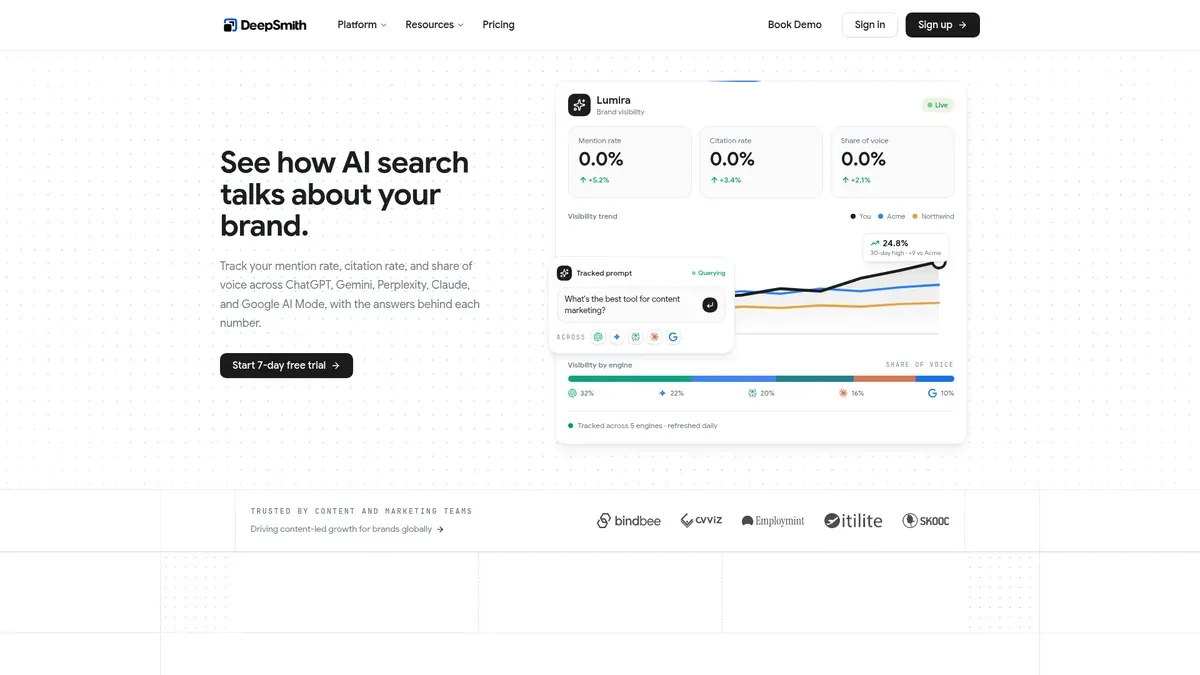
Best for: Marketing leads who need to see where AI answers mention or cite their brand, spot the competitive and topical gaps behind those numbers, and move straight into producing the content that closes them.
DeepSmith is one platform for AI search analytics and content production. That sentence is the whole point of its placement here. Every other tool on this list hands you a finding and then stops. DeepSmith carries the finding through to a published article.
Let's walk through it in the order you would actually use it.
You measure. AI Visibility reports mention rate, citation rate, share of voice, sentiment, and visibility trend, with per-platform breakdowns, a competitor leaderboard, and the sources AI cites most often. Prompts gives you per-prompt mention and citation rates plus full answer history, so you can see a question turn from a miss into a win. Pages shows which of your URLs AI actually cites and which prompts drive each one. Competitor citations shows exactly which rival pages are beating you, on which platform.

DeepSmith covers ten engines: ChatGPT, Gemini, Perplexity, Claude, Google AI Overviews, Google AI Mode, Grok, Meta AI, Microsoft Copilot, and DeepSeek.
You find the gap. Content Map crawls your site and unlimited competitor sites, then classifies every page onto one shared topic taxonomy and funnel stage. You get coverage gaps, where a competitor publishes more than you, and untapped topics, where a competitor publishes and you have nothing at all. Sitemaps re-check every 24 hours, so new pages fold in without a re-import.
You get ideas with evidence attached. Opportunity Agents read your own visibility and Content Map data and return ideas, each carrying the data point that justifies it. There are agents for winning citations on a tracked prompt, turning mentions into citations, taking a competitor's citations, fixing how AI describes you, and closing awareness, consideration, or decision-stage gaps. Every run is logged as an immutable record. That means you can defend your backlog in a planning meeting instead of guessing.
You produce. Content Studio moves an idea through New Ideas, Planned Content, and Produced Content. The Writer turns one planned idea into a finished, brand-grounded article with research, internal and external links, a cover image, and publish-ready metadata. Autowrite writes on a scheduled date with nobody in the app. Produced Content lets you review, edit, preview, regenerate the cover, and publish straight to WordPress, Webflow, Strapi, Sanity, or Contentful, or to your own webhooks.

You stay on brand. Deep IQ stores your positioning, products, personas, brand voice, visual guidelines, and content types once. Every draft is written against that context, so you are not re-briefing anyone per article. Keyword coverage, heading structure, schema markup, internal linking, and metadata are built into the pipeline, not bolted on after.
You distribute. Repurpose and the Apps Library turn a finished article into LinkedIn, X, Medium, Substack, newsletter and nurture email, Reddit, Facebook, Instagram, Slack or Discord, and WhatsApp versions. Distribution stops being the step that falls off the list.
Pricing: Pro is $99 a month, Grow is $199, Scale is $399, and Enterprise is custom. Billed annually those become $80, $160, and $299 a month. Pro includes 20 articles, 50 tracked prompts, and 5 seats. Grow includes 40 articles, 100 prompts, and 7 seats. Scale includes 90 articles, 200 prompts, and 10 seats. There is a 7-day free trial with real data and real drafts before you pay, no long-term contracts, and no cancellation fees. Enterprise adds 1:1 onboarding, a dedicated account manager, and custom limits.
Honest limitation: Engine coverage is tiered. Pro tracks ChatGPT, Grow adds Perplexity, Scale adds Gemini, and all ten engines sit on Enterprise. If Gemini is your day-one priority, you are starting at Scale. That tiering does not touch the production side at all, so a team whose first measurement priority is ChatGPT, or ChatGPT plus Perplexity, gets the full workflow from the entry plan.
2. Profound
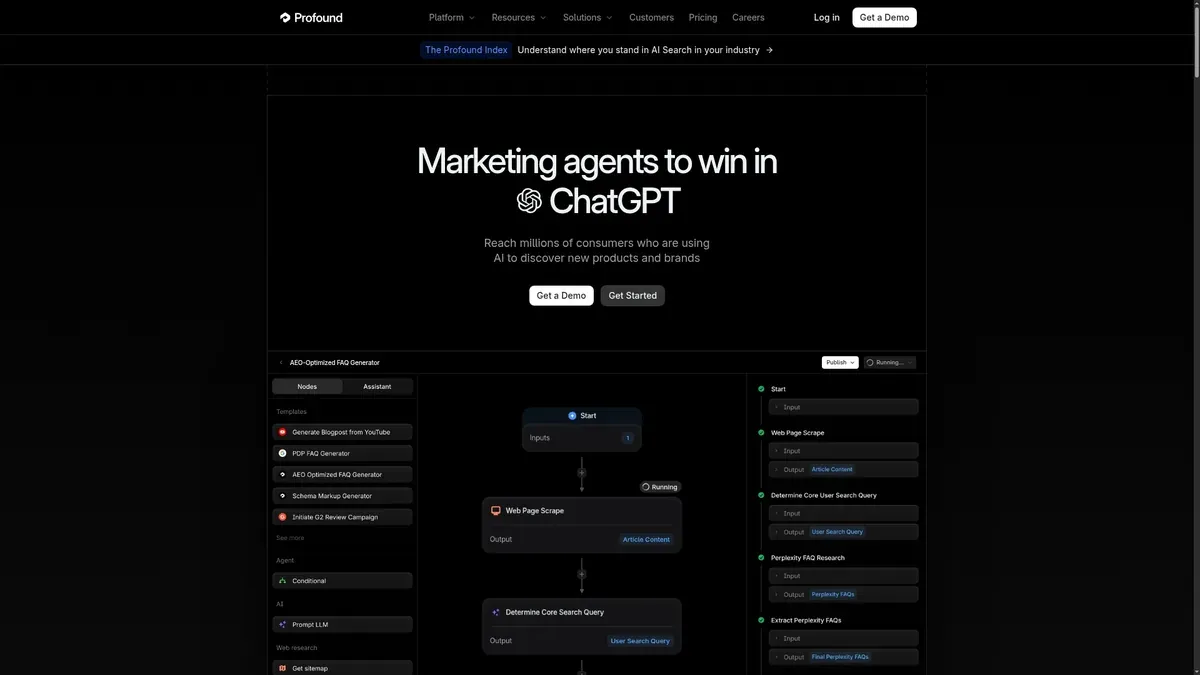
Best for: Enterprise marketing organizations and agencies that need broad visibility intelligence, agent-based AEO work, and AI traffic attribution.
Profound runs structured prompts across AI platforms daily and analyzes brand and competitor appearance, citations, sentiment, ranking, and competitive presence. Its modules are Prompt Volumes, Answer Engine Insights, Agents, Agent Analytics, and Aim.
Prompt Volumes surfaces what people are actually asking AI. Answer Engine Insights shows how AI represents your brand. Agents create autonomous marketing workers and AEO content workflows. Aim prioritizes the high-impact work. Agent Analytics tracks AI-sourced traffic and attribution across your domains, which is rare here.
The pricing page names ChatGPT, Perplexity, Google AI Overviews, Google AI Mode, Gemini, Microsoft Copilot, Grok, DeepSeek, and Anthropic Claude. Starter covers ChatGPT only, with 50 prompts, 1,500 responses a month, 100 agent credits, one region, one language, and one seat. Growth covers three answer engines, 100 prompts, 9,000 responses, 400 agent credits, and three seats. Enterprise reaches up to nine engines with custom everything.
Pricing: Starter is $99 a month billed yearly, Growth is $399 a month billed yearly, both with two months free. Enterprise is custom and adds SSO and SAML, SOC2 compliance, dedicated Slack support, and a specialist with a 24-hour SLA. Named integrations include Akamai, AWS, Cloudflare, Fastly, Google Analytics, Google Cloud Platform, Netlify, Vercel, and WordPress.
Limitation: API access is Enterprise only, so the two self-serve tiers cannot export programmatically. Agent usage is credit-based. The reviewed pages do not state a standard free trial.
Pick Profound instead if you run an enterprise AEO program and value autonomous marketing agents and traffic attribution more than a built-in editorial calendar.
3. Peec AI

Best for: Marketing teams and agencies that want a focused analytics workflow built around prompts, competitors, sources, and recommendations.
Peec AI starts you with prompts, tags, categories, and competitors, then helps you work out which prompts matter. AI-suggested prompts and search volumes narrow the field. From there you compare brands, find the key sources feeding AI answers, and act on recommendations. The current brand pricing page names six engines: ChatGPT, AI Mode, AI Overviews, Microsoft Copilot, Perplexity, and Gemini.
Starter, Pro, and Advanced all show daily tracking. Support is chat on Starter, chat plus email on Pro and Advanced. Comparison material describes API integration, SSO login, and GDPR compliance, and notes SOC2 certification as being pursued rather than held at the time. If security review matters to you, confirm that status directly.
Pricing: The reviewed pricing page names Starter, Pro, Advanced, and Enterprise but does not display current monthly or annual prices, credit allotments, seats, competitor limits, or trial terms. Pricing is based on tracked prompts and models analyzed. The agency page states that one prompt against one model for a month costs 30 credits, and a three-model setup costs 90 credits per prompt per month.
Limitation: Commercial terms are less transparent than the self-serve plans elsewhere on this list. You will need a conversation before you can budget.
Pick Peec instead if you want analytics and recommendations without adopting a full production system, and you are comfortable confirming price directly.
4. OtterlyAI

Best for: Solo marketers and small teams who want inexpensive, self-serve, daily monitoring that they can set up this afternoon.
OtterlyAI tracks brand and website appearances, mentions, citations, sentiment, referenced links, position, and change over time. It reports brand coverage rate, share of AI voice, citation share against competitors, average brand position, platform-level visibility, and trends. Prompt Research identifies prompts, topics, intent patterns, and category questions. Citation analysis shows which brands get cited, the source links behind them, and the third-party coverage you are missing. There are also content audits, crawlability checks, content briefs, and GEO recommendations.
Documented surfaces are ChatGPT, Google AI Overviews, Google AI Mode, Gemini, Perplexity, Microsoft Copilot, and Claude. The core paid plans include ChatGPT, AI Overviews, Perplexity, and Copilot. Claude, AI Mode, and Gemini are add-ons.
Pricing: Lite is $29 a month, or $25 displayed on annual billing, with 15 prompts, one workspace, daily tracking, and 1,000 GEO URL audits a month. Standard is $189, or $160 annual, with 100 prompts plus API, MCP, and Agent Analytics. Premium is $489, or $422 annual, with 400 prompts. Enterprise is custom, starting at $1,000 a month, and adds SSO, a quarterly GEO Health Check, onboarding, and a dedicated CSM. Extra prompts are listed at $99 per 100. A free trial is offered, and the feature page describes 14 days with no credit card.
Limitation: Fifteen prompts on the entry plan runs out quickly once you cover branded, unbranded, and competitor questions. Several engines cost extra. It is monitoring, audit, and recommendation software, not a calendar and publishing system.
Pick OtterlyAI instead if budget and speed to first insight matter more than integrated production.
5. Scrunch

Best for: Companies that care as much about how AI agents read their site as about how AI answers describe their brand.
Scrunch monitors brand appearance in key queries, competitive positioning, sentiment, citations and sources, prompt management, reporting dashboards, and funnel stages, with insights and recommendations layered on top. Its Site Diagnostics product is an always-on, page-by-page action plan. A Knowledge Hub compares your owned content, third-party content, and AI outputs to find accuracy gaps. Journey Mapping shows how AI agents and crawlers see and represent your business.
Pricing: Core is $250 a month with 125 unique prompts, five site audits a month, one brand workspace, five user licenses, and four engines: ChatGPT, Perplexity, Google AI Overviews, and Copilot. It comes with a 7-day free trial and Google SSO. Enterprise is custom, covers nine named LLMs, and adds API access and integrations, Looker Studio, Query API, custom MCP access, SAML and OIDC SSO, Slack support, onboarding, strategy calls, an account team, board reporting, and the Agent Experience Platform. The reviewed pages do not state a Core annual price.
Limitation: Core caps you at one country, three personas, two languages, five competitors, limited query fan-out, and one page optimization a month. Multi-market teams will feel those fast, and the advanced integrations sit behind Enterprise.
Pick Scrunch instead if making your site legible to AI agents is as central to your program as measuring citations.
6. Ahrefs Brand Radar

Best for: SEO teams already invested in Ahrefs who want research scale across AI answers and other discovery surfaces.
Brand Radar tracks visibility across AI answers, YouTube, and Reddit, with the wider product materials also naming Search Demand, Web Visibility, and TikTok. The help material names seven AI platforms: Google AI Overviews and AI Mode, ChatGPT, Perplexity, Gemini, Copilot, and Claude. You can research any brand, not only your own, which makes it useful for competitive and market research rather than just self-monitoring.
Pricing: A single platform or index is $199 a month. All platforms is $699 a month and includes 2,500 custom prompt checks. Custom Prompt Tracking is listed separately at $50 a month for 2,500 checks, $100 for 7,000, and $250 for 25,000, with overage after that. Custom prompts come with Lite and higher Ahrefs plans, while the AI indexes need the Brand Radar add-on on any paid plan. Claude is available for custom prompts only and each check consumes eight checks. Grok collection is temporarily unavailable due to policy changes.
Limitation: AI chatbot indexes update once a month, which is a different instrument from daily prompt monitoring. The reviewed material does not document an article production, scheduling, or publishing pipeline, and no named third-party integrations were stated.
Pick Brand Radar instead if you already live in Ahrefs and want database scale across AI and non-AI surfaces.
7. Semrush AI Visibility Toolkit

Best for: Teams whose daily operating environment is already Semrush.
The toolkit tracks and analyzes responses across Google AI Overviews, Google AI Mode, ChatGPT, Perplexity, and Gemini. Visibility Overview gives you a high-level read. Brand Performance reports share of voice and sentiment, which questions trigger mentions, which categories you win, and whether the tone is positive or neutral. You can see which pages get cited, which topics drive mentions, and where the gaps sit. Prompt Research is positioned as keyword research for AI, with topic-level volume, difficulty, and intent.
Pricing: The reviewed help page lists $99 a month per domain, billed annually. That includes one domain for Brand Performance analysis, 300 reports a day, and Prompt Research. Worth knowing: the standalone toolkit help page says it does not offer a free trial, while the broader Semrush page advertises a seven-day Semrush trial. Those are two different things.
Limitation: One domain and a reporting-first orientation. If you are looking for a content calendar, automatic article generation, brand voice context, and distribution assets in the same workflow, this is not that.
Pick Semrush instead if Semrush is already your home base and high-level benchmarking beats production automation for you.
8. Rankscale
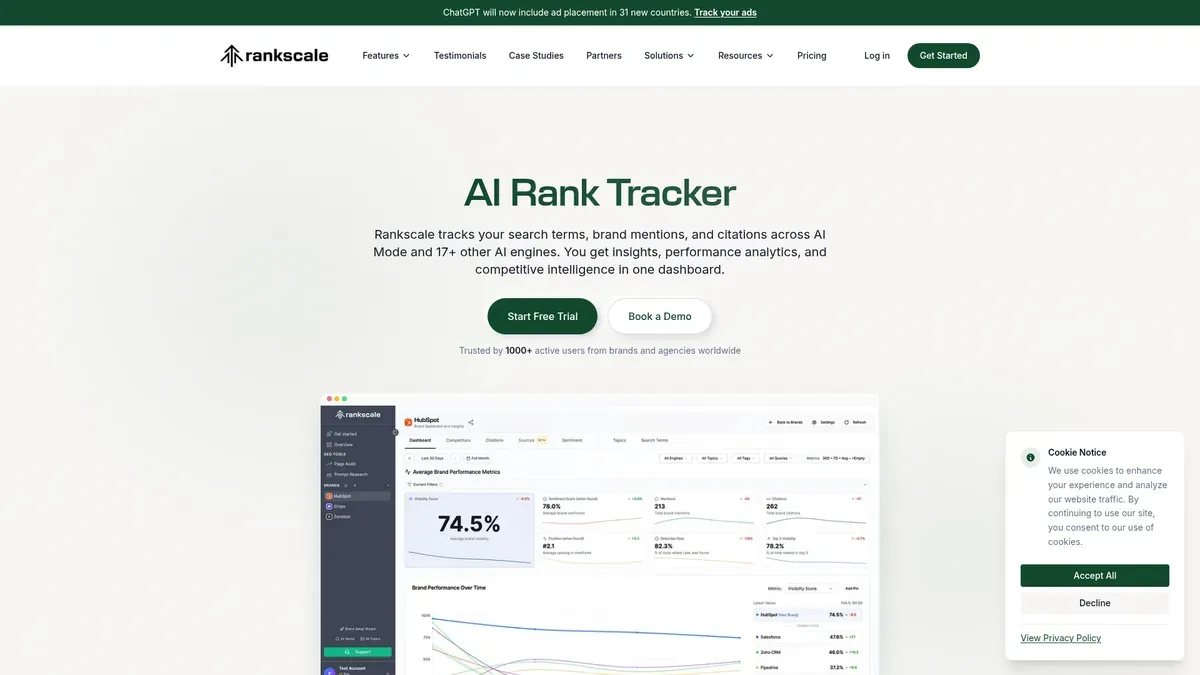
Best for: Teams and agencies that want wide engine coverage, flexible refresh, dashboards, and API or white-label options.
Rankscale tracks search terms, brand mentions, and citations across AI Mode and 17 or more AI engines. Its pricing page names ChatGPT, Gemini, Perplexity, Claude, DeepSeek, Mistral, Grok, and Copilot among others. Regions are listed as all regions, refresh ranges from hourly to monthly, and search terms are unlimited on the listed plans. The dashboard combines insights, performance analytics, and competitive intelligence.
Pricing: Essentials starts at $20 a month, though its credits and answer capacity are not displayed. Pro is $99 a month with 1,200 credits, ten brand dashboards, up to 4,800 answers, 50 page audits a month, Looker Studio, and a seven-day free trial. Growth is $385 with 5,500 credits, 50 dashboards, up to 22,000 answers, 200 audits, white-labeled dashboards, and a REST API. Enterprise is $780 with 12,000 credits, 100 dashboards, and up to 48,000 answers. Each AI engine query uses a fraction of a credit, typically 0.25.
Limitation: Credit economics make cross-tool price comparison genuinely hard until you know your engine mix and answer volume. The reviewed materials do not document publish-ready article generation, brand-context enforcement, scheduled writing, or built-in distribution.
Pick Rankscale instead if high-frequency monitoring, agency dashboards, white labeling, and API access matter more than production, and you already have writing handled elsewhere.
How to choose your alternative
Not sure where to start? Answer one question: what is actually broken?
If your problem is "we cannot see our AI visibility, and we cannot turn gaps into published work," choose DeepSmith. It is the fit when the bottleneck is production as much as measurement. Tracking, evidence-backed opportunities, a calendar, Autowrite, brand voice, internal linking, publishing, and distribution live in one place.
If your problem is enterprise scale, choose Profound. Custom infrastructure, traffic attribution, wide integrations, and autonomous agents are its strengths.
If you want focused analytics and can confirm pricing on a call, choose Peec AI. Prompt discovery and recommendations without a whole operating system on top.
If budget is the constraint, choose OtterlyAI. The lowest published entry price here, with a short path to daily monitoring.
If AI agents reading your site is the priority, choose Scrunch. Site diagnostics, knowledge accuracy, and journey mapping are its center of gravity.
If you already pay for Ahrefs, choose Brand Radar. Research breadth across AI answers, YouTube, and Reddit, on an Ahrefs bill you already approve.
If you already pay for Semrush, choose the AI Visibility Toolkit. Same logic, same ecosystem argument.
If you need engine breadth and an API, choose Rankscale. Especially if you run several client brands.
A note on cost. If you are moving off asklantern pricing, compare like with like. Some prices are billed yearly, some display an annual equivalent, some are per domain or per index, and some need a base SEO subscription underneath. Prompt quotas and response quotas are different numbers, and credits are a third thing again.
One more thing worth saying out loud. Engine coverage is not comparable by name alone. Two tools can both list Perplexity and collect different surfaces, regions, languages, prompt types, and response counts. Check the specific engines you need, not the length of the logo row.
Where to go from here
You do not need to solve this whole thing today. You need one tool that shows you the gap and one workflow that closes it.
If you want both in the same place, DeepSmith gives you a 7-day free trial with real data and real drafts before you pay. No long-term contract, no cancellation fee. Track your prompts, see who is winning your citations, and publish your first article against a real gap.
Start with one prompt you care about. Momentum matters more than a perfect setup.