You typed your own category into ChatGPT last week, and the answer named you. It also called you "a lesser-known alternative." That stung, and you have not stopped thinking about it since.
Here's the thing: that sentence is not an error. It is a characterization, and characterizations can be moved. This guide shows you how to monitor AI brand mentions on a repeatable schedule, read how AI describes my brand the way a buyer would read it, and take content actions that shift the framing over time.
We are staying on accurate-but-unflattering framing here. Outright factual errors and damaging falsehoods are a different job with a different playbook, so we will leave those aside.
Why the framing matters more than the mention
AI-mediated discovery is where a lot of buying now starts. ChatGPT alone reached roughly 900 million weekly active users by mid-2026 and serves something like 2.5 billion prompts a day. Around half of U.S. adults have used it. Roughly 73% of B2B buyers use AI tools in purchase research, and about half of B2B software buyers now begin research inside an AI chatbot rather than a search box. B2B buyers are adopting AI search at roughly three times the rate of consumers, so if you sell to businesses, this is not an emerging channel you can watch from a distance.
The click economics changed too. On queries where Google shows an AI Overview, organic click-through collapsed by around 61% in one 2025 study. Pew found that when an AI summary appears, people click a traditional result about 8% of the time, versus roughly 15% when no summary is present.
So the answer is the destination now, not the doorway. Your brand reputation ai answers carry is often the only impression a buyer forms before they ever reach your site. If the engine names you as "a viable alternative" while naming a competitor as "the leading choice," you are inside the answer set and losing the comparison anyway.
That distinction is the whole game. Presence is table stakes. Framing is the win.
Good news: this is trackable. The way AI describes you is not weather, it is an output of sources you can influence. The eight steps below turn that into a program you can actually run.
Step 1: Build a prompt library your buyers would actually type
You cannot track everything, and you should not try. Start with 50 to 100 prompts across five buckets:
- Informational: "what is X," "how does X work." Tests raw brand recall.
- Comparative: "X vs Y," "best X for [use case]," "X alternatives." Tests competitive placement, and this is where most buying decisions happen.
- Category: "best [category] tools," "top [category] software in 2026." Tests whether you make the roundup at all.
- Use-case: "best X for [persona] doing [job]." Tests relevance to real buyers.
- Brand-direct: "is X worth it," "X pricing," "X review," "X complaints." Tests reputation handling.
Where do the prompts come from? Not your keyword tool. Pull them from sales call recordings, support tickets, review-site language, and Google's "People also ask." The closer your tracked prompts sit to real buyer phrasing, the more actionable everything downstream becomes.
How you know it's done: every prompt in your list is one you could imagine a real buyer typing, unprompted, without knowing your brand name.
Where people go wrong: they track only head terms. Buyers ask hundreds of long-tail questions, and the long tail is where framing is softest and easiest to move.
One shortcut if the blank page is intimidating: Perplexity's related questions and Google's "People also ask" refresh themselves constantly and cost nothing. Mine them whenever you need new prompts to monitor AI brand mentions against.
Step 2: Baseline across every engine, not just the loud one
Run your prompt set on each engine your buyers actually use, and record the raw answers.
Engines disagree constantly. ChatGPT leans on parametric memory for established categories. Perplexity leans on retrieval and cites heavily. Gemini and Google AI Mode lean on Google's index. Claude tends to be more conservative. Your Perplexity share of voice can be double your ChatGPT share of voice in the same category, on the same question.
Sample more than once. Language models are stochastic, so a single run is noise, not data. Run the same prompt many times before you believe anything it told you. Ten to thirty runs per prompt is a reasonable bar for a decision you plan to act on.
Cadence: weekly at minimum if you are doing this by hand, twice weekly for fast-moving categories, daily if your tooling collects on a schedule.
How you know it's done: you have four numbers per prompt, per engine. Mention rate (how often you get named), citation rate (how often a page you own gets linked as a source), share of voice (your mention rate against the competitors you track), and a sentiment read.
Where people go wrong: treating one engine as the whole market. ChatGPT's answer does not predict Gemini's.
This is the step where tooling earns its keep, because doing five engines by hand across 50 prompts twice a week is a genuine slog. DeepSmith's AEO module tracks mention rate, citation rate, share of voice, and visibility trend across ChatGPT, Gemini, Perplexity, Claude, and Google AI Mode, with coverage scaling by plan tier, and it keeps the full answer history per prompt. That history is the part that matters for this guide, because the sentences themselves are your evidence. If you would rather stay manual, a spreadsheet and a recurring calendar block genuinely work up to about 30 prompts.
Step 3: Score the language, not just the checkbox
Here is where most programs stop too early. They log "mentioned: yes" and move on.
Go further. For every answer, capture three things:
- Polarity: positive, neutral, or negative.
- Aspect: what specifically got praised or criticized. Pricing, support, performance, integrations.
- Comparative position: the exact phrase the engine used. "The leading." "A viable alternative." "A lesser-known option." "Not recommended for teams that..."
Aspect is the one that turns feelings into a work ticket. "Negative sentiment" is not actionable. "Three engines describe our pricing as opaque" is a page you can go rewrite this week.
Watch the hedging too. Where the engine says "considered," "an option," or "may be suitable," it is telling you it lacks a source confident enough to commit on your behalf.
That third one is your real KPI. Copy the literal sentence into your tracker. Serious ai brand sentiment tracking means keeping the model's actual words, because the phrase is the thing you are trying to change.
Roll polarity up into a Net Sentiment Score: positive mentions minus negative mentions, divided by total mentions, times 100. It runs from -100 to +100. Consistently north of +20 is healthy. Ten to twenty is mixed. Below +10 is a problem, and below zero means unflattering framing is now the default story.
Where people go wrong: settling for neutral. A neutral mention is not a win, it is an unclaimed opportunity.
Pro tip: keep a running "what AI says about us" doc that aggregates the real sentences models produce. It becomes a standing brief for PR, content, and product marketing, and it is far more persuasive in a leadership meeting than a dashboard screenshot.
Step 4: Benchmark against whoever is in the answer with you
Pick three to seven competitors. Same prompts, same cadence, same scoring.
Track their mention rate, their citation rate, and the sources the engine credits them with. Concentration is normal in these answers, where the top three brands in a category usually take the majority of mentions. You want to know precisely who those three are on your prompts.
Then find the gap. Usually it is one of two shapes. Either they appear where you do not, or they get cited by a source that has never heard of you.
How you know it's done: for your top 10 prompts, you can name who wins, and you can name the exact phrasing difference between their description and yours.
Pro tip: watch for hallucinated peers. Engines regularly invent competitors who are not really in your category, or file you next to companies you would never lose a deal to. Audit the peer set monthly. You cannot correct it by complaining, but your owned content and earned coverage teach the model who you actually sit beside.
Step 5: Trace the sources the engine is reading about you
For every prompt where you are mentioned, record which URLs the engine cites. Then sort by domain.
The top 10 to 20 cited domains are your real ranking factors for that prompt cluster. You will usually find a small, stubborn set: a few listicles, two or three review sites, some trade publications, the occasional Reddit thread.
That list is your off-page to-do, and it is the most useful artifact in this whole process. Your brand reputation ai answers problem is rarely a mystery once you read what the engine is reading. Open those pages. Read them as a buyer would. What story do they tell about you?
Earned and press media is the single largest bucket of AI citations, somewhere around 46% across engines by one measure and considerably higher by another. Methodologies differ, so hold the exact number loosely and the direction firmly: press coverage feeds AI answers more than your blog does. Corporate blogs land around 12%.
Reddit deserves a footnote. Reddit citations in ChatGPT fell from roughly 29% in early 2025 to about 5% later that year after a data-licensing change. It still appears in conversational queries. It is no longer the cheat code it briefly was.
Step 6: Fix the upstream sources first
This is the highest-leverage step, and almost everyone does it last.
You cannot argue with a model. You can change what it reads. Work down this list:
- Wikipedia, if you have an article. Current facts, real citations, neutral language. Heavily leaned on by ChatGPT and Gemini.
- Review profiles: G2, Capterra, TrustRadius. Current positioning, recent reviews, clear differentiators. Disproportionately cited in B2B.
- Reference pages: Crunchbase, your LinkedIn company page, your About page. Crisp and factual. Engines treat these as authoritative.
- Trade publications: pitch three to five with original data, a customer story, or research. This is the earned-media lever, and it is the one that moves.
- Critical Reddit threads: answer substantively, never promotionally.
Sustained press coverage correlates with a large lift in citation rate, with one analysis putting the median around +239%. Treat that as a directional signal rather than a promise, but the direction is clear enough to act on.
To improve ai brand perception, you have to accept an uncomfortable truth: the fastest fix usually lives on someone else's website.
If that feels like a lot, shrink it. Pick the single most-cited domain from Step 5 and fix your presence there this month. One source, done properly, moves more than a quarter of blog posts aimed at nobody in particular.
Where people go wrong: buying placements on listicle farms. Modern engines de-weight obvious paid placement, and real editorial coverage carries more weight anyway.
Step 7: Publish the formats engines actually cite
Now your own content. Multiple studies converge on which formats get extracted:
- Listicles ("best X for Y"), the most-cited format by a wide margin.
- Comparison posts ("X vs Y"), second.
- Original research and data, durable and high-rate.
- FAQ pages with crisp question-and-answer blocks.
- How-to guides with explicit steps.
- Glossaries and definition pages, especially for category queries.
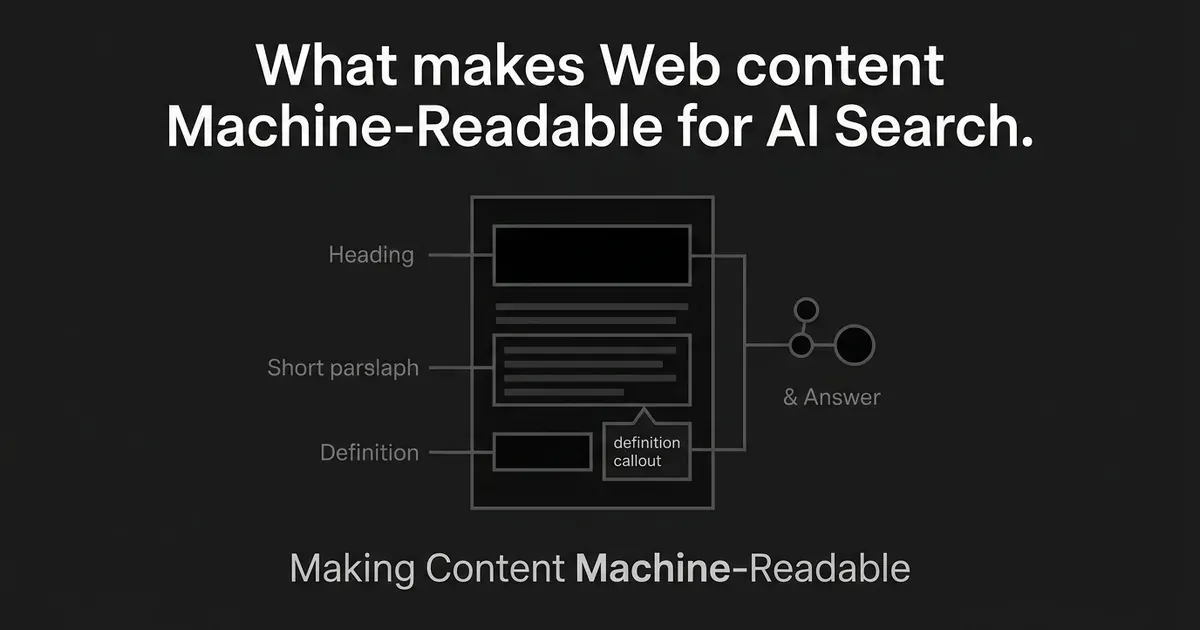
The formatting rules are boring and they work. Put the answer in the first sentence or two of a section, because engines extract the opening claim. Use questions as H2 and H3 headings. Use tables for comparisons. Name dates, sources, and entities, because specifics are citable and generalities are not. One claim per paragraph.
Add the machine-readable layer while you are in there: Organization schema, Article schema with author and dateModified, FAQ schema on Q&A pages, Product schema with aggregateRating. Schema correlates with higher citation rates in vendor-reported data, though the methodology is thin, so add it because it is cheap and clarifying, not because a number promised you something.
On llms.txt: add it, keep it short and current, and move on. It is one signal among dozens and it is not a ranking factor. Chasing it and calling the job done is a classic way to feel productive while nothing moves.
Volume matters here, because you are trying to shift a pattern across dozens of sources rather than fix one page. If publishing that consistently is where your team stalls, that is exactly the gap DeepSmith's Content Studio was built for: planned ideas turn into finished, brand-grounded articles with internal links, external links, cover image, and metadata already handled, and Autowrite can produce a planned piece on its scheduled date without anyone opening the app. It will not guarantee you a citation. Nothing can. It removes the reason your calendar keeps slipping.
Step 8: Set thresholds, then re-measure on a rhythm
Decide in advance what deserves your attention, or you will check dashboards forever and act on nothing.
Wire alerts for:
- A mention rate drop of more than 10 points week over week on any tracked prompt.
- A Net Sentiment Score move of more than 15 points negative.
- A new domain appearing as a citation source for your prompts.
- A competitor entering the top three for a prompt you care about.
Then set the rhythm. Daily: threshold alerts. Weekly: spot-check five prompts. Monthly: rerun your top 20. Quarterly: full re-audit of the prompt set and the source list.
That cadence is what separates ai brand sentiment tracking from doomscrolling your own dashboard. The thresholds decide when you look up. Everything else can wait for the monthly rerun.
Now the patience part. After six to eight weeks of sustained publishing and earned-media work, rerun the full set. Most teams see movement in 8 to 12 weeks. A real framing shift, the kind where "a lesser-known option" becomes "the leading," takes three to six months.
That is not slow. That is the actual clock speed of the thing you are changing. Measure monthly, act weekly, and judge the program on the trend rather than any single answer.
What to do next
Pick your 10 highest-intent comparative prompts. Run them across every engine your buyers use, twice. Write down the exact phrase each engine uses to describe you.
That is your baseline, and it takes an afternoon. Everything in this guide builds on that one document, because you cannot improve ai brand perception you have never actually written down.
If you want the monitoring layer running on a schedule instead of on your calendar, and the content engine to close the gaps it finds, you can start a DeepSmith free trial at https://app.deepsmith.ai/auth/sign-up and see your real numbers before you pay.
You are closer than you think. The engines are already talking about you. Now you get a say in how.