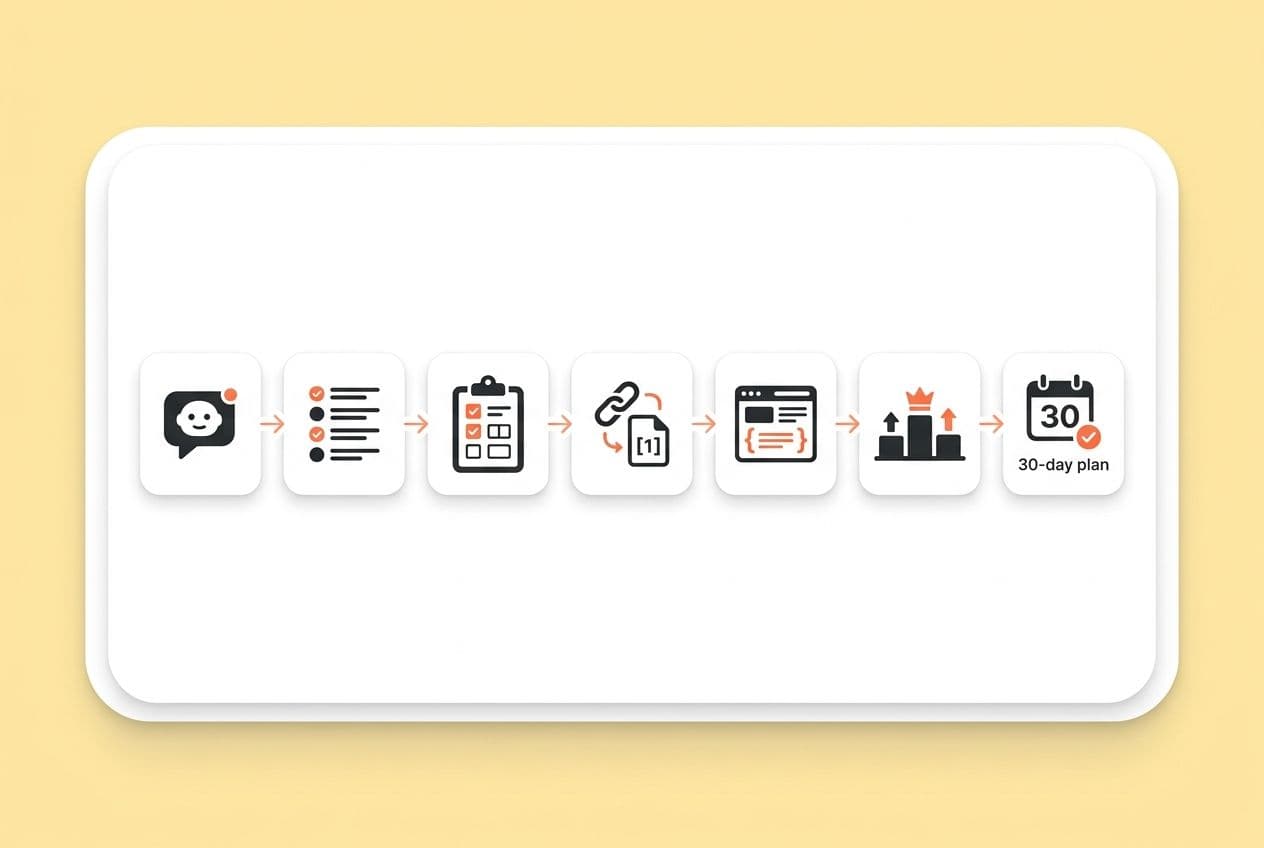
Let’s get straight to it. Running an AI brand visibility audit is a seven-step process: build a prompt set → pick 2–3 platforms → run prompts and log it all in a scorecard → check your citation and mention rates → audit your site’s tech and content structure → benchmark your competitors → and turn it all into a 30-day action plan.
That's the whole playbook. You can get a real, meaningful first pass done in a week with a small team and a spreadsheet.
I know that’s not what you usually get from "GEO strategy" articles. You've probably searched for your brand in ChatGPT, saw a competitor pop up, and then wasted an hour reading posts that just talk about AI's importance without telling you how to track anything, what to fix first, or how to explain progress to your boss. All while your team is stretched thin and another vague initiative is the last thing you need.
So let's run this like a real ops process, not a fluffy experiment. By the end of this article, you'll have a prompt set, a scorecard, a framework for figuring out why AI is ignoring you, and a 30-day plan your team can actually execute. I’ll also show you the pitfalls that wasted my time so you can skip them.
What Does It Mean to "Show Up" in AI Answers—and What Should You Measure?
The first time we tried to measure this, it was a mess. Everyone had a different definition of "showing up." So let's get crisp on what you're actually counting. AI visibility is measurable, but you have to break it into four parts: brand mentions, citations, share of voice, and sentiment/accuracy. Don't try to track all four on day one, but know what they are.
A brand mention is when the AI names your company or product in an answer, but doesn't link to you. A citation means the AI includes your page as a source with a link. Both are important, but for different reasons. A mention with no link means people are hearing your name, but they aren't landing on your site. A citation with a wonky mention means your page is being used as a source, but the AI might be getting your story wrong.
This is a huge difference from traditional SEO. In search, no click usually means no impact. With AI, a buyer can act on a recommendation they never click. The AI gives them a summary, and your brand's positioning (or how the AI butchers it) shapes their opinion before they even think about visiting your site.
Think of your AI visibility not as a single result, but as a giant, shimmering surface that is constantly changing across prompts, platforms, and time. Your brand can be the star on one platform and a ghost on another for the exact same prompt. This is why a single manual check tells you almost nothing. You need a structured sample.
Minimum viable metrics for a small, busy team:
- Mention rate: What percentage of your tracked prompts return your brand name? (A simple yes/no for each run).
- Citation rate: Of those prompts, what percentage include your URL as a source?
- Share of voice: How do your mention and citation counts stack up against 2–3 key competitors on the same prompts?
- Sentiment and accuracy: Is the answer positive, neutral, or negative? And is it right, outdated, or just plain wrong?
Here are three real scenarios I’ve seen that make this concrete:
- You're recommended but not cited. People are hearing about you, but you’re not getting traffic. You need to fix your on-page structure so the AI can link to you, not just name you.
- You're cited but framed incorrectly. This is a reputation fire you need to put out. Start by clarifying the copy on your own site, then look at third-party sources.
- A competitor dominates comparison prompts. You're losing shootouts before they even start. You need to create content that directly answers those comparison questions in a clean, extractable way.
Which Metric Matters Most at the Awareness Stage?
Start with consistency and correctness, not just citation counts. If AI platforms are describing your product wrong across your 20 most important buyer prompts, fixing that is more urgent than anything else. An inaccurate recommendation is worse than no recommendation at all.
Once your core prompts are reliably returning accurate, positive descriptions of your brand, then you can shift your focus to growing your share of voice and citation rate. Only tracking citations misses how influence really works. Buyers trust the AI's summary, not just the list of sources it provides.
Which AI Platforms Should You Audit First—and Why Results Won't Match?
Your first instinct might be to audit everything. Don't. Your team doesn't have the time, and you'll burn out by week two. I've been there. Audit the platforms your buyers actually use, not all of them. For most B2B SaaS teams, this means starting with two or three. I'd suggest at least one retrieval-forward engine (like Perplexity) and one assistant that's popular with your ideal customers (like ChatGPT). If organic traffic is a big deal for you, add Google AI Mode to the list.
Different platforms behave differently, which affects your audit:
- Retrieval-heavy engines like Perplexity and Google AI Mode pull from live or recently indexed web content. This is great because changes you make to your site can show up in their results faster, sometimes in just days or weeks.
- Model-dependent assistants like ChatGPT and Claude rely more on their core training data, which gets refreshed less often. Improvements can take longer to appear, and the results can be more unpredictable from one session to the next.
- Day-to-day variance is a real thing on every platform. The same prompt can give you different answers because of hidden settings and randomness in the system. That's why you need to run each prompt three times and record the typical outcome, not just treat one output as the absolute truth.
Here's a simple rubric to help you pick 2–3 to start:
- Where do your ideal customers actually ask questions? (buyer behavior)
- Does the platform show its sources? (citation transparency)
- How fast can you see the results of your work? (iteration speed)
- What can your team realistically track every week? (capacity)
| Platform | What to Test | What "Good" Looks Like | Caveat |
|---|---|---|---|
| Perplexity | Category queries, comparisons | Cited with correct page + framing | Results vary day to day; run 3x |
| ChatGPT | "Best tool for..." and evaluation prompts | Named accurately in shortlist | Slower to reflect site updates |
| Google AI Mode | High-intent BOFU queries | Cited in AI Overview with accurate snippet | Overlaps with organic; check robots access |
| Claude | Use case and "how to solve" prompts | Mentioned with correct positioning | Less citation transparency than Perplexity |
| Gemini | Comparison and alternatives prompts | Included in category summaries | Google ecosystem; rewards structured data |
How Often Should You Re-Run the Audit?
Run a baseline now. Then, re-check your top 10–15 prompts every week for the first month. This is how you'll learn to tell the difference between a real change and random noise. After that, you can probably switch to checking your full prompt library every two weeks or once a month.
Trust me, a single snapshot is genuinely misleading. The variance is high enough that one good result can make you think you're winning when you're actually invisible most of the time. The trend line across multiple runs is the only signal that matters.
How Do You Build a Prompt Set That Matches Real Buyer Questions—Not Vanity Prompts?
This is where most teams get it wrong, and I'll admit, we did too at first. Your audit is only as good as your prompts. We started by searching for our own brand name, "What is [Our Brand]?" It felt good to see our name, but it told us nothing about how new customers find us. Buyers who are evaluating tools for the first time don't know your name. They ask about categories, comparisons, and problems.
Build your prompt library from these six categories:
- "Best X for Y": Category recommendations ("best project management tool for remote SaaS teams")
- "X vs. Competitor": Direct comparisons ("Asana vs. ClickUp for small marketing teams")
- "Alternatives to X": Displacement queries ("alternatives to Salesforce for early-stage B2B")
- "How to solve [problem]": Solution education ("how to reduce content production time for small teams")
- "What tool should I use for…": Tool selection ("what tool should I use for AI citation tracking")
- "Is [Brand] good for…": Qualification prompts ("is [YourBrand] good for B2B SaaS content teams")
For even better results, add persona modifiers: "as a Head of Content at a 50-person SaaS company…" or "as a RevOps lead at a Series B startup…" These push the AI to give answers that are relevant to your actual customers.
A few rules to keep your data clean:
- Freeze your prompt text. Don't rephrase it between runs. Small changes can lead to very different outputs.
- Run each prompt 3 times per platform and record the most common outcome (present, absent, or cited).
- Keep your competitor set consistent. Only add or remove competitors when you do a quarterly review of your prompt library.
What to avoid: Prompts that only work if someone already knows you. "Tell me about [YourBrand]" is a vanity prompt. It tests recall, not discovery. Discovery is what drives your pipeline.
Start with a library of 15–20 prompts. The initial brainstorm is easy. The hard part is maintaining and expanding that coverage week after week. It’s where small teams get bogged down. This is actually a problem we built a feature for in our tool, DeepSmith. The AI Visibility — Prompts feature helps you manage your list, and a discovery function suggests other buyer questions you haven't thought of based on your company and persona info. It doesn't replace your judgment, but it helps your library grow from real context, not just guesswork.
Prompt Templates You Can Reuse for Any SaaS Category
Here's a starter kit. Just fill in the brackets for your business:
- "What is the best [category] tool for [team type/company stage]?"
- "[Your Brand] vs. [Competitor]—which is better for [use case]?"
- "What are the best alternatives to [Competitor] for [ICP descriptor]?"
- "How do I [solve core problem] without [common pain, e.g., a large team/big budget]?"
- "What should a [role] at a [stage] company use for [category]?"
- "Is [Your Brand] worth it for [specific use case]?"
- "What are the top [category] tools for [function, e.g., B2B lead generation]?"
- "How does [Your Brand] compare to [Competitor] on [evaluation criterion, e.g., pricing, integrations, ease of use]?"
Run each of these 3 times on each platform and log the results in your scorecard.
How Do You Run the Audit and Record Results in a Scorecard Your Team Will Actually Use?
Your enemy here is messy notes. I once had a marketer who would just paste screenshots into Slack. It was well-intentioned chaos. We couldn't see trends or prove progress. A scorecard forces you to be disciplined. It turns a wall of AI text into structured data you can track over time.
A scorecard forces you to be disciplined. It turns a wall of AI text into structured data you can track over time.
Your minimum viable scorecard columns:
- Prompt (exact text)
- Platform
- Date and time
- Brand mentioned? (Y/N)
- Brand cited? (Y/N + URL/domain if you can see it)
- Mention order (first, mid-list, absent)
- Competitors mentioned/cited (list their names)
- Sentiment/framing (positive / neutral / negative + a one-line reason)
- Accuracy check (correct / outdated / incorrect + what's wrong)
- Next action (content fix / PR / technical / messaging)
A simple way to score it:
- 0 = absent from response
- 1 = mentioned but not cited
- 2 = cited with a source link
- Give it a +1 if the framing is positive and accurate.
- Give it a –1 if the framing is negative or inaccurate.
This gives you a numeric score for each prompt, which means you can finally make a chart that shows a line going up or down for leadership.
How to run it fast with a small team:
Batch your prompts. One person can run them and fill out the scorecard in 30–45 minute blocks. Have a second person check 20-30% of the entries for consistency, especially the sentiment and accuracy columns, since those are judgment calls.
You can do this in a spreadsheet. We did for a while. But it gets messy fast as you try to track trends. This is the point where we realized a dedicated tool makes sense. A centralized tracker, like the AI Visibility Overview dashboard in DeepSmith, gives you trend charts and KPIs without you having to wrestle with a spreadsheet. It won't replace your judgment on accuracy, but it handles the grunt work of keeping data organized.
Patterns to look for after your first run:
- Which prompts do your competitors consistently own?
- Where are you mentioned but never actually recommended?
- Where is your positioning described incorrectly, even slightly?
A "One-Hour Weekly" Operating Rhythm (So This Doesn't Die)
- Weekly: Check your top 10 prompts on 2 platforms, update the scorecard, and flag any new accuracy issues.
- Monthly: Run your full prompt library on all tracked platforms, review the trend lines, and identify your wins and gaps.
- Quarterly: Refresh your prompt library (add new queries, update competitors) and decide if you need to change which platforms you're tracking.
When AI Doesn't Cite You, How Do You Diagnose the Cause?
Before you tell your content team to just "write more blogs," let's play doctor. I’ve wasted months applying the wrong fix. Let me save you the trouble. There are four common reasons you're being ignored, and only one of them is solved by more content.
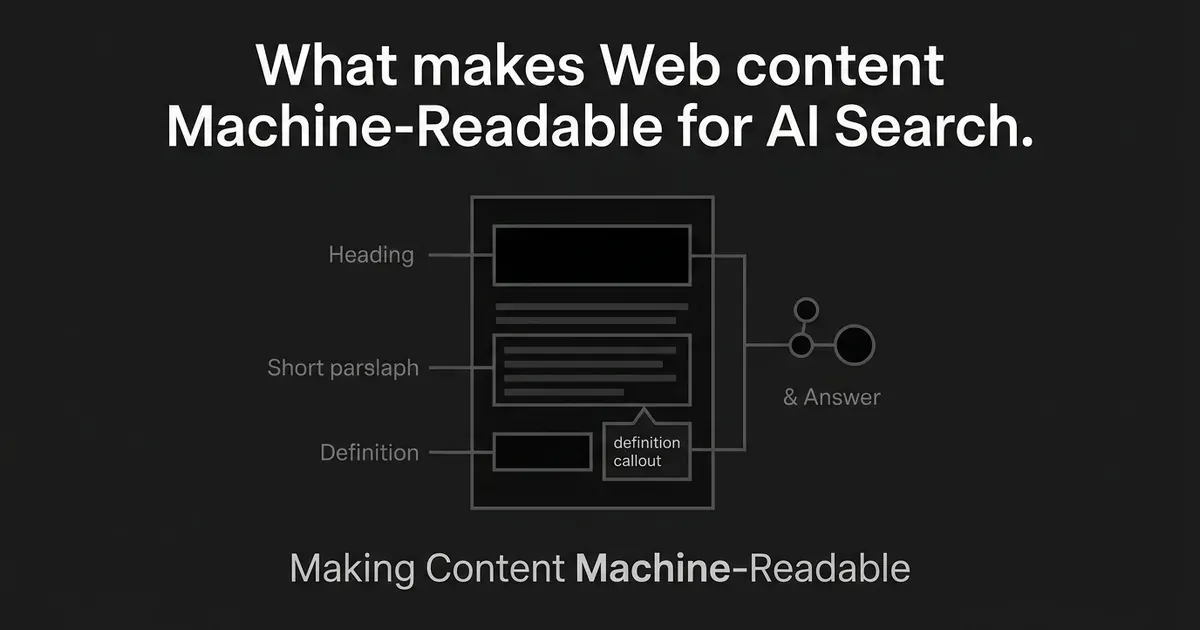
Bucket 1: The AI can't read your content. The answer is on your site, but the AI can't parse it. You'll see signs like long paragraphs, vague intros that bury the point, and no clear FAQ sections, tables, or lists. AI engines don't read whole pages; they extract sentences and paragraphs. If your answer isn't right there under a question-like heading, the engine often gives up and moves on.
Bucket 2: You have an authority problem. The AI hasn't seen anyone else vouching for you. Your competitors are getting cited from G2, Reddit, and industry blogs, while you're only mentioned on your own site. For an AI model, low corroboration means low confidence. The fix is to get more earned mentions: reviews, community posts, press, and partner pages that name you correctly.
Bucket 3: You have a technical access problem.
It's possible AI crawlers like Googlebot or PerplexityBot are being blocked by your robots.txt file. This is usually an oversight. Someone added a broad rule to block a crawler and didn't realize it would prevent AI models from indexing the content. It’s worth a quick check.
Bucket 4: You have a messaging problem. Your site isn't crystal clear about what category you're in, who you're for, and what makes you different. So, the AI just guesses. This happens more than you'd think. If your homepage and core product pages don't explicitly say "we are a [category] tool for [ICP]," the model will fill in the blanks, often incorrectly.
A few false positives to watch out for:
- AI models sometimes hallucinate features. Check a claim across a few runs before you treat it as a real misrepresentation.
- Old descriptions can linger even after you update your pages. Retrieval-based engines catch up faster than model-based ones.
- A one-off correct mention that vanishes the next day is just noise. Focus on the trend data, not snapshots.
How to Handle Inaccurate or Negative AI Answers Without Overreacting
First, verify the answer across at least 3 runs on 2 different platforms. The variance is high, and a single bad output might just be a fluke.
If the inaccuracy is consistent, start by fixing the clarity on your own site. Your pricing page, feature descriptions, and positioning pages are the most reliable sources for an AI. After that, you can work on third-party corrections like updating your G2 profile or flagging outdated press coverage.
What Changes Actually Increase AI Visibility—Without Turning Your Blog Into "AI Bait"?
You want the fastest wins? The stuff that actually moves the needle in the first 30 days? It comes down to three things. Forget writing more generic blog posts for a minute.
Owned content fixes (highest leverage first):
- Write "answer capsules" under question-style headings. Start with a 1–2 sentence direct answer, then use bullet points to elaborate. AI engines pull from the very beginning of a section. If your first sentence is just fluff, you lose the citation.
- Add comparison tables to pages where buyers are evaluating you. Don't just list features. Include rows for criteria like pricing, ideal team size, a key differentiator, and integration depth. These structured tables are gold mines for AI citations.
- Refresh your high-intent pages like use cases, integrations, and pricing. Make sure they are specific and up-to-date. Vague, outdated pages almost never get cited.
- Be consistent in how you talk about your product category and what makes you different. If three different pages call your product three different things, the AI will just get confused.
Earned/third-party corroboration:
- Earned/third-party corroboration: Look at the domains AI already references in your category. For SaaS, that’s usually G2 and Capterra, specific Reddit threads, industry publications, and partner docs. Encourage your happy customers to leave detailed, specific reviews. A vague five-star review doesn't help an AI understand what you actually do.
The content mix you should prioritize:
- Guides on implementation, evaluation criteria, and migrating from a competitor.
- Fewer generic "what is X" posts, unless you have a truly unique angle and provide clear, structured answers.
A lot of people think this means your writing has to sound like a robot. It doesn't. You can be direct and still have a personality. The "answer capsule" pattern (direct answer first, then your voice and nuance) leaves plenty of room for your brand.
A Simple "AI-Citable" Section Pattern Writers Can Follow
For any new piece of content, structure each section this way:
- Question-formatted H2 or H3 (that mirrors how a buyer would ask)
- 1–2 sentence direct answer (the main claim, stated simply)
- Bullets or a table (the supporting evidence or steps)
- A short nuance paragraph (the "it depends" context that the bullets miss)
- A "common mistake" callout (this is optional, but AI engines love content that anticipates and solves problems)
This pattern works for any topic, and it's often faster to write than a wandering, editorial-style post.
How Do You Turn Audit Findings Into a 30-Day Plan—and Prove Progress to Leadership?
This is my favorite part, because this is where the audit stops being a report and starts being a plan. The biggest mistake is doing all this work and then... nothing changes. Let's not let that happen.
Your 30-day execution plan:
Week 1 — Baseline Run the audit across your top 15 prompts on 2–3 platforms. Fill out the scorecard. Identify your top 5 visibility gaps (where competitors are crushing you) and your top 3 accuracy issues.
Week 2 — Fix Your Own House Go update your 5 most important pages. Add those answer capsules, improve your comparison tables, and fix any confusing positioning language. These are quick wins that can show up in retrieval-based engines within weeks.
Week 3 — Publish Gap-Filling Content Publish 2–3 new articles that directly target prompts your competitors are currently winning. Focus on comparisons and use-case explainers, which are formats AI engines love to cite.
Connecting audit gaps to the content calendar is where our process always broke down. It’s hard to do without a system. This is another reason we built a workflow for this in DeepSmith. It lets you turn a visibility gap into a content brief and track it through production without switching tools. The Competitors feature even shows you which competitor pages are winning citations, so you know what to build next based on what’s actually working.
Week 4 — Earn Corroboration Go after 2–3 third-party wins. Refresh your G2 profile, update a partner page, or do some targeted outreach. These take longer to show up in AI answers, but they build lasting authority.
What to report to leadership:
- Prompt coverage (how many prompts you're tracking now vs. the start)
- Share of voice vs. 2–3 competitors on your most important prompts.
- Mention rate and citation rate trends (your line charts from week 1 to week 4)
- Accuracy/narrative issues you've resolved (a key reputation metric).
- Early business indicators, like a lift in branded search or direct traffic (but be honest that attribution here is imperfect and directional).
Set honest expectations. Changes might show up in retrieval platforms in a few weeks, but model-dependent assistants will take longer. Authority builds over months. The goal of the first 30 days is to get a baseline and build momentum, not to solve the entire channel.
What Are the Most Common Mistakes in AI Visibility Audits—and How Do You Avoid Them?
If you only remember a few things from this playbook, make it these. These are the traps I see teams fall into over and over again.
- Auditing once and treating it as truth. Run each prompt 3 times and track the results over several weeks. A single snapshot is just noise.
- Using only branded prompts. New buyers don't know your name. The real action is in category, comparison, and "alternatives to" prompts.
- Tracking only citations. Unlinked mentions still influence buyers. Track your mention rate, citation rate, and accuracy together.
- Chasing every platform. You don't have the bandwidth. Pick 2–3 based on where your buyers are and how fast you can iterate.
- Publishing generic content. "What is [category]" posts rarely get cited. Content that is specific, structured with tables and lists, and answers a direct question is what wins.
- Ignoring third-party signals. If the only site saying you're great is your own, AI models won't trust you. Earned mentions have to be part of the plan.