You are shipping fast, watching runway, and now there is one more thing to worry about: what the AI models are doing. Maybe buyers are asking ChatGPT about your category and you have no idea if your brand comes up. Maybe you just wired an LLM into your product and you cannot see why it slows down or gives odd answers. Either way, you need eyes on it, and you need them without an enterprise invoice.
Here is the good news. You do not need a big budget to get real visibility. The best LLM monitoring tools for startups are self-serve, priced for a lean team, and cover more than one model. Affordable LLM monitoring is not a contradiction anymore, and you do not have to talk to a sales team to try one. This guide walks through nine of them, starting with our pick and staying honest about where each one is the wrong fit.
Take a breath. By the end you will know exactly which tool matches your situation.
First, two things people call "LLM monitoring"
The phrase gets used for two different jobs, and picking the wrong category wastes money. Let's sort them out first.
AI-answer visibility tracking. You define the questions your buyers ask AI assistants. The tool checks engines like ChatGPT, Perplexity, Gemini, and Claude on a schedule, then reports how often your brand is mentioned, how often your pages get cited, and your share of voice against named competitors. This is the tool you want if you care about being found in AI answers. Tools here: DeepSmith, Otterly AI, LLMrefs.
LLM application observability. You built a product that calls OpenAI, Anthropic, Gemini, or an open model. The tool instruments those calls, logs prompts and completions, and tracks latency, cost, tokens, and quality so you can debug regressions. This is the tool you want if you ship an AI feature. Tools here: LangSmith, Langfuse, Helicone, Arize Phoenix, Portkey, PromptLayer.
One measures what AI says about you. The other measures what your own AI does. Most startups need one, not both, so figure out which problem is yours before you compare prices.
How we picked these tools
A roundup is only as good as its filters, so here are ours. Every tool below had to clear these bars.
- Affordable for a startup. Entry tier under $200 a month, or a genuine free tier. This is affordable LLM monitoring, not enterprise governance.
- Multi-model coverage. It tracks or supports more than one major model or AI engine. Startup multi-model AI monitoring is the whole point here, so single-vendor lock-in did not make the cut.
- Self-serve signup. No SOC 2 questionnaire, no mandatory annual contract. You can start today.
- Trackable output. Real signals like mention rate, citation rate, share of voice, or traces, spans, and evals. Not a vanity dashboard.
- Clear methodology. The tool is explicit about how it measures a mention, a citation, or a trace.
The tools at a glance
| # | Tool | Category | Entry price | Free tier | Best for |
|---|---|---|---|---|---|
| 1 | DeepSmith | AI-answer visibility + content production | $99/mo ($80/mo annual) | 7-day trial | Founders who want tracking and on-brand content in one tool |
| 2 | Otterly AI | AI-answer visibility | $29/mo ($25/mo annual) | Free trial | Solo marketers on the tightest budget |
| 3 | LLMrefs | AI-answer visibility + AI-SEO utilities | $79/mo | 7-day trial, no card | Teams wanting maximum engine coverage at one price |
| 4 | LangSmith | LLM observability | $39/seat/mo | Free: 5k traces/mo | LangChain and LangGraph engineering teams |
| 5 | Langfuse | LLM observability (open source) | $29/mo | Free: 50k units/mo | Teams wanting open source and framework-agnostic tooling |
| 6 | Helicone | LLM observability + AI gateway | $79/mo | Free: 10k requests/mo | Teams wanting a gateway and observability together |
| 7 | Arize Phoenix / AX | LLM observability + evals | $50/mo (AX Pro) | Phoenix free; AX free 25k spans/mo | Teams that want OpenTelemetry or self-hosting |
| 8 | Portkey | LLM gateway + observability | ~$100+/mo | Free: 10k logs/mo | Teams routing across many providers |
| 9 | PromptLayer | Prompt registry + observability | $49/mo | Free: 2.5k requests/mo | Teams focused on prompt versioning |
Now let's go one by one, starting with our pick.
1. DeepSmith

Best for: seed-to-Series-A founders who need to know whether AI assistants mention their brand and want to ship the content that wins those mentions, without buying two separate tools.
DeepSmith tracks ten AI engines, ChatGPT, Perplexity, Gemini, Claude, and Google AI Overviews among them, to see how they answer the questions your buyers actually ask, then uses that same data to plan and write publish-ready articles that close the gaps it finds. That loop, from measuring visibility to producing the content that fixes it, is what sets it apart in this list. Nothing else here does both.
On the tracking side, the AEO module reports mention rate, citation rate, and share of voice, with trend lines, a per-platform breakdown, a competitor leaderboard, and the sources AI cites most. You can drill into any tracked prompt to see its full answer history, and the Pages view shows which of your URLs AI actually cites and which prompts drive them. So you are not guessing where you stand. You can see it.

On the production side, the Writer turns one planned idea into a finished article with research, internal and external links, a cover image, and publish-ready metadata. Autowrite runs the whole thing hands-off on a schedule and lands the piece in Produced Content, where you review and publish to WordPress, Strapi, Webflow, or your own webhook. Every finished article ships with social posts ready to copy, so distribution is built in, not a separate chore.

Here is what it costs. Pro is $99 a month, or $80 on annual billing, with 20 articles, 50 tracked prompts, and ChatGPT tracking. Grow is $199 a month, or $160 annual, and adds Perplexity. Scale is $399 a month, or $299 annual, and adds Gemini. Enterprise unlocks all ten engines. There is a 7-day free trial, no long-term contract, and no cancellation fee. That makes it the lowest entry price among all-in visibility-plus-production platforms.
Key features
- Mention rate, citation rate, and share of voice, tracked on a schedule
- Per-platform breakdown, competitor leaderboard, and top-cited sources
- The Writer and Autowrite for publish-ready, on-brand articles
- Direct publishing to WordPress, Strapi, Webflow, or webhooks
- Deep IQ brand context so output sounds like you, not generic AI
One honest limitation: engine coverage scales with tier. Pro tracks ChatGPT only, Grow adds Perplexity, Scale adds Gemini, and the full ten-engine set needs Enterprise. Here is the counterweight. ChatGPT is the engine your buyers reach for most, so Pro covers the biggest slice from day one, and Enterprise tracks all ten while still writing the content that closes the gaps it finds. If you genuinely need every engine at the lowest tier and nothing else, one of the flat-price trackers below is the better fit. And if you need traces and spans for your own product's LLM calls, this is the wrong category entirely.
2. Otterly AI

Best for: solo marketers or small teams who want a cheap scorecard and do not need integrated content writing.
Otterly is the budget-friendly brand-mention tracker for AI assistants. It is built for people who already know they need AEO but refuse to pay enterprise rates. At $29 a month, or $25 on annual billing, the Lite plan is the cheapest real AEO tracker on the market, and it still gives you a prompt library, a brand visibility index, and a GEO URL audit. If you want the absolute lowest-cost way to start measuring, start here.
Key features
- Lite plan at $29 a month, the lowest entry price in AEO tracking
- Base engines: ChatGPT, Google AI Overviews, Perplexity, and Copilot
- Brand visibility index and GEO URL audit
- Looker Studio connector at the Standard tier for existing reporting stacks
One honest limitation: the base subscription covers only four engines, and Claude, Google AI Mode, and Gemini are paid add-ons at every tier, so the headline engine count can mislead. Lite also caps at 15 prompts, which is tight once you track more than one product.
3. LLMrefs

Best for: SEO and content teams that want maximum engine coverage plus on-page AI-SEO utilities, and do not need an in-product writer.
LLMrefs takes a different angle: one plan, one price, and the widest engine list in its band. For $79 a month you track 500 prompts across 11-plus engines, including long-tail ones like Grok, Meta AI, and DeepSeek that most tools charge extra for. It bundles on-page utilities too, from an LLMs.txt generator to an AI crawlability checker and a fan-out query generator, so it replaces a few standalone subscriptions. There is a 7-day free trial with no credit card.
Key features
- Single plan at $79 a month, 500 tracked prompts
- 11-plus engines, including Grok, Meta AI, and DeepSeek at no add-on cost
- Bundled AI-SEO utilities: crawlability checker, LLMs.txt generator, and more
- 7-day free trial, no card required
One honest limitation: it is a newer entrant with a smaller review footprint and community than Otterly, and there is no integrated content production, so you still hand recommendations off to another tool to write.
4. LangSmith

Best for: engineering teams already building on LangChain or LangGraph who want tracing, evals, and prompt versioning under one roof.
Now we move from visibility to observability. LangSmith is the tracing, evaluation, and prompt-management tool from the LangChain team, and it is the default for anyone building on that stack. The free Developer tier gives you 5,000 traces a month, which is generous for a prototype, and the Plus plan is $39 per seat a month for 10,000 traces and faster support.
Key features
- Deepest integration with LangChain and LangGraph
- Free Developer tier with 5,000 traces a month
- Tracing, evaluations, and prompt versioning in one place
- Hybrid or self-hosted deployment on Enterprise for regulated work
One honest limitation: per-seat pricing gets uncomfortable as your engineering team grows, and the free tier drops traces after 14 days, which hurts long-running debugging. Outside LangChain, some teams find it over-fit.
5. Langfuse

Best for: engineering teams that want open-source flexibility, a generous free tier, and prompt versioning without LangChain lock-in.
Langfuse is the open-source LLM engineering platform: tracing, prompt management, evaluations, and datasets, released under an MIT license you can self-host or run as managed cloud. The free Hobby tier includes 50,000 units a month, ten times LangSmith's free trace count, and the Core plan is $29 a month. It is framework-agnostic, so it works with LangChain, LlamaIndex, the OpenAI SDK, or raw HTTP.
Key features
- Truly open source (MIT) with full self-hosting, no vendor lock-in
- Free Hobby tier with 50,000 units a month
- Framework-agnostic across LangChain, LlamaIndex, and raw SDKs
- Strong prompt versioning and dataset tooling
- 50% off the first year for early-stage startups
One honest limitation: self-hosting means you run Postgres, an async queue, and an object store yourself, and the units-based pricing takes a minute to map to your real traffic.
6. Helicone
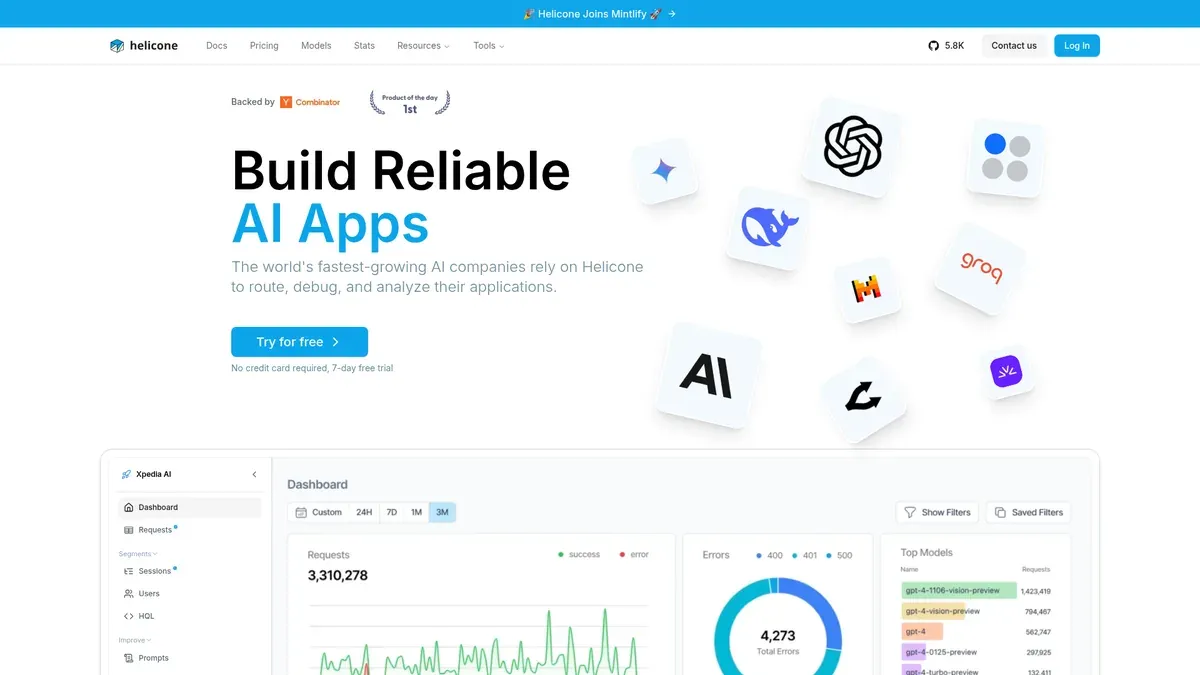
Best for: cost-conscious teams that want an open-source gateway plus observability and will invest a little engineering time in setup.
Helicone is observability that doubles as an AI gateway, with caching, routing, rate limiting, and fallbacks. It logs every request to more than 250 models through one unified API, and the caching alone can pay for the tool. The free Hobby tier gives you 10,000 requests a month, and Pro is $79 a month with unlimited seats.
Key features
- Open source with a permissive license
- Gateway plus observability in one product
- 250-plus models through a unified API
- Free Hobby tier with 10,000 requests a month
- 50% first-year discount for startups under two years old with under $5M funding
One honest limitation: the free tier retains data for only 7 days, and it has less out-of-the-box eval depth than Langfuse or Arize.
7. Arize Phoenix / AX

Best for: engineering teams that want OpenTelemetry-native tracing and do not mind self-hosting Phoenix for the free tier.
Arize gives you two paths. Phoenix is the open-source project, free and self-hosted with unlimited spans and retention. AX is the managed SaaS, with a free tier at 25,000 spans a month and an AX Pro plan at $50 a month. Both are OpenTelemetry-native, so they slot into the rest of your observability stack, and the eval tooling is strong, covering LLM-as-judge, human annotation, and drift detection.
Key features
- OpenTelemetry-native, plays well with existing observability stacks
- Phoenix open source is genuinely free with no usage caps when self-hosted
- Strong eval tooling: LLM-as-judge, human annotation, experiments
- AX Pro at $50 a month for managed hosting
One honest limitation: the AX free tier retains data for only 15 days, and Enterprise pricing is opaque.
8. Portkey

Best for: teams routing across many model providers that want a gateway and observability in one product.
Portkey is a unified API sitting in front of more than 250 LLM providers, with logging, caching, fallbacks, guardrails, and prompt management. If you switch models often or run several providers at once, the gateway earns its keep fast. The free Dev tier is generous at 10,000 logs a month with 30-day retention, and Pro runs roughly $100 or more a month.
Key features
- Unified API across 250-plus providers
- Gateway plus observability, with caching and fallbacks
- Free Dev tier: 10,000 logs a month, 30-day retention
- Key management, routing, and prompt management included free
One honest limitation: the Pro overage math can surprise a bursty workload, and Enterprise pricing is opaque and sales-led.
9. PromptLayer

Best for: small, prompt-engineering-heavy teams that care more about versioning and a registry than a full observability stack.
PromptLayer was one of the first tools to treat a prompt as a versioned artifact, with a registry, evaluation, and observability around it. The free tier is real: 5 users, 2,500 requests a month, and 750 agent executions. Pro is $49 a month. If shipping prompt changes safely is your main worry, this is a clean, founder-friendly way to do it.
Key features
- Clean prompt-versioning model with a registry
- Free tier: 5 users, 2,500 requests a month
- Webhooks and registry make prompt changes safe to ship
- Evaluation and observability around every prompt
One honest limitation: the free tier caps at 5 users, which becomes a constraint fast, and there is no built-in gateway or caching.
How to choose the right tool for you
Not sure which one is yours? Start with the category, then match your situation. Here is the simple version.
You want to know if AI assistants mention your brand, and you want the same tool to write the content that fixes it. DeepSmith is the integrated pick. Grow at $160 a month on annual billing gets you Perplexity alongside ChatGPT plus the full production engine. This is the startup multi-model AI monitoring setup that also closes the gap it finds, so you are not stitching a tracker to a separate writer.
You just want the cheapest way to start measuring. Otterly Lite at $25 a month on annual billing is the lowest-cost entry into a cheap LLM tracking tool. If a cheap LLM tracking tool is all you need this quarter, this is where to begin. You will hand recommendations off to write elsewhere, and that is fine when the budget is that tight.
You want maximum engine coverage at one flat price. LLMrefs at $79 a month is the call, with 11-plus engines and no add-on fees. Pick it when coverage matters more than a built-in writer.
You ship an AI feature and need traces and spans. Now you are in observability. Reach for LangSmith Plus at $39 a seat if you live in the LangChain ecosystem. Choose Langfuse (free Hobby or $29 Core) if you want open source and framework-agnostic. Pick Helicone (free or $79 Pro) if you also want an AI gateway with caching. Go with Arize Phoenix (free) or AX Pro ($50) if OpenTelemetry matters. Use Portkey (free Dev or ~$100 Pro) if multi-provider routing is your priority. And take PromptLayer (free or $49 Pro) if prompt versioning and a registry are what you care about most.
The honest truth is that no single tool wins for everyone. A visibility tracker will not debug your API calls, and an observability platform will not tell you what ChatGPT says about your brand. Pick for the problem you actually have this quarter, not the one you might have next year.
Ready to see where you stand in AI search?
If your problem is visibility, that your buyers are asking AI about your category and you cannot see whether you come up, you can find out in an afternoon. DeepSmith shows you your mention rate, citation rate, and share of voice, then hands you the on-brand content to close the gaps, all in one place. Start a free trial and get real data and real drafts before you pay a cent. You are closer to being found than you think.