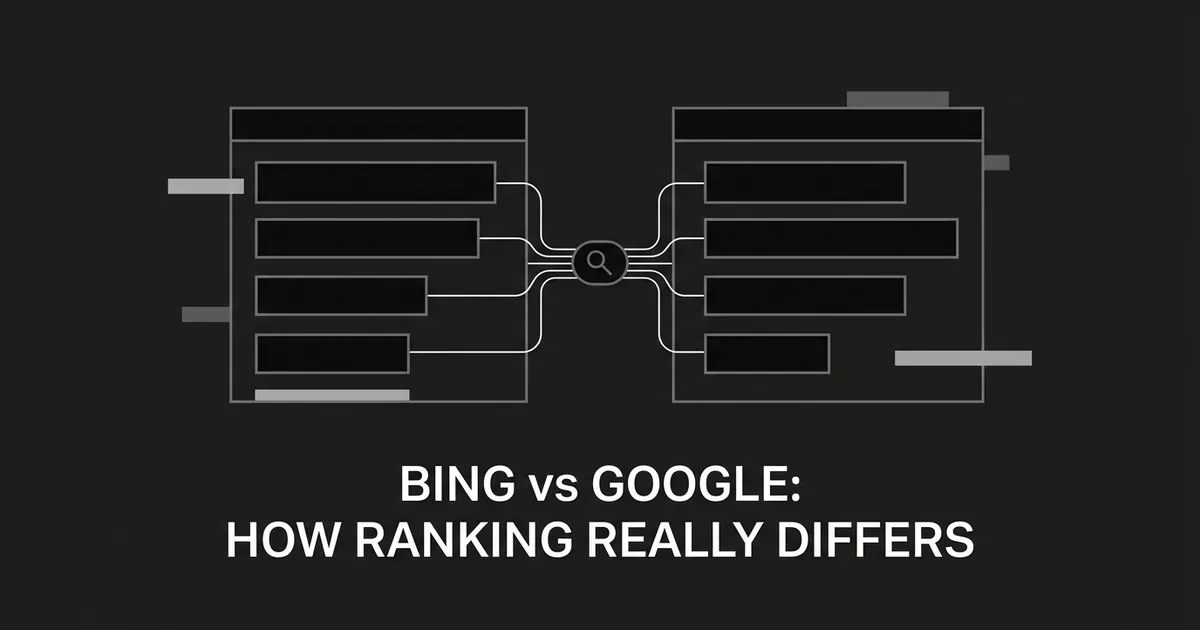
A client asks why their site shows up on page one of Google and nowhere on Bing, and the honest answer is not a secret formula. It is that Bing ranks websites with its own system, built on its own index, and that system shares most of its foundations with Google's without being the same machine. If you are looking for Bing vs Google algorithm differences you can act on, the real answer is less about picking a side and more about verifying both engines separately instead of assuming one proves the other.
Bing publishes a short, ordered list of its main ranking parameters. Google names a set of specialized systems instead of a single list. Neither engine discloses exact weights, and both say importance shifts by query. Here is the honest version of how Bing ranks websites against how Google does it, so you can give a client a straight answer the next time they ask.
| Bing | ||
|---|---|---|
| What it publishes | Six main parameters, in general order of importance | Multiple named systems (BERT, RankBrain, neural matching, and others) plus broad signal categories |
| Relevance | Page terms, link text, semantic equivalents | Keyword matching plus language models and neural matching |
| Quality signal | Purpose, usability, authority, reputation, transparency | Expertise, authoritativeness, trustworthiness, references from reputable sites |
| Engagement | Clicks, dwell time, quick returns, reformulations | Aggregated, anonymized interaction data |
| Discovery help | IndexNow, sitemaps | Indexing API (restricted to specific content types) |
The short version of the Bing vs Google algorithm question: where Bing actually diverges in practice is discovery and verification, not in some secret, simpler version of ranking. Keep reading for where that distinction matters for your reports and your client's roadmap.
What is Bing's ranking algorithm?
Bing describes a set of learned ranking models that match a search query against the pages in its index. The models are trained on signals that include how users interact with results and judgments from human raters and automated systems with human oversight. That makes it a system that learns from evidence, not a checklist that assigns points by hand.
These six confirmed Bing ranking factors are listed in general order of importance:
- Relevance - how closely a page matches the intent behind a query, judged from page terms, the wording of links pointing to the page, and semantic equivalents such as synonyms and abbreviations.
- Quality and credibility - the clarity of a site's purpose, its usability and presentation, its authority and reputation, and how transparent it is about who stands behind the content.
- User engagement - whether people click a result, how long they stay once they do, whether they bounce straight back to Bing, and whether they rephrase the query.
- Freshness - a general preference for current content, with the rate at which a topic goes stale varying by subject.
- Location and language - the searcher's country and city, where a page is hosted, the page's own language, and where a page's other visitors are located.
- Page-load time - whether a page loads fast enough that a visitor actually reaches the content.
Microsoft immediately qualifies that list: the relative importance of each parameter can change from search to search and shift over time. Treat it as a map of what Bing is looking at, not a fixed point system with six slots to fill.
What is Google's ranking algorithm?
Google does not publish a single ordered list. Instead it names a collection of ranking systems, each doing a distinct job, that work together across many factors and signals. The systems work mostly at the page level, while site-wide signals and classifiers also play a part.
A few of the systems Google names:
- BERT reads how combinations of words express meaning and intent, not just the words themselves.
- RankBrain connects a query to relevant content even when the page does not use the exact words in the query.
- Neural matching lines up the concept behind a query with the concept behind a page.
- Passage ranking looks at the relevance of an individual section of a page, not only the page as a whole.
- Separate systems also handle link analysis, surfacing original content, and spam detection.
Google says the weight given to any factor shifts with the nature of the query, the same caveat Microsoft gives for Bing. Neither company has published a universal formula, and no credible source outside the companies has reverse engineered one either.
How do they interpret relevance and authority?
This is where the myths cluster, and the documentation from both engines quietly contradicts most of them.
Exact-match wording is not the edge people assume. Bing's own description of relevance includes semantic equivalents alongside literal terms, the same combination Google describes through BERT and neural matching. A page about customer relationship management software does not need to repeat "CRM" in every heading to be judged relevant to a CRM query on either engine. There is no documented basis for treating Bing as the exact-match engine and Google as the meaning-aware one.
Authority is not just domain age or size. Bing's quality guidance makes a point of saying a firsthand account on a personal blog can carry more authority than unsourced content from a larger site. Google's version leans on expertise, authoritativeness, and trustworthiness, with references from other reputable sites as one input among several. Both descriptions are reaching for the same thing: is this a credible, useful answer, not simply a page that contains the right words.
Backlinks are a shared signal, not a divided one. Google runs dedicated link-analysis systems, and Bing's guidelines treat links as evidence of structure and authority while prohibiting manipulative link schemes. Nothing in either company's documentation supports the idea that Bing cares about link quantity while Google cares about quality, or the reverse. That is a distinction agencies repeat to clients with no primary source behind it.
Exact-match domains get a specific Google carve-out. Google has a named system meant to stop domains built purely to match a query from getting an unearned boost. There is no equivalent statement from Bing, but an engine's silence on a safeguard is not proof that the opposite preference exists. Treat a keyword-stuffed domain as a bad idea on both engines rather than a Bing-specific opportunity.
How do engagement and page experience differ?
Here the disclosures diverge in detail, even where the underlying idea is shared.
Bing is explicit that it looks at whether people click a result, which result they click, whether they linger on the page they clicked or bounce straight back to the search results, and whether they reformulate the query. That is a concrete, almost diagnostic list. Google's public statement is broader: it confirms using aggregated and anonymized interaction data to help assess relevance, without walking through the same step-by-step behaviors.
Do not read that difference in detail as a difference in substance. Both companies say they use interaction signals. Neither publishes a target click-through rate, a target number of seconds on page, or a bounce-rate threshold that triggers a ranking change, and nothing in the documentation supports treating a short visit as automatically bad. A visitor who gets their answer in ten seconds and leaves has had a successful search, not a failed one.
Page-load time sits as Bing's sixth named parameter: a slow page is more likely to lose a visitor before they ever see the content, which makes it both a user-experience problem and a ranking disadvantage. Google folds page experience into its broader quality and usability signals and publishes specific Core Web Vitals targets (loading, interactivity, and visual stability) as guidance for sites. Those Google numbers are not a disclosed Bing threshold, so do not sell a client on hitting Google's Core Web Vitals targets as a guaranteed Bing fix. Fixing genuinely slow pages helps on both engines; copying one engine's published number onto the other does not.
Freshness follows the same pattern of shared intent and different framing. Bing says it generally favors fresh content and that how quickly a topic goes stale depends on the subject. Google's documentation makes the same point about factor importance varying with query needs. A page covering a changing price or an eligibility rule needs faster updates than a page defining a stable concept; that is true regardless of which engine is sending the traffic.
Where does Bing-specific optimization actually change the work?
The real, practical divergence between the two engines sits in discovery and verification, not in a separate style of writing.
Verify Bing on its own terms. Visibility in Google tells you nothing definitive about visibility in Bing, because each engine runs its own index and its own ranking decisions. Bing Webmaster Tools shows how people interact with a site's pages in Bing search, which is the closest Bing equivalent to what Search Console shows for Google. Treat a Bing gap as its own diagnosis, not an extension of a Google problem.
Use IndexNow for Bing's preferred discovery path. Bing recommends IndexNow as a way to tell participating engines that a URL has been added, changed, or removed, and the protocol supports submitting up to 10,000 URLs in a single request. Submitting a URL is a notification, not a guarantee: the engine still decides when and whether to crawl and index it on its own schedule. Google's documented Indexing API, by contrast, is restricted to job postings and livestream video, so it is not a general substitute for ordinary articles. That gap is a real operational difference worth building into a client's publishing checklist, and it is also why we recommend submitting new and updated URLs to IndexNow as a routine step rather than an occasional cleanup task.
Keep sitemaps and canonical signals accurate. Bing's guidance calls for sitemaps that reflect current site structure, list canonical URLs, and drop pages that have been deleted or redirected, with accurate last-modified dates as a useful change signal. This matters most for sites with frequent catalog changes, migrations, or heavy URL churn, where a stale sitemap can leave Bing working from an outdated map of the site.
Make the important content reachable. Bing's current guidance warns against burying essential content behind heavy client-side rendering or blocking access to it outright; content Bing cannot reliably render may not get indexed at all. That does not mean Bing cannot process JavaScript, only that reliable access to the content that matters is worth confirming rather than assuming.
Keep crawl controls and indexing controls separate. Bing is explicit that robots.txt governs crawl access, not indexing, and that a page meant to stay out of Bing's results needs a NOINDEX directive instead. Mixing the two up is an easy way to create a visibility problem that has nothing to do with ranking at all.
Treat metadata and structure as a shared foundation, not a Bing trick. Both engines want descriptive, non-duplicated titles and meta descriptions, and both warn against keyword stuffing. Bing's own guidance frames missing or overly short titles as a reliability problem for indexing and ranking, which is a reason to fix meta descriptions and titles properly, not evidence that a specific keyword placement moves a Bing ranking by a predictable amount.
One more reason Bing eligibility is worth checking on its own: Microsoft says Copilot Search is grounded on Bing's search results, and current Bing guidance describes Copilot and classic Bing search as sharing the same crawling, indexing, and ranking foundation. That is a reason the underlying infrastructure matters beyond the blue-link results page. It is not the same question as what gets a brand cited inside a Copilot answer, which is a separate topic with its own mechanics.
When should an agency give Bing more attention?
Bing is a smaller channel by most measures. Statcounter's worldwide figures for September 2026 put Google at 89.94% and Bing at 5.29% of measured search referrals, a dataset built from pageviews across more than three billion monthly measurements rather than a census of every search performed anywhere. That number says Bing is a smaller slice of the referral traffic Statcounter can see, not that it is worth 5.29% of every client's leads, and it is not a measure of AI-answer usage either.
Use that context, then decide by the client's own situation rather than by the global split:
- The client already gets commercially useful traffic from Bing, so there is a real baseline to protect and grow.
- Important pages show different discovery or indexing coverage between the two engines, which is a sign something operational needs fixing.
- The site adds, updates, or removes URLs often enough that discovery mechanics genuinely matter.
- A migration or a rendering change is in progress or recently happened, which is exactly when access problems surface.
- The client operates across several countries or languages, where a single blended report can hide a real gap in one market.
When none of those apply, the better move is not a separate Bing content strategy. Do not create duplicate pages, add a second keyword-density target, or chase keyword domains and social engagement in the name of Bing: none of that is supported by anything either engine has actually published. If a site's real problem is thin content, unclear intent, or pages that are hard to reach, fix that shared foundation first. It is the same foundation both engines are grading against.
That is the decision rule worth giving a client directly: keep one strong content and technical foundation, then add Bing-specific discovery and measurement where the client's audience, publishing habits, or observed coverage gaps justify it. Do not let a client's Google rank stand in for a Bing answer you have not actually checked, and do not treat how Bing ranks websites as a mystery that only a Bing-only playbook can solve.