You have kept a sitemap running for years. Now ChatGPT, Perplexity, and Google AI Overviews are the surfaces you care about, and you are quietly wondering if that old file still earns its place. Is it doing anything for AI search, or is it SEO habit you can finally drop?
Here is the good news. You do not have to guess, and you do not have to rip anything out. By the end of this piece you will know exactly what an XML sitemap AI crawlers actually read can do for discovery, what it cannot do no matter how clean it is, and the handful of things worth fixing this week.
Let's settle the big question first, then get practical.
The short answer: yes, keep your sitemap
Yes, XML sitemaps still help AI crawlers find and re-fetch your content. Keep yours.
A sitemap is a discovery aid, not a ranking lever. It tells a crawler which URLs exist on your site and signals which ones changed recently. That is genuinely useful, because a page an AI crawler never discovers can never be cited. Discovery is the floor you have to stand on before anything else matters.
Every major AI search vendor runs a public crawler, and all of them honor the same web conventions. Google, Bing, OpenAI, Anthropic, Apple, and Perplexity operate bots that respect robots.txt and accept sitemap submissions. These are the sitemaps AI search engines accept and re-fetch on their own schedule, so the file you already maintain is not talking to a dead channel. It is one of the inputs these crawlers use to learn what you have published.
One vendor has said this out loud. In a July 2025 post, Bing stated that sitemaps remain foundational for comprehensive URL discovery in AI-powered search. That is about as direct an endorsement as you will get from a search engine.
So the honest answer to "do sitemaps help AI" is a clear yes on discovery, and a firm no on rankings and citations. Hold both of those in your head. The rest of this piece is about where that line sits and what to do on each side of it.
What an XML sitemap actually does (and does not do)
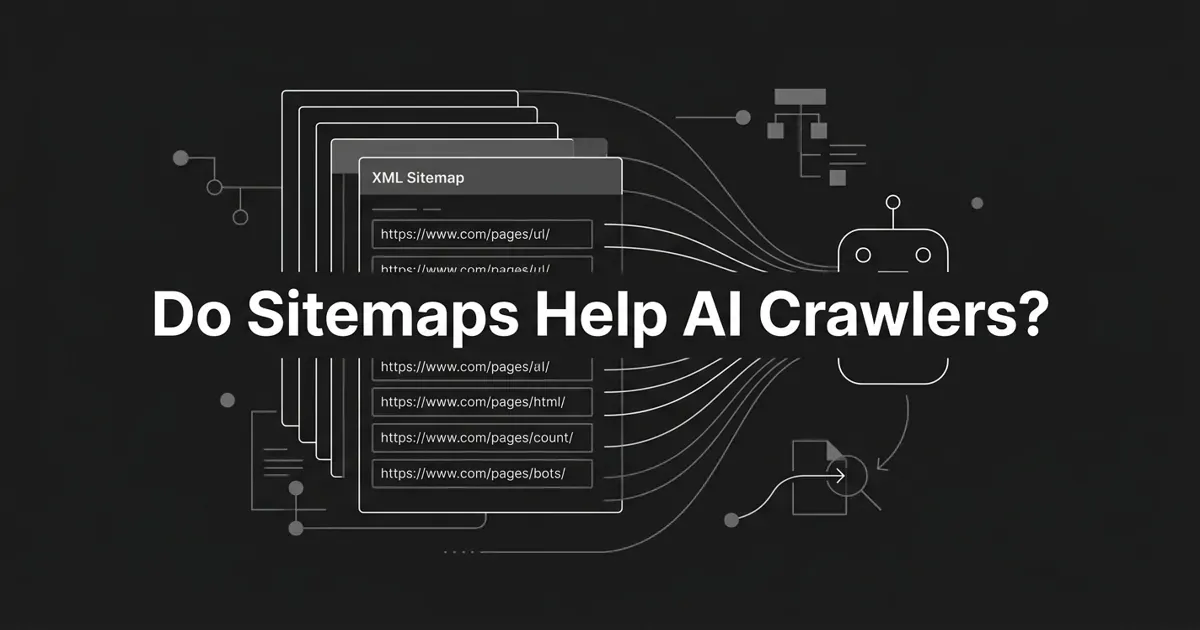
An XML sitemap is a machine-readable file that lists the URLs you want crawlers to know about. That is it. It is not a navigation menu, and it is not a promise that anything gets indexed. This is the XML sitemap AI crawlers rely on to learn which URLs you have published.
Think of it as a directory you hand to a crawler. Each entry sits inside a <url> tag with a <loc> child holding the full, absolute address of the page. The file starts with <urlset> and ends with </urlset>, uses UTF-8 encoding, and caps out at 50 MB or 50,000 URLs per file, whichever you hit first. Bigger site? You split into multiple files and tie them together with a sitemap index file, which can point to up to 50,000 child sitemaps.
Now the part people miss. A sitemap lists URLs, but it does not enforce them. Crawlers still decide which pages to fetch and how often. A few rules of thumb hold across every documented vendor:
- A URL in your sitemap that is also blocked in robots.txt gets treated by the robots.txt rule. Google is explicit that it generally will not crawl or index a disallowed URL even when it sits in your sitemap.
- A sitemap cannot rescue a broken page. If a URL returns a 404, carries a noindex tag, or redirects elsewhere, listing it changes nothing.
- Sitemaps and internal links are partners, not substitutes. Internal links remain the strongest signal of which pages matter, so a sitemap complements your linking, it does not replace it.
If that feels like a lot of caveats, take a breath. The takeaway is simple. A sitemap helps a crawler find good, working pages faster. It does no work on pages that are broken, blocked, or unimportant, and it was never meant to.
How each AI crawler treats your sitemap
Different engines, slightly different behavior. Here is what each one has actually documented about the sitemaps AI search crawlers read, so you know where you are standing on evidence and where you are standing on reasonable assumption.
Google treats sitemaps as a way to tell it about pages that might otherwise be hard to find. It reads a submitted sitemap roughly once a day, faster for large, frequently updated files. This matters more than it looks, because AI Overviews and AI Mode draw on the same index as regular Search. No index entry, no AI surface. Your sitemap supports indexing, and indexing is the table-stakes ticket to showing up in Google's AI answers.
Bing has been the most vocal. Its bots power Copilot and Copilot Search, and Bing has stated plainly that sitemaps are foundational for AI-powered indexing, with the <lastmod> field as a key freshness signal. When you submit a sitemap to Bing, it fetches the file immediately, then re-checks at least daily.
OpenAI runs three bots you can control separately: OAI-SearchBot for surfacing links in ChatGPT search, GPTBot for training data, and ChatGPT-User for real-time fetches when someone asks ChatGPT to act on a URL. All three respect robots.txt. OpenAI has not published sitemap-specific behavior, so treat your sitemap as one discovery input among several here, not a guaranteed path.
Anthropic maintains ClaudeBot for general crawling, Claude-User for user-triggered fetches, and Claude-SearchBot for search retrieval. They respect robots.txt. No sitemap-specific statement, same working assumption as OpenAI.
Apple runs Applebot for Spotlight, Siri, and Safari suggestions, plus Applebot-Extended for Apple Intelligence training. You can opt out of the training variant with robots.txt without hurting the search one. No sitemap-specific guidance published.
Perplexity is the pleasant surprise. It runs PerplexityBot and Perplexity-User, and it publicly recommends that publishers submit XML sitemaps to make content more discoverable for citation in its answers. Alongside Bing, that is one of the most direct endorsements of sitemaps for AI search from any vendor.
The pattern is easy to hold onto. Google and Bing give you documented, sitemap-aware behavior. Perplexity openly asks for your sitemap. OpenAI, Anthropic, and Apple stay quiet on specifics but all honor robots.txt, so a clean sitemap plus a clean robots.txt is still your safest bet with them.
Lastmod: the one field that moves the needle
If you only tune one thing in your sitemap for AI crawler discovery, make it <lastmod>.
Most optional sitemap fields are noise now. Search engines widely treat <changefreq> and <priority> as informational at best, and both Google and Bing commonly ignore them. Skip them unless your CMS adds them for free.
<lastmod> is different. It is the one optional field with documented, observable impact. Bing calls it a key signal for deciding what to recrawl in AI-powered indexing. Google uses it as an input into crawl prioritization. When your <lastmod> says a page changed, you are nudging crawlers to come back and re-fetch the fresh version, which is exactly what you want after you update a piece.
But there is a catch, and it is the reason so many sitemaps get ignored. The signal only works if you keep it honest. Here is how to keep the sitemap lastmod AI crawlers trust:
- Use a precise ISO 8601 timestamp, like
2025-07-15T14:30:00+00:00. Bing specifically recommends the format with a time, not just a date. - Update it only when the page content actually changed in a meaningful way. Not on template tweaks. Not when only metadata moved.
- Never stamp every URL with today's date. Sites that set every
<lastmod>to "now" burn the crawler's trust in the signal, and then it stops meaning anything.
That last one is the common own goal. A sitemap that screams "everything changed today, every day" teaches the crawler to ignore your freshness claims entirely. Accurate beats aggressive. This is the same freshness logic that decides which sources feel current enough to cite, so treating <lastmod> with care pays off well beyond the sitemap file.
One more honest note. There is no published, at-scale study proving that a well-tuned <lastmod> lifts your AI citations. What we do have is Bing saying it drives recrawl decisions and Google saying it informs crawl priority. So treat this as a strong, well-supported discovery signal, not a guaranteed citation trick.
The Cloudflare wrinkle: access comes before discovery
Here is a newer thing worth knowing, because it can quietly undo all of the above.
In July 2025, Cloudflare began defaulting new domains to block AI crawlers unless the publisher explicitly allows them in. It also launched a pay-per-crawl option where publishers can charge AI bots for access. This is opt-in, not opt-out, which flips the old assumption on its head.
Why does this matter for your sitemap? Because a sitemap is useless if the crawler cannot reach your site at all. If an AI bot gets blocked at the CDN layer, discovery breaks before it starts. The cleanest sitemap in the world cannot help a crawler that was turned away at the door.
So the mental model is now two layers, not one. Access first, then discovery.
- If you sit behind Cloudflare, decide which AI bots you actually want, then allow them in the AI Crawl Control dashboard. Pair that with a robots.txt that permits the same bots.
- If you are not behind Cloudflare, you still want a clean robots.txt and sitemap, because respecting robots.txt is the shared convention across every documented vendor.
None of this changed how the engines read a sitemap once they are allowed in. It changed who decides whether they get in at all. Check your access settings before you spend another minute polishing the file, because the file only matters after the crawler is let through.
Discovery is not citation: where sitemaps stop helping
This is the part that saves you from disappointment, so read it slowly. Getting found and getting cited are two different stages, and your sitemap only touches the early ones.
Picture the journey from your page to an AI answer as five steps:
- Discovery. Does the crawler know your URL exists? Sitemaps, internal links, and external links all help here.
- Fetching. Does the crawler retrieve the page? Crawl budget, freshness, robots.txt, and access policy decide this.
- Indexing. Is the content stored in a usable form? Rendering, content quality, and canonical selection decide this.
- Retrieval. Is your page pulled as a candidate source for a given question? Topical relevance, entity signals, structured data, and authority decide this.
- Citation. Does the answer actually name and link your page? Ranking, answer fit, and each provider's policy decide this.
Your sitemap contributes real value to steps one and two. It contributes little to nothing on steps four and five. That is not a flaw. It was never the sitemap's job to make you the best answer.
Which means the biggest wins live in the stages a sitemap cannot reach. Whether an AI engine picks your page as a source comes down to relevance, structure, and trust, not to the tidiness of an XML file. If your pages are getting found but not cited, the sitemap is not your problem, and no amount of sitemap work will fix it. The fix lives in your content: clear answers near the top of the page, strong topical coverage, structured data, and the kind of authority that earns a citation.
That is also why the smartest teams stop obsessing over the file once it is clean. A correct sitemap is hygiene. It is table stakes, not a growth lever. Get it right, then put your energy where the leverage actually is.
Your practical checklist for AI crawler discovery
Let's make this doable. You do not need a project. You need a short pass over what you already have. Here is the minimum-viable setup for AI crawler discovery, in plain steps.
Get the file clean:
- Use XML as your default format. RSS, Atom, and plain text work as fallbacks, but XML is universal.
- Put the sitemap at your root, like
/sitemap.xml, and reference it from robots.txt with aSitemap:line. - Include only canonical, indexable URLs that return a 200. No noindex pages, no redirects, no dead ends.
- Leave out pagination, faceted-navigation duplicates, and internal search pages unless you have a real reason to include them.
- Stay under 50 MB and 50,000 URLs per file, and split into a sitemap index when you outgrow that.
Get the freshness right:
- Set an accurate
<lastmod>in ISO 8601 format, updated only on meaningful content changes. - Skip
<changefreq>and<priority>. The major engines ignore them. - Regenerate the sitemap on publish or a genuine update, not on every cron tick.
Get it submitted and let in:
- Submit the sitemap in Google Search Console and Bing Webmaster Tools.
- If you publish a lot of images, news, or video, add the matching extension sitemaps.
- If you are on Cloudflare, allow the AI bots you want in AI Crawl Control, and mirror that in robots.txt.
Do not try to do all of this today. Pick the one that is most broken for you. For most teams that is either a <lastmod> that lies or a robots.txt that quietly blocks a bot they meant to allow. Fix that one thing, then move on.
How to tell if your sitemap is actually working
You do not have to wonder whether any of this landed. The signals are already in tools you have.
In Google Search Console, open the Sitemaps report and check the read date, the discovered URL count, the indexed count, and any errors. In Bing Webmaster Tools, look at the same shape plus Bing's recrawl diagnostics. A widening gap between submitted and indexed URLs is a quality or canonical flag worth chasing.
Your server logs tell the rawest story. Count how often /sitemap.xml gets fetched by known bots like Googlebot, Bingbot, OAI-SearchBot, ClaudeBot, PerplexityBot, and Applebot. A sitemap that never gets fetched is not contributing, full stop.
Discovery is only the first half, though. To see whether the pages you care about are actually getting cited in AI answers, you need to watch the answers themselves, prompt by prompt, engine by engine. That is a different measurement job from sitemap hygiene, and it is the one that tells you whether your content is winning where it counts.
This is where a platform earns its keep. DeepSmith brings your published pages into one place, keeps a fresh summary and classification of each so your internal linking and coverage stay accurate, and tracks how often AI engines mention and cite your brand across ChatGPT, Perplexity, Gemini, Claude, and Google AI Mode. So you can keep your sitemap clean for discovery, and separately watch the citation stage a sitemap can never move on its own.
Keep the sitemap, spend your energy where it counts
So, do XML sitemaps help AI crawlers find your content? Yes. Keep yours, keep it clean, and keep <lastmod> honest. It is one of the most reliable discovery signals you have, and Bing has said as much out loud.
Just hold the line in your head. A sitemap gets you found and re-fetched. It does not get you ranked or cited. Those come from content quality, structure, topical authority, and trust, the stuff no XML file can supply. Sitemaps are hygiene. The real leverage is everywhere the sitemap cannot reach.
Not sure where to start? Fix the one broken thing in your file this week, then turn your attention to whether AI engines are actually citing you. If you want the discovery hygiene and the citation tracking in one place, you can start a free trial and see your real pages and real answers before you commit to anything.