You know things about your customers that nobody else does, but that knowledge is stuck in your head and it keeps getting rewritten from scratch every time a writer touches it. Your blog has a pile of decent how-to articles, but none of them add up to a point of view. This guide walks you through named framework marketing: building one named framework, a simple, ownable model with a name your reader can hold onto, so every article you publish after this one can build on the same idea instead of starting over. By the end you will have a one-page specification you can hand to a writer, or to Content Studio, and it will already sound like you.
Marketers sometimes call this content IP, a recognizable, reusable idea tied to your brand that content keeps building on. You do not need a legal team or a branding agency to get there, you need one real problem, a method you already use to solve it, and a name simple enough to say out loud.
1. Choose the recurring customer job your framework will address
Start with one audience, one situation that keeps coming up, and one decision or outcome you want to make easier for them. Go back through the actual conversations: onboarding calls, support tickets, objections in sales, the moments where a generic explanation you gave someone clearly did not land. Write down the customer's own words next to your diagnosis of what was actually going on.
You know you have it when you can finish this sentence: "When [audience] faces [situation], this model helps them [specific decision or action]." You should be able to point to real interactions that back it up, not just a hunch that sounds plausible. If your audience is "everyone" or your framework is really just a list of product features in disguise, you have not found the job yet, you have found a marketing brief.
If you already track where you show up in AI answers, gaps and recurring questions surfaced there are a reasonable place to look for candidate situations. That data can point you toward a problem worth naming. It cannot tell you what your point of view on that problem should be, that part is still yours.
Common mistake: picking a catchy label before you have pinned down a real, recurring problem. The name should come later. If you start with the name, you will spend the rest of this process bending the method to fit words you already like.
2. Extract the point of view from work you already do
Lay out a handful of representative customer situations and write down what your team actually notices, what you rule out, what you prioritize, and what you do next. Somewhere in there is a distinction or a decision rule that a generic how-to article leaves out. Ask yourself what you would recommend that an informed competitor might not, and write down the evidence or experience behind that judgment, along with the situations where it would not apply.
This is really what a signature methodology content strategy is built from: not a new invention, just your own judgment made explicit enough for someone else to reuse. You do not need to invent an entirely new category of business problem. Plenty of strong frameworks are just an existing method, made explicit for the first time. What matters is that you can state a specific claim, explain the reasoning behind it, and point to at least one real situation where that claim changes what you would actually recommend.
Keep a short source-of-truth document as you go: approved definitions, a couple of examples, and the claims you are not willing to make. If your brand context is already centralized somewhere, that document is a natural home for it, since it keeps every future explanation of the framework consistent instead of drifting a little with each new writer. This is the step that turns a good idea into actual content ip: not the name, the documented reasoning behind it.
Where people go wrong: dressing up familiar advice in new terminology, or making a sweeping claim off three anecdotes. A slogan is not a method, no matter how well it scans.
3. Arrange the method into a model someone can actually use
Now pick a structure that matches the actual shape of the task. If the work has to happen in a fixed order, use ordered steps. If you are comparing alternatives, a decision matrix fits better. If someone is making the same kind of judgment call over and over, a small set of distinct checks might be the right shape. Define each component as an action or a judgment, not a vague theme, and state what goes in, what question gets asked, what comes out, and how that output feeds the next component. Cut any stage that is really just repeating the one before it.
You will know the model works when a reader can apply it to a concrete situation and explain, in their own words, what changes at each step. Write a one-page working specification with the audience and trigger, the promised decision or outcome, the underlying point of view, each component's name and definition, the order or relationship between them, one worked example, and one honest limitation.
Where people go wrong: landing on three or four stages because that number looks tidy on a slide, building categories that overlap so a reader cannot tell which one applies, or drawing arrows between boxes that do not represent a real dependency. The one-page spec is a working document, not a length requirement to hit.
Ahrefs publishes B.R.E.W., a named model it says it uses to decide which marketing ideas to pursue, scoring each one on business potential, reach, effort, and who it is for. It is one example of an existing internal method turned into a structure other people can actually apply, not proof that four components or that particular scoring scale will work for your situation.
4. Name the model without letting the name outrun the idea
Generate plain-language names from the problem, the decision, or the distinction you are most proud of. Try each candidate with and without a subtitle: "The [Name] Method: [the specific job it helps someone complete]." If you are leaning toward an acronym, cover the letters and check whether each underlying word still describes the right action. Favor something a person can say out loud, remember, and drop naturally into a sentence over something clever.
Before you invest much in a launch, run a basic search for obvious conflicts on the web and in trademark records. That search tells you whether something similar is already out there. It does not clear you legally and it is not a substitute for advice from someone qualified to give it, especially if the name is going to carry real weight for your business.
You are ready when the name can be explained in one sentence, the labels for each component actually mean something on their own, and your initial search did not turn up an obvious, confusingly similar use in a related space.
Common mistake: treating a coined acronym as proof that you own the underlying process. Coining an acronym does not, by itself, establish novelty, usefulness, exclusive rights, or customer demand for the method behind it. In the United States, a trademark generally protects a brand name or logo used with specific goods or services. Copyright protects the actual words you use to explain an idea, not the underlying method or system itself. Those are different kinds of protection, and neither one hands you ownership of a category. If the name matters enough to defend, talk to a lawyer instead of assuming a clean search result means you are covered.
5. Test the explanation on a real customer situation
Show a short explanation of the model, plus one concrete example, to people who understand the customer problem, ideally including at least one person who had no hand in writing it. Ask them to describe the model back to you in their own words, tell you which component they would reach for next in a real situation, and flag any term or assumption that confused them. Separately, ask whether the underlying problem you named actually matches something they have run into.
Watch what they do with it rather than just asking whether they like the name. You are looking for evidence that a relevant person can identify the job, tell the components apart, and land on a sensible next step without you standing over their shoulder filling in the gaps. Write down where they got stuck and revise the model or its wording from there. There is no fixed sample size or pass rate that makes a framework officially validated, treat this as a useful lightweight check, not a formal certification.
Where people go wrong: testing only with colleagues who already know the pitch, mistaking politeness for genuine understanding, or fixing a confusing label while leaving a genuinely broken decision sequence untouched underneath it.
6. Publish one definitive explanation that others can work from
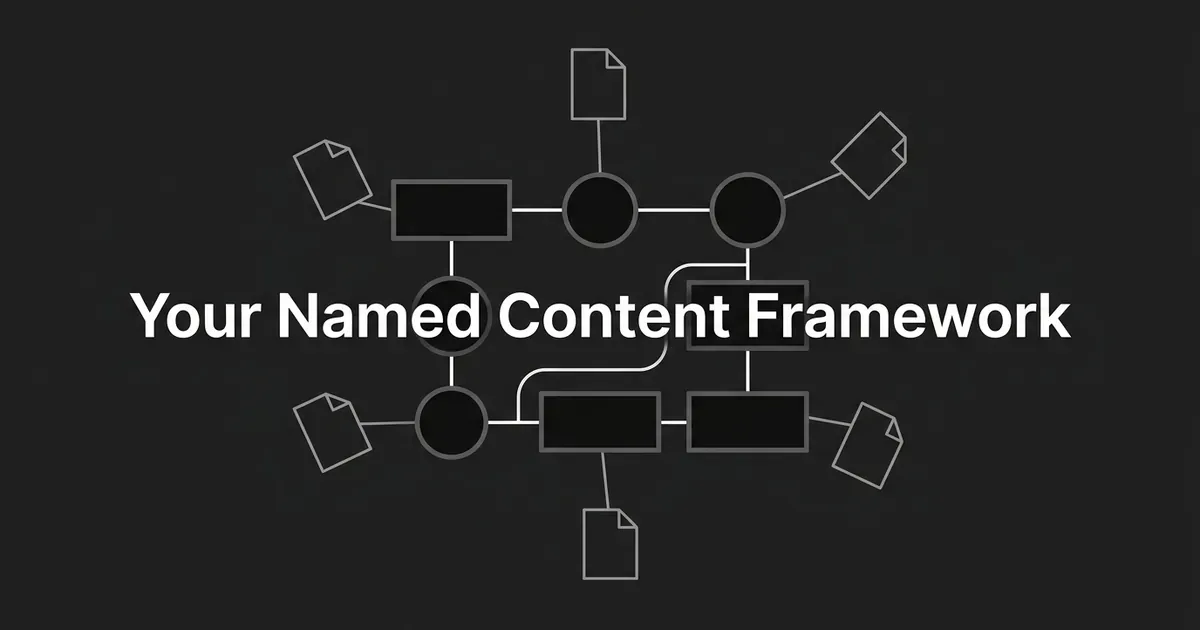
This is the anchor piece, the one place that states who the model is for, the problem it solves, what makes your take on it distinctive, how each part works, one worked example, its limits, and a clear next step for the reader. Keep the definitions and the relationships between components stable from here forward. A simple table or a plain diagram is enough if it makes the logic clearer, a decorative graphic that cannot teach the method on its own is not worth the space it takes up.
This anchor piece is the center of gravity for a proprietary framework content marketing program actually needs, the one page every other piece points back to. You will know this piece is doing its job when someone who has never met you can read it and build an accurate example without asking you what a term means. That is also the test for whether you can actually hand this off: give writers an approved brief with the terminology, the component definitions, the boundaries of a good example, and the claims that are off the table, and they should be able to write from it without a call.
This is one of the steps where a production tool genuinely helps. Content Studio's Writer can turn a planned idea into a researched, brand-grounded article using the context you have stored, complete with SEO and AEO formatting, links, an image, and publish-ready metadata. It still needs you to supply the framework's actual claims and worked examples and to review what comes back, since the tool produces the article, not the underlying point of view.

Where people go wrong: publishing a graphic that cannot teach the method by itself, burying the method under a product pitch before the reader understands it, or announcing a clever name with no explanation of how to actually use it.
7. Reuse the same decision logic in distinct content pieces
This is where a proprietary framework content marketing effort actually pays off, since one anchor piece can seed months of smaller ones. Pick a small set of real questions your framework can genuinely answer, then plan a piece for each one. For every piece, specify the audience situation it addresses, which component or relationship it demonstrates, the new example or evidence it adds that the anchor piece did not already cover, and where it points the reader for the full explanation. A worked walkthrough, a mistake-and-fix article, a comparison of two decisions made using the model, a customer-situation explainer, a sales deck, a newsletter example, a short social post, all of these can carry the framework if each one teaches something the last one did not.
You will know this is working when each new piece adds a use case, a distinction, an objection handled, or a proof point, while keeping the model's definitions exactly as you defined them in the anchor piece. Someone who reads three or four of these pieces over a few weeks should recognize the same method each time and still come away having learned something new.
Common mistake: slapping the framework's name onto an unrelated article just to reuse a keyword, changing a stage's label between channels because it reads better one way on LinkedIn, or mechanically chopping the anchor piece into smaller posts that add nothing new. Once a piece is drafted, DeepSmith's Repurpose and Apps Library can adapt it into channel-specific formats like LinkedIn posts or a newsletter, which saves the manual rewriting, but it is still worth a pass to confirm the framework is represented faithfully in each version, since repurposing something quickly is not the same as an audience understanding it.
8. Check whether the framework is useful and revise it deliberately
Separate three different questions instead of collapsing them into one vague sense of "is this working." Can people understand it. Do they actually use it. Does it contribute to conversations that matter to the business. Look at comments and interview feedback, cases where someone applied the framework's terms correctly on their own, whether your sales team or writers are using it accurately without you correcting them, engagement on the anchor explanation, and any relevant search or AI-answer visibility. Record a baseline before you start comparing later numbers to it, otherwise you have nothing to compare against.
You are done with this step when you have documented observations, you know which component causes the most confusion, and you can make a deliberate call to keep the model as is, simplify it, rename it, or retire it. Keep a versioned copy of the definition as you revise, so an older piece does not quietly contradict a newer one.
If you already track how AI engines answer questions in your space, tools like DeepSmith's AEO module report mention rate, how often a brand gets named, separately from citation rate, how often a page actually gets linked as a source. It also reports share of voice and page-level citations alongside those two. Those numbers can help you monitor whether your framework's language is showing up where your buyers are asking questions, but none of them alone prove that naming the framework caused a lead or a sale. Treat visibility data as one input into this step, not the whole answer.
Where people go wrong: treating a mention, an impression, or one attributed lead as proof the framework drove revenue, watching only for your coined term while your buyers are still searching in plain, ordinary language, or assuming an AI mentioning your brand is the same thing as it citing your page as a source.

What to do next
Pick one recurring customer problem this week and write the sentence from step one: when this audience faces this situation, this model helps them do this specific thing. That single sentence is the test for whether named framework marketing is actually worth doing for you, or just a name looking for a reason to exist. A signature methodology content strategy built on that sentence will hold up a lot longer than one built on a clever acronym. If DeepSmith is already part of your stack, pull up your tracked prompts or Opportunities for a look at where the gaps and recurring questions already are, then start your one-page specification from there. If you are not on DeepSmith yet, you can start a free trial and see your own AI visibility and content gaps before you commit to anything.