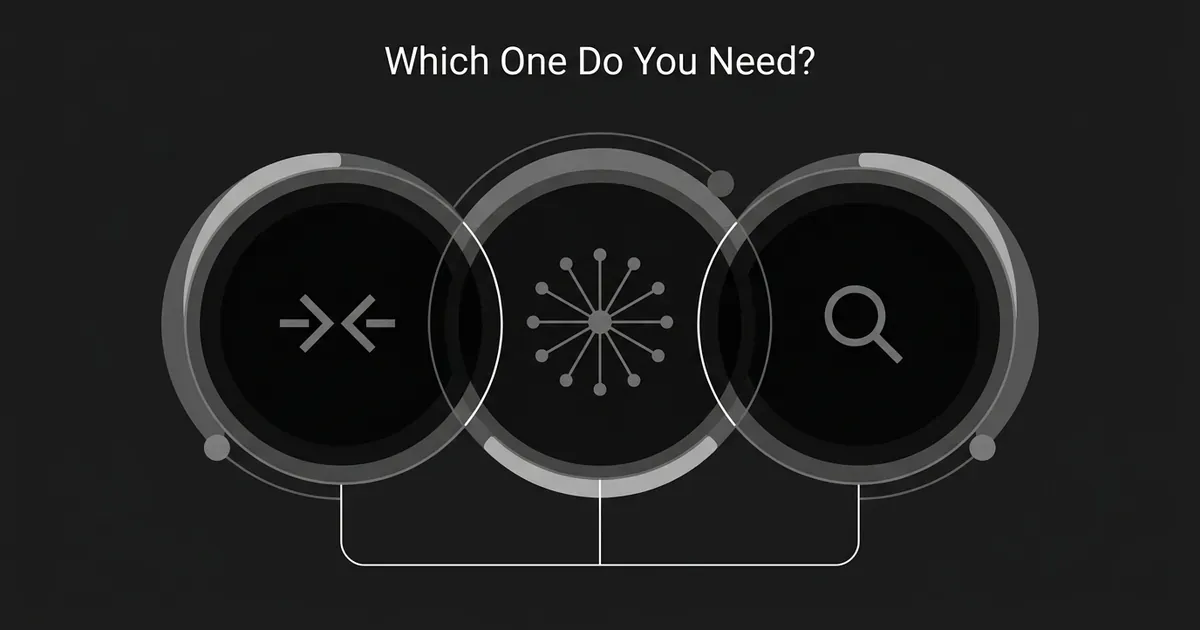
If you have ever sat in a planning meeting where someone says "we need more market research" and someone else says "no, we need competitive intelligence," you already know the problem. The three terms get used almost interchangeably, but they answer different questions, and picking the wrong one wastes weeks. The short version of competitive intelligence vs market intelligence vs market research is this: competitive intelligence tells you what rivals are doing and what it might mean for your choices, market intelligence gives you a wider view of the market itself, including customers, competitors, and shifting conditions, and market research answers one specific question about a market or its buyers. You pick between them based on the decision you are trying to make, not based on which term sounds most impressive in a deck.
None of this is a rigid taxonomy that every practitioner agrees on. Some teams use competitive intelligence broadly enough to fold in market intelligence. Others keep it narrow, strictly rival versus rival. A single customer interview can inform more than one of these at once. What matters for a working team is not winning an argument about definitions, it is knowing which lens to reach for when you are stuck.
The three at a glance
| Your question | Best starting lens | What you're looking at | What you get back |
|---|---|---|---|
| What are our rivals doing, and what does it mean for us? | Competitive intelligence | Rival positioning, launches, content, pricing, distribution | A read on rival moves, what they imply, and what's still uncertain |
| Where is this category heading, and where should we compete? | Market intelligence | Customers, competitors, products, and outside conditions together | A view of opportunities, risks, and where to position |
| What do our actual buyers think or do, and will this idea work for them? | Market research | A defined audience or question | Findings from a study built to answer that question |
Treat this table as a starting point, not a fence. All three can, and often do, feed the same decision.
Competitive intelligence: what rivals are doing, and what it might mean
Competitive intelligence is the lawful, ethical practice of gathering and analyzing information about the people you compete with, then using it to sharpen your own decisions. For a marketing lead, that usually means watching which topics a rival is pushing, what claims they are making, which of their pages seem to be gaining traction, or how their positioning has shifted since last quarter.
It is easy to shrink this down to "spying on competitors," but the formal discipline is broader than head-to-head rivalry. It can take in suppliers, adjacent technologies, regulatory shifts, and the wider business environment a company operates in. Some practitioners separate out "competitor intelligence" as the narrower, direct-rival version of this work, while treating competitive intelligence as the larger umbrella. Either framing is fine as long as you are consistent about what you mean inside your own team.
The part worth holding onto is the gap between an observation and a conclusion. A competitor publishing a new guide is something you observed, not proof of their budget, their traffic, or their next move. Good competitive intelligence separates the two: here is what we saw, and here is what we think it might mean, with the uncertainty left visible rather than papered over.
Market intelligence: the wider view of where a market is heading
Market intelligence is the systematic reading of everything shaping your market at once, customers, competitors, your own products, and outside conditions like economic shifts or new regulation, built to support a strategic decision. It blends the quantitative, market size, growth rate, adoption curves, with the qualitative, shifting preferences, emerging complaints, a new category taking shape. Sources for it can include industry reports, customer surveys, and yes, competitive analysis folded in as one input among several.
The real difference from competitive intelligence is breadth, not a hard wall against competitor data. Market intelligence definition matters here because the term gets used loosely: some sources describe it as a continuous, always-on function, which is a common way teams run it, but not a requirement. You can commission a one-time market assessment ahead of a single decision and still call it market intelligence.
One thing worth flagging directly: market intelligence and marketing intelligence are not always the same phrase for the same thing. Some teams use marketing intelligence for a narrower, marketing-function-only version of this work. If you are writing a brief or briefing a vendor, say which one you mean rather than assuming everyone reads it the same way.
Market research: answering one specific question about your market or buyers
Market research is the gathering and analysis of evidence built to answer a defined question about a market or its customers. That question might be whether a proposed message actually lands with your audience, why prospects are turning down your offer, or whether a segment you are eyeing actually has the problem you think it has.
Research is often treated as scoped, a project with a start and an end, while intelligence is often treated as ongoing. That is a useful rule of thumb, not a law: tracking studies repeat on a schedule, and a one-off intelligence brief is still intelligence even though it never becomes a program. Research also is not synonymous with surveys. It can be primary or secondary, qualitative or quantitative, and it is not limited to customers either, a well-scoped research project can look at competitors or products just as easily.
The market research vs competitive intelligence line gets blurry here because both can involve looking at what competitors are doing. The difference is in the question being answered. Research exists to settle a specific, defined question with evidence. Competitive intelligence exists to interpret a rival's moves for what they mean to you. The same interview transcript could feed both, depending on what you do with it afterward.
Where the real differences show up
The decision each one is built for
Competitive intelligence is the right starting point when your decision hinges on another player's actions or where you stand relative to them. Market intelligence takes over when that competitor is just one piece of a market-wide opportunity or risk you are trying to size up. Market research wins when you have a specific claim about buyers or a market that needs testing, not another round of internal guessing.
Picture a marketing lead noticing a rival's new guide keeps showing up as a source in ChatGPT answers for a topic they care about. Finding out where that rival is earning those citations is a competitive-intelligence question. Asking whether buyer questions and demand across the whole category are shifting is a market-intelligence question. Asking whether your own audience actually understands your explanation of the same topic is a research question. These are illustrations of how the three questions differ, not a claim about any real competitor or platform.
What each kind of evidence can and cannot prove
The same raw input rarely belongs to only one of these three buckets. A single interview with a lost deal might test a hunch about your audience, surface an objection that applies to the whole category, and reveal something about how a rival is perceived, all at once. What changes is what you do with it. Competitive intelligence reads it for competitive implications. Market intelligence relates it to other signals across the market. Research judges what it actually supports about the specific question it was designed to answer, and a couple of interviews cannot establish that something is true across your whole buyer base without a study built to carry that weight.
The same caution applies across the board. A comparison of competitor content can tell you a lot about how a rival is positioning itself, but it cannot, by itself, tell you whether buyers actually want what that content promises. A market-size estimate gives you context for a bet, not proof that your specific message will land. A survey tells you what respondents said, not what a competitor is about to do next. Evidence gets classified by the decision it is meant to support and how it is used, not by whether it started life as a screenshot, an interview, or a spreadsheet of survey answers.
How often you come back to it
Rival behavior and market conditions tend to need ongoing attention, since a competitor's next move or a shift in the category rarely announces itself once and then holds still. A sharply defined research question, by contrast, often has a bounded answer: you run the study, you get the finding, you move on. Treat this as a helpful expectation, not a rule that always holds. Plenty of teams repeat the same research study on a cadence, and plenty of "intelligence" work happens as a single brief pulled together for one meeting and never touched again.
Picking the lens for your actual decision
Start with one question: what uncertainty is actually blocking you from deciding?
If you do not know how a rival is positioning itself, or what a specific move of theirs means for you, start with competitive intelligence. Just be careful not to read a rival's private strategy or their commercial results off public activity alone; a new page or a pricing change tells you what happened, not why.
If you do not know whether a category, segment, or demand pattern is worth investing in, start with market intelligence. Competitor evidence belongs somewhere in that picture, but it should not stand in for the whole market on its own.
If you do not know what your target buyers actually need, believe, or prefer, start with market research built around that exact uncertainty. Do not let an untested internal opinion pass for buyer evidence just because everyone in the room agrees with it.
Some situations call for more than one lens at once. Say you know a competitor is winning attention on a topic, but you are not sure your own buyers actually care about it. Competitive intelligence establishes that the gap exists. Research tests whether the buyer interest is real. Market intelligence places both inside the wider category context so you know how much weight to put on the finding. That is a way of thinking through a decision, not a fixed process you have to run in order every time.
And sometimes the answer is that you already have the evidence you need. If you are sitting on relevant data from all three and still stuck, the missing piece is usually interpretation, not another round of collection. More data will not fix a decision that is actually waiting on judgment.
For a marketing lead specifically, this shows up constantly in choosing what to write next. A rival publishing a lot on a topic suggests a competitive gap, but it does not prove there is a real audience need behind it. A shift in category-wide demand can point you toward a topic, but it does not confirm that the specific article you are planning actually answers what readers are asking. Defined audience research can test that question directly, but on its own it will not tell you what your competitor's next move looks like. This is part of why teams doing AI-search content work increasingly benchmark their AI visibility against named competitors as one input into that decision, alongside audience research and a read on the wider category, rather than leaning on any single lens by itself.
A few limits worth keeping in mind
Terminology in this space is genuinely contested. One academic account treats market intelligence as a subtype nested inside a broad competitive-intelligence practice. A more practical industry comparison treats competitive intelligence as the narrower, more specific of the two. Both framings exist in circulation, so pick a consistent internal definition and hold to it rather than assuming there is one settled hierarchy everyone else is using too.
"Intelligence" here does not mean secret or improperly obtained information. Legitimate competitive work operates within clear legal and ethical bounds, and professional bodies in the space emphasize lawful, honest collection as the baseline, not an aspiration. Research carries its own responsibilities toward the people providing the data: current industry codes for market and social research draw a real line between research and non-research uses of data, and call for separate consent when data collected for research gets used for something else.
Keep the core caution close at hand across all three: an observation is not an outcome. A publication, a citation, a ranking, or a claim a rival makes about themselves is not proof of their revenue, their conversion rate, their market share, or their actual intent. None of the three replaces the other two, either. Buyer responses, category trends, and rival actions can point in different directions at once, and the right call depends on figuring out which uncertainty is actually standing between you and the decision.