If you plan content for a living, you have probably had this argument with yourself, or with a teammate: should this piece be built around a persona, or around a segment? A buyer persona vs audience segment mix-up is one of the more common ways a content brief goes sideways, because the two words get used almost interchangeably in a lot of marketing teams, and that is where the trouble starts.
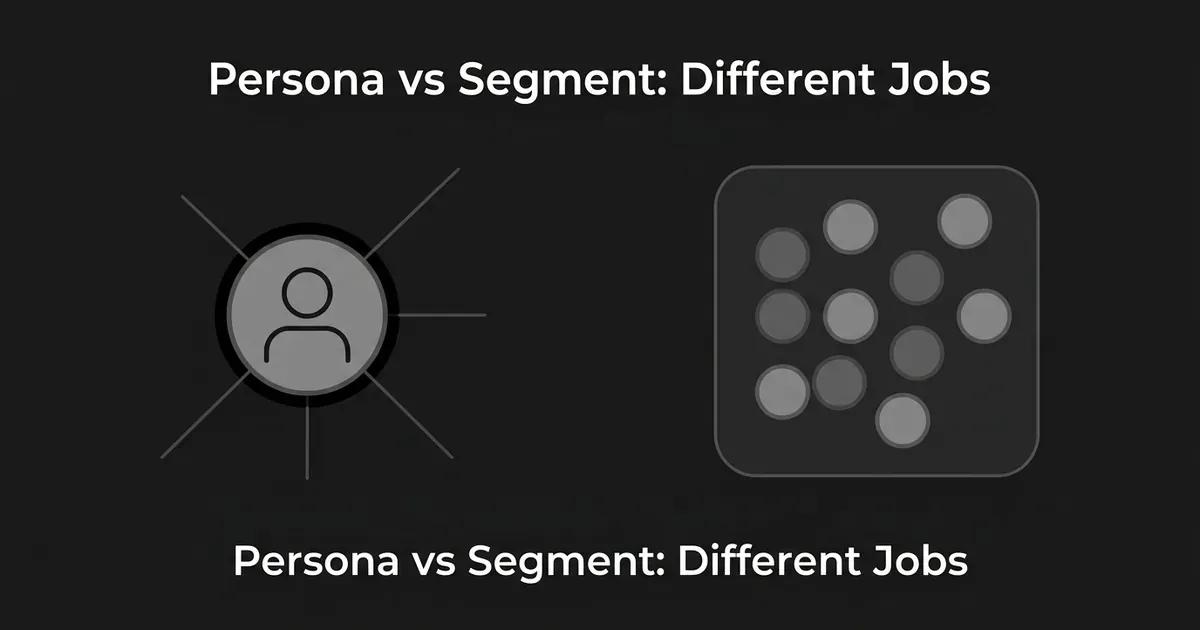
Here is the short version. A buyer persona is a composite profile of a decision-maker: their goals, their problems, and why they act. An audience segment is a group of people defined by something you can measure, like their industry, their behavior, or where they sit in your funnel. You use the persona to decide what a piece of content means to the reader. You use the segment to decide who gets that piece, and when.
| Buyer persona | Audience segment | |
|---|---|---|
| What it is | A composite decision-maker | A group defined by shared, measurable traits |
| Main question it answers | Who is this person and why will they act? | Which people should get this content? |
| Built from | Goals, pain points, objections, decision criteria | Demographics, behavior, intent, lifecycle stage |
| Job in content planning | Shapes the angle, language, and examples | Shapes who receives it and which version |
| Usually owned by | Content, product marketing, sales enablement | Marketing ops, lifecycle, paid media, CRM |
| Main risk | Turning into a stereotype nobody checks | Getting so broad or stale it can't be activated |
Keep that table in mind as you read the rest, because most of the confusion between these two terms comes from treating them as competitors instead of two different jobs.
What is a persona, exactly?
Before comparing the two side by side, it helps to answer what is a persona on its own terms, since that word alone gets stretched to cover almost any audience description a team has on hand.
What is a buyer persona?
A buyer persona is a fictional or semi-fictional profile of a type of buyer, built from patterns across real customers rather than from one actual person. It is not a targeting list, and it is not the average customer. It is a composite: a way of putting a human face on a recurring pattern so your team can write and plan with that person in mind.
A useful persona usually pulls together:
- The person's role and where they sit in a buying decision
- Their goals and what success looks like to them
- The problems, pain points, and constraints they are dealing with
- What triggers them to start looking for a solution
- The objections and risks they worry about
- How they actually make a decision, and what evidence they need to trust it
- The language they use to describe their own problem
Notice what is missing from that list: age, favorite brands, a stock photo, a made-up name. Those things show up in a lot of persona templates, and they are the part that turns a persona into a stereotype. "Marketing manager at a midsize company" tells you almost nothing useful. A persona earns its place when it tells you what that person is responsible for, what pressure they are under, and what they are afraid of getting wrong.
It is also worth being precise about which kind of person you are describing. A buyer persona is about the person who participates in the buying decision, not necessarily the person who uses the product day to day. In B2B, one account can hold several buyer personas at once: an economic buyer who signs off on budget, a daily user who lives in the product, a technical evaluator who checks it against requirements, and an executive sponsor who wants to see the outcome on a dashboard. Writing one article "for the buyer" without deciding which buyer only gets you halfway.
A persona also is not the same thing as an ideal customer profile. An ideal customer profile describes the kind of company that is a good fit: size, industry, budget. A buyer persona describes the person inside that company who is part of the decision. You need both, but they are not interchangeable, and a lot of teams blur the two without realizing it.
What is an audience segment?
An audience segment is a group of people, current customers, past customers, or prospects, who share something you can measure. That something could be almost anything: industry, company size, geography, what page they last visited, whether they opened your last three emails, or whether they attended a demo and then went quiet.
Segments are usually built from a handful of common bases:
- Demographic or firmographic: job title, company size, industry, seniority
- Geographic: country, region, or service area, especially when regulation or language changes what you need to say
- Behavioral: what someone has actually done, like pages visited, content consumed, or past purchases
- Intent-based: signals that someone is actively researching a category right now
- Lifecycle: prospect, trial user, active customer, lapsed customer, renewal-stage customer
- Modeled or lookalike: a statistically inferred group that resembles a known seed audience, useful for prospecting but less certain than anything directly observed
A segment is usually stored as a list, a query, or an audience rule rather than as a document your team reads and internalizes. That is by design: a segment exists to be activated, whether that means sending an email, showing a different page, or deciding a lead is ready for a sales follow-up.
One thing worth clearing up here: a segment is not always a group of buyers. It can include users who never bought anything, subscribers, anonymous site visitors, or people who merely encountered your brand once. And a segment is not permanent. People move between segments constantly, from anonymous visitor to lead, from active customer to lapsed. Behavioral and intent segments in particular can shift week to week, which is part of why they need to stay connected to fresh data rather than a snapshot from six months ago.
You will also hear the term "audience profile" thrown around, and it does not mean one fixed thing across every team. Sometimes it is a lightweight summary of a segment. Sometimes it edges closer to a persona, with motivations layered on top of the group description. An audience profile vs persona comparison usually comes down to the same question either way: is the document describing a measurable group, or is it describing a representative person's reasoning? That question, not the label, tells you what you are looking at.
How do buyer personas and audience segments really differ?
The cleanest way to separate them is not "qualitative versus quantitative." A well-built persona draws on plenty of data, and a segment can carry psychographic detail too. The real difference is the job each one does.
Group versus representative person. A segment is the group itself. A persona represents that group through one composite decision-maker. The persona is still grounded in patterns across many people, but it gives your team a single point of view to write from instead of a spreadsheet of rows.
What versus why. A segment mostly tells you what is observably true: where someone is, what they did, where they sit in a lifecycle. A persona adds the interpretation of why: what problem they are solving, what outcome they want, what makes them hesitate. Behavioral and intent segments can hint at some of the why, but they were not built to carry that interpretation the way a persona is.
Selection versus empathy. Segmentation helps you decide which part of a market deserves attention right now, and which version of your content that part of the market should see. A persona helps your team write from inside the reader's head: what promise leads the piece, which objection you handle, which example lands.
Stable versus shifting. A persona is treated as a relatively durable reference, reviewed occasionally as the market or product changes. A segment's membership can change continuously, sometimes day to day, which is part of why segments live in a system rather than in someone's head.
Angle versus delivery. This is the distinction that matters most for content planning. The persona is usually the stronger unit for deciding the angle: the problem to lead with, the stakes to name, the outcome to promise. The segment is usually the stronger unit for deciding delivery: who sees the piece, at what stage, through which channel, and whether a separate version is worth building at all.
Put simply: let the persona decide what the content means to the reader. Let the segment decide which reader gets it, when, and in what version.
Which one should drive a content piece's angle?
There is no universal answer here, and treating this as a competition between the two is where a lot of content plans go wrong. The right planning unit depends on what is actually different between the people you are trying to reach.
Reach for the buyer persona to set the angle when the piece needs to speak to one decision-maker's problem, when the main difference between readers is their motivation or objection rather than their behavior, or when the content is educational and needs one coherent point of view. For most general explainer articles, the persona is the right starting point, because the piece needs a single promise and a single reader in mind rather than trying to serve several audiences at once.
Reach for the audience segment when the content genuinely needs to vary by stage, behavior, geography, or intent. If a prospect who downloaded an introductory guide needs something different from a prospect who sat through a demo and went quiet, that is a segment decision, not a persona decision: both people might share the exact same buyer persona, a marketing operations lead trying to prove ROI, but they need different next steps because of what they have already done.
Often the honest answer is to use both, in sequence. Start by defining the persona whose problem the piece addresses. Then check whether any segment, by stage, behavior, or channel, changes what that person actually needs to read next. If it does, decide whether the opening, the examples, or the offer should change for that segment, or whether one version genuinely serves everyone. What you should not do is write a single article as though it has several equally important audiences. That usually means the piece ends up talking to no one in particular.
A simple test for a content team: ask what is meaningfully different between the people you want to reach. If the difference is their problem, motivation, or objection, start with the persona. If the difference is their behavior, stage, or context, start with the segment. If both differ, use the persona for the central angle and the segment for how you adapt or distribute it. And if neither differs enough to change the promise, resist the urge to build separate versions just to look personalized. That effort rarely pays for itself.

Common mistakes worth watching for
Treating a persona as a stereotype. A persona with a job title, an age, and a stock photo but no real evidence about goals or decision behavior is decoration, not a planning tool. Even a well-researched persona is a model of a pattern, not a claim that every person in the group thinks identically.
Treating a segment as only demographic. Demographics are the easiest segment to build, but they are often the least useful for deciding what content someone needs next. A demographic group can contain people at completely different points in their decision, which behavior and intent data will reveal and a job title alone will not.
Confusing the audience with the buyer. An audience for a piece of content might include users, researchers, subscribers, and prospects who will never sign off on a purchase. A buyer persona should name the actual decision-maker role the piece is meant to help, when that distinction changes what you write.
Over-segmenting. Splitting an audience into more segments than your team can realistically maintain often produces content variants with no meaningful difference in reader value. A segment earns its existence when its defining condition genuinely changes the message or the next step, not just because it can technically be built.
Trusting stale or thin segment data. A segment is only as good as the data behind it. Outdated attributes, missing consent, or weak identity matching can quietly make a segment inaccurate long before anyone notices.
Treating a modeled audience as an observed fact. A lookalike or modeled segment is inferred from patterns in a seed group, which makes it useful for prospecting but less certain than something you actually observed. Treat it as a hypothesis worth testing, not as proof that everyone in it shares the seed group's needs.
Making a persona too broad or too narrow. A persona built to represent every possible buyer, user, and executive at once becomes too vague to guide an angle. A persona built around one unusually specific detail stops representing a real pattern and starts describing an anecdote. Either version fails the same test: does a real, meaningful group of readers recognize themselves in it.
Bringing the two together in a content plan
A working content plan can hold both ideas without forcing a choice between them, and the practical version of this is short enough to fit in a brief:
- Primary persona: the representative decision-maker whose problem and perspective shape the piece.
- Primary segment: the measurable condition, stage, behavior, or context, that determines who should actually receive it.
That two-line habit is the practical shape of content targeting: it is what keeps a content operation from treating personas and segments as competing philosophies. They are not fighting for the same job. The persona makes sure the piece means something to the person reading it. The segment makes sure the right person is the one reading it, at the right point in their own decision. A content system that keeps that distinction clear, storing the persona's motivations separately from the measurable stage and topic data that decides delivery, has an easier time producing content that stays relevant as an audience grows and splits into new segments over time.
Neither artifact replaces judgment. A persona built on assumptions instead of evidence is a guess with a name attached. A segment built on stale or incomplete data is a target you cannot actually hit. Used well, together, they answer two different and equally necessary questions: what should this content mean, and who should it reach.