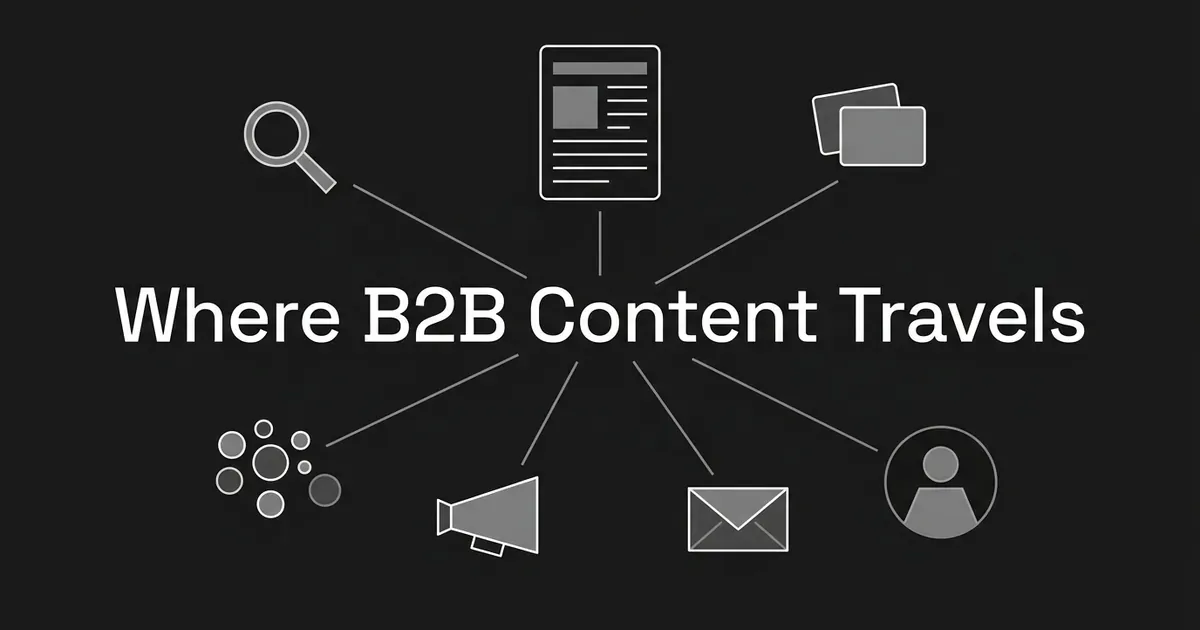
The content distribution channels worth a B2B team's time come down to six: organic search, an owned community, syndication partners, paid amplification, newsletters, and expert or influencer placements. None of them is the best one for everyone. Each solves a different access problem, so the useful question is whether you need to be found, to stay in touch, to borrow someone else's readers, or to get in front of people quickly.
If you've published something good and then watched it sit there, this list is for you. Distribution is the part that tends to fall off when a team is busy, and it's easier to keep doing when you know what each channel is actually for. In this piece, distribution means getting an article, report, or interview seen or used beyond the page where you first published it. A search result, a newsletter mention, and a partner republishing your work are three separate ways to distribute content that started as one piece of work, and they don't each create a separate lead.
What made the list, and what didn't
These six are the b2b content promotion channels that hold up when you look at how a buyer actually finds something useful: they search for it, they hear about it from a group or a publication they trust, they get it in an email they asked for, or they see it where you paid to put it. Each one earned a place among the ways to distribute content because it can hold a real explanation of when to use it.
A few things are deliberately left out. Organic social and paid social are their own territory and get their own pieces. On-page and technical SEO is a craft of its own, so search shows up here only as a channel. This also isn't a planning process or a list of tools to buy. It's a reference you can come back to when you're deciding where a specific piece should go.
One more thing that helps to hold onto while you read. A channel can be owned, borrowed, or bought. Your subscriber list and your own community are owned, because you have a direct and ongoing relationship with those people. A syndication partner or an expert's audience is borrowed, because someone else built that relationship. Paid placement is bought, because you're paying for access to it. Search sits a little apart, since the search engine and the reader's own question decide who arrives. These groups overlap, and that's fine, but they aren't interchangeable.
Organic search for questions buyers already ask
Search is the channel to lean on when your buyers research a question, a comparison, or a problem on their own and you can give them a useful answer they'll find later. It's the one channel where the reader starts the conversation, and it can reach people who have never joined your list or your community.
The reason it works is that a useful page keeps being available. You don't have to send it to anyone again. A durable explainer or reference page is a good example, because its value doesn't depend on a launch date. Google also says AI Overviews and AI Mode can surface links to supporting websites, so an answer-led page can be found through those experiences as well. It's worth knowing that Google doesn't promise inclusion, and following its guidance doesn't guarantee a page gets indexed or shown. It also reports appearances in those AI features inside overall web search traffic in Search Console, so you can't treat every AI-search exposure as its own traffic source.
The trade-off is speed and control. Search discovery is neither immediate nor something you can turn on the way you can with a purchased placement. It also won't help much when the people you want to reach seldom search for your subject, which can happen with a small buying committee that mostly hears about things through colleagues.
To put it to work, pick the recurring question from your own sales or support conversations, such as a procurement or operations question people keep asking, and make the page that answers it plainly. A clear answer to a question like that is a better candidate for this channel than a webinar registration notice that expires in two weeks. This is a channel-level choice, not an SEO checklist, so the decision to make here is only whether the question is one your buyers actually type.
An owned community for people who are already gathered
A community earns a place when you actually have a group of customers, practitioners, partners, or peers who come back to talk about a shared problem. In that setting, an article, a research finding, or an answer can become the starting point for a conversation, and that's a different thing from an impression.
What sets it apart is that members can push back, interpret, and apply what you share together. That only works if the community has a reason to exist when you have nothing to promote. The 2024 CMX industry report lists community goals such as customer support, member-created content, and external engagement or retention. That's a useful reminder that communities do more than carry marketing links. It doesn't show that a community automatically produces leads or beats the other channels, and the survey covers community professionals broadly, not only B2B marketers, so it shouldn't be read as a B2B benchmark.
A customer forum or a member community is an owned venue. A post dropped into an unrelated third-party group isn't the same thing, and it usually isn't welcome. The channel is a weak choice if you don't already have an engaged group or can't keep taking part in a useful way. Starting an empty group isn't the same as gaining an audience.
Of all the content distribution ideas on this list, this one asks the most patience. A good move here is to share a finding that helps practitioners settle a question they're already discussing, and then leave room for their experience or disagreement. If someone in the group says your number doesn't match what they see, that's part of the value. A general announcement with no link to what members care about is a poor fit, so it's worth holding it back.
Syndication partners who bring their own readers
Syndication works best when a relevant trade publication, association, specialist outlet, or other partner reaches the job titles or the industry you want to inform, especially if your own audience is still small. A partner might republish an article, carry an adapted excerpt, include a report in its own content program, or offer access to a gated asset. Those arrangements are different from each other. Someone who reads a republished article isn't necessarily a lead, and a contact a partner hands over isn't necessarily ready to buy.
The partner supplies an audience and an editorial setting that you don't control. So the thing to check is whether that audience is the right one and how your content will be treated, rather than treating a big circulation number as proof that the readers are relevant. If contact details change hands, the permissions matter, including what those people agreed to receive.
There's a search side to this, too. If a partner republishes substantially the same article, their version can compete with your original for search visibility. Google's guidance on duplicate articles in Google News says syndication partners who want to avoid duplication can keep their copies from being indexed, and it cautions against relying on a canonical link for syndicated articles. That guidance is about news articles in Google News, so it isn't a universal rule for every B2B licensing arrangement, and it doesn't mean syndication always hurts your search performance. It just means the trade-off is real and worth talking about with the partner before you agree.
A specialist association featuring a substantial finding from your report can reach qualified readers your own site can't reach yet, and that's a strong fit. A broadly syndicated, lightly changed copy with no clear agreement on credit, audience, or permissions is a weaker one. This research didn't turn up a reliable cost per lead or conversion benchmark for syndication, so it's wise to be wary of anyone who quotes you one as if it were settled.
Paid amplification for reach you can't wait for
Paid distribution makes sense when you have a defined audience or a time-sensitive asset and you want reach you can't reasonably wait to build through search, your list, or your community. The options that fit here include search advertising that points to a useful resource, contextual or display advertising, sponsored placement with an industry publisher, and clearly labeled native advertising. These are examples of things you can buy. Nobody is suggesting you buy all of them.
What's different about paid is that you're buying access or placement, and it won't make weak content persuasive. Google describes Search campaigns as text ads that appear on search results for people looking for what you offer. That makes search ads easiest to justify when the resource really does match the query, and harder to justify as a way of pushing an unrelated article in front of people. A publisher sponsorship or contextual display can introduce a resource while someone is reading something else, and native placements can look a lot like editorial content, so the line between the two needs to stay clear to readers. The US Federal Trade Commission advises that native ad disclosures go where people will notice them, including near the headline.
A time-sensitive research report promoted through a trade publisher whose readers are your intended buyers is a good case for spending money. A sponsored slot that offers impressive impression numbers but little match with your audience is a poor one. Sponsored newsletters belong under this heading when you think about cost, even though the message arrives by email, and the overlap with the newsletter channel below is worth keeping in mind so you don't count one purchase as two separate results.
This piece doesn't quote a typical spend, cost per click, or return for paid amplification, because none of the sources support one. The practical step is to set a small, bounded test around one asset and one audience you can name, and to look at who actually saw it before you decide whether to repeat it.
Newsletters for readers who chose to hear from you
A newsletter is the right fit when you have subscribers who expect relevant updates, or when a credible partner's newsletter reaches an audience that matches yours well. Your own newsletter can make a new article useful to existing readers, and a mention in a partner's newsletter borrows that publisher's relationship with its subscribers. Unlike a search result, it shows up on a schedule and doesn't wait for anyone to ask a question.
The email doesn't have to say only "read our new post." A short takeaway or excerpt can be useful in the inbox and point interested readers to the full piece. Where newsletters fall down is repeated announcements that give subscribers nothing new. They also can't reach anyone outside the subscriber list unless another publisher carries the piece.
On the numbers, Content Marketing Institute's 2025 B2B research found that 42% of respondents said email was an effective distribution channel. That's what people said they think works, and it isn't a measured conversion rate or a reason for every company to send more email. In the same research, 52% named in-person events and 51% named webinars, which is useful context, though those two aren't entries in this six-channel list and the percentages shouldn't be compared as if a controlled test had ranked the channels.
Mailchimp's industry benchmark page, which is live and undated, reports a 35.63% average open rate and a 2.62% average click rate across all included users. Those figures come from tracked emails and campaigns sent to at least 1,000 subscribers on its own platform, so they aren't a representative sample of B2B senders. Mailchimp also says Apple Mail Privacy Protection affects how accurate open rates are, so the click figure, along with its limits, is the safer one to keep in mind. Gmail's sender guidance for high-volume senders stresses authentication, avoiding unwanted mail, and making it easy to unsubscribe, which is worth a look if you plan to send at volume.
Among the simpler content distribution ideas is this one. Take the one finding or takeaway from your latest article that a subscriber could use without clicking, put it in the email, and link to the full piece for people who want more. Then look at whether people who clicked stayed on the page, not just at whether they opened.
Expert and influencer placements that carry credibility
This channel fits when a respected practitioner, analyst, customer expert, or subject-matter creator has an audience that cares about your specific issue, and their honest contribution makes the piece better. Placements that aren't organic social include an expert's newsletter, a podcast conversation, a contributed piece in a publication, or a co-created research discussion. How relevant the expert is, and whether they're willing to stand behind the argument, matters more than how big their following is.
It isn't the same as paying a well-known name to repeat a link. A good expert adds experience, interpretation, or a challenge to your findings, and the placement introduces that fuller argument to readers who already trust the expert or the host. TopRank Marketing publishes a 2025 B2B influencer marketing report, but the report's landing page doesn't establish a reliable return figure for any single placement. It's fair to read its existence as a sign that this is a recognized B2B practice, and it doesn't promise a result.
An operations specialist discussing a substantial finding from a co-authored report on a niche podcast or in a newsletter is a strong fit. A paid endorsement from someone with no connection to the topic is a poor fit, even if their audience is large. If money or any other material relationship is involved, make it clear. The FTC's guidance on endorsements covers disclosing material connections between advertisers and endorsers, and that holds even when the message feels editorial.
A good place to begin is with someone who has already discussed your topic in public and who might disagree with part of what you found. Ask them to react to a specific finding, not to promote you, and let their view stand. Some of these experts also use social platforms, but that's their channel and this list isn't about it.
How to prioritise across the six
There's no source-backed universal order for these content distribution channels, and no cross-channel league table that says which one returns the most. The surveys measure different populations and different outcomes, Mailchimp reports activity on its own platform, and the Google, Gmail, and FTC pages are guidance about platform behavior and disclosure, not studies of what works. So it's better to decide by asking a few plain questions about your situation.
Are your buyers already asking questions you can answer? Then search comes first, because it keeps working after you publish. Do you have subscribers or members who already return? Then a newsletter or a community is the shortest path to people who want to hear from you, and it's worth using them before you look elsewhere. Is there an outside audience that fits and that you can't reach yet? Then a syndication partner or an expert placement can lend you access. Does the timing matter more than the cost? That's when paid amplification earns its place.
Try to resist adding channels just so you can say the piece was widely distributed. It's better to put a useful piece where its intended readers already look or gather than to spread the same thing across a lot of places that don't fit. If you're short on time, choose the one or two channels where you already have a real connection to the audience, and do those well. If you'd like help with the repetitive part, DeepSmith's Apps Library turns a finished article into versions written for channels like newsletters and email, so you're not adapting each piece by hand, and you can start a free trial to see how that works. The rest of the work, such as finding the partner, the expert, or the right question, is still yours.