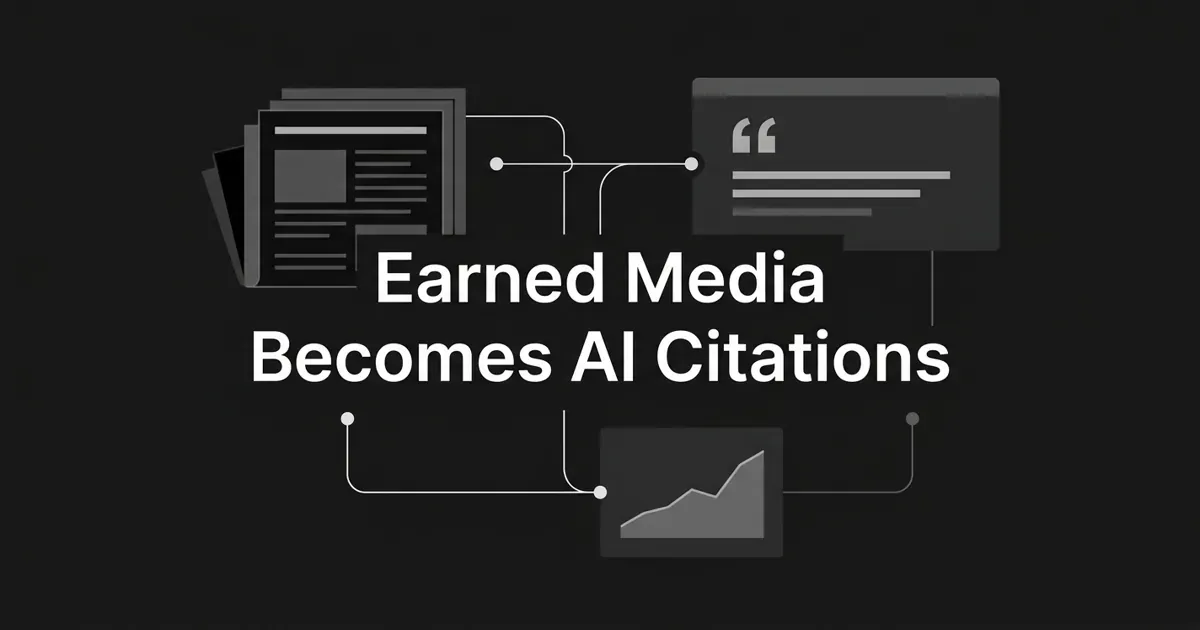
You published the guides. You fixed the schema. And ChatGPT still names a competitor when someone asks about your category. Here is the part nobody warns you about: most of what AI engines cite is not your website at all. Across three editions of the Muck Rack study, earned media accounted for roughly 82 to 89 percent of AI citations, and other analyses put the range as high as 95 percent. That gap is exactly what digital PR AI search work exists to close, and this guide walks you through the whole motion: which prompts to target, which publications to pitch, what to pitch them, and how to tell whether any of it moved.
If that feels like a lot, take a breath. You do not need an agency retainer to start. You need a short prompt list, one real story, and about a quarter of patience.
Start with the mechanic: how a press mention becomes a citation
Before you pitch anyone, you need to know what you are pitching into.
AI engines answer in two modes. In parametric mode, the model answers from training data and shows no live sources. In retrieval mode, it pulls live pages and attributes them. Retrieval mode is where your coverage gets found and reused, and a typical answer synthesizes three to seven distinct sources.
Each engine has its own taste. Google AI Overviews lean hard on pages that already rank, with about 76 percent of citations coming from the top 10 and roughly 86 percent from somewhere in the top 100. Perplexity draws from a narrower pool, with close to half its citations coming from Reddit. ChatGPT skews toward Wikipedia and Reddit, which together account for more than a quarter of its US citations, and here is the surprise: WSJ, NYT, and Bloomberg do not appear in its top 20 most-cited sources.
So what does get chosen? Authority signals help. Around 96 percent of AI Overview citations come from sources with strong E-E-A-T signals. But raw domain authority is not the lever people assume. In one analysis it explained only about 3 percent of the variance in citation probability. Topical match predicts far more.
One more thing worth knowing before you spend a dollar. Press releases account for under 2 percent of AI citations. Only about 0.3 percent of releases get cited by ChatGPT or Claude, and editorial content beats syndicated wire content by something like 30 to 1. The press coverage AI answers actually reach for is editorial, not promotional. It comes from a journalist writing about you, not from a distribution invoice.
That is the whole reason PR for AEO looks different from PR for awareness. You are not buying reach. You are placing a durable, quotable fact inside a document a machine will read six months from now.
Step 1: Map the prompts you actually need to win
Start with questions, not publications.
Build a prompt universe: the real questions your buyers type into AI engines. Pull them from sales call transcripts, support tickets, Search Console queries, People Also Ask boxes, and the prompts where competitors already show up. Write them the way a human would ask, not the way a keyword tool would phrase them.
Then sort each one by funnel stage and persona. Awareness prompts ("what is X"), consideration prompts ("how do teams handle X"), decision prompts ("best tool for X"). Twenty to forty prompts is plenty for a first pass. You can always add more once you see which ones matter.
How to tell it is done: every prompt on your list is a full question a real buyer would ask, and you can name which persona asks it.
Where people go wrong: stuffing your brand name into the prompts. Branded prompts feel great and teach you nothing. The prompts that decide your growth are the ones where nobody has heard of you yet.
Step 2: Audit who gets cited today, before you pitch anyone
You cannot target publications you have not measured.
Take your prompt list and run every prompt across the engines your buyers use: ChatGPT, Gemini, Perplexity, Claude, and Google AI Mode. For each one, record four things. Is your brand mentioned? Is a page of yours cited as a source? Which URLs did the engine cite instead? Which competitors showed up?
That gives you a baseline: mention rate, citation rate, and share of voice. Those three numbers are your before picture, and without them, every claim about improvement later is a guess.
Doing this by hand once is educational. Doing it by hand every month is a job nobody wants. This is one of the two or three places in this process where tooling genuinely earns its keep. DeepSmith runs your tracked prompts across ChatGPT, Gemini, Perplexity, Claude, and Google AI Mode on a schedule and reports mention rate, citation rate, and share of voice, plus which exact pages get cited and which competitors win the prompts you are missing. That last view is what turns a vague sense of losing into a target list.
How to tell it is done: you have a table with one row per prompt and a column for every engine, and you can point to the ten prompts where a competitor is cited and you are absent.
Where people go wrong: running each prompt once and treating the answer as fixed. Answers shift. Spot-check your top prompts weekly and do the full sweep monthly, or you will chase noise.
Step 3: Build a tiered target list from the citations you found
Here is the shift that makes digital PR AI search work different from classic media relations. You are not starting from a generic media list. You are starting from the domains that actually appeared in your own audit.
Open your audit table and list every domain the engines cited for your gap prompts. That list is your real target list. Then sort it into three tiers.
Tier 1 is the outlets cited broadly across engines and topics: Reuters, the Associated Press, Forbes, the Financial Times, Time, Axios, and the major publisher networks. High effort, high durability.
Tier 2 is the vertical press your category lives in. TechCrunch, Wired, and The Verge for tech. Harvard Business Review for business. Healthline, WebMD, and Mayo Clinic for health. NerdWallet, Investopedia, and Bankrate for finance. These are often easier to land and, because topical match beats raw authority, frequently more citable for your specific prompts.
Tier 3 is the niche layer: industry associations, trade publications your buyers actually read, and high-authority specialist blogs.
One nearby play is worth separating out. Getting listed in third-party best-of roundups is its own motion with its own tactics, and it rarely responds to a media pitch. Run it as a parallel track, not as part of this one.
Weight the effort by where your buyers ask. A placement that shows up in ChatGPT carries roughly 4.5 times the answer influence of a comparable Perplexity placement, so if ChatGPT is where your category gets researched, prioritize the outlets that surfaced there.
Pro tip: for each target outlet, name the specific journalist and read their last five pieces before you write a word. Publications do not accept pitches. People do.
How to tell it is done: every gap prompt maps to three to five named outlets, and every outlet has a named reporter with recent, relevant coverage.
Where people go wrong: chasing Tier 1 exclusively. A trade publication that owns your topic will get cited for your prompts more reliably than a national outlet that mentions you once in a roundup.
Step 4: Build the two assets journalists will actually use
You have a target list. Now you need something worth their inbox.
Two assets produce most earned media AI citations: a data story and a commentary bank. Build both.
Build one original data story
Data-driven pitches get roughly three to five times the pickup of generic commentary pitches, and original research creates newsworthiness even in categories nobody calls exciting.
You have four honest ways to make one:
- An original survey of your market or ICP, with at least 500 respondents for reliability
- Proprietary behavioral data from your own product, anonymized and aggregated
- A meta-analysis that combines public datasets under a new frame
- A time-series comparison that shows a real market shift
Then avoid the four things that kill credibility: surveying only your own customers, publishing without a methodology section, releasing data with no news hook, and leading with percentages drawn from samples under 200.
Build a commentary bank
Spokesperson-led campaigns get cited two to three times more often than product PR for AI Overview pickup. Quoted expertise reads as a trust signal in a way that a product announcement never will.
So prepare in advance. Stand up a spokesperson page with a bio, headshot, topic list, and contact details. Write five prepared commentary angles on the debates in your category. When news breaks, you want to respond inside 60 to 120 minutes, and you cannot draft a position in that window from a standing start.
How to tell it is done: one data story is in production with a written methodology, your spokesperson page is live, and five commentary angles are drafted and waiting.
Where people go wrong: treating the wire as the story. Distribution is not coverage, and the citation data is blunt about it.
Step 5: Pitch like a source, not a brand
This is the step people dread. It is also the one where a small team can beat a big one, because responsiveness matters more than budget.
Start with journalist query platforms, where reporters come to you. Featured.com offers a free tier with three pitches a month, with paid plans at $99.99 and $149.99 a month. Qwoted has a free tier with two pitches a month and a Pro plan at $149 a month for 35 pitches. SourceBottle is strong in UK and Australian markets. If you remember HARO, it closed under Cision in December 2024, became Connectively, and was sold to Featured.com in April 2025, so the name lives on in a different shape.
These platforms are the fastest way to get quoted in AI answers, because a quote inside a journalist's article is exactly the kind of third-party editorial content engines reach for.
Then pitch directly. The format that works is boring and strict:
- Subject line under 60 characters
- Body under 300 words
- One clear ask, not three
- A first line that references their recent coverage specifically
- One follow-up after four to seven days, then stop
If you need a media database, they exist at every budget. JustReachOut runs around $84 a month billed annually. Prezly starts near $199 a month. Prowly runs roughly $239 to $469 a month. Meltwater starts around $4,500 a year for media relations. Cision is quote-based and priced for enterprise comms teams. Start at the bottom of that list, not the top.
How to tell it is done: you are sending ten personalized pitches a week and logging every one with the outlet, journalist, angle, and date.
Where people go wrong: mass-pitching an identical email to 200 reporters. It burns the list you will need next quarter, and it teaches you nothing about which angles land.
Step 6: Make each placement easy for an engine to reuse
Coverage landed. Congratulations, genuinely. Now make sure the machines can use it.
You do not control the publisher's page, so focus on what you do control. Give journalists a consistent description of your company so every article describes you the same way, because entity consistency is what lets an engine connect five separate mentions to one brand. Provide a clean, quotable fact rather than a paragraph of positioning, since crisp statements get lifted and marketing prose does not.
Placement inside the article matters too. Roughly 55 percent of AI Overview citations come from content sitting in the top 30 percent of a page, so a quote high in the piece is worth more than a mention buried at the bottom.
Then snowball it. One placement makes the next pitch easier. Take the same angle to complementary publications, and share the coverage on your owned channels with proper attribution.
How to tell it is done: every placement is logged with its URL, the quote used, and the prompt it was meant to serve.
Where people go wrong: letting coverage sit. A placement you never build on is a single data point. Extend it into three and you have a pattern, and the press coverage AI answers reuse most is the coverage that shows up in more than one place.
Step 7: Measure citation lift, not clippings
Old PR measured placements. This measures whether the placements changed what the engines say.
Track six primary numbers:
- Mention rate: the share of tracked prompts where your brand is named
- Citation rate: the share where one of your URLs is linked as a source
- Share of voice: your mentions against competitors across the same prompts
- Citation source diversity: how many distinct publications cite you
- Citation velocity: new citations earned per month
- Citation quality: how relevant and authoritative the citing pages are
Behind those, watch the secondary signals: brand search lift around coverage moments, direct traffic to cited URLs, inbound link growth, and conversions from AI-referred traffic.
Set a cadence and hold it. Weekly, spot-check your top ten prompts across engines. Monthly, re-run the full prompt universe and report share of voice. Quarterly, benchmark against competitors and review which publication tiers actually produced citations.
This is the second place tooling does real work. DeepSmith tracks mention rate, citation rate, and share of voice across ChatGPT, Gemini, Perplexity, Claude, and Google AI Mode, with a page-level view of which pages earn your citations and a competitor view of who wins the prompts you lose. It will not make an engine cite you, and no platform can promise that. It will tell you the truth about whether the coverage moved anything, which is the question your CFO is going to ask.
How to tell it is done: you can compare this month's mention rate, citation rate, and share of voice against your Step 2 baseline and name what changed.
Where people go wrong: judging the program in week two. Crawling, indexing, and model refresh cycles all lag. Give it a quarter before you decide.
Step 8: Scale what earns citations, retire what does not
Now you get to be ruthless, kindly.
After a quarter you will see patterns. Certain publication tiers produce earned media AI citations and certain ones never do. Certain formats, usually original data and named expert commentary, get pulled into answers repeatedly. Certain angles get polite passes every time.
Double down on the first group. Retire the second. Then expand outward: take the format that worked to adjacent publications, and add the next twenty prompts to your tracked set.
One habit is worth building here. Whenever a data story lands coverage, publish your own citation-ready version on your site: the full methodology, a clear data table, and a definition of the finding near the top. The coverage earns the third-party trust signal, and your page becomes the primary source both journalists and engines can reach for. That combination compounds in a way neither half does alone.
How to tell it is done: you can name the two formats and the two publication tiers that produced the most citations last quarter, and your next quarter's plan reflects that.
Where people go wrong: scaling volume instead of scaling what worked. Twice as many mediocre pitches will not double your citations. One repeatable format will.
What to do next
Do not build the whole program this month. Pick five prompts where a competitor is cited and you are not. Run them across the engines and write down the baseline. Pull the cited domains into a target list. Pitch one data story or one expert angle to five of them.
That is a complete, small version of PR for AEO. Everything after it is repetition at higher volume.
If you only change one thing this quarter, make it this: stop measuring PR in clippings and start measuring it in citations. The channel is the same. The scoreboard is not.
Want to see which prompts you are losing and which sources AI engines cite instead, before you spend a quarter pitching? Start a free DeepSmith trial and get your baseline first.