If you run content for an agency, you have probably had this conversation with a client: they want an ABM program, and somewhere in the kickoff deck is a slide that says "personalized content for every segment." Nobody defines what that means, and a few weeks later someone is asking for twelve near-identical industry pages that all say the same thing with a different logo swapped in. A real abm content strategy is not about writing more pages. It is about deciding, segment by segment, whether the personalized content b2b accounts actually need is worth building, and building only the parts that earn it. By the end of this guide you will have a repeatable way to make that call for any client, plus a small register you can keep updating instead of starting from scratch on the next account.
Content personalization is a planning decision here, not a technology one. It does not cover the tools that swap content on a page at runtime, CMS setup, or personalized email and ad variants. It is about what to personalize, for whom, and how many versions are worth maintaining once you have made that call.
Define the accounts and the decision you are trying to improve
Before you write anything, agree with the client and their sales team on the actual target-account list, the ideal customer profile, the account tiers, and which decision the content needs to support. Write down what evidence you already have for grouping accounts: industry, company size, any operational traits that matter, how engaged each account already is, objections that keep coming up, and the questions accounts are currently asking. Keep account tiering separate from what you write, and pull up Demandbase's account-tiering guidance if you want a starting checklist for that piece. A tier is a resource-allocation call about which accounts get more attention, and it helps to be clear on the persona vs audience segment distinction before you assign either one to a piece of content. A tier is not, by itself, a content segment.
How to tell it is done: every group you propose has a membership rule anyone could apply, a buying need that is recognizable rather than assumed, an owner on the client side who can confirm it is real, and a stated reason it might deserve different content from the rest of the plan. You should be able to explain the same framework to a different client next month without dragging this client's facts along with it.
Where people go wrong: treating every firmographic field as a content segment. A 200-person company and a 2,000-person company might be asking the exact same question. Two companies the same size might face completely different approval processes or integration constraints. This is one of the common buyer persona mistakes that also shows up in segmentation work: a firmographic field gets treated as proof of a different need. Company size alone does not tell you that, so do not let a tier decide the number of pages before you have checked.
Map buyer questions before mapping variants
Build a short inventory before you touch personalization at all: for every asset that exists or is planned, write the main question it answers, the buying stage it targets, the product or use case involved, who reads it, the evidence its answer needs, and who owns it. This is where segment-based content earns its name, because you are mapping questions to segments, not segments to pages, and every segment-based content decision after this step traces back to something in this inventory. An awareness asset might explain a problem the reader has not fully named yet. A consideration asset might compare approaches. A decision asset might help someone evaluate fit or defend the purchase internally, and if you have not done this before it helps to map buyer stages to the questions an account is actually asking at each one. Not every buyer moves through these in a straight line, so treat this as a planning aid, not a rule about how people actually behave.
How to tell it is done: every variant you are about to propose traces back to a specific question that one group asks differently from another. If you already have a backlog for this client, it is worth the hour it takes to audit the content inventory before you plan anything new, since the inventory should also surface gaps, questions nobody is answering yet, and material you can reuse instead of rewriting.
Where people go wrong: starting with a request for three industry pages before checking whether those three industries actually need different answers. A related mistake is mixing a general explainer, a product comparison, and a procurement justification together and calling them equivalent variants of the same asset, when they are really three different jobs. Gartner's research on scaling ABM personalization flags the same pattern: pilot-level personalization is easy to maintain, and it is scaling that personalization past a handful of accounts that breaks most teams' process, which is exactly why the modular approach in this guide matters more than the first variant you ship.
DeepSmith's AI Visibility can track the buyer prompts you choose and show you the answer history for each one, including who gets mentioned, who gets cited, and which pages are winning those citations. You can also segment AI visibility by buyer stage to see which stage a client is weakest in before you plan the next asset. Content Map shows what a client (or their competitors) already has coverage on. Both are useful for picking which questions matter and for auditing what already exists. Neither one decides your ABM segments for you, and a tracked prompt is not the same thing as a measured intent signal for one named account.

Choose the smallest useful segment axis
Most personalization plans die from combining too many dimensions at once. Compare the likely axes on their own before you combine any of them:
| Axis | Consider a real variant when | Keep one shared version when |
|---|---|---|
| Industry | Workflows, regulations, terminology, or evaluation criteria genuinely differ and you can back that up | Only the industry name or an opening anecdote would change |
| Company size or complexity | Approval process, available resources, or the economic case actually change | Employee count is the only fact you have |
| Buying stage | The reader needs a different kind of help, like defining a problem versus comparing options | Both readers still need the same explanation and the same evidence |
Use case and the role of the person reading are worth checking too, but treat them as filters, not automatic new categories on top of the ones above. Rank whatever you are considering by how many accounts it covers, how confident you are that their questions really differ, whether there is already a coverage gap there, and how much it will cost you to write and maintain an honest answer for it.
How to tell it is done: the team can name one primary axis to test first, and can explain in plain terms why the other axes stay as context rather than becoming their own page family.
Where people go wrong: multiplying every available field. Three industries times three sizes times three stages gives you 27 theoretical combinations before anyone has confirmed a single one needs its own page. That math is a warning about maintenance, not a plan to execute.
Pro tip: treat any combination of two axes as an exception that needs its own evidence. An enterprise healthcare page at the decision stage only earns its own treatment if that specific combination raises a question the healthcare material and the enterprise material do not already answer between them.
Decide which parts of each asset should actually change
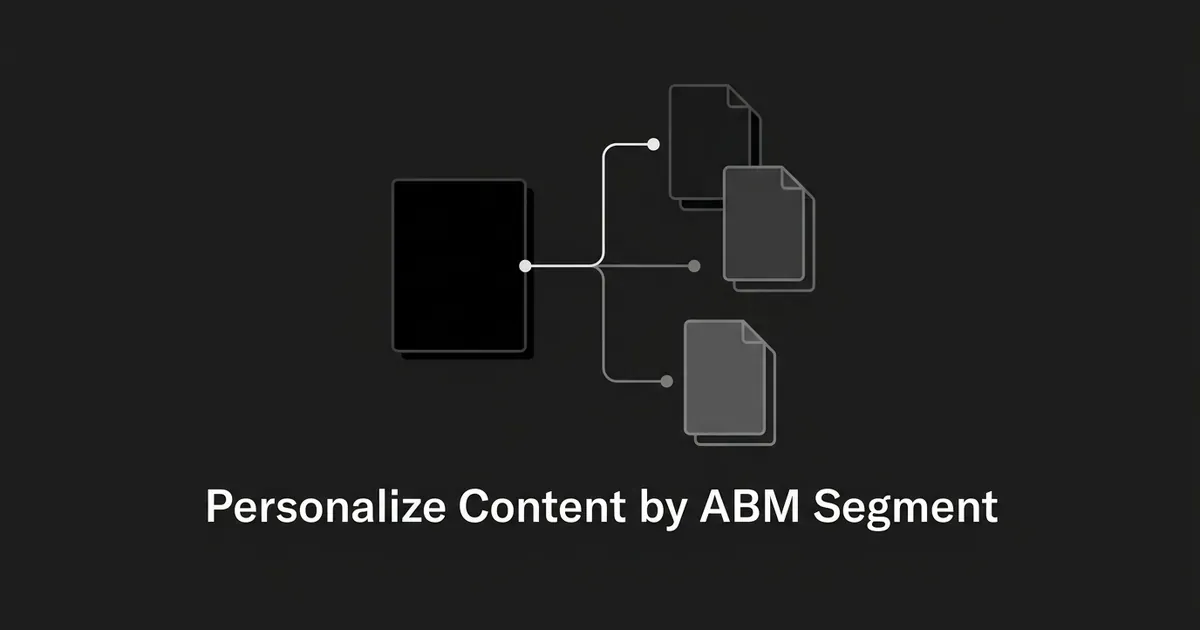
Once you have a segment worth testing, mark the asset at the level of its parts, not the whole page. Keep the shared explanation of the problem and the solution wherever it is still true for everyone. Flag only the pieces that genuinely need different examples, different proof, different objections handled, different evaluation criteria, or a different next question. For each proposed change, ask four things: does it make the answer more accurate, will this reader actually notice the difference, can you back it with a fact you can verify, and is the improvement worth the ongoing work of keeping it current.
How to tell it is done: the brief clearly labels what is shared, what is segment-specific, and what still needs a source before it can be published. A writer should be able to produce one honest base article without recreating almost the same piece for every group.
Where people go wrong: cosmetic substitution, where an industry name gets swapped into an otherwise identical article. The opposite mistake is just as common: rewriting universal definitions for every single variant, which creates more maintenance and, eventually, inconsistent claims about the same thing.
This is also where Deep IQ earns its place if you are using DeepSmith, because it holds each client's product facts, persona detail, and voice separately, which is the same problem you are solving when you try to keep multiple client brand voices consistent while editing AI drafts. A draft for one account comes out grounded in that account's real context instead of leaking another client's positioning into it. Content Studio can take an approved brief the rest of the way to a draft. Neither tool decides whether a sector-specific claim is actually true, or whether a segment has earned a separate page. That judgment stays with you.
Set a variant budget and a page-creation gate
Create one variant register per client with these columns: the base asset, the segment and its inclusion rule, the buyer question, what facts or sections need to be different, who owns the evidence, who owns the edit, where it lives, when it gets reviewed, its current status, and the reason (if any) it needed a separate page instead of staying part of the base asset.
Before you commission another public page, make the team answer one question out loud: what would someone in this segment find here that the shared page cannot already give them? If the honest answer is a changed heading, keep the one page. If the segment is genuinely facing a different question that deserves a complete answer of its own, a separate asset is worth the investment.
This is the part of an abm content strategy that most teams skip, because a content personalization register feels like overhead until the second or third client asks the same question about a segment you already solved. A reasonable starting point, not a rule to defend, is one shared asset plus one or two evidence-backed variants on a topic that already matters to the client. Look hard at how that pilot actually performs before adding more. Zero variants is a perfectly fine outcome for a given topic. The right number depends on what the segment actually needs and what your team can realistically maintain, not on a fixed target.
How to tell it is done: every additional page in the plan has a written reason and a named owner, and the team can say in advance what would make them merge it back, update it, or retire it.
Where people go wrong: publishing one page per account, per industry label, or per keyword variation with no distinct answer behind any of them. Google's own guidance on how it clusters near-duplicate pages confirms that it groups pages whose main content is the same or very close together and picks one representative page to show. Ordinary similarity is not an automatic penalty, but publishing many near-identical URLs does not guarantee each one gets its own place in search either, so it is worth treating as a planning caution, not just an SEO afterthought. If the client already leans on a hub-and-spoke structure, the same logic that governs cornerstone content vs pillar pages applies to a segment variant too: only build a new node when it earns its own place in the structure.

Pilot it, review quality, and compare the results
Before scaling a matrix across a client's entire plan, put the base asset and each proposed variant side by side and have a subject-matter reviewer or the client themselves say, honestly, what a reader learns from each one that they would not get from the others. Check every example, every product claim, and any industry-specific language for accuracy. Set a baseline, then track account-level engagement and content consumption alongside sales feedback and how much effort the assets actually took to maintain, comparing similar account groups over similar time windows where you can.
How to tell it is done: reviewers can name the specific, distinct value of each variant you keep, and there is a scheduled point where the team decides to continue, revise, consolidate, or drop it.
Where people go wrong: treating a page view, an AI citation, or a change in an account's buying stage as proof that one article caused a deal to move. Vendor segment performance reporting that shows account cohorts moving between buying stages is useful for watching general movement, not for a controlled test of a single piece of content. Small ABM cohorts, plus everything else sales and marketing are doing at the same time, make that kind of attribution especially shaky, so hold any performance claim loosely.
DeepSmith's AI Visibility can show which pages a client's tracked prompts are actually citing, and how that compares with what competitors are winning. If you are not sure how large that prompt set should be, sizing a prompt portfolio is a separate exercise worth doing before you lean too hard on citation data as a variant signal. Use that to spot unanswered questions or to check whether a variant is getting picked up at all. It is not a substitute for account engagement or pipeline data, and publishing a variant is never a guarantee it gets cited.
Govern the library so the variant count stays intentional
Assign one clear owner to the base asset and to every approved variant. Revisit each one whenever the product changes, new proof shows up, the target-account list shifts, or a common objection changes. This is the same discipline agencies use to govern AI content quality across a whole client roster, just applied to one account's variant set. At a regular planning review with the client, check whether the original distinction between the base asset and each variant still holds, and whether the team can still stand behind every claim in it. Merge variants that have drifted back toward saying the same thing, update the ones whose unique evidence has changed, and retire the ones nobody is using. Log every one of these decisions in the same register you used to approve the asset in the first place.
How to tell it is done: you can explain to the client, at any point, why every variant that is still live exists, and the next strategist who inherits this account can pick up the plan without having to reconstruct the reasoning behind it.
Where people go wrong: counting the number of assets produced as the win, while older segment-specific claims quietly go stale. The other common trap is taking one variant that worked and expanding it into a full matrix without testing whether the other combinations actually need their own version too.
What to do next
Pick one high-value question this client already gets asked, and one segment where you have real evidence the personalized content b2b buyers there actually need is different from the shared answer. Build the base asset and that one variant, run it through the review steps above, and only expand once it has proven both useful and maintainable. That is a far smaller commitment than a twelve-page industry matrix, and it gives you a defensible answer the next time a client asks why an account segment does or does not have its own content.
If you want help running this at agency scale across several client accounts, DeepSmith keeps each client's brand voice, product facts, and tracked prompts separate in one workspace, and Content Studio turns an approved brief into a publish-ready draft so your strategists spend their time on judgment calls like these instead of assembling pages by hand. It is part of the same idea behind a repeatable content engine that scales across clients without adding headcount for every new logo. You can start a free trial and try it against a real client account before committing to anything.