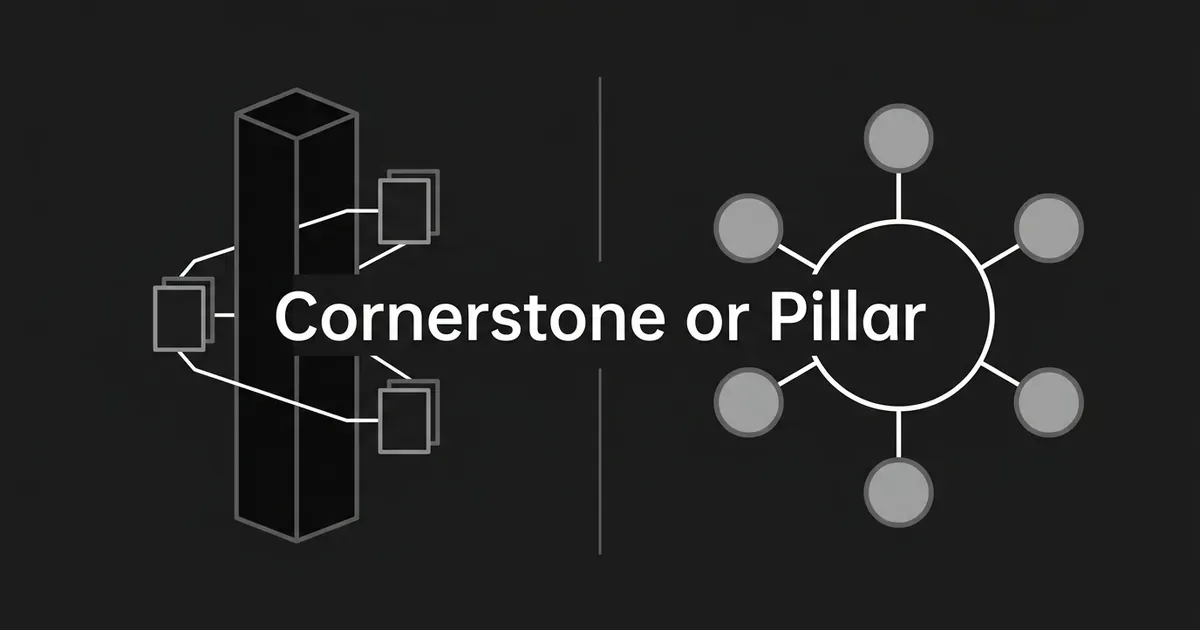
The cornerstone content vs pillar page debate is mostly a vocabulary problem wearing a strategy costume. Both terms describe important, comprehensive pages that other content links to, and a large part of the industry uses them interchangeably. The useful distinction, where one exists, is that cornerstone describes how important a page is to the site, while pillar describes how the page is built and where it sits in the architecture. That framing survives contact with real content programs, because it lets a single page be both. This comparison sets out what each term means, where the two overlap, where they genuinely diverge, and which model fits a given site situation. It also examines what either model does, and does not, do for visibility in AI answers, since that is where a growing share of the traffic argument now sits.
The short answer, before the detail
Framed as a definition, what is cornerstone content comes down to an editorial designation rather than a format. The term names the small set of pages a site treats as its most important, most authoritative assets, the ones the business most wants to rank for and most wants to be known for. The designation says nothing about the page's format. A cornerstone can be a blog post, a guide, or a standard page.
A pillar page is a format and architecture decision. It names a comprehensive, standalone page that covers a broad topic in depth, often positioned as the central page of a topic cluster with narrower spoke pages around it. The label says nothing about whether the business considers the page strategically important, although in practice it usually does.
The two models are therefore answering different questions. Cornerstone asks which pages deserve priority. Pillar asks whether one page should carry a broad topic completely. Teams that treat pillar page vs cornerstone as rival systems tend to spend a planning cycle on a distinction that does not change what they publish.
Cornerstone content vs pillar page at a glance
| Decision lens | Cornerstone content | Pillar page |
|---|---|---|
| What it describes | The pages a site treats as most important | A comprehensive page format and, in some frameworks, the central page in a topic architecture |
| Primary question | Which pages should represent the most important topics | Whether one page should comprehensively answer a broad topic |
| Scope | A page or a post, and usually one of several important assets | Usually one substantial standalone page focused on one broad topic |
| Main role | Strategic priority, authority, and internal-link destination | Complete resource, topical coverage, navigation, and sometimes cluster coordination |
| Relationship to related content | Related articles commonly link back to it | May link out to related resources; in hub-and-spoke usage, spokes link back to it |
| Navigation | May be prominent, but prominence is not inherent in the term | Often given prominent navigation and an in-page table of contents |
| Content system | Can exist without a formal cluster | Often discussed as part of a topic cluster, though it can stand alone |
| AEO relevance | A candidate answer source when it is useful, clear, and trusted | A candidate answer source when comprehensive coverage makes it useful for retrieval |
| Best fit | A site-wide prioritization and governance decision | A page-level format and information-architecture decision |
Neither column contains a ranking factor. The label a team applies to a page changes nothing about how a search engine or an answer engine evaluates it.
What Is Cornerstone Content
The cornerstone content meaning that most sources agree on is straightforward: cornerstone content is the core of a website, the collection of the best, most comprehensive, highest-quality pages the publisher most wants to rank for. The emphasis falls on importance to the business, not on a special page type or a required structure.
That cornerstone content meaning carries a set of traits with it, and the pages that qualify tend to share them. They represent a topic the business wants to be known for. They target an important or competitive subject rather than a narrow long-tail question. They provide a complete resource instead of a thin overview, and they work as an entry point for a reader who is new to the topic. Related articles link back to them, which makes their importance legible in the site structure. They are researched, edited, and then maintained, because a cornerstone that goes stale stops being the site's best answer.
Two clarifications matter more than they appear to. A homepage is not cornerstone content by default, since a homepage carries a brand and navigation role and rarely has the focused topical depth needed to rank for a specific subject. And cornerstone is not a count. A small site may designate three or four; a large site may run several across each of its main categories.
What a pillar page is
A pillar page is a comprehensive, standalone page that covers a broad topic in depth on one page. Its purpose is information delivery: answer the major questions a reader brings to the subject, and keep the page useful enough that the reader does not have to open every related article to understand the topic.
The recurring characteristics are architectural rather than editorial. A pillar page addresses a broad central topic rather than one isolated subquestion. It aims at comprehensiveness, usually carries a hyperlinked table of contents so a long page stays navigable, and links out to related internal pages where the detail lives. It is often placed prominently in site navigation. In topic-cluster usage, it is the central page that more specialized spoke pages attach to.
There is no word count that makes a page a pillar page. Comprehensiveness, organization, and genuine coverage of the subject matter far more than length, and a long page that repeats generic material is not a pillar page in any useful sense. Teams that publish a three-thousand-word threshold as a rule end up padding pages that would have been stronger at half the length.
The hub content model and where the terms collide
The hub content model is the third piece of vocabulary in this conversation, and it is where the confusion concentrates. A topic cluster is a group of pages organized around a central subject. The hub-and-spoke version contains a hub page giving an overview and helping readers navigate, spoke pages covering narrower subtopics in detail, links from the hub to the relevant spokes, and links from the spokes back to the hub.
The problem is that the industry does not agree on which page in that arrangement gets called a pillar. Some sources reserve pillar page for the comprehensive standalone resource and call the navigational center a hub. Others use pillar page for the central hub of the cluster regardless of how much it covers on its own. A third group states plainly that pillar pages are cornerstone content and treats the terms as synonyms.
That inconsistency has a practical consequence. A hub whose main job is navigation and a pillar page that answers the broad topic on one page are not the same reader experience, even when a team calls both of them pillars. A short hub sends the reader onward; a comprehensive pillar tries to satisfy the reader in place. Any team adopting the hub content model should define which of those it is building before it briefs the page, because the two produce different outlines, different lengths, and different internal-link patterns.
Where the two models overlap
Most of what makes a cornerstone page good also makes a pillar page good, which is the strongest evidence that the distinction is narrower than the terminology suggests. Both models favor content that is broad enough to matter to the business and the audience, thorough and accurate, strong enough to serve as an entry point to a subject, supported by sensible internal links, and maintained rather than published once and abandoned. Both are written for readers first rather than padded toward a length target.
Both also support organic visibility by the same mechanism, which is making the relationships among pages easier for readers and search engines to follow. Internal links connect users and crawlers to related pages, provide context, aid discovery, and clarify how pages relate to one another, and descriptive anchor text helps both audiences understand a linked page before they open it. That is a reason to design a coherent structure. It is not evidence that a particular label or link pattern guarantees a ranking.
The overlap is wide enough that a hybrid is often the honest answer. A cornerstone pillar is a page the business treats as strategically central, written as a comprehensive standalone resource, linked naturally with related content, and maintained as a priority asset. Choosing that hybrid avoids forcing a decision between two properties a page can hold at the same time.
Where pillar page vs cornerstone actually diverges
The terms are not identical, and four differences in the pillar page vs cornerstone comparison hold up under scrutiny.
Strategic priority versus page experience. Cornerstone is the stronger term for a conversation about editorial prioritization, because it answers which assets deserve the most attention, the most internal links, the most updating, and the most investment. Pillar is the stronger term for a conversation about the page itself, because it answers whether the reader can get a substantial answer in one place, how that page is organized, and how it relates to the wider topic system.
One-page completeness versus a distributed system. A standalone pillar page attempts to cover the broad topic on the page. A hub page in a cluster may deliberately stay concise and route the reader to specialized spokes. Cornerstone content works in either arrangement, since it may be a self-contained flagship guide or the central destination that accumulates authority from the articles linking to it.
Navigation and conversion. Pillar pages are frequently placed in top-level navigation, organized with a table of contents, and sometimes paired with a lead-generation action or a downloadable companion. That pairing is a practitioner convention rather than part of the definition. Cornerstone content is defined by importance and quality rather than by placement or conversion mechanics, and it can be a blog post, an FAQ, or any other page type.
Breadth and maintenance. Both benefit from depth, and neither has a magic length. Cornerstone programs treat updating as a continuing responsibility, which is the discipline that keeps the designation meaningful. Pillar programs face the opposite risk, which is comprehensiveness turning into a page that is difficult to scan and expensive to keep accurate.
What either model means for AEO
Neither label creates eligibility in AI answers. Google's guidance does not define a special cornerstone or pillar class, states that there are no additional technical requirements or special optimizations for AI Overviews or AI Mode, and requires no dedicated AI text file or schema markup. A page must still be indexed and eligible to appear in ordinary Search with a snippet before it can appear as a supporting link in those features. Google reports AI-feature traffic inside the Search Console Performance report under the Web search type, which is the same place ordinary search performance is reported.
The defensible claim is narrower than the one usually made. A clear, comprehensive, people-first resource may be a good candidate for retrieval when it directly answers a relevant question and meets ordinary quality and accessibility requirements. Answer systems draw on multiple sources and vary their formats, so citation outcomes fluctuate and have to be measured rather than assumed. Publishing a pillar page and waiting for citations is a plan with no feedback loop attached.
Google's people-first tests apply to both models without modification. Is the content primarily useful to an intended audience. Does it add original information, research, analysis, or experience rather than rewriting existing sources. Does it demonstrate relevant expertise. Does the reader leave with a satisfying answer. A page that fails those tests fails them under either label.
For a marketing lead, the operational AEO questions sit one level below the model choice. Which buyer questions are AI engines currently answering in the category. Does the site have a clear, accurate page addressing each of them. Which pages are actually cited and which are ignored. Which competitor pages win citations for the same prompts. Those questions decide which page to build next, and the cornerstone or pillar label decides only how to build it.
Choosing the model for your situation
Choose the cornerstone model when the site already has many articles and the real problem is identifying the few that deserve priority. It fits teams dealing with inconsistent internal linking, diluted authority, or genuine uncertainty about which pages represent core topics. It fits a business that wants a durable set of flagship resources across several categories, tied closely to its positioning and its most competitive subjects. It is the right frame when existing high-value pages need updating and reinforcement more than the team needs a new format, and when the program will be governed through priorities, ownership, and internal-link decisions.
Choose the pillar-page model when a broad topic needs one clear, comprehensive destination and readers would benefit from getting the main answer in one place with optional links to deeper detail. It fits a site that needs a prominent resource with strong navigation and an in-page contents structure, and a team organizing a topic cluster that has to decide which page anchors the central subject. It is the right frame when the page's success depends on being a complete, link-worthy reference rather than on being labeled important.
Choose the hybrid when the page is both a core business topic and a broad reader question, when the site needs one substantial answer supported by specialist pages, and when the team wants the page prioritized for updating and internal links while it also plays a clear hub or pillar role. This is the common case in mature programs, and treating it as a compromise rather than a legitimate design usually costs a planning cycle.
Running either model with DeepSmith
Choosing a model is the easy half. The harder half is knowing which topics deserve a flagship page, which pages AI engines already cite, where competitors are winning answers the team cares about, and how to produce the supporting content without the production cost that a cluster implies. That is where a platform becomes relevant, and it is worth being precise about what it does and does not replace.
DeepSmith is an AI search analytics and content production platform. It does not decide whether a page is a cornerstone or a pillar, and it does not remove the editorial judgment that decision requires. What it connects is the evidence and the execution around it.
On the measurement side, AI Visibility tracks mention rate, citation rate, and share of voice across the tracked engines, with a per-engine breakdown and a competitor leaderboard. The Pages view attributes citations to specific pages on the site, each with its citation count and the tracked prompts driving it, which is the direct answer to whether a flagship page is actually being retrieved. Competitor citations show which rival pages win the prompts that matter and on which exact URLs. Content Map crawls the site and competitor sites into one shared topic taxonomy classified by funnel stage, then surfaces coverage gaps where competitors publish more and untapped topics where the site has nothing at all. Sitemaps are re-checked every 24 hours, so the map does not drift.

On the production side, Opportunity Agents turn that evidence into ideas with the justifying data point attached, including agents for winning a tracked prompt, taking a competitor's citations, and closing awareness, consideration, or decision-stage gaps. Content Studio moves an idea through New Ideas, Planned Content, and Produced Content, with the Writer producing a researched, brand-grounded article carrying internal and external links, a cover image, and publish-ready metadata. Autowrite generates planned articles on their scheduled dates without anyone in the app, which is what makes a cluster of a dozen spoke pages a schedule rather than a quarter of manual work. Deep IQ stores company, product, persona, brand voice, visual, and content-type context so every run is grounded in the brand rather than a generic prompt.

Pricing starts at $99 per month for Pro, which covers 20 articles, 50 tracked prompts, 5 seats, and ChatGPT. Grow is $199 for 40 articles, 100 prompts, and Perplexity alongside ChatGPT. Scale is $399 for 90 articles, 200 prompts, and Gemini as well. Enterprise and Custom plans cover all ten tracked engines with custom limits. Annual billing lowers the effective monthly rate to $80, $160, and $299 respectively, and a 7-day free trial runs before any payment, with no long-term contract.
The honest boundary: Pro tracks ChatGPT only, which is narrower than the ten engines the platform covers at the top tier, and ChatGPT is where most buyer research currently starts, so the entry plan is a real measurement program rather than a token one. A team that needs a one-off definition of these two terms, or that already runs a mature manual editorial operation with reliable visibility reporting, does not need a platform to make this decision. A team that needs a repeatable system connecting AI citation evidence to on-brand output has a clearer reason to evaluate one.
Which should you choose
For teams deciding which existing or planned pages deserve strategic priority across the site, use the cornerstone model. The value is in the prioritization and the maintenance commitment, not in the page format.
For teams building a comprehensive, navigable destination for one broad topic, use the pillar-page model. The value is in the coverage and the architecture, and the cornerstone question can be answered separately.
For most established content programs, use the hybrid. A page that is both the flagship asset for a business-critical topic and the central answer in a topic system is not a confused page. It is the page the model debate has been circling.
Whichever model is chosen, the outcome has to be measured rather than assumed, because neither label earns a ranking or a citation on its own. Teams that want the visibility evidence and the production capacity in one place can start a DeepSmith free trial at https://app.deepsmith.ai/auth/sign-up and see real citation data and real drafts before paying.