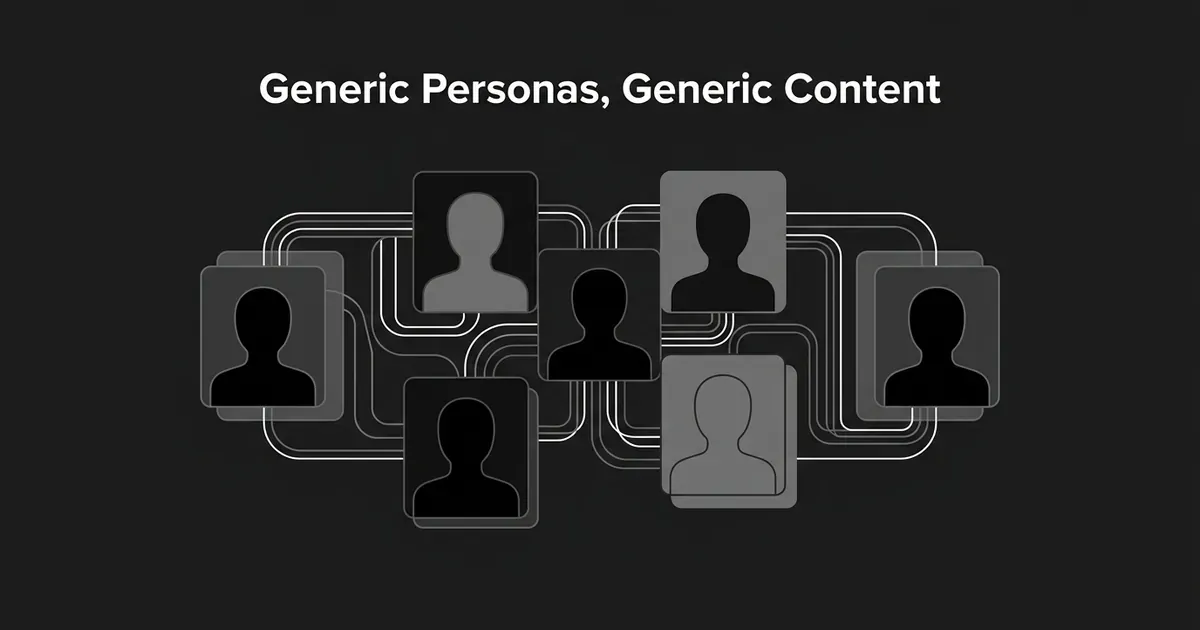
If your team already has buyer personas and your content still reads like everyone else's, the personas are probably not the problem you think they are. A persona document can exist, look thorough, even have a name and a stock photo, and still fail to shape a single editorial decision. That's what causes a generic content persona problem: not the absence of a persona, but a persona that describes a label instead of a decision.
A useful buyer persona is a research based profile of a real audience segment. It goes past age, job title, and company size into the behaviors, motivations, goals, and pain points that actually drive a buying decision. The gap between those two things is where most generic content comes from, and it's usually the same handful of buyer persona mistakes behind it. Below are the persona mistakes content marketing teams run into most often, what each one costs in practice, and the specific move that fixes it.
Treating a job title as a need
The persona is named "Marketing Mary" or "Director Dan," and the description stops at department, seniority, and a list of assumed responsibilities. That's a classification, not an explanation. A job title tells you where someone sits in an org chart. It does not tell you why they're researching a problem right now, what changed for them, or what would make them trust one option over another.
The same title can mean different things at different companies. A person with the title "Marketing Director" at one company might carry the same authority and the same headaches as a VP of Marketing somewhere else. And a title-based persona misses everyone outside the named department who still influences the purchase. An "HR buyer" persona, for example, can miss the marketing manager who wants better holiday tracking, the customer service leader worried about employee behavior, or the founder trying to fix the company's overall people operation.
When writers only have a title to work from, content defaults to department-level language and familiar industry generalities. It might reach the right audience and still miss the actual trigger, business consequence, or objection that would make the piece feel specific to them.
The fix is to replace the title-first description with the job to be done: the trigger event that started the search, the decision criteria, the risks the buyer is weighing, and the proof they need before they'll move forward. A challenge based persona does more work than a function based label.
Describing the person instead of the buyer's decision
Some persona documents are full of detail and still useless, because the detail is about the person rather than the purchase. The team spends time on age, hobbies, stock photography, and personality labels, and leaves the actual buying process vague: how this person evaluates options, what they compare, what they'd need to justify the decision internally.
Content is supposed to influence behavior. If the persona doesn't explain how the buyer weighs alternatives or what would change their mind, a writer has nothing decision specific to work with and fills the gap with advice that would apply to almost anyone. The article might be technically relevant to the right reader and still be interchangeable with a competitor's article on the same topic, because neither one reflects that reader's actual decision context.
Demographics can stay in the document as supporting context. They shouldn't be the main input. What belongs at the center are the buyer's attitudes, decision criteria, the trade-offs they perceive, the objections they'd raise, and the evidence that would change their mind.
Inventing the persona in a conference room
A lot of personas start the same way: a few people in a room brainstorm a plausible customer, give them a name, and build a slide around it. Research gets promised for later and never happens, because the slide already feels finished.
The problem with this approach is that internal assumptions are usually familiar, safe, and incomplete. They reproduce what the company already believes about its audience rather than revealing the language customers actually use, the event that started their search, the alternatives they looked at, or the reason they hesitated before buying. Writers end up with guidance that's polished but empty: they know who the company thinks the audience is, not what the audience actually says or does.
This isn't an argument that every article needs its own research project. It's an argument that a persona built entirely from internal agreement can't be treated as settled fact just because several people signed off on it. The underlying profile should be informed by real conversations, market research, surveys, or behavioral data, and that research should include people who chose a competitor as well as people who chose you. A persona built without any of that is a hypothesis wearing the costume of a fact.
Relying on one department for the whole picture
Sometimes the persona gets built by asking a single team: marketing asks sales, product asks customer success, or one manager supplies the whole customer picture from memory. Other times the research itself is convenient rather than representative, recruiting friends, colleagues, or whoever was easiest to reach instead of real prospects.
No single team sees the entire customer journey. Sales tends to understand late-stage objections well. Product understands what the product actually does. Customer success sees adoption problems after the sale. None of them necessarily knows how a buyer first recognized the problem, what words they used to describe it, or which alternatives they rejected before landing on yours.
When the persona overweights one stage or one department's view, content gets good at answering one narrow question and misses everything else: the discovery trigger, the comparison criteria, the implementation worries, what happens after the purchase. The fix is to treat sales, product, customer success, analytics, and direct customer interviews as complementary evidence, each covering a piece the others miss, and to be careful when the people you're learning from aren't actually representative of who you're trying to reach.
Using one persona for an entire buying committee
A complex B2B purchase often gets represented by a single "decision maker" persona, usually built around whoever has the most senior title or whoever marketing can most easily reach. That's a convenient simplification, and it costs more than it saves.
Complex purchases are usually negotiated by a group, not decided by one person alone. Different stakeholders carry different definitions of risk. A senior executive might care about growth and time to value. IT might care about integration, security, and ongoing maintenance. HR might care about adoption and training. Finance might care about total cost of ownership and how quickly the investment pays off. Research on complex B2B buying groups has put the number of people involved at close to seven, though that figure should be read as a reported benchmark rather than a rule for every deal, and it applies most to complex B2B purchases rather than simple or consumer ones.
When content only speaks to one of those roles, it can win over a champion and still leave that champion without the material to convince finance, IT, or legal. Marketing sometimes reads the resulting stall as a traffic or SEO problem, when the real issue is that the buying group never got the coverage it needed. A meaningful share of forecasted deals end with no decision at all, and unresolved buying group dynamics are part of why, though persona gaps alone don't explain every stalled deal.
The fix is to distinguish personas by role, influence, and concern only where those differences actually change what the content needs to say, and to write some of that content so stakeholders can use it to explain the decision to each other. Not every purchase needs this. A simple, low-risk purchase with one dominant decision maker may not need a full buying-group model at all. The mistake is using one persona for a purchase whose stakeholders have materially different concerns.
Creating too many personas
The opposite failure is just as common. Every job title, industry, company size, and geography gets its own persona, until the team is maintaining dozens of documents that all say something close to the same thing.
Over-segmentation feels like precision, but when the distinctions between personas aren't meaningful, the team ends up writing thin variations of the same message under different labels. The content calendar fragments. Writers can't tell which audience actually matters for a given piece, and every article gets stretched to accommodate too many hypothetical readers at once. One practitioner recommendation puts a practical ceiling around six audience segments, often fewer, not as a hard research finding but as a useful check against segmenting yourself into paralysis.
The fix is to merge personas that share the same trigger, problem, decision criteria, objections, and information needs, and to keep them separate only where those differences genuinely change the content's claim, proof, structure, or call to action.
Filling the persona with irrelevant personal detail
Some persona documents are rich in exactly the wrong kind of detail: stock photography, hobbies, invented biographical color, lifestyle assumptions. They're thin on the business context that would actually help a writer.
Personal detail can create a feeling of empathy without creating any useful editorial direction. A writer might know the persona has a dog and still have no idea what caused them to start searching, what's blocking them internally, or how they judge one option against another. The document feels vivid and still doesn't tell the writer what to say.
Personal information is worth keeping only when it changes the buying situation, the way this person prefers to communicate, or some other relevant context. Everything else should give way to language, behavior, motivation, pain, desired outcome, and proof, which is what actually shapes an article's angle.
Building the persona and then never using it
A persona can be well researched, decision focused, and still fail, if it sits in a PDF or a shared drive that writers never open. This is one of the more common failures because it's invisible: the company can point to a real document and still produce content that ignores it.
A persona that doesn't influence briefs, headlines, examples, claims, or objections handled isn't really part of the content system. It's reference material with no operational effect. When that happens, every writer effectively starts from a blank page. The company pays once to build the persona and then keeps paying, article after article, to rediscover the same audience context from scratch, and quality drifts depending on which writer happens to be working that week.
The fix is to make the persona part of how editorial decisions actually get made: choosing the reader's problem, the angle, the examples, the objections to address, the proof to use, the next question to answer. If the document is too long for anyone to actually reference while writing, the answer is to condense it to the decision relevant parts, not to add more detail on top.
Never revisiting the persona
The last mistake is treating the persona as a permanent artifact, even after the product, market, pricing, audience, or competitive landscape has changed around it. A persona that was accurate two years ago can describe a company's audience today in ways that are subtly, then significantly, wrong.
A survey of 156 user experience professionals on persona maintenance found real variation in how often teams revisit their personas: close to half updated every one to four years, a smaller group updated quarterly or more, and about a quarter updated after five years or never at all. The professionals who updated most frequently also rated their personas as having more impact on their work than the group that rarely or never revisited them. That's a perceived impact measure from one professional community, not a controlled study of content performance, but the direction is worth taking seriously: neglect has a cost, even if the exact size of that cost isn't pinned down.
There's no universal review schedule that fits every business. A fast moving market needs more frequent review than a stable one. What matters is revisiting the persona when the business, the product, the audience, or the buying environment changes enough that the old assumptions stop holding, rather than waiting for a fixed date on the calendar.
How these mistakes compound
Generic content is rarely caused by just one of these mistakes. It's usually several working together: a title becomes a stand-in for a whole profile, that profile gets invented internally instead of grounded in real customer evidence, several different buying-group roles get compressed into one average buyer, the resulting document ends up too broad or too fragmented to actually guide anything, and nobody uses it when briefing or reviewing content anyway.
That chain explains something that trips a lot of teams up: a company can honestly say it has buyer personas and still publish content that reads like it was written for no one in particular. The problem was never the existence of the document. It's whether the document contains real decision insight and whether it actually reaches the point where content gets planned and reviewed against it. Most of the persona mistakes content marketing teams make trace back to that same gap between having a document and using one.
This also explains why AI tools can make the problem more visible rather than causing it outright. AI scales whatever context it's given. Feed it a generic persona and the output comes back fluent, well organized, and just as generic as the input. The counterweight isn't avoiding AI. It's giving the writer, human or otherwise, real information about the audience's situation, goals, obstacles, language, and decision criteria, so the content is written for someone specific instead of addressed to a demographic category.
Where to start
Work through these in the order they're most likely to be your actual problem. Start by asking whether the persona explains what the buyer is trying to decide, not just who they are. Then check whether it reflects every stakeholder whose concerns matter for this purchase, whether its claims came from real evidence rather than an internal guess, whether anyone actually references it when planning or reviewing content, and whether it still matches your market as it exists today.
A persona is not a real individual, and it isn't meant to be. It's a summary of recurring patterns in a meaningful audience segment, useful exactly to the degree that it captures a decision instead of a demographic. Left unchecked, the same generic content persona gap just moves further down the funnel. Fixing the prose without fixing the audience model behind it usually just produces a more polished version of the same generic article. A good test for any persona you already have: pick a piece you're about to write and see whether the persona actually changes a real choice in it, the angle, the example, the objection you address, the proof you use. If it doesn't change anything, the document needs work before the next draft does.
If keeping that decision-level detail current across a growing backlog is the actual bottleneck, that's a structured-context problem as much as a research problem. DeepSmith stores persona goals, triggers, and objections as data that every draft in the pipeline pulls from, so the audience context stays specific instead of drifting back toward a title and a stock photo.