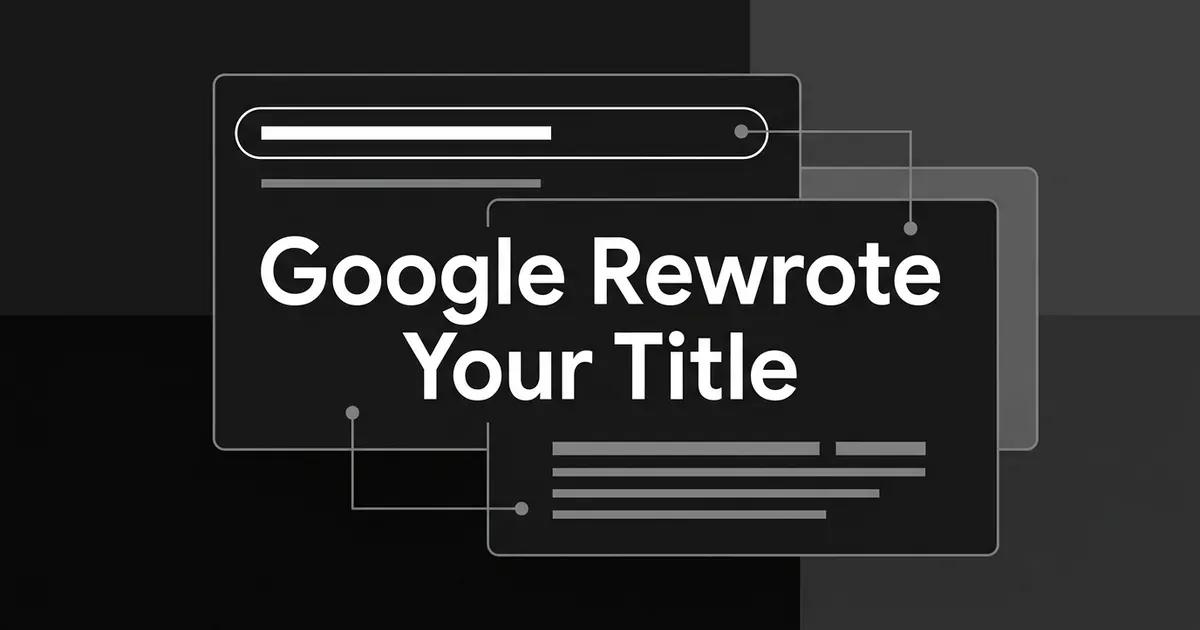
You wrote a title tag, published the page, and then searched for it and saw something else in the result. It can be a different word order, a missing brand name, a heading from the middle of the page, or a title you don't recognize at all. If you have been asking yourself why did google change my title, the short answer is that Google builds the clickable title link automatically, and when your HTML title looks missing, repetitive, outdated, or out of step with the page, it may use other text it finds instead.
The HTML title is still one of the main inputs, so this is not Google ignoring you. Google just doesn't treat it as an order to copy word for word. This piece goes through the documented reasons google rewrites title tags, roughly in the order they are worth checking, and for each one it covers what it looks like, how to confirm it, and what to change. You should be able to tell in a few minutes whether you have a one-page problem or a template problem.
First, check that it is really a rewrite
Before you go looking for causes, make sure you are looking at a title tag rewrite and not something that only resembles one. A few things get mistaken for it all the time.
The HTML title is the text inside the <title> element. The title link is the clickable title Google shows for a result, and it can be different from the HTML title. Your page's big visible headline, usually the <h1>, is a third thing. Google says it generates the title link from the page and from references to it elsewhere on the web. The inputs it lists include the <title>, the main visual title, headings including the <h1>, og:title, large or prominently styled text, other page text, anchor text on the page, text in links pointing to the page, and WebSite structured data. That is a list of possible inputs, not a fixed order.
Three lookalikes to rule out first:
- A shortened title. Google says it can shorten a title link to fit the width of the device. A trailing ellipsis usually means the title was cut to fit, not that Google chose different words.
- A site name change. The site name shown with a result is a separate, site-level element. Google can also leave a site name out of a title link when it is already shown elsewhere in the result.
- A different page. If Google picked another canonical URL for your content, you may be looking at a result for a different page.
Two more things are worth knowing. In its August 2021 update, Google said the updated system generally would not change titles with the query, and "generally" means you may still see differences between queries and devices. Also, a rewrite on its own doesn't tell you a page has a ranking problem, and Google says it can't change a title link for a single site by hand.
How often does this actually happen?
There are two numbers you will see quoted, and they don't measure the same thing. In September 2021, Google said its system used the HTML title element for title links around 87% of the time, up from around 80% after some refinements. Those are dated statements about Google's system, and they don't tell you what share of your own titles will show unchanged today.
The other number comes from a Zyppy study. It compared 80,959 title elements across 2,370 sites, using desktop Google results collected through site: searches in early 2022, and reported that Google rewrote 61.6% of them. Zyppy also points out that many of those changes were small, and that what you see can vary by query and device. The data is from the first quarter of 2022.
It is tempting to average these into one figure, but they come from different years, samples, and ideas of what counts as used or rewritten. What you can safely take from them is that a changed title is normal for a lot of pages, so check the cause page by page.
One more note on order. Neither Google's documentation nor the studies I reviewed give a measured ranking of which causes come up most often. The order below is a practical triage order, starting with problems that are common on templates and quick to check.
Cause 1: Generic, duplicate, or half-empty titles
What it looks like. Several different pages share the same HTML title, like "Home," "Untitled," just the site name, or one category label reused everywhere. Sometimes a template variable didn't fill in and the title reads something like | Site Name. A quieter version is what Google calls micro-boilerplate, where a group of pages share a title even though each one has something that sets it apart.
How to confirm. Put the live page's HTML title and its visible headline next to the title link in Google. Then look at sibling pages built from the same template, since their neighbors often share the problem. A plain crawl or a CMS export will show you repeated and empty title fields faster than anything else. In Google Search Console, URL Inspection lets you check the indexed version of the page, when it was last crawled, and how a live test compares. It shows what Google could reach, not the exact title it shows for every search.
The fix. Fill in the missing field and give each page a descriptive title that sets it apart from the others. Google's own example is a set of three season pages that all use the title "My so-called amazing TV show," where the better title links add "Season 1," "Season 2," and "Season 3." When it affects many URLs, fix the template and then look at a sample of the results, instead of only correcting the first page you happened to notice.
Cause 2: The HTML title and the visible page tell different stories
What it looks like. The result shows your <h1> or some other prominent phrase in place of the HTML title. This often happens when a static title promises things the page doesn't reliably show. Google's example turns "Giant stuffed animals, teddy bears, polar bears - Site Name" into the broader "Stuffed animals - Site Name" when the page doesn't consistently list all of that.
How to confirm. Compare four things: the title link in the result, the current HTML title, the first big heading on the rendered page, and what the page is actually about. If you suspect Google saw a different version of the page than you are looking at, use the indexed information and the live test in URL Inspection. The live test can show a rendered screenshot, and Google's help notes that this screenshot isn't available for the indexed result.
The fix. Make the title describe what a visitor can reliably find on that URL, and make the title and the main heading agree on the subject and the key details. They don't need to match character for character. If a template pulls in changing details like inventory, write wording that stays true when they change, and don't swap a truthful headline for a keyword-stuffed one just to make the strings match.
Cause 3: The title went stale after the page changed
What it looks like. The page's visible headline has a new year, edition, or subject, and the title element still has the old one. Google's illustration is an HTML title of "2020 admissions criteria - University of Awesome" on a page whose headline says "2021 admissions criteria." In that case Google may show "2021 admissions criteria - University of Awesome." Those years are Google's old example, not current information.
How to confirm. Look at the HTML and the visible heading on the same URL. Then check in URL Inspection when Google last crawled it. That separates a page that is really inconsistent from one Google hasn't reprocessed yet.
The fix. Update the title whenever recurring content changes, and make sure it agrees with what the page says now. If the page is already correct, give Google time. It says changes to title sources can take a few days to a few weeks to be reflected. You can ask for a recrawl of a single URL through URL Inspection, but sending the request over and over for the same URL doesn't make the crawl any faster.
If a lot of your titles go stale, that is usually a process gap and not a writing one, and it fits well with a content audit for decaying pages. When you update older posts, refreshing old SEO articles is a natural point to check the title too.
Cause 4: Keyword-heavy, vague, or overextended wording
What it looks like. The title repeats the same keyword, reads like a list of search phrases, doesn't say what the page is, or has so much in it that Google shows a different portion. Google names keyword stuffing, very long titles, missing titles, and repetitive boilerplate as reasons an HTML title may not describe a page well.
How to confirm. Read your HTML title as if it were a promise to a searcher, then compare it with the page and with the result. Check whether words repeat only to catch variations, and whether Google picked a meaningful part of the title instead of just cutting the end off. For an extremely long HTML title, Google has said it may choose a useful portion.
The fix. Say what the page is about, make it clear how it differs from the pages near it, and take out the repetition you don't need. Google recommends descriptive, concise titles and discourages keyword stuffing. No documented character count guarantees that a title stays unchanged, and how long a title should be is its own topic that this piece doesn't try to settle.
Cause 5: The page has competing prominent headings
What it looks like. The page has several headings or big blocks of text that all look equally important, and the result uses one you didn't intend to be the main title. Google lists "no clear main title" as a possible problem, and says it may use the first heading when the prominent candidates have the same styling or level.
How to confirm. Look at the rendered page and not only the HTML source, and ask which heading looks like the title to a visitor. A successful live test in URL Inspection gives you a rendered screenshot and information about the resources that loaded. Then compare the main visual title, the heading order, the HTML title, and the words Google is showing. Our guide to semantic HTML and heading hierarchy covers the markup side.
The fix. Give the page one clear main title, usually the first visible <h1>, and avoid styling unrelated headings so they look like equal alternatives. Keep that main title in line with what the page is about. Heading markup isn't a switch that tells Google to copy a certain phrase, but a page with one obvious title gives Google less reason to look elsewhere.
Cause 6: The brand label is being dropped or changed
What it looks like. The page-specific part of the title stays, but your brand suffix disappears, or Google adds a site name you didn't put there. Google advises keeping branding short in HTML titles, and it notes that it may leave out a site name from a title link when that name is already shown elsewhere in the result.
How to confirm. First work out whether the text that changed is part of the per-page title link or the separate site name display. If the site name itself is wrong, look at the WebSite structured data and other naming signals on your home page instead. Our note on how to keep brand facts consistent across the web covers the wider version of this.
The fix. Keep the useful page-specific words up front and the branding short. Google gives a hyphen, colon, or pipe as possible separators, and none of them is required. For a wrong site name, Google points to WebSite structured data on the home page as an important way to state your preference, and it also looks at og:site_name, home page titles, headings, and other text.
Cause 7: The title's language or writing system doesn't match the page
What it looks like. The HTML title is in a different language or script than the main content, and Google shows wording that fits the content better.
How to confirm. Compare the title element with the prominent body content in the affected language version. Look at the page Google can actually crawl.
The fix. Write the title in the language and writing system the main content uses, and correct the localization template if that is where it went wrong. This is a documented cause, but none of the sources I reviewed say how often it happens, so it sits late in the list.
Cause 8: Google can't get a clear title from the page
What it looks like. The title or the page is missing, malformed, blocked, or not the version you expect, and the result reflects other text it could find, which can include the words used in links pointing to the page.
How to confirm. In URL Inspection, check the indexing status, any crawl problems, the indexed version, the canonical URL Google chose, and the last crawl. Run a live test to see whether Google can reach and render the content.
The fix. Give the page a valid, descriptive title and correct any access or rendering problems you find. One caution from Google is that blocking crawling with robots.txt doesn't necessarily keep a URL out of the index, and when the page content isn't available, anchor text from other places can inform the title. If what you want is to keep a page out of the index, Google points to noindex and not to a title trick. Decide on the page's intended indexability before you remove any crawl block.
When none of these matched
Sometimes you go through all eight and nothing fits. Before you change anything else, record the affected URL, the exact title link you saw, the search and device where you saw it, the current HTML title, the main visual title, and the date of the last edit. Then use URL Inspection to check indexing, canonical selection, crawl status, and whether the live test differs from the indexed version.
Check again that you are not looking at a site name, a clipped title, or a result for a different canonical page. Once you have fixed a genuine issue, request a recrawl for an important URL, wait out the days to weeks Google mentions, and then look at the result again.
If you manage a lot of pages, sample the template or page type that is affected and hand the fix to whoever owns the title field or the heading template. If you build pages from reusable article templates, the title field belongs in that template. That separates a widespread template defect from a one-off editorial difference. The Search Console Performance report can then give you page-level and query-level impressions, clicks, and click-through rate over time. Those numbers give context, but they don't prove a changed title caused any movement. If the wider picture is a traffic dip and you aren't sure the titles are the reason, a step-by-step traffic drop diagnosis can help you sort out what changed.
Keeping your titles intact in practice
No page owner can lock a result to an exact string, so the goal is to make it easy for Google to agree with you. Zyppy's sample found that titles with square brackets were rewritten 77.6% of the time and that pipes were removed or replaced 41.0% of the time. Those are correlations from one sample, and they don't show that brackets or pipes cause a rewrite, so treat them as a reason to look closer and not as a rule.
When Google rewrites title tags across a whole site, the better move is to fix the patterns that misdescribe many pages at once, mainly broken templates and titles that disagree with what readers see on the page. Titles are one of the SEO fundamentals that still matter as search changes. Make the page and its title tell the same accurate story, and then check what Google shows after it has had time to process the change.
Teams that publish at volume can treat titles as part of how each article is produced, so that page-specific metadata is written alongside the content and each page gets its own distinct title. DeepSmith's Writer produces the article and its publish-ready metadata together, grounded in the brand context you store in Deep IQ. It can't decide what title Google displays, and it isn't a way to see why Google picked a particular one. If you want to see how the production side works, you can start a free trial and try it on a few of your own topics.