You opened a tracker, saw a number move, and still did not know what to do next. That is the honest reason most people start hunting for Otterly alternatives.
Take a breath. This is a normal place to be. The AI brand monitoring market is barely two years old, every vendor counts things differently, and half the pricing pages leave out the number you actually need.
So let's make this simple. Below are nine tools, ranked, with what each one publishes about price and coverage. Some are pure monitoring. Some connect monitoring to action. Knowing which kind you need is most of the decision.
One note before we start. This is not a review of Otterly itself. If otterly ai pricing or a missing metric is what sent you looking, you already know your side of the story. What you need now is a fair look at what else is out there.
How we ranked these Otterly alternatives
Criteria first, because a roundup without criteria is just a list of logos. The best Otterly alternatives for you are the ones that fix your bottleneck, not the ones with the longest feature page.
Every tool here was judged on five things:
- Engine breadth. How many named AI engines it checks, and on which plan.
- Measurement depth. Whether it reports mentions, citations, sentiment and share of voice, or only some of those.
- Competitive and source intelligence. Whether you can see who is winning your prompts and which exact pages get cited.
- Action. Whether insight turns into optimization or published content, or stops at a dashboard.
- Price-to-capability fit. What the published price actually buys a marketing team.
One more rule that matters more than it sounds. These tools do not measure in the same unit. Some sell prompts. Some sell AI responses. Some sell credits, checks, audits, projects or page optimizations. A 1,200-credit plan and a 125-prompt plan are not comparable, so every number below carries its unit.
Where a vendor does not publish something, this article says so instead of guessing. "Best" here means best fit for a documented job, not a benchmark result.
Otterly alternatives at a glance
| Rank | Tool | Published entry price | Published coverage or allowance | Strongest fit |
|---|---|---|---|---|
| 1 | DeepSmith | $99/mo Pro | 50 to 200 tracked prompts, 20 to 90 articles/mo by tier | Teams that need measurement connected to production |
| 2 | AthenaHQ | Free Essential, $295/mo Starter | 3,600 credits on Starter, 1 credit equals 1 AI response | Broad multi-engine coverage plus optimization workflows |
| 3 | Knowatoa | $59/mo Starter | Unlimited sites, question allowance not published | Smaller teams needing multilingual, multi-location checks |
| 4 | Scrunch | $250/mo Core | 125 prompts, 5 audits/mo, 4 LLMs | Structured audits and reporting |
| 5 | Profound | $99/mo Starter, billed yearly | 50 prompts, 1,500 responses/mo | Answer-engine analytics and attribution |
| 6 | Peec AI | Starter, Pro, Advanced, Enterprise custom | 1 to 5 projects, 3 models, daily tracking | SEO teams running several projects |
| 7 | Rankscale | $20/mo Essentials, $99/mo Pro | Pro: 1,200 credits, up to 4,800 answers | Agencies needing volume and scheduling |
| 8 | Goodie | $399/mo Explorer | 100 prompts, 3,000 responses, 10 optimization actions/mo | Revenue attribution and closed-loop action |
| 9 | ZipTie | $69/mo Basic | 500 to 2,000 AI Search checks/mo | A simple, low-cost starting point |
Now the detail.
1. DeepSmith
Best for: Content and marketing teams who need AI visibility measurement to feed straight into published, on-brand content.
Here is the gap most monitoring tools leave open. You learn that a competitor owns eight of your ten buying prompts. Then what? Someone still has to write the pages that change the answer, and that someone is usually you.
DeepSmith closes that loop inside one platform. It is AI search analytics and content production together, not a dashboard plus a separate writing tool you glue on later.
What it measures
The AEO area reports mention rate, citation rate, share of voice, sentiment and visibility trend, broken down per platform. You get a competitor leaderboard and the sources AI cites most often for your prompts.
Prompt tracking goes deeper than a score. Every tracked prompt carries its own mention and citation rate over time, plus the full answer history, so you can read what the engine actually said about you. Pages reporting shows which of your URLs get cited, each page's share of your total citations, and the prompts driving them.
Competitor citations show who wins your prompts, on which exact pages, and how each rival performs by engine. That last part is what turns a scary chart into a to-do list.

How it turns that into content
Content Map crawls your site and your competitors' sites into one shared topic and funnel taxonomy. It flags coverage gaps, where a rival publishes more than you, and untapped topics, where they publish and you have nothing. Sitemaps re-check every 24 hours, so new pages fold in on their own.
Opportunity Agents read that data and return ideas with the evidence attached. Take a competitor's citations. Fix how AI describes you. Close a decision-stage gap against four rivals at once. Each idea arrives with the data point that justifies it, which is how you defend a backlog instead of defending a hunch.
Content Studio then moves an idea through New Ideas, Planned Content and Produced Content. The Writer turns a planned idea into a finished article with research, internal and external links, a cover image and publish-ready metadata. Autowrite runs it on a scheduled date with nobody in the app. You can publish straight to WordPress, Webflow, Strapi, Sanity or Contentful, or push to your own webhooks.

Deep IQ is why the output sounds like you. Your positioning, products, personas, brand voice, visual guidelines and content types are stored once as structured context, and every draft runs against them. No re-briefing per article. No invented product claims.
Repurpose and the Apps Library take each finished article into LinkedIn, X, Medium, Substack, newsletter and nurture email, Reddit and more. Distribution stops being the step that falls off.
Pricing
| Plan | Monthly | Annual rate | Articles/mo | Tracked prompts | Seats | Engines |
|---|---|---|---|---|---|---|
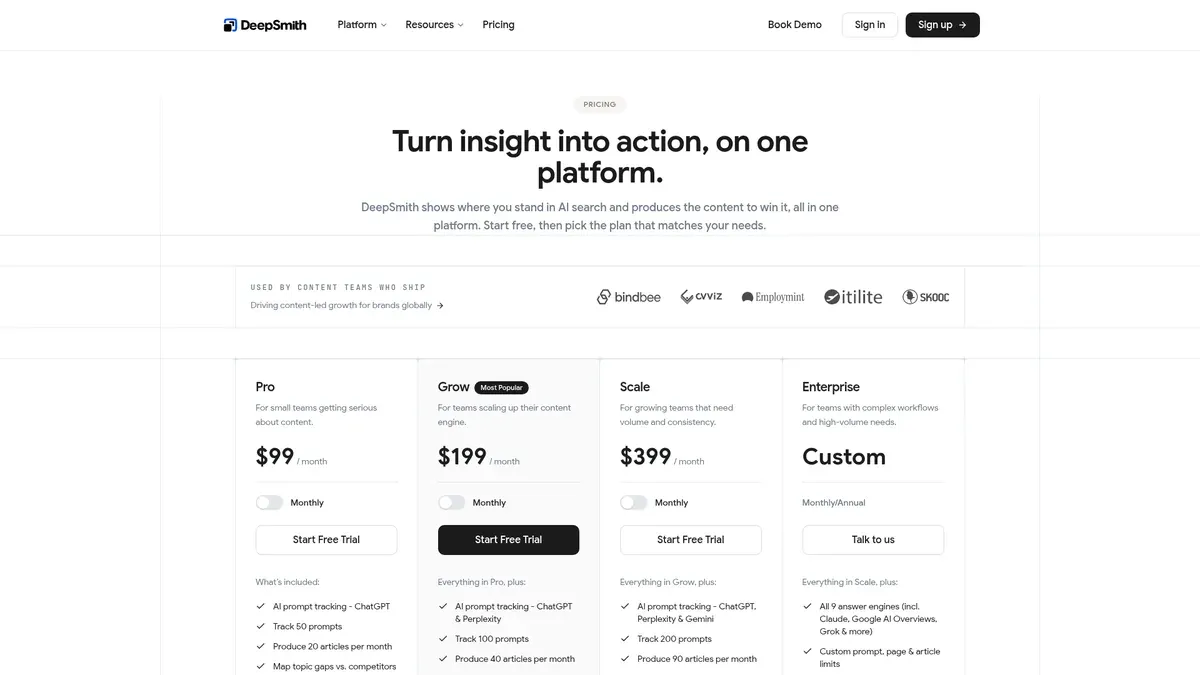
| Pro | $99 | $80 | 20 | 50 | 5 | ChatGPT |
| Grow | $199 | $160 | 40 | 100 | 7 | ChatGPT, Perplexity |
| Scale | $399 | $299 | 90 | 200 | 10 | ChatGPT, Perplexity, Gemini |
| Enterprise | Custom | Custom | Custom | Custom | Custom | All ten engines |
There is a 7-day free trial with real data and real drafts. No long-term contracts, no cancellation fees. Enterprise adds one-to-one onboarding and a dedicated account manager.
Ten engines are covered across the tiers: ChatGPT, Gemini, Perplexity, Claude, Google AI Overviews, Google AI Mode, Grok, Meta AI, Microsoft Copilot and DeepSeek.
One honest limitation
Engine coverage scales with the plan. Pro tracks ChatGPT, Grow adds Perplexity, Scale adds Gemini, and all ten arrive on Enterprise or custom.
If your board is asking about Claude and Meta AI this quarter, that is a real constraint, and the answer is the custom tier rather than a cheaper one. For most marketing teams the honest picture is different. ChatGPT and Perplexity are where the buying questions land first, and starting there for $99 or $199 while your production engine runs at full strength beats paying more for engines you are not acting on yet.
2. AthenaHQ

Best for: Teams that want the widest published engine list plus an optimization workflow attached.
AthenaHQ positions itself as an AEO and GEO platform. Its Starter plan states visibility across ten models: ChatGPT, Perplexity, Google AI Overviews, Google AI Mode, Gemini, Claude, Copilot, Grok, DeepSeek and Meta AI. Extra models can be requested.
Key features
The published list is broad: unlimited topics, prompt-volume estimation, prompt variations with conversation context, unlimited competitor tracking, impersonation and benchmarking, real-time brand sentiment, citation intelligence, content recommendations and a content-optimization agent. Enterprise adds the Athena Recommendation and Citation engines, knowledge-base and claim review, discrepancy detection and persona targeting.
Integrations include Shopify, Webflow, GA4 and Google Search Console, with Tableau, Power BI and Looker on Enterprise. Enterprise support includes a dedicated Slack channel and a stated 2-hour SLA.
Pricing
Essential is free with 300 credits. Starter is $295 per month with 3,600 credits, where one credit equals one AI response. Enterprise is custom. An annual discount is advertised.
Limitation
Share of voice is not explicitly stated on the reviewed pricing page, and the free-trial duration is not published. Broad engine coverage does not automatically mean every metric you want is on your plan, so confirm both before you sign.
3. Knowatoa

Best for: Smaller teams that need several sites, several languages and a low published entry price.
Knowatoa publishes $59 per month for Starter and $199 for Growth, with custom Enterprise. Annual pricing is available and you can cancel anytime. Starter lists ChatGPT, Google AI Overviews and Google AI Mode. Growth and Enterprise state "all 7 services," though the seven are not named on the reviewed page.
Key features
The platform covers competitor visibility gaps, trusted citation sites, brand sentiment alerts, every language and market you track, and a weekly digest of what changed. Brand terms can include products, executives and events, not just the company name. Language and location settings work at account, site and question level.
Reporting connects through API, MCP, Looker Studio and NinjaCat. Support runs on Discord and email.
Limitation
You can track unlimited sites, but they share one question limit and that number is not published. Share of voice is not listed in the reviewed pricing content, and seat limits are not stated either. Knowatoa suits you when the entry price and language coverage matter more than a fully itemized feature matrix.
4. Scrunch

Best for: Teams whose buying trigger is a structured audit and a report someone senior will read.
Key features
Core covers ChatGPT, Perplexity, Google AI Overviews and Copilot, with 125 unique prompts, five site audits a month, one brand workspace and five user licenses. You also get funnel stages, citations and sources, prompt management, a reporting dashboard, sentiment analysis and recommendations, plus AI agent and bot traffic tracking.
Enterprise expands to nine LLMs and adds full query fan-out, multi-domain tracking, advanced API and Query API access, Looker Studio, custom MCP access, SAML and OIDC SSO, executive reporting and a dedicated account team.
Pricing
Core is $250 per month with a 7-day free trial. Enterprise is custom.
Limitation
Core is tightly bounded: one country, two languages, five competitors, a 25-page site map, limited query fan-out and one page optimization per month. API, MCP and Looker Studio are not included. That makes Scrunch a strong auditing and reporting product rather than an open-ended operating system for a large international program.
5. Profound
Best for: Teams and agencies that want response-level analytics and AI traffic attribution.
Key features
Profound analyzes how brands and competitors appear in AI platforms, tracking citations, sentiment, ranking and competitive presence. Agent Analytics follows AI-sourced traffic and attribution across unlimited domains. Integrations include Akamai, AWS, Cloudflare, Fastly, Google Analytics, Google Cloud Platform, Netlify, Vercel and WordPress.
Pricing
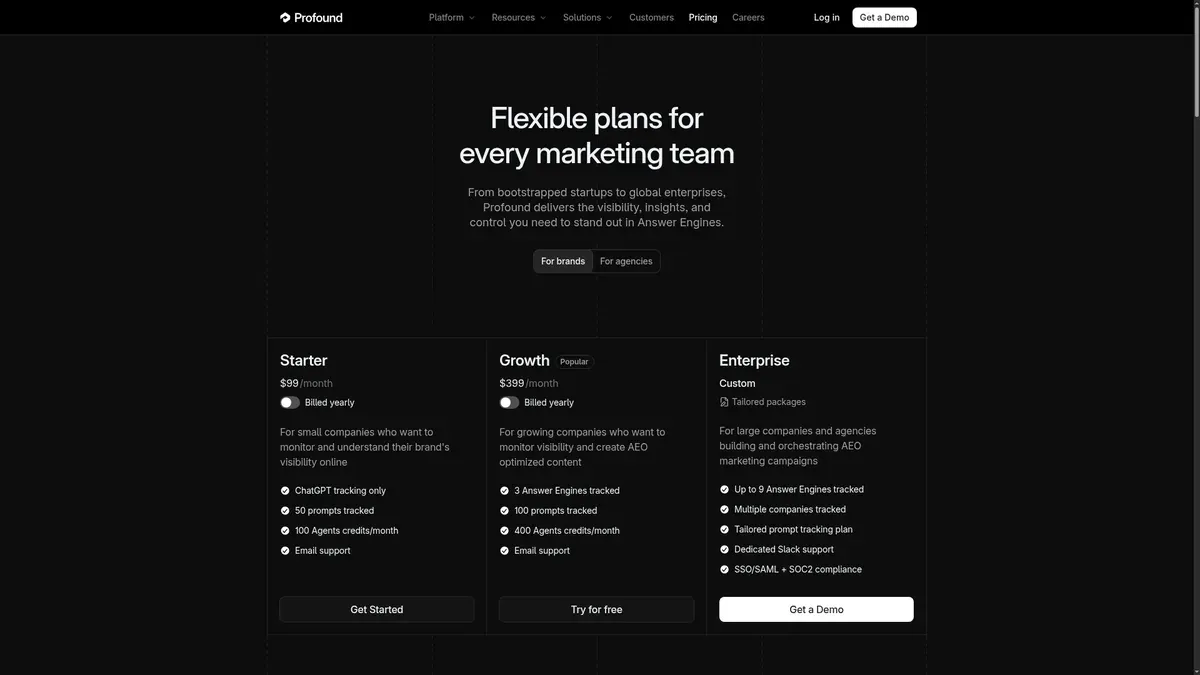
Starter is $99 per month billed yearly: 50 unique prompts, 1,500 responses a month, 100 Agent credits and ChatGPT only, on one seat. Growth is $399 per month billed yearly: 100 prompts, 9,000 responses, 400 Agent credits and three seats, covering ChatGPT, Perplexity and Google AI Overviews. Enterprise is custom and reaches up to ten answer engines. The published pricing shows two months free on yearly billing.
Limitation
Starter is ChatGPT only, which is narrow if you are trying to see several AI surfaces at once. Growth reaches three engines, one language and one region. Content allowances are modest: Growth publishes three generated and three optimized articles a month, and Starter publishes none. Profound is analytics-first, and teams past three people are pointed toward a custom plan.
6. Peec AI

Best for: SEO teams tracking two to five projects with daily refreshes.
Key features
Peec AI lists ChatGPT, Google AI Mode, Google AI Overviews, Microsoft Copilot, Perplexity and Gemini as available models, with three models included and selected during onboarding. Tracking runs daily. Starter covers one project, Pro covers two, and Advanced covers five, with three countries per project on the paid tiers.
AI Shopping, Looker integration, API access, MCP integration and SSO appear as feature fields on the page.
Pricing
Peec AI publishes Starter, Pro and Advanced tiers, with Enterprise custom. The source material reviewed for this article did not capture the self-serve amounts, so read the current numbers straight off the live pricing page rather than a figure quoted second-hand.
Limitation
Plan-by-plan availability is hard to read. The page does not clearly map citations, sentiment, competitors, share of voice, seats, integrations or shopping to each tier. The safe claim is that Peec offers multi-project daily tracking on three selected models. Ask sales to put the rest in writing.
7. Rankscale

Best for: Agencies and high-volume teams that would rather buy credits than prompts.
Key features
Rankscale lists ChatGPT, Gemini, Perplexity, Claude, DeepSeek, Mistral, Grok, Copilot and more. Features include visibility tracking, competitor benchmarking, citation analysis, sentiment analysis, custom dashboards, prompt research, query fan-out, shopping analysis and Scout recommendations. Exports run to CSV, Google Sheets and Looker Studio. Growth adds white-label options and REST API access.
Paid tiers allow unlimited search terms, all regions and scheduling from hourly to monthly. Credits roll over up to 2x on Pro and 3x above it.
Pricing
Essentials is $20 per month. Pro is $99 with 1,200 credits, up to 4,800 answers, ten dashboards and 50 page audits a month. Growth is $385 with 5,500 credits and up to 22,000 answers. Enterprise is $780 with 12,000 credits and up to 48,000 answers. Pro has a 7-day trial with no charge until day seven.
Limitation
Credits make direct comparison harder. Each engine query typically uses a fraction of a credit, usually 0.25, so your real answer capacity depends on which engines you pick. Essentials is cheap but its entitlements are less fully published. Model your expected engine calls before you compare this against a prompt-based plan.
8. Goodie

Best for: Teams that need to tie AI visibility to revenue, and have budget to match.
Key features
Goodie describes a closed loop of research, monitoring, action and measurement. Explorer includes Google Analytics revenue attribution, MCP server access, an AEO strategy call and the Optimization Hub, which returns prioritized recommendations and can create or optimize content, fix technical signals and target outreach. Pro adds prompt and demand research plus SKU-level agentic commerce visibility. Integrations include Google Analytics, Search Console, Bing Webmaster Tools, Vercel, WordPress and Cloudflare.
Goodie states that it measures citation frequency, ranking position, sentiment and share of voice against competitors.
Pricing
Explorer is $399 per month: 100 prompts, 3,000 AI responses and ten optimization actions a month, three seats, a 7-day free trial, covering ChatGPT, Google AI Overviews and Perplexity. Pro and Enterprise are custom and demo-led, reaching 250 and 500-plus prompts, with Enterprise covering up to 11 models.
Limitation
Pro and Enterprise prices are not published, so anything past Explorer means a sales conversation. Explorer's three-engine coverage is much narrower than the Enterprise list. Goodie earns its price when revenue attribution is the thing you are being asked for. It is not the transparent self-serve option.
9. ZipTie

Best for: Marketers who want a cheap, understandable way to start checking.
Key features
ZipTie works in three steps: configure your brand and tracking preferences, monitor where and how often you appear in AI search, then use its recommendations to find improvements. It is positioned as monitoring plus content optimization rather than monitoring alone. Setup is fast and checkout runs through Stripe.
Pricing
Basic is $69 per month for 500 AI Search checks, Standard is $99 for 1,000 and Pro is $159 for 2,000. There is a 14-day free trial.
Limitation
The public material is clear on checks and the trial, and much less clear on everything else. Plan-by-plan engine mix, sentiment, share of voice, competitors, seats, integrations and support are not fully mapped. Treat the check allowance as your comparison point and verify the rest on the live pricing page before you commit.
How to choose your Otterly alternative
Not sure where to start? Start with the bottleneck, not the feature list.
Pick DeepSmith if your problem is what happens after the dashboard. You know the gaps. You cannot produce enough accurate, on-brand pages to close them. Measurement, evidence-backed ideas, scheduled writing, internal linking, publishing and repurposing sit in one workflow, so the loop actually closes.
Pick AthenaHQ if engine breadth is the buying requirement. Ten named models on Starter, unlimited competitor tracking, benchmarking and an optimization agent. Confirm share of voice and trial terms first.
Pick Knowatoa if budget and geography drive the decision. A $59 entry price, unlimited sites, every language and market, sentiment alerts and a weekly digest. Confirm the question limit before you scale.
Pick Scrunch if someone needs a report. Audits, funnel stages, citations, sentiment, bot traffic and a reporting dashboard, sized for a defined program rather than a global one.
Pick Profound if analytics depth is the point. Response volume, daily monitoring, agent credits and AI-sourced traffic attribution, with content production left to another tool.
Pick Peec AI if you run several brands or sites. Two to five projects, three selected models, daily tracking. Get the price and the plan mapping in writing.
Pick Rankscale if you are an agency chasing volume. Unlimited search terms, all regions, hourly-to-monthly scheduling, credit rollover and many dashboards.
Pick Goodie if you are being asked for revenue. Attribution, optimization actions and commerce visibility, at a price that assumes those answers are worth it.
Pick ZipTie if you just need to start. Five hundred checks and a 14-day trial will tell you more than another month of guessing.
Here is the good news. You do not have to get this perfect. Most of the best Otterly alternatives offer a trial, and one week of real data about your own prompts will teach you more than every comparison table on the internet, including this one.
Your next step this week
Write down the ten questions your buyers actually ask an AI engine before they shortlist anyone. Not keywords. Questions.
That list is the input every tool here needs, and it is the thing most teams skip.
Then, if you want to see those answers and turn the gaps into published pages in the same place, start a DeepSmith free trial. Seven days, real data, real drafts, before you pay anything.
You are closer to a working AI search program than you think. One prompt list is the start.