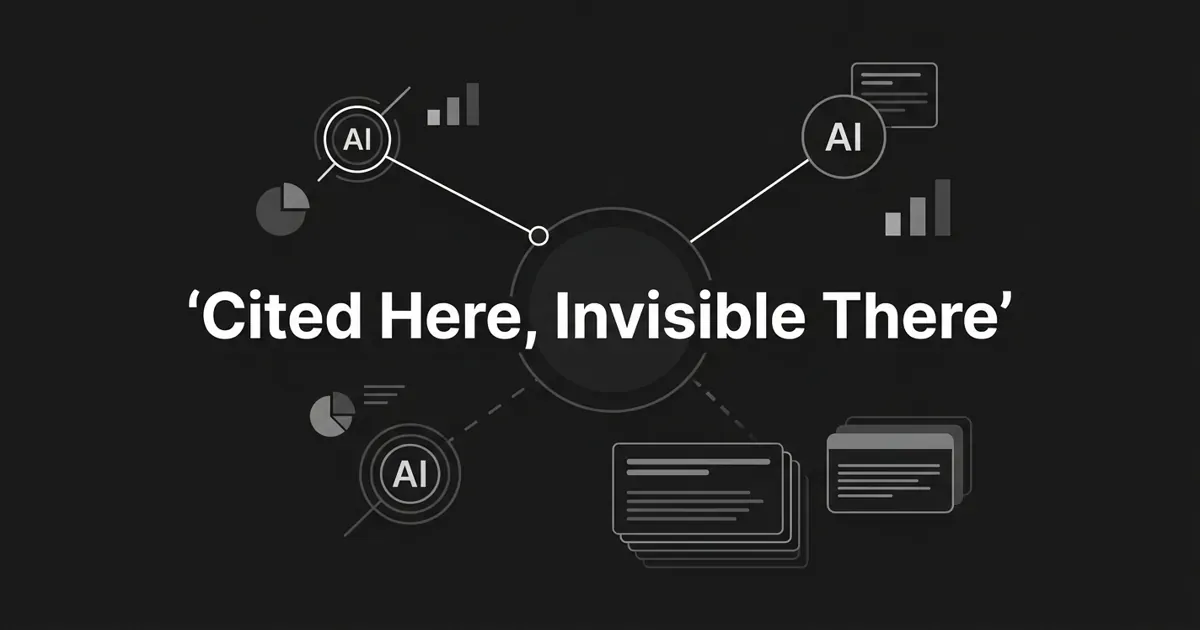
You searched your own category in ChatGPT and there you were. Then you tried Perplexity, and you had vanished. If you are cited in ChatGPT not Perplexity, take a breath, because this is normal and it is fixable. This guide is for marketing leads who see the gap and want a clear answer to why me here and not there. By the end, you will know how to compare your per-engine AI visibility, name the exact cause of each gap, and close the laggard.
Here is the good news up front. That gap is not a sign you did something wrong. Different AI engines cite differently by design, and once you can see why, the fix gets a lot smaller than it feels right now.
Why one engine cites you and another ignores you
Let's start with the thing that makes all of this make sense.
Each AI answer engine runs its own retrieval pipeline. Its own index, its own ranking signals, its own taste in sources. A page can rank on Google, get pulled into ChatGPT, and still never show up in Perplexity. That is not a bug. It is the structure of how these systems work.
The overlap is smaller than most people expect. Studies suggest only around one in ten domains cited by ChatGPT are also cited by Perplexity. Most of what one engine trusts, the other never touches. So being visible in one and invisible in another is the default, not the exception.
It helps to know what each engine actually does under the hood.
ChatGPT has two modes. In its default mode it answers from training data with no live retrieval, so no real citations. In search or browse mode it runs a live Bing query, fetches the top results, and links to them. Analyses suggest the large majority of its browse-mode citations overlap with Bing's top results. So for ChatGPT, Bing indexing and Bing ranking are the levers that matter.
Perplexity always retrieves live. It pulls a handful of pages per query and cites only a few of them, leaning hard on recency and on sources it can quote cleanly. Its single most cited source is Reddit, by a wide margin, with YouTube and Wikipedia behind it. Freshness is one of its strongest signals, which is exactly why a stale corporate blog post slips off its radar.
Gemini, Google AI Overviews, and AI Mode are built on Google's own index and ranking. A meaningful share of their citations comes from pages already ranking in Google's top results, though recent data shows that share dropping as they pull from further down the page. Here, traditional SEO signals carry the day: topical authority, E-E-A-T, and structured data.
So when you ask why Perplexity ignores me while ChatGPT loves me, the answer is almost always that you are strong on one engine's signals and weak on another's. There are six structural reasons different AI engines cite differently: different indexes, different ranking signals, different source preferences, different freshness tolerances, different extractability rules, and different trust models. You do not need to memorize all six. You just need to know that the gap has a cause, and the cause is findable. Now let's find out which one is yours.
Step 1: Build one buyer-prompt set you reuse
Before you measure anything, you need a fixed list of questions. This is the ruler you will hold up to every engine, every week.
What to do: write 25 to 50 prompts that real buyers actually ask, in natural language, not keyword strings. Spread them across four intent types so you cover the full journey:
- Definitional: "what is X"
- Comparative: "X vs Y"
- Vendor-selection: "best X for teams like mine"
- Use-case: "how to do X for Y"
Phrase them the way a person talks to an assistant, because that is what the engines are answering.
How to tell it's done: you have one list, saved somewhere stable, that you will not keep rewriting. The same prompts run every cycle, so your numbers are comparable over time.
Where people go wrong: they build the list from keyword research artifacts instead of buyer questions. Keywords tell you what people type into Google. They do not tell you what people ask an AI. If your prompt set sounds like a spreadsheet of head terms, start over and write like a human. It is worth taking the time to map and prioritize your prompts once, so every measurement after that is clean.
Step 2: Query each engine and capture every citation
Now you go looking. This is the step that turns a vague feeling into evidence.
What to do: run your whole prompt set through each engine, one at a time. Do ChatGPT in both default and search mode, separately, because they behave like two different products. Then Perplexity, which is always live. Then Gemini or Google AI Mode.
For every prompt, write down five things:
- Is your brand present, yes or no?
- Is your brand cited with an actual link, yes or no?
- Which competitors show up?
- The top three cited URLs.
- What kind of sources they are (encyclopedia, Reddit thread, publisher, brand site).
Run these in a clean, private session wherever you can. Your account history and your location personalize the answers, and personalized results will lie to you about your real visibility.
How to tell it's done: you have a filled grid, one row per prompt per engine, with citations captured. No gaps.
Where people go wrong: they paste prompts by hand, once, in a logged-in browser, and call it a baseline. That is slow, it is not repeatable, and personalization skews it. This is the point where an AI visibility tracker earns its keep. A tool that covers ChatGPT, Perplexity, and Gemini, keeps mention separate from citation, and reruns your prompt set on a schedule turns a painful afternoon into a dashboard you glance at. DeepSmith's AI visibility module does exactly this: you define the prompts, it checks them on a schedule and reports which engines name you, which link to you, and which cite a competitor instead.
Step 3: Score three metrics per engine
Raw citations are noise until you turn them into rates. Three numbers, calculated per engine, tell you the whole story.
What to do: for each engine, compute:
- Citation rate: the share of your prompts that produce a link to your domain.
- Mention rate: the share of prompts that name your brand at all, linked or not.
- Share of voice: your citations divided by all citations across the set, ideally next to your top three competitors.
Keep these three separate, per engine. Never average them into one blended score.
How to tell it's done: you can point at a single engine and say "here my citation rate is low but my mention rate is fine," or the reverse. That contrast is the diagnosis.
Where people go wrong: they conflate mentions and citations. These measure different things. A mention means the engine knows you exist. A citation means it trusts you enough to link. Brands get mentioned far more often than they get cited, so mention rate is your leading indicator and citation rate is the trust that follows. If you track only one, you miss half the picture.
Common mistake: reporting one aggregate visibility score across all engines. Aggregate hides the gap. The whole point of per-engine AI visibility is to see ChatGPT and Perplexity as separate scoreboards, because a healthy average can be masking a total blackout on the engine your buyers actually use. This is another place a platform that surfaces per-engine breakdowns and a competitor leaderboard saves you from spreadsheet math and shows you the laggard at a glance.
Step 4: Classify each gap by cause
Here is where diagnosis beats guessing. A low score on one engine has exactly four possible causes, and the fix depends entirely on which one you have.
What to do: for each underperforming engine, sort the gap into one of four buckets:
- Index gap: your page is not in that engine's index at all. It cannot cite what it cannot see.
- Retrieval gap: your page is indexed, but never pulled for your prompts.
- Ranking gap: your page gets retrieved, but competitors outrank it.
- Extractability gap: your page ranks, but the engine cannot lift a clean passage from it into the answer.
Work top to bottom. There is no point tuning your passages for extraction if the page is not even indexed. Confirm presence first, then retrieval, then ranking, then extractability.
How to tell it's done: every gap on your scorecard has a cause label next to it, not just a red number.
Where people go wrong: they jump straight to optimizing pages without checking whether the page is in the engine's index at all. That is the difference between a retrieval problem and a ranking problem, and it matters, because retrieval and ranking need completely different fixes. Name the cause before you spend a single hour on the cure.
Step 5: Match the fix to the engine and the cause
Now you know the engine and the cause. This is where you fix engine-specific citation gap problems with the right move instead of a generic one. The mistake most teams make is applying one universal checklist to every engine. That is why they stall: the same page needs a different push on Bing than it does on Perplexity. Let's go engine by engine, and match the move to the cause you named in Step 4.
If ChatGPT is your laggard
ChatGPT sees the world through Bing, so start there.
- Index gap: submit and verify your site in Bing Webmaster Tools, then confirm Bingbot can render the page. No Bing inclusion, no browse-mode citation.
- Retrieval gap: earn presence in the sources ChatGPT leans on, which means high-authority publishers, review sites, and a neutral, well-sourced Wikipedia article where one fits.
- Ranking and extractability gaps: give the answer a clean passage to lift. Short answer-first definitions, comparison tables, and clear FAQ blocks, with declarative claims and named specifics.
One thing to expect: Bing updates take a few weeks to surface in ChatGPT. Make your change, then give it time before you judge it.
If Perplexity is your laggard
This is the classic being cited in ChatGPT not Perplexity case, and if you have been quietly asking why Perplexity ignores me, the cause is usually one of two things: freshness or source type.
- Index gap: check that robots.txt does not block Perplexity, and review any aggressive bot-blocking rules. Cloudflare documented in 2025 that Perplexity uses stealth crawlers and shifting user agents, so over-blocking can quietly shut it out even when your site is otherwise fine.
- Retrieval gap: go where Perplexity looks. Reddit is its single largest cited source, so authentic, genuinely useful participation in the right subreddits moves the needle. Clear YouTube coverage helps too.
- Ranking gap: refresh your top pages on a regular cadence. Roughly half of AI-cited content is only a few months old, and Perplexity is the most aggressive engine on staleness. A visible "last updated" date and revised copy go a long way.
- Extractability gap: write self-contained passages the engine can quote, with dates, named entities, and sourceable claims in a tight span.
If Gemini or AI Overviews is your laggard
Gemini rides on Google, so this gap is mostly a classic SEO gap wearing a new coat.
- Index gap: confirm the page in Google Search Console and clear any crawl or rendering errors.
- Retrieval and ranking gaps: rank on Google first, then build topical authority with real topic clusters, internal links, and consistent entity data. Add structured data (Organization, Product, FAQ, HowTo, Article) and demonstrate E-E-A-T with author bios, credentials, and primary sources.
- Extractability gap: use clean question-based H2s, answer-first intros, and FAQ structure so a passage lifts easily.
Pro tip: a few levers help you on every engine at once. Build genuine branded search demand through PR, partnerships, and reviews, since brand search volume is one of the strongest documented predictors of getting cited. Keep your brand facts identical everywhere the web describes you. And do not lean on schema alone to rescue a weak page, because structured data carries only a small slice of the weight compared to authority.
Step 6: Prioritize, then close the laggard's gap
You could have a dozen gaps by now. You are not going to fix them all this week, and you should not try.
What to do: score each gap on two axes. How big is it, one to five? How hard is the fix, low, medium, or high? Then start with the high-gap, low-difficulty combinations. Those are your fastest wins, and early momentum keeps the work alive.
How to tell it's done: you have a ranked shortlist, not a wall of red cells. The next three things to ship are obvious.
Where people go wrong: they let diagnosis become the whole project. A beautiful scorecard that never turns into shipped pages changes nothing. The gap only closes when refreshed pages, new passages, and Reddit answers actually go live. This is the slow part, and it is where most teams stall, because finding the gap and staffing the fix are two different jobs.
That handoff is exactly what DeepSmith is built to shorten. It tracks your per-engine visibility, shows you where a competitor is cited and you are not, and then feeds that gap straight into a content production queue, from idea to planned to published, in your brand voice. Diagnosis and the fix live in one place, so the laggard engine gets a fresh, citable page instead of another line on a to-do list. To be clear about what that buys you: the platform tracks mention and citation across the engines your plan covers, and it does not control or guarantee rankings, citations, or traffic. What it removes is the manual gap between knowing and doing.
What to do next
You do not need to boil the ocean. Pick your single worst engine, the one where buyers ask and a competitor answers, and run Steps 1 through 4 on just that one this week. Name the cause. Ship one fix. Then check again in a week, because AI answers move on a rolling cadence and this is a weekly metric, not a monthly one.
That is the whole loop: measure per engine, classify the gap, fix the cause, recheck. Do it once and it stops feeling like mystery and starts feeling like maintenance. The reason this works is simple. Once you accept that different AI engines cite differently, you stop chasing one universal fix and start closing one specific gap at a time. That reframe is most of the battle. You are not behind on some impossible new channel. You are running a normal diagnostic loop on a few engines, and each pass makes the next one easier.
And you do not have to fix engine-specific citation gap patterns alone or all at once. One engine, one cause, one shipped page this week is real progress. The stress you felt when you first saw the gap was never about the size of the work. It was about not knowing where to start. Now you do.
If you would rather not run the prompt sweeps and the scorecard by hand every week, that is what DeepSmith automates. You can start a free trial and see your real per-engine visibility, and your first drafts, before you pay.