You typed your own category prompt into ChatGPT last week and a competitor's product came back in the carousel. Not yours. That stings, and it also tells you exactly where the work is.
Here is the good news: the fix is not a new channel. It is the PR motion you already know, pointed at a different scoreboard. Welcome to ecommerce digital PR AI work, where a placement in the right publication is worth more than a hundred impressions in the wrong one.
This guide walks you through seven steps, in order, from mapping buyer prompts to keeping citations alive after the first win. Take it one step at a time. Most brands are closer than they think.
Step 1: Map the buyer prompts you actually want to win
Your ecommerce digital PR AI plan starts with one list, and it is not a keyword list.
Write down 50 high-intent prompts a real buyer would type into an AI engine. Pull the phrasing from sales calls, support tickets, and your own product reviews. Tag each one by category, by SKU, and by buyer stage.
How you know it is done: you have a spreadsheet of 50 or more prompts, each mapped to a product or category. Fewer than 50 and the sample is too noisy to read a trend from.
Where people go wrong: writing prompts that sound like search queries. "Best espresso machine" is a keyword. What buyers actually type is closer to "what is the best espresso machine for someone who drinks lattes every morning and has limited counter space." AI engines are strongest on that long tail, so lean into it.
Feeling stuck at prompt 20? Open your last 30 support tickets and read the subject lines out loud. The prompts are already written. You just haven't collected them yet.
Step 2: Audit where you stand across all five AI engines
Now find out what those engines say today. Run every prompt through ChatGPT, Perplexity, Gemini, Claude, and Google AI Mode, and record three things per prompt: are you mentioned, are you cited, and which exact pages are cited instead.
That third column is the one that matters. AI answers cite a small set of sources per response, roughly seven for ChatGPT, around twelve for Google AI Overview, and around sixteen for Perplexity. Position inside that small set beats raw volume every time.
It helps to know what's happening under the hood, because it explains why some placements move the needle and others vanish.
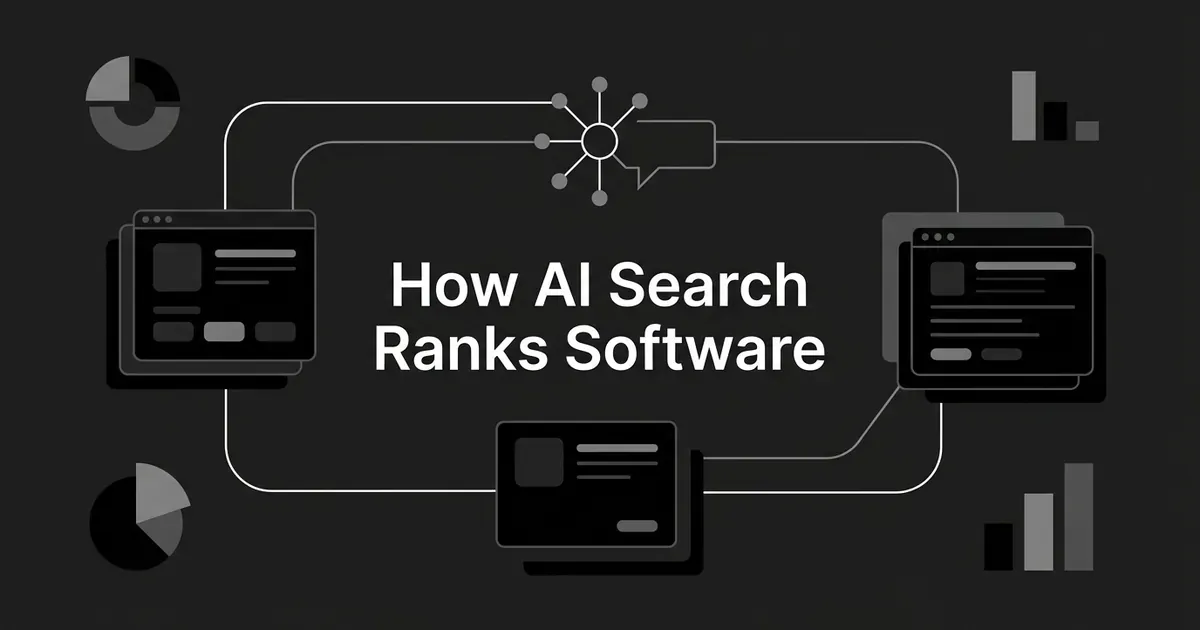
An engine rewrites your buyer's question into several intent variants. It retrieves and evaluates dozens of URLs against a live index weighted for recency and authority. Then it hands the top few back to the model with citations attached. Not three pages like a human researcher. Dozens, filtered hard, and ChatGPT cites only about 15% of what it retrieves.
The filtering is uneven, and that is good news for you. ChatGPT's per-citation influence runs around 0.27 against roughly 0.06 for Google AI Overview and Perplexity, so one placement on a publication ChatGPT trusts carries roughly 4.5 times the answer influence of a Perplexity-only mention. That asymmetry is exactly why product placement AI citations reward a short, sharp target list over a wide one.
How you know it is done: you have a mention rate and a citation rate per prompt per engine, plus a competitor leaderboard. Benchmarks help you read the number without panicking. Global household names show up in roughly 73% of relevant AI answers, established mid-market brands in around 44%, and niche or smaller brands in about 11%. If you are a niche brand sitting near 11%, you are normal, not broken.
Where people go wrong: tracking ChatGPT only. The engines behave differently. Perplexity leans on Reddit and Wikipedia far more than the others, so a brand that skips it misses an entirely separate ranking surface.
Doing this by hand across five engines and 50 prompts is a weekend you will not get back. This is the part DeepSmith was built for: AI Visibility runs your prompts on a schedule and reports per-prompt mention and citation rates, share of voice, a competitor leaderboard, and full answer history. Engine coverage rises by plan, from ChatGPT on Pro at $99 a month up to all five engines on Enterprise.
Step 3: Build your publication target list from the audit
You now have a pile of cited URLs. Cluster them into publications, then into named editors and beats. That cluster is your media list, and it was chosen by the engines rather than by you.
For product categories the list usually skews toward Wirecutter, The Strategist, Reviewed, the Good Housekeeping Institute, Tom's Guide, and TechRadar. For finance and business framing it skews toward Reuters, Forbes, and Business Insider. Wikipedia shows up for definitions across every engine, and YouTube shows up whenever the prompt has video intent.
How you know it is done: roughly 30 publications, each with a named editor and a tracked pitch. The editor list matters more than the outlet count.
Where people go wrong: chasing only the famous names. The niche tier, category blogs and specialist reviewers, drives a real share of long-tail citations and is far easier to win. One rule of thumb: if a publication showed up in your citation audit, it belongs on the list. If it didn't, it's a nice-to-have.
This is also where competitor citation data earns its keep. DeepSmith's Competitor Citations view shows which competitor pages win each of your prompts and on which engine, so you are reading the actual coverage that beat you instead of guessing at it.
Common mistake: building the media list first and the audit second. That gets the order backwards, and it is the single most common reason a quarter of pitching produces no visible movement.
Need help finding the humans behind the mastheads? You have options at every budget.
Prowly starts at $258 a month billed annually and includes a media contacts database plus a seven-day free trial. Qwoted has a genuinely usable free tier, with Pro at $149 a month. Muck Rack sits at agency scale, roughly $10,000 to $15,000 a year for its standard tier. And HARO, which became Connectively, now belongs to Featured.com after Cision sold it in April 2025. Five pitches a month are free there, with extra pitches at $0.99 each.
Start free. Upgrade only when the list outgrows you.
Step 4: Build one press kit before you send a single pitch
Editors don't reject your product. They reject the friction of chasing details. Remove that friction once and reuse it everywhere.
Your kit needs a position statement of around 120 words, a product fact sheet with dimensions, weight, materials, specs, and clear differentiators, three to five high-resolution images on a permanent CDN, a founder bio with one line of credentials, customer quotes you have permission to use, your DTC link plus retailer list, a media contact, and a boilerplate under three paragraphs.
That's one afternoon of work that pays out for a year.
How you know it is done: the same kit can go to Wirecutter, The Strategist, a regional magazine, and a creator with only light edits. The fact sheet is a separate file, not buried in a narrative.
Where people go wrong: pitching without a kit, which collapses hit rates, and leading with your brand story instead of the reader problem the publication is trying to solve.
Pro tip: one number beats three paragraphs of adjectives. "12,000 verified reviews, 4.7 median rating" is specific, checkable, and quotable. Editors reward that, and so do AI engines, which favor dense, specific pages over vague ones. Review infrastructure matters here too: brands with 500 or more verified reviews and a median rating above 4.2 stars see materially higher citation probability.
Step 5: Pitch on the editorial calendar, not on your launch calendar
This is where product launch PR AEO lives or dies. Not on the pitch copy. On the lead time.
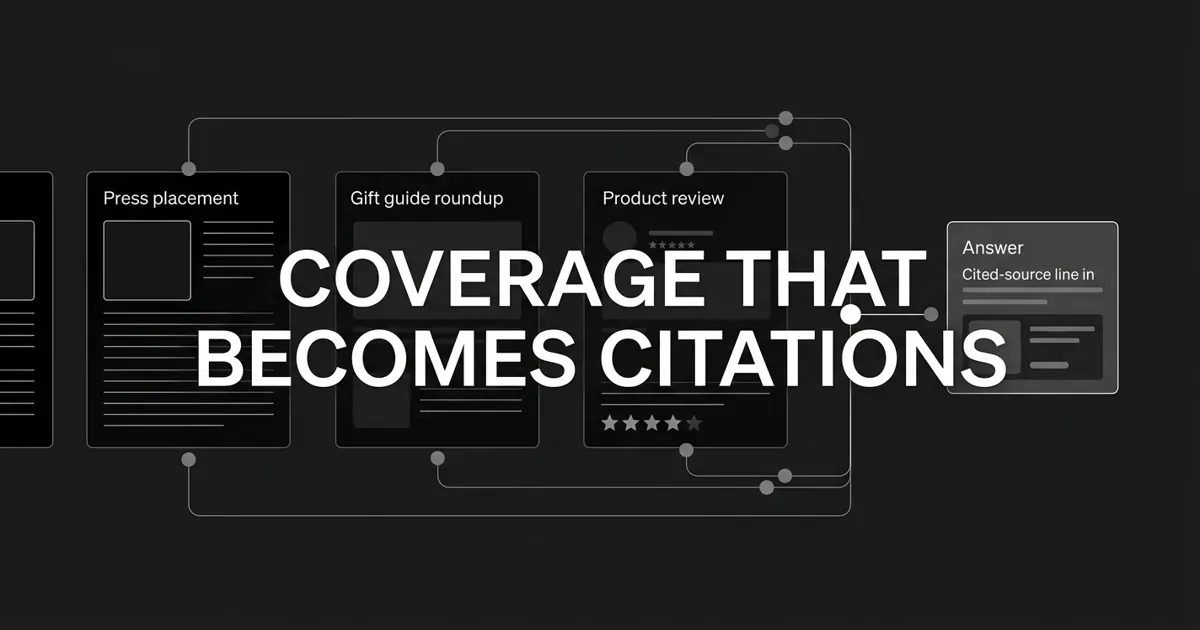
Print magazines need four to five months. Pitch November and December issues in July or August, and January issues in September or October. Daily online gift guides need two to four weeks, so pitch in November for December. Local and regional media need six to eight weeks. Most major outlets close holiday selections in early October and publish mid-November, ahead of Black Friday. Practically, that means holiday pitching starts in June.
Keep the first pitch under 250 words with three to five concrete reasons the product belongs. Follow up seven to ten days later in one paragraph. Follow up again seven to ten days after that with a fresh angle, a news hook, a sale activation, or a new image. Last touch at 30 days, then stop.
How you know it is done: every target publication has a dated pitch and a dated follow-up in your calendar, and your seeding boxes left the warehouse roughly 90 days before the guide deadline.
Where people go wrong: "just checking in" follow-ups with no fresh hook, pitching the same editor across multiple beats, and image links that expire before anyone opens them. Use permanent URLs.
Seeding buys you the reviews that make the pitch land. Platforms like Influenster run sample-box programs with a reviewer tier system, and BzzAgent sends product to members who then share their experience publicly. Both work best when the box arrives with the press kit attached and roughly 90 days of runway before the guide deadline. Subscription boxes in your vertical are another quiet route onto an editor's desk ahead of the cycle.
A press release still has a small role. Wire citations grew roughly fivefold between July and December 2025, and wires now account for around 1% of AI citations. Small, but the content is highly crawlable, so a product launch PR AEO plan can include a wire for recency and confirmation. Just do not mistake it for the main path.
Step 6: Layer affiliate and creator commerce on every placement
An editorial mention you cannot monetize is half a win. Fix that before the coverage lands, not after.
Join the affiliate networks your target publications already use. For most ecommerce brands that means Amazon Associates, which pays up to 10% on qualifying purchases, plus a network such as ShareASale, CJ Affiliate, Awin, impact.com, or Rakuten. ShareASale publishes its pricing at $9.99 a month with a $100 network access fee and a $100 minimum deposit. impact.com starts at $30 a month for Starter and $2,500 a month for Pro. CJ Affiliate, Awin, and Rakuten quote through sales rather than publishing rates.
Then add creator commerce so gift guide placements convert. LTK reaches roughly 40 million monthly shoppers with brand-set commissions typically in the 10% to 20% range. ShopMy is free for creators with brand-paid commissions of 10% to 30%. BrandCycle works with around 700 brand partners. TikTok Shop sets commissions in Seller Center.
How you know it is done: every earned mention on your target publications is also a monetizable, trackable click, you are enrolled in at least one traditional network and one creator program, and disclosure is compliant on every link.
Where people go wrong: disclosure. The FTC revised its Endorsement Guides in June 2023, and reviewers with a material connection have to disclose it. Amazon Associates separately requires a compliant disclosure and identification of the Associate relationship on every page carrying affiliate links. Put the disclosure before the link, in plain language. A buried footer line doesn't count.
Treat affiliate gift guide AI visibility as one motion rather than two teams. The same placement that earns a commission is the placement an engine may cite, and your affiliate gift guide AI visibility improves fastest when PR and partnerships are working the same target list.
Step 7: Produce the supporting content that keeps citations alive
Coverage decays. The half-life of a single placement is measured in months, so one-and-done pitching fades inside a quarter. The brands that hold position are running a loop.
Two jobs here. First, keep auditing: re-run hot prompts weekly and the long tail monthly, and compare this period's mention and citation rates to last period's. When a competitor pulls ahead on a prompt, open the page that won and write the better answer.
Second, keep publishing. For every priority prompt where you're invisible, publish the article on your own site that answers the question directly in the first 60 words, uses clean headings and structured lists, carries Product and FAQPage schema, and links out to authoritative sources.
Recently updated "best" lists are the most prominent page type ChatGPT surfaces for top-of-funnel product queries, and self-promotional best-of lists on a brand's own site did lift ChatGPT visibility in that research. So yes, your own roundup counts.
A useful test before you publish: strip your brand name out. Does the page still help someone? If not, no engine will cite it.
How you know it is done: one recurring report comparing period over period, a stale tag on every prompt, and a content backlog queued rather than improvised.
Where people go wrong: stopping after the first win. Roughly 2% of brands capture about 80% of unprompted AI recommendations, and those brands are running compounding loops of editorial density, review volume, and recency.
If the calendar is your bottleneck, this is where DeepSmith does real work. Content Studio takes a planned idea through the Writer with your stored brand context, internal links pulled from your own sitemap, a cover image, and publish-ready metadata. Autowrite schedules pieces to write themselves on a set date and land ready to review. As one of our customers put it: "Went from four articles a month to fifteen with the same two people."
Two checks before you pitch anything
Two technical items sit underneath all seven steps, and both are quick.
Check robots.txt. GPTBot, PerplexityBot, ClaudeBot, and Google-Extended are separate user agents, and allowing one does not allow the others. Blocking them removes you from the citation pool entirely.
Check your Google Shopping feed. Around 83% of ChatGPT's product carousel recommendations come from Google Shopping data, and ChatGPT pulls from roughly the top 40 organic Shopping results. OpenAI's shopping research reads product pages directly, cites sources, and describes inclusion as organic. A neglected feed quietly caps everything else you do.
What to do next
Pick one thing this week. Not seven.
If you have never audited, do Step 2 on ten prompts, not fifty. If you already know where you stand, rebuild the publication target list from this month's citation audit and pick three editors to pitch before the next gift guide cycle closes. That is how earned media ecommerce AI answers get built: one list, one pitch, one published answer at a time.
The loop is the whole strategy. Placement, citation, refresh, repeat. Every step after this one is about turning product placement AI citations into a habit instead of a lucky quarter.
Want to see the audit run end to end before you build it yourself? Start a 7-day DeepSmith trial and watch your prompts, citations, and competitor pages populate with real data.